LangChain Tool Returning 200 Means It's Safe? Detecting API Schema Drift

Third-party API schema drift hides under HTTP 200; use bounded sampling and comparison, and weigh where to place checks.
The article discusses how LangChain tools calling third-party APIs can suffer silent failures under HTTP 200 due to schema drift like field renaming. The core detection approach is bounded sampling at the tool boundary compared against a known-good window to identify field-level changes. The challenge is distinguishing real drift from legitimate optional field variation, requiring schema definitions, statistical baselines, or whitelists. Check logic can live inside the tool, in a shared HTTP client, or in standalone monitoring, each trading off context richness and maintainability. Community practices suggest basic detection in a shared HTTP client, extra business validation in critical tools, and sample storage/cleanup strategies. The pre-alpha tool Agindow attempts runtime auto-detection and repair of API drift, but its effectiveness is unverified.
When a third-party API silently renames a field, your LangChain tool still returns a 200 status code—your system may already be silently breaking. This article explores how to catch this kind of "schema drift" and shares practical ideas from the community.
When 200 OK Becomes a Trap: The Hidden Nature of Third-Party API Schema Drift
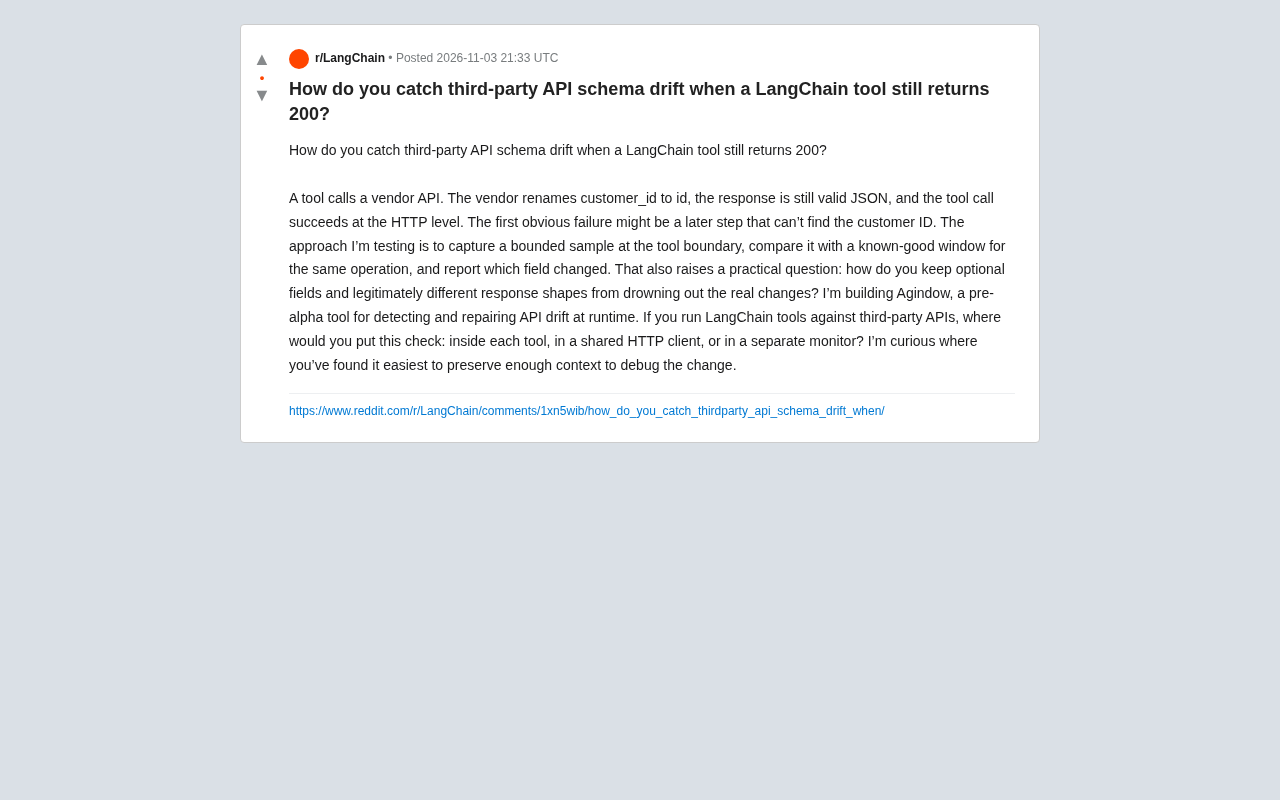
A typical scenario: your LangChain tool calls a vendor's API, and the vendor renames customer_id to id. The response is still valid JSON, and everything looks fine at the HTTP level. The tool call succeeds, but downstream steps fail because they can't find customer_id. This kind of problem often only surfaces much later, making debugging extremely costly.
According to a Reddit community discussion, a developer is building a pre-alpha tool called Agindow designed to detect and fix API drift at runtime. His proposed approach is to capture bounded samples at the tool boundary, compare them against a known-good window for the same operation, and report which fields have changed. This raises a practical question: how do you prevent optional fields and legitimate variation in response shapes from drowning out real changes?
Schema Drift is a common concept in data engineering and API integration, referring to unexpected changes in a data source's structure (schema) over time—such as fields being added, removed, renamed, type changes, or nested structure changes. In traditional ETL scenarios, schema drift is usually handled through explicit schema versioning or runtime validation. But in HTTP API integration, because response bodies are dynamic JSON and HTTP status codes only reflect transport-layer success, schema drift is easily masked. Common drift types include: field renaming (customer_id → id), field removal, type changes (string to number), nested level adjustments, and so on. These changes do not trigger HTTP errors but break downstream code's assumptions about fields. As the bridge between LLMs and external APIs, LangChain tools often have their output consumed directly by subsequent chained calls, so schema drift failures propagate along the call chain and are hard to pinpoint at the tool call site.
Detection Strategy: Bounded Sampling and Known-Good Window Comparison
The core idea of the developer's approach is "bounded sampling." At the tool boundary (i.e., the entry point where a LangChain tool calls a third-party API), capture samples of requests and responses, and limit the number of samples or the time window to avoid storage explosion. Then compare these samples against historical "known-good" samples for the same operation.
The key to comparison is identifying field-level changes rather than differences in the entire response body. For example, if the original customer_id field disappears from the response while a new id field appears with the same value, you can infer a renaming occurred. The tool can report "field customer_id was renamed to id" or similar information, helping developers quickly locate the problem.
But the difficulty lies in distinguishing real schema drift from legitimate response variation. For example, an API may return different optional fields depending on request parameters, or certain fields may legitimately be missing in some cases. Developers need to design a mechanism that can ignore these expected variations and focus only on unexpected changes.
Bounded Sampling is a technique for limiting sample count and storage cost in streaming or high-frequency call scenarios. In API schema drift detection, it means not recording every request/response, but sampling by time window (e.g., keeping the most recent 100 samples per hour) or an upper count limit. A Known-Good Window refers to a set of samples that have been verified and confirmed to match the expected schema, serving as a comparison baseline. Comparison typically involves field-level diff analysis rather than whole-text comparison, to distinguish structural changes from value changes. The challenge with this approach is that the baseline needs periodic updates to accommodate legitimate schema evolution, while avoiding misclassifying occasional missing optional fields as drift. Statistical methods such as field occurrence frequency and value distribution changes can aid judgment, but sufficient historical data is needed to establish a stable baseline.
Optional Fields and Legitimate Shape Changes: How to Avoid False Positives
In the community discussion, developers proposed several strategies. One idea is to maintain a schema definition that specifies which fields are required, which are optional, and the field types and possible value ranges. An alert is triggered only when the response doesn't match the schema definition. But third-party API schemas may not be public, or may change frequently, so the schema needs to be learned from samples.
Another idea is to use statistical methods, such as recording the frequency of each field and the distribution of values. When a field suddenly disappears or a new field appears, if the frequency change exceeds a threshold, it is flagged as suspicious. This requires enough historical data to establish a baseline.
Other developers suggest that for optional fields, presence changes can be ignored during comparison, focusing only on required fields. But how do you determine which fields are required? It may require manual configuration or extraction from API docs.
The Agindow developer mentions that the methods he is testing include capturing bounded samples and comparing against known-good windows. He acknowledges that handling optional fields and different response shapes is a real challenge that needs further exploration.
Where to Put the Check: Inside the Tool, the HTTP Client, or Standalone Monitoring?
The developer asked the community: if you call a third-party API in a LangChain tool, where would you put this check? Options include: inside each tool, in a shared HTTP client, or in a standalone monitoring service.
Checking inside the tool gives you the richest context, such as the tool's name, input parameters, business logic, and so on. The downside is that the check logic must be reimplemented in every tool, leading to high maintenance cost.
Checking in a shared HTTP client allows centralized management, with all tools sharing the same detection logic. But it may lose tool-level context, such as the expected response schema specific to a particular tool.
A standalone monitoring service can decouple detection from business logic, collecting data via logs or a proxy. But it may introduce latency and requires additional deployment and operations.
There is no consensus in the community yet. Some developers prefer implementing at the HTTP client layer because it covers all outbound requests and is easy to update uniformly. Others believe inside the tool is more flexible and allows judgment combined with business semantics.
Shared HTTP Client refers to a component that uniformly encapsulates all outbound HTTP requests within an application, typically built on libraries such as httpx or requests, and centrally handles retries, timeouts, authentication, and logging. In the context of schema drift detection, putting check logic at the shared HTTP client layer means all third-party API calls pass through the same set of interceptors or middleware, enabling unified monitoring and policy enforcement. The advantages are broad coverage, avoidance of duplicate code, and easy centralized updates to detection rules. However, it may lack tool-level semantic context (e.g., the specific response schema expected by a particular tool), making it impossible to distinguish legitimate differences between different APIs. A standalone monitoring service achieves decoupling through a proxy or asynchronous log analysis, but introduces extra latency and operational complexity. Choosing where to place the check is essentially a trade-off between context richness and maintainability.
Practical Recommendations: Balancing Context and Maintainability
Based on the discussion, some practical recommendations can be summarized:
- Prioritize implementing basic schema drift detection in a shared HTTP client or middleware to capture all third-party API calls. This provides a unified protection layer and reduces duplicate code.
- For critical tools, add extra business-level validation inside the tool, such as checking whether specific fields exist.
- When using bounded sampling and known-good window comparison, design a good sample storage and cleanup strategy to avoid unbounded growth.
- Consider reporting detection results to a monitoring system for timely alerts and tracking.
- For optional fields, establish a whitelist through configuration or learning to reduce false positives.
As a pre-alpha tool, Agindow's approach is worth watching. It attempts to automatically detect and fix API drift at runtime, and if mature, could provide a new reliability safeguard for the LangChain ecosystem. But it is still at an early stage, and its actual effectiveness remains to be verified.
Conclusion
Third-party API schema drift is a common problem in distributed systems, and it is especially hidden in LangChain tool-calling scenarios. Through bounded sampling and comparison, field-level changes can be detected early. The choice of where to place the check requires weighing context richness against maintainability. The community is still exploring best practices, and tools like Agindow may bring new solutions.
One-line Summary
Third-party API schema drift occurs silently under HTTP 200, requiring bounded sample comparison detection and trade-offs in check placement.
Paragraph Summary
The article explores how, when LangChain tools call third-party APIs, schema drift such as field renaming can cause silent system failures under HTTP 200 responses. The core detection idea is bounded sampling at the tool boundary, compared against a known-good window, to identify field-level changes. The difficulty is distinguishing real drift from legitimate optional field variation, requiring schema definitions, statistical baselines, or whitelists to reduce false positives. Check logic can be placed inside the tool, in a shared HTTP client, or in a standalone monitoring service, each with trade-offs between context richness and maintainability. Community practices suggest prioritizing basic detection in a shared HTTP client, supplementing critical tools with business validation, and designing sample storage and cleanup strategies. The pre-alpha tool Agindow attempts runtime automatic detection and repair of API drift, but its effectiveness remains to be verified.
Related articles

9 AI Subscription Plans Compared: The Real Cost Per 100M Tokens Revealed
Bilibili creator tests 9 AI subscription plans from Volcano, Alibaba, Tencent, Baidu, Zhipu, Xiaomi, MiniMax and more, converting them all to real cost per 100M tokens, breaking down fixed-quota vs. three-tier coefficient billing and how caching, time-of-day discounts, and window limits affect actual quota.

Vibe Coding for Beginners: Expressing Intent Instead of Handwriting Code
What is Vibe Coding? A 137-episode Bilibili course defines it: the core is expressing intent, not writing code. This article analyzes Vibe Coding's productivity logic, target audience, and entry expectations to help beginners decide if it's worth learning.

LangChain Beginner's Guide: An Agent Development Roadmap from LangGraph to Deep Agents
Clarify the encapsulation relationship among LangChain, LangGraph, and Deep Agents, and master the learning path and selection logic for agent development frameworks—suitable for beginners in large model development.