LangGraph Agent Architecture Explained: From Agent to Orchestration in Practice

LangGraph is a low-level orchestration framework providing precise control for fixed workflows, forming a layered tech stack with LangChain and Deep Agents.
The article explores LangGraph's positioning and value in AI application development. Addressing the lack of control of LangChain Agents in complex multi-step tasks, LangGraph, as a low-level orchestration runtime, provides deterministic flow control through checkpoints, human-in-the-loop, conditional branching, and other capabilities. It outlines the hierarchical relationship between LangChain (a high-level wrapper on LangGraph), Deep Agents (a higher-level Harness architecture), and LangGraph, noting that higher encapsulation means lower flexibility. Finally, it offers selection advice: LangGraph for fixed flows, LangChain for rapid setup, Deep Agents for standardized delivery, and LangSmith for tracing, evaluation, and deployment.
In AI application development, agents are seen as key to automating complex tasks. However, as task steps multiply and logic chains lengthen, agents that rely solely on large models for autonomous decision-making often reveal a lack of control. LangGraph emerged precisely to solve orchestration challenges in these fixed, process-oriented scenarios. Based on a Bilibili hands-on tutorial, this article dissects LangGraph's architectural positioning, core components, and its relationship with LangChain and Deep Agents, helping developers understand when and how to choose this orchestration framework.
Why LangGraph: The Process Control Dilemma of Agents
Agents in LangChain can call large models for reasoning, perform multi-turn tool calls, and integrate results. After a user submits a request, the large model autonomously decides whether to call tools, which tools to call, and finally returns an answer. This pattern works flexibly for simple tasks, but problems surface when facing fixed multi-step workflows.
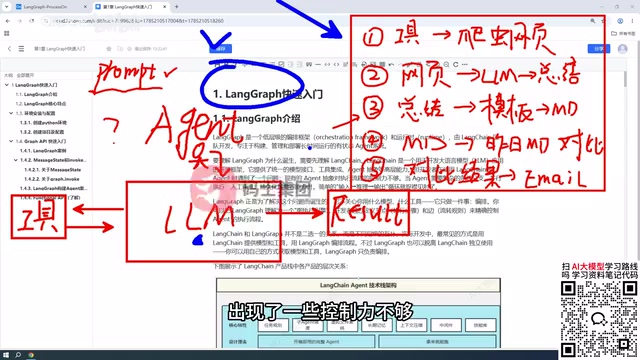
The tutorial gives a typical five-step task: scrape a specified webpage, summarize the content with a large model, generate a Markdown document according to a template, compare it with yesterday's Markdown file, and email the comparison results. Completing this with a single Agent is not impossible, but the user must describe in detail each step's tools and specifics in the prompt. As execution proceeds, context accumulates, and the importance of the initial prompt is gradually diluted; the Agent may forget to call certain tools, call tools incorrectly, or even miss key steps.
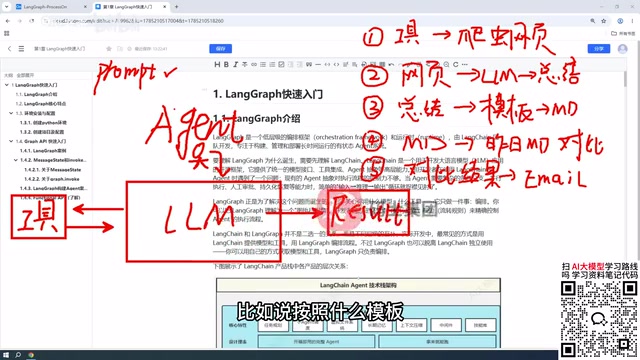
The root of this "lack of control" is that the Agent lets the large model decide the process based on context, rather than having the developer fix the steps. When the business logic itself has a clear sequence, handing process control to the model instead increases uncertainty.
LangGraph's Positioning: A Low-Level Orchestration Runtime
LangGraph's core responsibility is orchestration—it doesn't care what model or tools you use; it only defines how steps execute and how branches flow. As a low-level orchestration framework, LangGraph provides precise control over the execution process.
Core Capabilities at a Glance
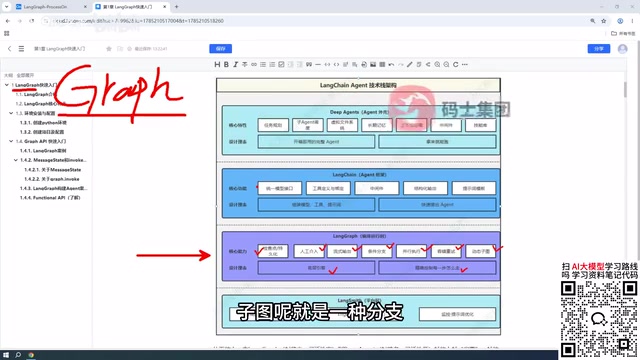
- Checkpoint: Supports saving state within the flow for recovery and debugging.
- Human-in-the-loop: Pauses before sensitive or critical steps, waiting for human confirmation to continue.
- Conditional branching: Decides which branch to take next based on runtime state.
- Parallel execution: Multiple steps can run simultaneously to improve efficiency.
- Fault-tolerant retries: Retries failed steps to enhance robustness.
- Subgraph: Supports nesting of main graphs and subgraphs for modular flow design.
This means developers can explicitly specify "what to do in step one, what to do in step two," and within each step, whether to call a large model, call a tool, or execute custom business logic is entirely up to the developer. LangGraph doesn't restrict implementation; it only ensures the flow proceeds as expected.
Orchestration Runtime refers to the software layer responsible for scheduling and executing the underlying infrastructure of computing tasks. In the context of LangGraph, it means the framework itself doesn't provide specific implementations of large model inference or tool calls, but focuses on managing the execution order, state passing, and error handling of these components. Similar to how an operating system schedules processes, the orchestration runtime ensures each step is executed at the right time with the right inputs and handles dependencies between steps. This design decouples LangGraph from any model or tool, allowing developers to freely replace underlying components without changing the flow definition. Meanwhile, the runtime's checkpoint, retry, and other mechanisms provide reliability and observability foundations for complex flows.
The Hierarchical Relationship Between LangChain, LangGraph, and Deep Agents
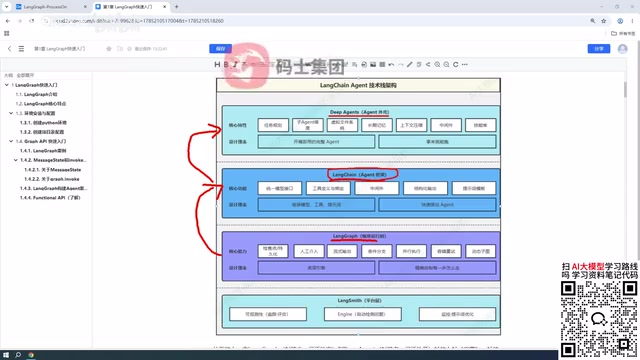
Understanding the relationship between these three helps make reasonable judgments during technology selection. The tech stack architecture given in the tutorial clearly shows their layers.
LangChain: A High-Level Wrapper on Top of LangGraph
LangChain's design philosophy is to wrap a layer on top of LangGraph, letting developers quickly assemble models, tools, and prompts to build Agents. The Agent's execution process is autonomously decided by the large model, not advanced according to a preset flowchart. LangChain also provides capabilities such as tool definitions, middleware (e.g., human-in-the-loop), dynamic prompts, dynamic models, safety checks, and structured outputs. Essentially, LangChain's underlying implementation is LangGraph, just with a higher degree of encapsulation and easier use, with correspondingly reduced flexibility.
Deep Agents: A Higher-Level Harness Architecture
Deep Agents is a further encapsulation on top of the Agent framework, an implementation of the Harness architecture. Compared to Agents in LangChain, Deep Agents adds the ability to operate on the file system and supports a sandbox backend (virtual file system), isolating file execution from the host environment. In addition, Deep Agents introduces the concept of Skill—a high-level encapsulation through LangChain Agent's dynamic prompts, forming configurable skill steps.
The higher the encapsulation, the easier the onboarding, but the lower the flexibility. The tutorial points out that Deep Agents is suitable for quickly delivering standard scenarios, LangChain is suitable for customized Agents (combining models and tools, non-process scenarios), and LangGraph is more suitable for complex flows that require precise control.
Harness Architecture in AI engineering refers to a framework pattern that tightly integrates agents with execution environments (such as file systems, command lines, browsers). Its core idea is to constrain and guide the Agent's behavior through a standardized "harness" (originally meaning horse gear, extended to control and connection devices), enabling it to safely and controllably operate external resources. As an implementation of the Harness architecture, Deep Agents provides mechanisms such as a sandbox file system and skill configuration, allowing the Agent to perform file read/write, code execution, and other operations in a restricted environment, thereby expanding the Agent's capability boundary while reducing security risks. This architecture is suitable for standardized task scenarios that require deep interaction with the environment.
LangSmith: Tracing, Evaluation, and Deployment
Besides the above frameworks, the tutorial also mentions LangSmith. This is a tool for tracing, evaluating, and monitoring the Agent execution process. Developers can deploy the entire Agent or Graph flowchart to LangSmith to achieve tracing and monitoring of the execution process, and can also deploy the Agent as an interface externally through this platform.
For scenarios that require observing flow runtime status, locating issues, or providing external services, LangSmith offers the necessary observability support.
Observability is crucial in AI Agent development; it refers to the ability to understand the internal state of a system through logs, metrics, and trace data. LangSmith's tracing feature records every model call, tool use, and state change during Agent execution, forming a complete call chain. The evaluation feature allows developers to define test cases and automatically measure the Agent's output quality. Monitoring displays runtime metrics in real time, helping to detect anomalies promptly. For Agents in production, observability is not just a debugging tool but the foundation for ensuring system reliability and continuous optimization. LangSmith integrates these capabilities into the LangGraph ecosystem, making the loop from development to deployment smoother.
Practical Advice: How to Choose the Right Technology Layer
Based on the tutorial content, the following selection approach can be summarized:
- Fixed task steps requiring precise control: Choose LangGraph, using its orchestration capabilities to fix the flow and flexibly implement business logic within each step.
- Relatively simple tasks with a desire for rapid setup: Choose LangChain Agent, quickly going live by assembling models, tools, and prompts.
- Needs for file operations, sandbox isolation, or standardized skill configuration: Consider Deep Agents, trading higher encapsulation for development efficiency.
- Needs for monitoring, evaluation, or external deployment: Combine with LangSmith for tracing and publishing.
LangGraph's value lies not in replacing Agents but in providing deterministic execution guarantees for process-oriented scenarios. Only by understanding the positioning and boundaries of each framework layer can you make reasonable technical decisions in actual projects.
One-line Summary
LangGraph is a low-level orchestration framework that provides precise control for fixed workflows, forming a layered tech stack with LangChain and Deep Agents.
Paragraph Summary
The article explores LangGraph's positioning and value in AI application development. Addressing the lack of control of LangChain Agents in complex multi-step tasks, LangGraph, as a low-level orchestration runtime, provides deterministic flow control through checkpoints, human-in-the-loop, conditional branching, and other capabilities. The article clearly outlines the hierarchical relationship between LangChain (a high-level wrapper on top of LangGraph), Deep Agents (a higher-level Harness architecture), and LangGraph, noting that the higher the encapsulation, the lower the flexibility. Finally, it offers technology selection advice: choose LangGraph for fixed flows, LangChain for rapid setup, Deep Agents for standardized delivery, and combine with LangSmith for tracing, evaluation, and deployment.
Related articles

Zero-Cost Local Jarvis: Open-Source Voice Cloning and Task Automation in Practice
AI Workshop shows how to build a zero-cost local Jarvis with Ollama and Voice Studio: local model switching, open-source voice cloning, file retrieval, and tool-calling tests, with setup steps and hardware trade-offs.

Mistral Large 4 Released: 1T-Parameter MoE Tops Western Open-Source Leaderboard
Mistral releases its flagship Mistral Large 4: a 1T-parameter MoE architecture activating only 49B parameters at inference, trained from scratch on 3,800 Grace Blackwell GPUs, topping the Western open-weight leaderboard with third-party endorsements in law, finance, and cybersecurity.

Mistral Large 4 Review: Can Europe's Strongest Open-Source Model Challenge the US and China?
Mistral Large 4 (L-Charm) review: trillion-parameter MoE, standout cybersecurity benchmarks but behind Kimi K3 in software engineering, 3,800 GPUs, a key step for European sovereign AI.