LLM WIKI in Practice: Making Agents Truly Understand Enterprise Business

Enterprise AI bottleneck is undocumented business knowledge; consolidate it via LLM WIKI before agent execution.
The article, based on a practical sharing by Bilibili creator Lao Xiao, argues that the real bottleneck in enterprise LLM implementation isn't model selection or RAG/tool calling, but that agents don't understand the business. Business rules aren't recorded, processes lack documentation, and the business side is reluctant to cooperate, so agents merely "look like they can run." The solution is building an LLM WIKI private knowledge base to structure tacit knowledge into a source of business facts for the agent, with FDE engineers translating business lines into agent-executable forms.
Enterprises want to use large models to cut costs and boost efficiency, but the real difficulty isn't model selection, nor is it technical modules like RAG or tool calling. It lies in a more fundamental problem: the agent simply doesn't understand your business.
This judgment comes from a practical sharing session by Lao Xiao, a Bilibili creator (lead instructor of the Ma-style Education large model course). Using a simulated order customer service business line as a case study, he demonstrated the complete approach to building an LLM WIKI private knowledge base from scratch and getting an Agent to run through enterprise business processes.
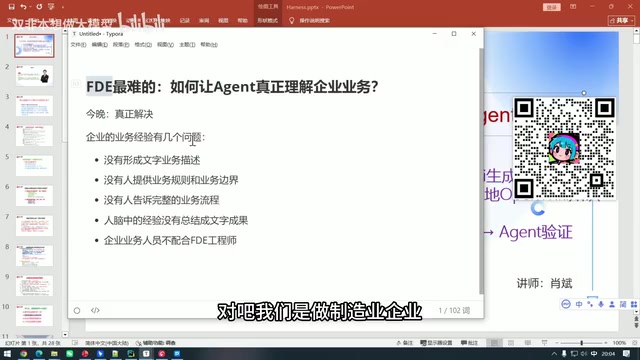
The Real Bottleneck of Enterprise Business Implementation: Knowledge That Never Became Text
Lao Xiao summed up the hardest part of enterprise AI implementation in one sentence: how to make the agent understand the enterprise's business. He listed several common states of missing business knowledge in enterprises:
- Business rules and business boundaries are not recorded. A customer service manager trains two assistants by hand, and once they're trained, it's done. No one writes down "what to do when you see what situation" in text.
- Business descriptions are not turned into documents. Processes exist only in the heads of veteran employees. Newcomers learn by observation, and no one systematically organizes the complete business process.
- Business personnel have low willingness to cooperate. When engineers tasked with implementation go to learn about the business line, the business side often feels it's "none of their business" and lacks the motivation to proactively contribute knowledge.
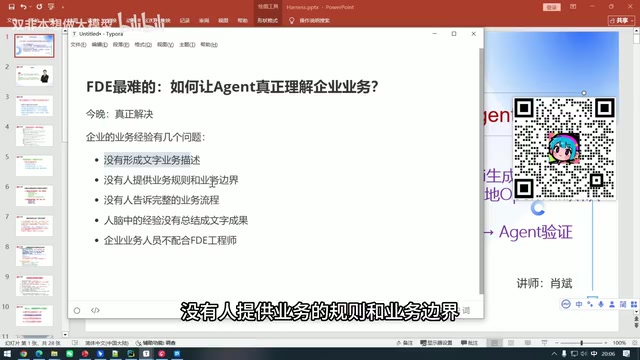
The combined result of these three points: even if engineers build out the entire tech stack of RAG, tool calling, short-term memory, long-term memory, and MCP, the resulting agent still only "looks like it can run"—it doesn't truly understand what order customer service should do or where the boundaries are.
This problem isn't new in the industry, but Lao Xiao emphasized that it is precisely the first hurdle in getting any agent project implemented, and the core problem his sharing aims to solve.
Using LLM WIKI to Make Tacit Knowledge Explicit
Lao Xiao's solution is to build an LLM WIKI—an enterprise private knowledge base designed for large models. What's noteworthy about his approach is that the order customer service business line in the case study itself "never formed any text," meaning he deliberately recreated the real state of fragmented, undocumented enterprise knowledge, and then had the agent run this business on its own.
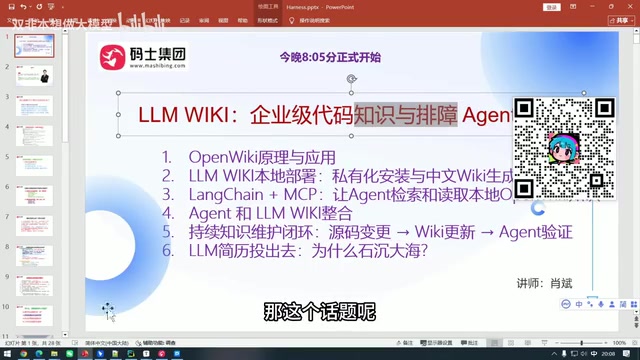
Methodologically, LLM WIKI's role isn't merely "storing documents"—it's about consolidating business rules that were scattered across people's heads, oral transmission, and fragmented experience into structured knowledge for the Agent to call upon during reasoning. This goes a step further than simply piling up a vector database: the structure and content quality of the knowledge base directly determines how well the agent can understand the business.
Combined with the technical components he mentioned (tool definitions, context, short-term and long-term memory, MCP, etc.), we can infer that LLM WIKI plays the role of "source of business facts" in the overall architecture—the Agent queries business rules through it, then completes specific actions with tool calling.
Tacit Knowledge is a core concept in the field of knowledge management, proposed by philosopher Polanyi. It refers to knowledge that is difficult to express clearly through language, text, or symbols—such as a veteran employee's intuitive judgment of an abnormal order, or the hands-on experience passed from master to apprentice. In contrast, explicit knowledge can be encoded, recorded, and transmitted. The reason enterprise AI implementation gets stuck at the knowledge stage is essentially that tacit knowledge accounts for too high a proportion: business rules are hidden in people's heads, and the Agent cannot read them. The value of knowledge bases like LLM WIKI is to transform tacit knowledge into structured text through interviews, process mapping, case summarization, and other means, making it explicit knowledge that the model can retrieve and reason over. This process cannot be fully automated; it often requires repeated collaboration between FDE engineers and the business side to complete.
The Role of the FDE Engineer: The Translation Layer Between Business and Model
In his sharing, Lao Xiao introduced the concept of the FDE engineer. His definition is direct: FDE engineers solve the problem of how each specific business line in an enterprise can combine large models and agents to achieve real implementation. Whether the industry is manufacturing, internet, banking, or logistics, the essence of the role is the same—translating a business line into a form that the agent can understand and execute.
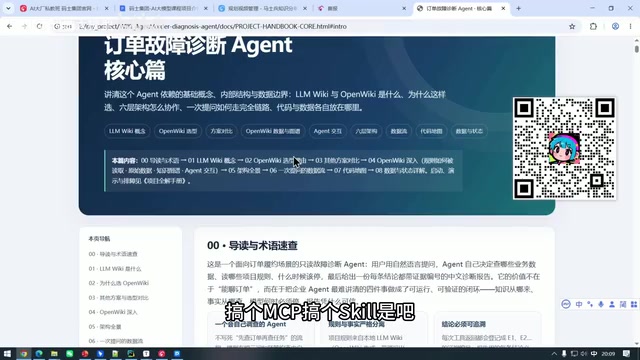
This also explains why he considers "making the agent understand the enterprise's business" the hardest part of FDE. Learning and combining technical components is replicable, but acquiring, organizing, and structuring business knowledge depends heavily on collaboration with the business side—and this is precisely the most lacking link in the current enterprise environment.
FDE (Forward Deployed Engineer) is a role first adopted at scale by data intelligence companies like Palantir. It refers to engineers stationed at the client site, directly embedded in the business team's work. Unlike traditional engineers who are only responsible for delivering code, FDEs must not only understand the tech stack but also deeply understand the client's business logic and industry constraints, serving as a bridge between product capabilities and customer scenarios. In generative AI implementation scenarios, the FDE's responsibilities have further expanded to: organizing business line knowledge, designing the Agent's prompts and tools, building knowledge bases, evaluating results, and continuously iterating. The reason this role has regained attention in the large model era is that the stronger general models become, the more the last mile of business adaptation depends on deep human understanding of the scenario.
MCP (Model Context Protocol) is an open protocol proposed by Anthropic and gradually adopted by the industry, used to standardize how large model applications connect to external data sources and tools. You can think of it as the "USB interface" of the Agent world: whether it's a database, a CRM system, or an enterprise internal API, as long as it's encapsulated as a server according to the MCP specification, the Agent can discover and call these capabilities in a unified way without writing separate adapter code for each system. In enterprise agent architectures, MCP is usually used in conjunction with knowledge bases and memory modules—the knowledge base provides business facts, while MCP lets the Agent safely execute specific actions such as queries, order placement, and ticket routing. Together they support the closed loop from "understanding the business" to "completing the business."
Three Insights for Implementation Practice
Knowledge base construction must precede Agent development. If the enterprise's business rules themselves aren't written down, going straight to an agent will only produce a system that spins its wheels. First consolidate business boundaries, handling rules, and complete processes into the LLM WIKI, and only then does the Agent have a basis for judgment.
Choosing an undocumented business line for the pilot better validates the approach. Lao Xiao deliberately chose an order customer service scenario that "never formed any text," essentially stress-testing the mettle of the LLM WIKI methodology. When enterprises select pilots, they might prioritize business lines where knowledge is most tacit and most dependent on veteran employees' experience.
The business side's cooperation is an engineering problem, not an attitude problem. The root cause of business personnel not cooperating is the lack of mechanisms and tools to support knowledge output. If solutions like LLM WIKI can lower the cost of knowledge consolidation, the willingness to cooperate will also improve accordingly.
The specific operational details of this sharing (knowledge base construction steps, Agent configuration process) have not yet been elaborated in the original content, but from the problem definition and methodological framework, it points to a clear conclusion: competition in enterprise AI implementation will ultimately come down to the ability to structure business knowledge, not model parameters or framework choices.
One-line Summary
Enterprise AI implementation bottleneck lies in undocumented business knowledge; LLM WIKI must consolidate it first before the Agent can execute.
Paragraph Summary
The article, based on a practical sharing by Bilibili creator Lao Xiao, points out that the real bottleneck in enterprises using large models to cut costs and boost efficiency is not model selection or technical modules like RAG and tool calling, but rather that the agent doesn't understand the business. Business rules aren't recorded, processes lack documentation, and the business side has low willingness to cooperate, resulting in an agent that only "looks like it can run" after the tech stack is built. The solution is to build an LLM WIKI enterprise private knowledge base, structuring tacit knowledge scattered across people's heads and oral transmission into a source of business facts for the Agent to call upon during reasoning. The article also introduces the concept of the FDE engineer, positioning it as the role that translates specific business lines into forms the agent can understand and execute, and offers three implementation insights: knowledge base construction should precede Agent development, prioritize undocumented business lines for pilots, and the business side's cooperation is essentially a matter of mechanisms and tools.
Related articles

Gemini 4 Neon Review: Benchmark Scores Rival Carbon, API Pricing and Quota Breakdown
Google Gemini 4 Neon is now live, benchmark scores closely tracking Carbon, API pricing 3/15 at twice Hydrogen's rate. This article compiles Bilibili creator testing: Neon can replace 90% of Carbon scenarios, AntiGravity quota consumption is only one-third of Carbon, plus subscription channel restrictions and 2API ban risks.

Gemini 4 Helium Coming Soon? Signals of Google Loosening Subscription Restrictions
Google team member hints releases will continue; community speculates Gemini 4 Helium (Flash Lite) may be next. Subscription ban controversy gets a response as product lead says "Soon," suggesting restrictions may be lifted. This article covers Gemini developments, OpenAI Coding Agent and risk management, Doubao real-time audio-video API, and compute business dynamics.

AI-Assisted React Development in Practice: Optimizing a Video App and Handling Errors
A 14-year veteran developer demonstrates AI-assisted React video app optimization: compressing video from 80MB to 5MB (~94%) via ImageKit, plus reliable error handling and retry mechanisms. Includes planning, code understanding, and verification methods for working with AI.