Manus Is Great but Closed — Where's the Middle Ground for Open-Source Agents?

Exploring the missing middle ground between closed-source convenience and open-source control in AI Agents.
Manus has proven that everyday users can harness AI Agents through its polished, end-to-end task completion experience. Meanwhile, open-source alternatives offer full transparency and control but demand significant technical expertise. This article examines the fundamental tension between convenience and controllability in the AI Agent ecosystem, and argues that the ideal solution is a progressively open architecture — delivering finished products by default while offering optional inspectability and customization for advanced users.
A Real-World Dilemma for AI Agents
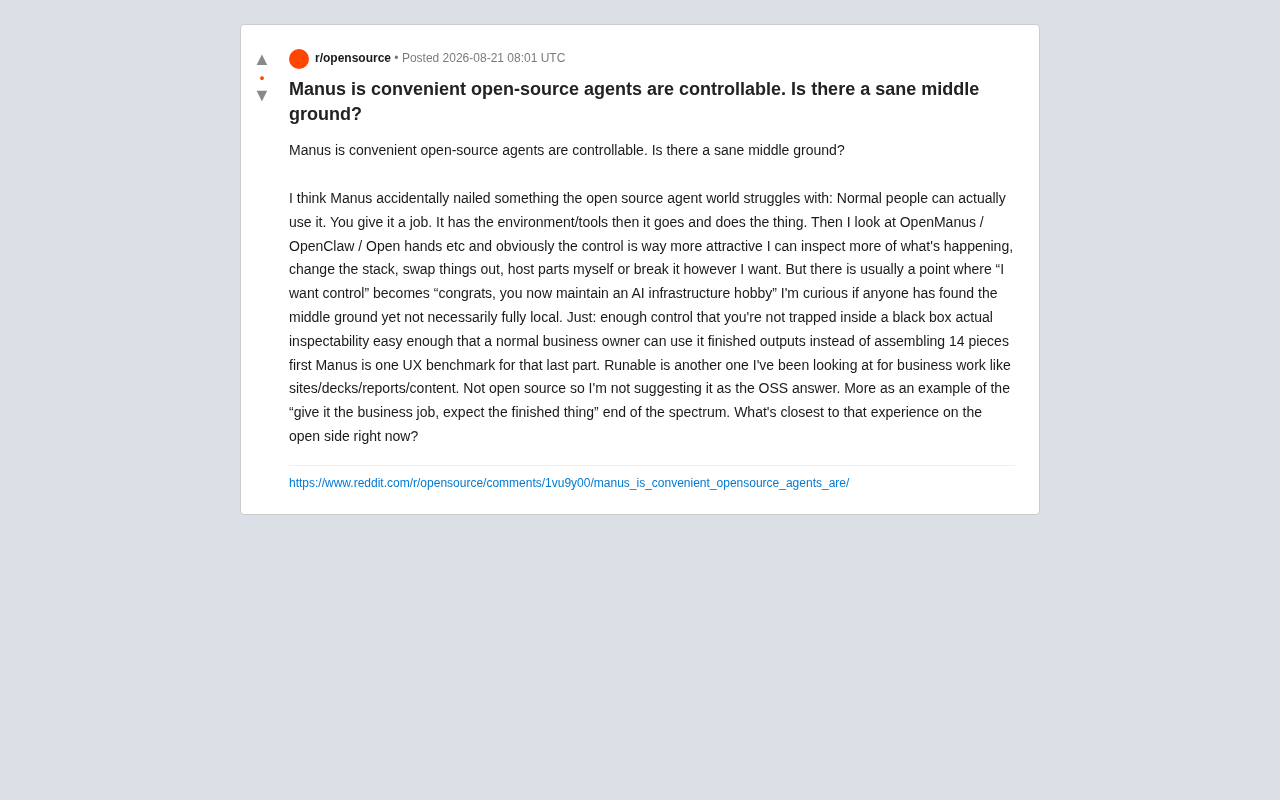
In a Reddit discussion, a developer raised what may be the sharpest contradiction in today's AI Agent landscape: Is there really a sane middle ground between convenience and control?
AI Agents are AI systems capable of autonomously perceiving their environment, making decisions, and taking actions to achieve specific goals. Unlike traditional chatbots, Agents possess capabilities such as multi-step reasoning, tool invocation, and environment interaction. A typical Agent workflow looks like this: understand user intent → formulate an execution plan → call external tools (search engines, code executors, API endpoints, etc.) → observe execution results → iterate and adjust until the task is complete. Since 2024, as the reasoning capabilities of large language models have improved, Agents have rapidly evolved from academic concepts into real products, becoming one of the core paradigms for AI applications.
The question seems simple, yet it strikes at the heart of the entire AI Agent ecosystem. Closed-source products like Manus have won over a massive base of everyday users through sheer ease of use — you give it a task, it has a ready-made environment and tools, and it just gets the job done. Meanwhile, open-source alternatives like OpenManus, OpenHands, and OpenClawAd represent a different path: complete transparency and control.
Manus is an AI Agent product developed by a Chinese team that generated widespread attention in early 2025, renowned for its end-to-end task completion capabilities. It comes with a fully integrated sandbox execution environment, browser, code runner, and other tools — users simply describe their task objective and receive finished output. OpenManus is an open-source recreation project inspired by Manus; OpenHands (formerly OpenDevin) focuses on software development Agents; and OpenClaw is another project attempting to deliver a Manus-like open-source experience. Together, these projects form an active but fragmented open-source Agent ecosystem, each making different trade-offs in architecture design, tool integration, and model compatibility.
But as the original poster pointed out with surgical precision: "When 'I want control' turns into 'congratulations, you now maintain an AI infrastructure hobby project,' things have gone sideways."
What Manus Accidentally Got Right
The author argues that Manus "accidentally" solved a core problem that the open-source Agent world has long struggled with — ordinary people can actually use it.
Behind that statement lies an important insight. The vast majority of open-source Agent projects are essentially technical tools built for developers. They're powerful and architecturally flexible, but for a business professional who just wants to get work done, the barrier to entry is absurdly high. You need to understand Agent orchestration logic, configure model APIs, set up runtime environments, debug tool chains... Before you can produce any actual output, you often have to "assemble 14 separate components" first.
Orchestration refers to the control mechanism for coordinating multiple components to work together on complex tasks. Common orchestration patterns include: ReAct (reasoning-action loops, where the model alternates between thinking and tool invocation), Plan-and-Execute (generate a complete plan first, then execute step by step), and multi-Agent collaboration (multiple specialized Agents each handling their own responsibilities). The typical tech stack involves: LLM APIs (such as OpenAI, Claude, or locally deployed open-source models), tool-calling frameworks (like LangChain or LlamaIndex), sandbox environments (Docker containers or virtual machines), and supporting components like vector databases. For non-technical users, understanding and configuring these components presents an enormous barrier — which is the fundamental reason why open-source solutions have limited usability.
Manus's product philosophy is the exact opposite: deliver finished products, not a pile of components to be assembled. You describe a business objective; it returns a usable result. This end-to-end task completion experience is precisely what ordinary users are willing to pay for. The author also mentioned another similarly positioned product, Runable, which focuses on business scenarios like websites, presentations, reports, and content — another representative of the "give it a business task, expect a finished deliverable" approach.
The Appeal and Cost of Open-Source Agent Solutions
The advantages of open-source Agents are obvious, and the author lays them out quite clearly:
- Inspectability: You can see what's actually happening under the hood, rather than facing a black box
- Customizability: You can swap out tech stacks, replace components, and self-host parts of the service
- Freedom: Modify it however you want — even breaking it is perfectly fine
Inspectability has very specific technical meaning in the Agent context. It includes: execution trace tracking, which provides a complete record of every reasoning step and tool call; intermediate state visualization, letting users see the input and output at each decision node; and tool invocation logs, recording which external services the Agent called, what parameters were passed, and what results were returned. In enterprise scenarios, inspectability also relates to compliance auditing — when an AI Agent makes business decisions on behalf of humans, organizations need the ability to trace the decision rationale after the fact. This is a major reason why regulated industries like finance, healthcare, and law remain cautious about closed-source black-box Agents.
For users who value data sovereignty, need deep customization, or simply don't trust closed-source black boxes, these features are extremely compelling.
But the costs are equally real. The "control" of open source often comes at the price of "maintenance burden." When you choose to self-build, you effectively take on the full operational responsibility of an AI infrastructure stack — model deployment, tool integration, version updates, troubleshooting. For individual developers, this might be enjoyable. But for a business owner who just wants to boost operational efficiency, it's a disaster.
What the Ideal Middle Ground Looks Like
The author paints a very specific picture of the "sane middle ground" — one that every Agent product designer should reflect on carefully. It doesn't necessarily need to run entirely locally, but it should satisfy several conditions simultaneously:
Sufficient Control
"Not being trapped inside a black box." Users want to understand the Agent's decision-making process and be able to intervene and adjust when necessary, rather than passively accepting results.
Genuine Inspectability
This isn't just marketing language — it means actually being able to see the Agent's execution chain, tool calls, and intermediate states. When things go wrong, users should be able to pinpoint the cause instead of just retrying or giving up.
Simple Enough for a Regular Business Owner to Use
This is the hardest requirement. Inspectability and ease of use are inherently in tension — the more detail you expose, the heavier the cognitive load. How to provide transparency without scaring away non-technical users is the central product design challenge.
Deliver Finished Products, Not Parts
Users want final results — a functional website, a complete report, a piece of publishable content — not a dozen intermediate artifacts they need to assemble themselves.
The Deeper Significance of This Discussion
This question resonates so widely because it reveals a fundamental rift in current AI Agent product design: the misalignment between the developer's perspective and the user's perspective.
The open-source community typically starts from technical capability, assuming users are willing to pay the learning and maintenance costs for control. Commercial closed-source products start from user experience, trading transparency and freedom for convenience. Each occupies one end of the spectrum, while the middle ground remains relatively empty.
In reality, the true opportunity may lie precisely here. The ideal solution might be a "progressively open" architecture: by default, it provides a foolproof finished-product delivery experience that lets ordinary users get started immediately; at the same time, it retains clear inspectability interfaces and a pluggable component design, allowing advanced users to dive deep, make adjustments, and self-host critical components when needed. Transparency should offer "selectable depth" rather than mandatory complexity.
Progressive Disclosure of Complexity is actually a classic concept from human-computer interaction design, proposed by IBM researchers in the 1980s. The core idea is to organize complex functionality in layers, so novice users only encounter the simplest interface while advanced users can drill down progressively. In Agent products, this means: the first layer is the finished-product delivery interface, where users simply input a task description and receive results; the second layer is execution process visualization, where users can view the Agent's reasoning chain and tool invocation process; the third layer is component-level configuration, allowing users to swap underlying models, customize tools, and adjust system prompts; the fourth layer is full self-hosting and source-code-level modification. This architecture already has successful precedents in cloud computing — platforms like AWS offer both one-click managed services and fine-grained control over every infrastructure component, letting users at different levels take what they need.
As of this discussion, the author candidly admits they haven't found an open-source solution that fully matches the Manus experience. This is both a regret and a clear market signal — whoever can bridge the gap between controllability and usability may well define the standard for the next generation of Agent products.
Final Thoughts
Manus has proven that ordinary people can harness AI Agents. The open-source ecosystem upholds the baseline of control and freedom. But for now, users still seem forced to choose between a "convenient black box" and a "controllable burden."
This question from the community is essentially a call for a new product paradigm — one that respects users' legitimate need for transparency without dumping maintenance complexity onto them. For teams building or exploring in this space, this may be more worth contemplating than piling on more features — because the answer isn't about being "more powerful," but about finding "just the right degree of openness."
Related articles

Bilibili's Hit Dify Tutorial: A Practical Guide to Building 20+ AI Apps from Scratch
A distilled guide to Bilibili's top-rated Dify tutorial: Windows + Docker deployment, MySQL connection, five app types, model integration strategy, and publishing.

Agent Skills Beginner's Guide: From Concepts to Multi-Agent Collaboration in Practice
A comprehensive guide to Agent Skills: core concepts, components, the importance of Description, standardization, beginner learning paths, and multi-agent collaboration.

One Neuron Detects Both Cats and Cars? We Reproduced It and Found a New Explanation
The cat-car neuron reinterpreted: researcher Cammarata argues it distinguishes pointy from round, not cats from cars. We reproduced the experiment and found the new explanation holds on most inputs—but cars are the exception. The interpretability debate continues on language models.