MCP Official Servers Hit 1.0.0: Major Stability and Security Upgrades

MCP official reference servers hit v1.0.0 with foundational stability, security hardening, and engineering upgrades.
The MCP official reference server collection has released v1.0.0, covering seven servers across TypeScript (SemVer) and Python (CalVer) ecosystems. The update introduces no new features, focusing instead on three areas: stability fixes (Unicode path handling and UNC share support in filesystem; cross-process file locking and concurrent write races in memory), security hardening (fetch now blocks private/loopback/metadata addresses by default to prevent SSRF), and engineering upgrades (the Agentic Software Factory framework with 90% per-file coverage gates, protocol-level characterization tests, and a shift to issue-based contributions). As the MCP ecosystem's official reference, this stabilization sets an important quality benchmark for the broader community.
The Model Context Protocol (MCP) official reference server collection has officially released v1.0.0. This milestone update is packed with fixes, test hardening, and security improvements — marking the moment these widely-used MCP development reference implementations formally enter a stable 1.x era.
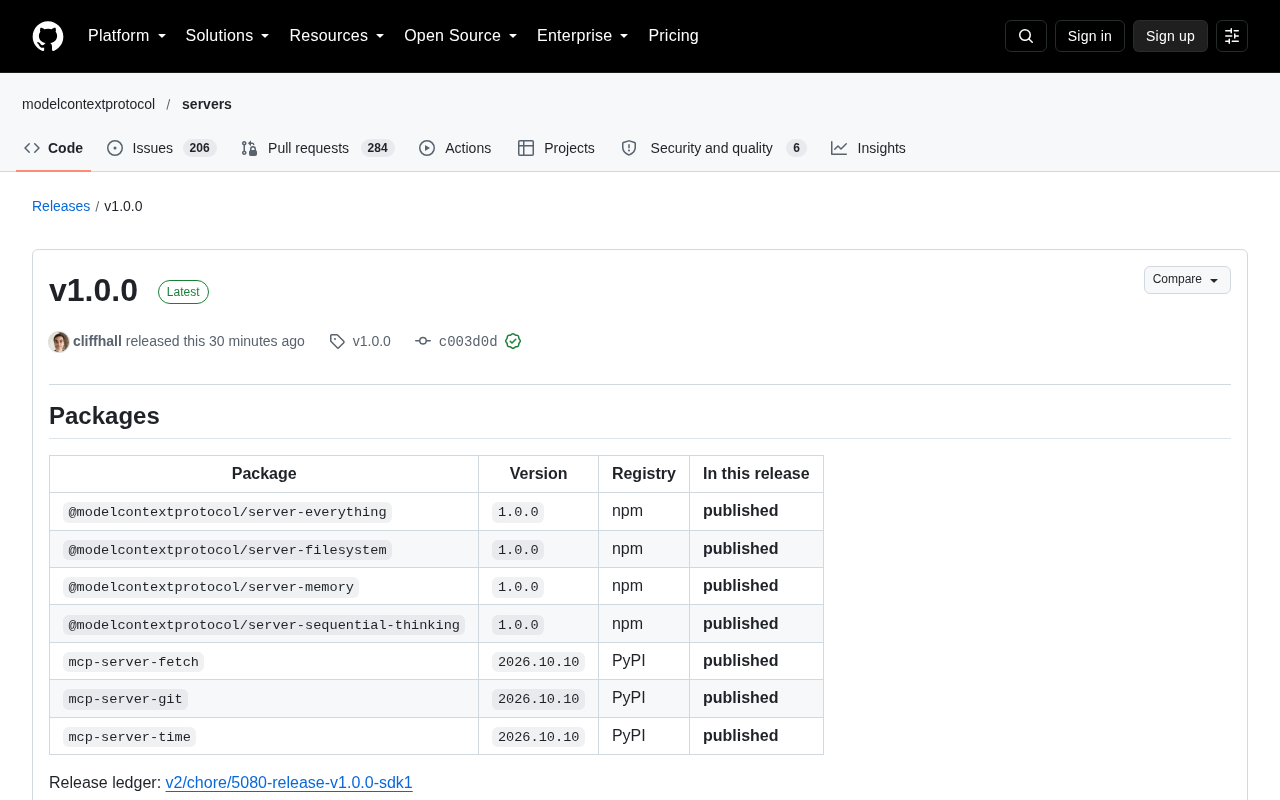
What's Included in This Release
v1.0.0 is not a single package but a coordinated release across multiple servers, spanning both the npm and PyPI ecosystems:
- TypeScript / npm (version 1.0.0):
@modelcontextprotocol/server-everything,server-filesystem,server-memory,server-sequential-thinking. - Python / PyPI (using CalVer: 2026.10.10):
mcp-server-fetch,mcp-server-git,mcp-server-time.
Notably, the two ecosystems adopt different versioning strategies — TypeScript servers follow Semantic Versioning (SemVer) at 1.0.0, while Python servers use Calendar Versioning (CalVer). This parallel approach is even reflected in the issue form placeholders, which display both version formats to help contributors report bugs correctly.
These servers serve as the "official blueprints" of the MCP ecosystem — developers frequently reference them when building their own tool services. Reaching the 1.0.0 stability milestone therefore sets an important quality benchmark for the entire community.
filesystem & memory: Tackling Path and Data Reliability
The filesystem server (server-filesystem) addresses a batch of long-standing path handling issues. It fixes path resolution bugs where paths differed only in Unicode normalization form and didn't match what was actually on disk, adds support for allowed directories under UNC share roots, and requires waiting for the initial roots to be ready before tool calls — failing visibly if no directory is configured, rather than silently misbehaving. Additionally, edit_file now preserves original line endings and indentation, and overwrite operations replace existing files in-place.
The memory server (server-memory) changes target data consistency directly. It adds cross-process file locking on the graph file to ensure neither write is lost when two server instances operate on the same file; introduces entry validation when loading the knowledge graph from disk; fixes misleading behavior where deletions were reported as successful even when nothing was actually deleted; and serializes graph mutations to prevent concurrent write race conditions. File permission modes are now preserved on save, and writes to read-only files are properly rejected. These fixes make the memory server significantly more trustworthy in multi-instance, concurrent scenarios.
fetch, git, time: Security Hardening and Behavioral Consistency
The most notable change in the fetch server (mcp-server-fetch) is that it now blocks private addresses, loopback addresses, and metadata endpoints by default. This is an important SSRF (Server-Side Request Forgery) protection measure, preventing the tool from being tricked into accessing internal networks or cloud environment metadata endpoints. SOCKS proxy support has also been added, and misconfigured proxy settings are now surfaced as tool errors.
The git server (mcp-server-git) standardizes the output structure of git_log, rejects empty commits with clear feedback, properly reports detached HEAD states resulting from git_checkout, and updates git_show to output native Git format while handling non-UTF-8 patches. The time server (mcp-server-time) normalizes timezone error handling: an invalid --local-timezone now exits with a single informative message, and convert_time provides clear error messages for both non-existent local times and empty timezone arguments.
All three Python servers now correctly report their own package versions in serverInfo, which is helpful for client identification and debugging.
A note on SSRF: SSRF (Server-Side Request Forgery) is a class of vulnerability that tricks a server into making requests on behalf of an attacker. In the MCP tool context, if a fetch server forwards arbitrary URLs without restriction, an attacker could craft requests targeting 127.0.0.1, 169.254.169.254 (the AWS/GCP metadata endpoint), or internal IP ranges — leveraging the AI tool's access privileges to probe or even manipulate internal services that shouldn't be publicly exposed. Cloud-native environments are especially vulnerable, since metadata services typically return sensitive information like temporary credentials without requiring authentication. Blocking private and metadata addresses by default is the most fundamental and critical defense against this class of attack — developers building MCP tools with network access capabilities should treat this as a primary reference practice.
Engineering Foundation: The Agentic Software Factory in Practice
The deeper change behind this release is the "Agentic Software Factory" engineering framework championed by maintainer cliffhall. The commit history shows this system was built across at least ten parts, covering:
- Using
AGENTS.mdas the absolute rules file, replacing the oldCLAUDE.md; - Aligned quality gates for both TypeScript and Python sides (Prettier, ESLint, ruff, root validation, CI);
- A skills infrastructure including reusable skills such as pr-flow, issue-triage, security-advisory, and release;
- A 90% per-file coverage gate enforced in both CI and local gates;
- A protocol-level characterization test suite.
One notably controversial decision is the shift in contribution model: the project has closed the channel for external direct PR submissions, moving instead to a "submit issues, not PRs" approach, with issue forms and a backlog plan used to organize contributions. Dependabot's automatic PRs have also been replaced with "issue triage scanning." This workflow gives maintainers tighter control over the merge cadence — well-suited to factory-style development with high quality gates — but may also raise the barrier for external contributors who want to submit code directly.
A note on protocol-level characterization testing: A protocol-level characterization suite is a testing strategy centered on protocol contracts: test cases don't depend on implementation details but directly verify whether the server's externally exposed MCP protocol behavior conforms to the spec — for example, that a given tool call with specific inputs must return a JSON-RPC response of a specific structure. Compared to unit tests, this is closer to integration testing, but with the test boundary fixed at the protocol layer, allowing assertion logic to be reused across server implementations in different languages. This is especially important for "official reference servers": when community developers model their own servers after the reference implementation, protocol-level tests provide a clear compliance baseline rather than just self-testing internal logic. The design of AGENTS.md as an "absolute rules file" provides strong constraints for AI-assisted coding agents (such as Claude, Copilot, etc.), ensuring that auto-generated code also adheres to quality gates — which is the core meaning behind the name "Agentic Software Factory."
What This Means for Developers
For developers currently building MCP tools, v1.0.0 sends several clear signals. First, these reference servers now have protocol-level test coverage and high coverage guarantees, making them more reliable as learning references. Second, security improvements like fetch's default SSRF protection and filesystem's directory boundary validation serve as reminders to apply the same network and filesystem boundary controls in your own MCP services. Third, the dual-track versioning strategy — SemVer for TypeScript and CalVer for Python — means you'll need to track two separate version schemes when upgrading.
This release also gives special thanks to more than a dozen first-time contributors and numerous community members who reported issues. Real-world bugs surfaced through actual use — such as Unicode path issues, concurrent writes, and detached HEAD states — were the core driving force behind getting 1.0.0 across the finish line. Overall, v1.0.0 reads more like a "solidify the foundation" release: no flashy new features, but a critical leap forward in stability, security, and engineering standards.
Related articles

Free Unlimited Claude Code Solution: Agnes AI + CC Switch Setup Guide
No paid subscription needed — pair the free AI platform Agnes AI with the open-source tool CC Switch to provide a backend for Claude Code, enabling unlimited free calls to text, image, and video models. This guide covers the full setup, test results, and usage boundaries.

A Complete Zero-Cost Guide to Getting Started with Claude Code for Beginners in China
A beginner's guide to Claude Code for users in China: two installation methods (command line and IDE plugin), full configuration steps for replacing the official API with the free domestic LongCat model, and a hands-on demo of building a small tool with natural language, plus tips.

When the NSA Gets Involved: The AI Supply Chain Crisis Behind Open-Source CVEs and API Key Hijacking
Multiple open-source projects disclosed severe CVEs in one day, PHP flaws alarmed the FBI, and Railway and OpenCode were breached with API keys stolen. This article breaks down the vulnerability window, AI-accelerated exploitation, and the AI supply chain crisis behind the API key black market, with a developer defense checklist.