Meta Releases the Most Powerful Open-Weight Model in the US, Coming Soon to Ollama

Meta releases what is called the most powerful open-weight model in the US, soon to launch on Ollama for local running.
Meta's AI research team has released a new open-weight model described as "the most powerful open-weight model in the US to date," expected soon on Ollama so developers can run and experiment locally. The article explains how open-weight models release training parameters, promote transparency and community innovation, and notes Meta's role via Llama. Ollama support lowers deployment barriers, while architecture and benchmark details remain undisclosed.
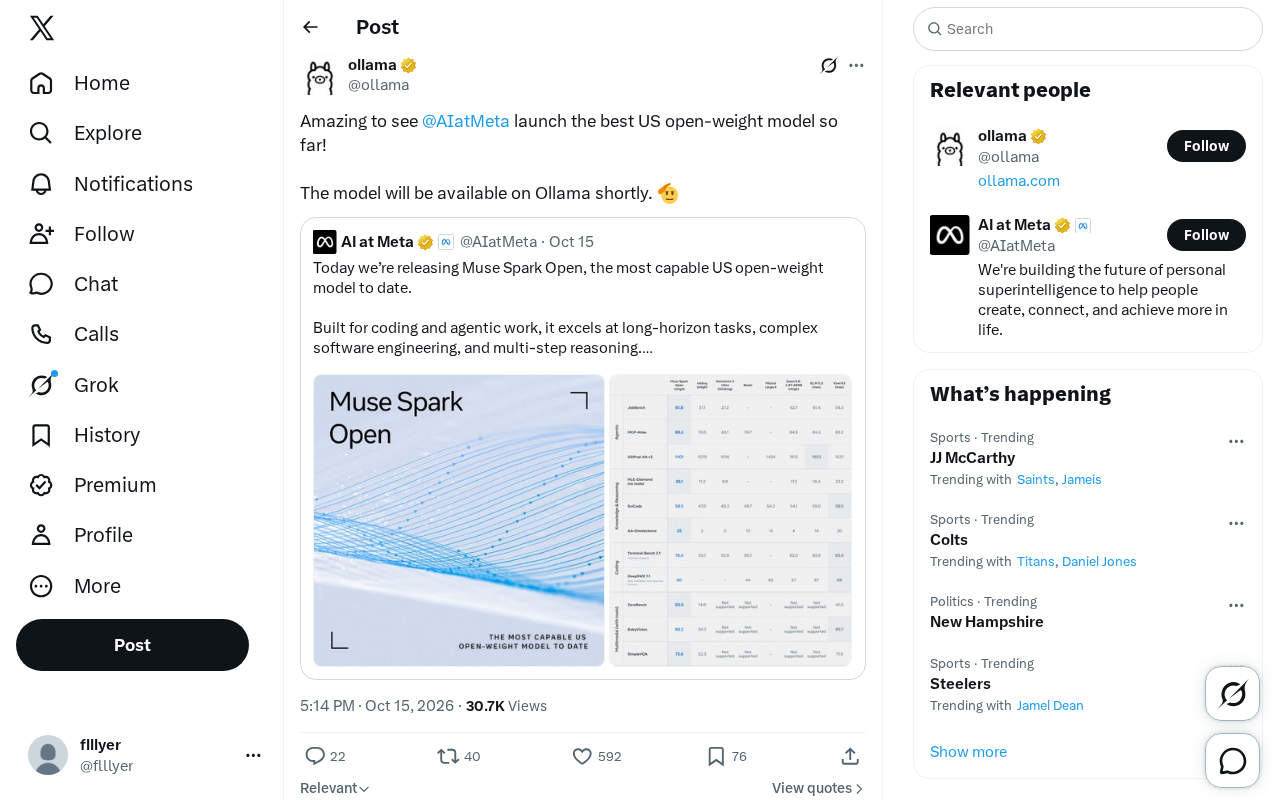
Meta's AI research team (@AIatMeta) has recently released a new open-weight model, described by industry observers as "the most powerful open-weight model in the US to date." According to discussions on social platforms, the model will soon be available on the Ollama platform, meaning developers can more easily run and experiment with this new model locally.
The Significance of Open-Weight Models
Open-weight models refer to models whose training parameters are publicly released, allowing researchers and developers to download, inspect, and even fine-tune them. Compared with fully closed-source models, open-weight models promote transparency, reproducibility, and community innovation. Meta has long been an important advocate of open-weight models, and its previously released Llama series has already had a broad impact on the open-source community. This new model is described as "the best in the US," suggesting that its performance may surpass that of previous comparable US open models.
Open weights and open source are not strictly equivalent. Open weights merely means that the model's post-training parameters are publicly released, so users can download them and perform inference or fine-tuning directly; however, the training code, training data mixture, data cleaning pipeline, and similar details are often not released alongside them, so they usually do not fully satisfy OSI's (Open Source Initiative's) complete definition of "open-source AI." The Llama series is a typical example of open-weight models, and its license also includes additional terms regarding user scale and commercial use. By contrast, fully open-source models (such as some released by academic institutions with complete training scripts and data documentation) offer stronger reproducibility but are rare in number. The value of open weights lies in three things: first, they allow researchers to conduct interpretability and safety analyses on real weights; second, they enable enterprises to fine-tune on private data without sending that data outside; third, they foster an ecosystem around weight distribution, quantization and compression, and local inference tools. Understanding this distinction helps determine whether a given release represents a "transparency improvement" or "limited openness."
Support on the Ollama Platform
Ollama is a popular local large-model runtime tool that supports users in easily deploying and running various open models on personal computers. The model's upcoming arrival on Ollama means developers can experience its capabilities without complex configuration, which typically greatly lowers the barrier to use and accelerates the model's application and feedback loop in real projects.
Ollama's operating mechanism deserves separate explanation. It is essentially a combination of a model runtime and a model repository: users pull model files via the command line (usually quantized GGUF format), and Ollama handles loading weights, managing the context window, exposing a local HTTP API, and supporting OpenAI-style interface calls. Quantization (such as 4-bit or 8-bit) trades a certain loss of precision for significantly reduced VRAM and memory usage, enabling the model to run on consumer-grade GPUs or even CPUs. Therefore, "coming to Ollama" not only means easy installation, but also means the model must first undergo format conversion and quantization adaptation, and the community often follows up within days with different quantization levels. For developers, this provides an inference path that is offline, low-latency, and keeps data local, but it is also important to note that quantized versions may show perceptible differences from the original weights on long-context and complex reasoning tasks.
Impact on Developers and the Research Community
For developers, the new model's open weights and Ollama support mean more flexible experimentation opportunities. Researchers can deeply analyze model behavior, and enterprises can fine-tune the model on their own data without relying on external APIs. However, detailed information about the model's specific architecture, training data, and benchmark results has not yet been disclosed in the original tweet, and the community is still waiting for a more complete technical report.
Competitive Landscape and Future Outlook
Competition in open-weight models is becoming increasingly intense, and Meta's new release may further advance US progress in open-source AI. With the model launching on Ollama, it is expected to attract a large number of developers to test and compare it, and its actual performance and ecosystem support will become a focus of attention.
(Note: This article is based on public tweet information; detailed model specifications are subject to the official release.)
One-line Summary
Meta releases what is called the most powerful open-weight model in the US, soon to land on Ollama for local running.
Paragraph Summary
Meta's AI research team has released a new open-weight model, described by industry observers as "the most powerful open-weight model in the US to date," and it is expected to launch soon on the Ollama platform, allowing developers to run and experiment with it conveniently on local machines. The article introduces the characteristics of open-weight models—publicly released training parameters that promote transparency and community innovation—and notes that Meta, through the Llama series, has already been an important advocate of this approach. Ollama support will significantly lower the deployment barrier and accelerate the model's application and feedback in real projects. For developers and researchers, open weights provide room for flexible experimentation and fine-tuning on private data; however, details such as model architecture, training data, and benchmark results have not yet been disclosed. Competition in open-weight models is becoming increasingly intense, and the new model's actual performance and ecosystem support will be the focus of follow-up attention.
Related articles

Build an AI Super Employee System at Zero Cost: A Full Breakdown of Automated Agent Workflows
A deep breakdown of the AI super employee system demoed on Bilibili: agent orchestration, digital human voiceovers, map and enterprise lead generation, 24/7 customer service, and legal modules. We analyze the business logic and compliance risks behind zero-cost signup to help entrepreneurs judge the real ROI of this AI digital employee system.

The Essential Difference Between Chatbots and AI Agents: Crossing from Conversation to Execution
What's the difference between a chatbot and an AI agent? Based on the MCP series on the Learn Tech channel, this article uses examples like booking flights and summarizing notes to explain: a chatbot only gives answers, while an agent actually completes tasks through a think-act-observe loop. It breaks down the four core components—model, tools, memory, and goal—as well as MCP's role as a bridge, and discusses agents' applicable boundaries and permission risks.

Free GitHub Repo: 342 Hours of AI Courses, from Math to MCP Servers
A free GitHub repo offers 342 hours of AI courses: 523 lessons across 20 phases, from math fundamentals to agent building and MCP servers. Nearly 100,000 learners have started.