Nature Buddy AI: Using Open-Source AI to Guide You Away from Screens and Into Nature

Nature Buddy AI uses local AI inference and gamified missions to nudge users outdoors and into nature.
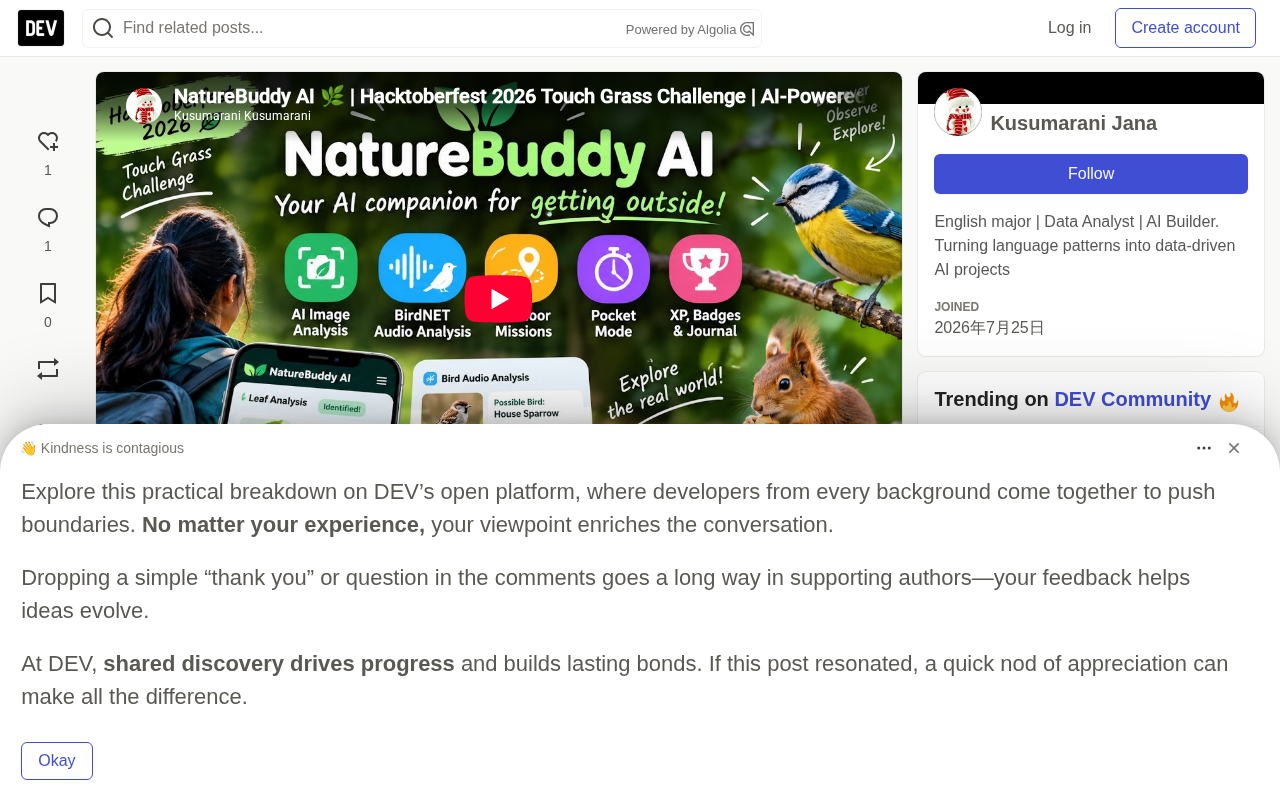
Nature Buddy AI is an open-source project born from the Hacktoberfest "Touch Grass" challenge, designed to pull users away from screens and into the real world. It combines outdoor missions, AI photo identification, acoustic sound mapping, Pocket Mode, and a gamified nature journal into a complete exploration loop. Built on React/Vite/FastAPI, it runs the open-weight BLIP vision model locally in the browser via WebAssembly, with optional support for Groq, Hugging Face, and Ollama — protecting privacy while avoiding costly closed APIs. The author's core message: open innovation ensures AI-powered nature education remains accessible to everyone.
An AI Product Built to Work Against Itself
Most AI applications are laser-focused on keeping users glued to their screens. Nature Buddy AI does the opposite. Born from the Hacktoberfest Week 1 "Touch Grass" challenge, this open-source project has a refreshingly straightforward premise: the screen is just the starting point — the real experience happens outdoors.
The developer wanted to harness AI's recognition and guidance capabilities to encourage people to step outside, explore their surroundings, identify plants and wildlife, and notice the small details they normally overlook. This design philosophy — using technology to pull people away from technology — sets it apart from most AI applications in the space.
Five Features That Form a Complete Outdoor Exploration Loop
Nature Buddy is more than just an identification tool. It wraps the entire outdoor exploration experience into a gamified, end-to-end system.
Outdoor Missions: Bite-sized challenges that guide exploration — from 15-minute walks to finding fallen leaves or discovering hidden natural textures — lowering the psychological barrier to actually going outside.
AI Nature Identification: Upload a photo of a leaf, butterfly, or natural scene and receive AI-generated observations, fun facts, and suggestions for what to explore next.
Acoustic Sound Mapping: Listen to birdsong, rustling leaves, and other outdoor sounds, then dive deeper into discovering their sources.
Pocket Mode: A timed outdoor break with relaxing natural ambient sounds.
Nature Journal & Gamification: Log outdoor activities, earn XP, complete missions, and maintain streaks.
This combination links identification, listening, journaling, and motivation into a single cohesive experience. The target audience includes students, beginner nature enthusiasts, and anyone who wants to spend less time scrolling and more time experiencing the real world. The developer candidly noted that while building this project, he started noticing the fallen leaves, birds, and small creatures around him in a different way — and that's exactly the experience he hopes to pass on to users.
Tech Stack: In-Browser Local Inference Is the Key Highlight
On the technical side, Nature Buddy uses React, Vite, and Tailwind CSS for the frontend, paired with a FastAPI backend. The project integrates outdoor challenges, a nature exploration interface, image analysis, text-to-speech, and progress tracking into a unified package.
The most noteworthy aspect is its AI architecture. Nature Buddy supports the open-weight BLIP vision model, running directly in the browser via WebAssembly, while also offering optional third-party vision model integration through providers like Groq, Hugging Face, and Ollama.
The significance of in-browser local inference is real: for supported features, it reduces dependence on external services, protecting privacy and lowering the barrier to entry. A user can snap a photo of something they discover outdoors, get an immediate identification, and receive inspiration for the next exploration task — all without being tied to an expensive closed-source API.
The developer also built timed walks, outdoor missions, XP, an achievement system, and a nature journal — all with the singular goal of encouraging real-world engagement rather than keeping users on-screen longer.
BLIP (Bootstrapping Language-Image Pre-training) is a vision-language pre-training model introduced by Salesforce Research in 2022, capable of handling image captioning, visual question answering, and image-text retrieval simultaneously. Unlike many multimodal large models that require enormous parameter counts, the BLIP model family (including the follow-up BLIP-2) maintains strong recognition capabilities while keeping a relatively compact footprint — a prerequisite for being quantized and run via WebAssembly in the browser. WebAssembly (Wasm) is a low-level bytecode format for the browser that allows high-performance code written in languages like C++ or Rust to execute directly inside the browser sandbox at near-native speeds. By compiling a machine learning inference engine (such as ONNX Runtime Web or Transformers.js) into a Wasm module and loading quantized model weights, image inference can be performed on the user's device without installing any local software — and photos never leave the user's device.
Why Open Innovation Matters
The project's author explicitly articulated the reasoning behind choosing an open-source-first approach: AI-powered nature education shouldn't be gated behind expensive services or closed APIs.
Open-weight models give developers the freedom to experiment, learn, adapt, and run AI in diverse environments. In-browser inference further reduces reliance on external services. By building Nature Buddy with open-source tools and flexible AI integrations, the author was able to try different models, learn from the community, and make it easier for other developers to extend the project.
More importantly, open innovation allows technology to serve a more meaningful goal — encouraging people to reconnect with the world beyond their screens.
Groq, Hugging Face Inference API, and Ollama represent three distinct archetypes of AI inference services today. Groq delivers ultra-low-latency cloud inference via its custom LPU (Language Processing Unit) chips, ideal for latency-sensitive online use cases. Hugging Face provides hosted inference endpoints covering tens of thousands of open-weight models, serving as the hub of the community ecosystem. Ollama takes the local-first route, letting developers run models like Llama and Mistral on their own machines with a single command, no internet connection required. Nature Buddy's support for all three paths means developers and users can freely switch inference backends based on privacy requirements, network conditions, and cost constraints — without being locked into a single provider. This is the "open integration" philosophy made concrete at the engineering level.
A Few Observations
Nature Buddy AI is a quintessential Hacktoberfest project: pragmatic tech stack, clear vision, and polished enough to be a fully demonstrable product (the project provides a live demo, video walkthrough, and GitHub repository). Its value lies not in cutting-edge technology, but in weaving together local AI inference, gamified motivation, and outdoor behavior nudging into a coherent, self-contained loop — and releasing it to the community as open source.
For developers interested in on-device AI, WebAssembly-based inference, or building behavior-change applications, this project offers a lightweight, well-scoped reference worth studying. Curious readers can try it firsthand through the live demo.
Related articles

LLaMA-Factory in Practice: A Complete No-Code Guide to Fine-Tuning Large Models
An introduction to LLaMA-Factory, the open-source fine-tuning tool: its 60.1K-star background, supported models and algorithms, local vs. cloud deployment, and CUDA setup steps.

Zeng Ming's Deep Retrospective: Why OpenAI May Not Be the Ultimate Winner — and Why the Corporate System Will Disappear
Zeng Ming's deep retrospective on the AI endgame: model companies are just infrastructure, OpenAI and Anthropic won't be the final winners; the next battle is the Agent entry point standard; the corporate system will disappear as AI restructures collaboration, and only mission-driven companies can survive the cycle.

OpenHands v1.28.0: OpenCode and PI Added as Built-in Agents, API Keys Requestable In-Conversation
OpenHands ships 5 releases in 21 days: v1.27.0 adds OpenCode and PI as built-in agents, v1.28.0 enables in-chat key requests. ACP integration, credential reuse, model list changes, and upgrade advice.