NOAN: A New Approach to Building an Enterprise 'Fact Layer' for AI Agents

NOAN creates a verified, versioned enterprise Fact Layer so all AI Agents share one consistent source of truth.
As enterprises deploy multiple AI Agents simultaneously, conflicting interpretations of the same documents have become a growing problem. NOAN introduces the concept of a 'Fact Layer' — consolidating officially approved pricing, policies, and product information into a verified, versioned single source of truth, then distributing it to all downstream models and apps via API and MCP. Unlike traditional RAG, this approach governs knowledge at the source rather than relying on statistical retrieval approximations. NOAN earned 171 votes and a #2 ranking on Product Hunt, targeting enterprise teams building multi-Agent systems.
When Every AI Is 'Interpreting' Your Documents on Its Own
Enterprise environments often accumulate thousands of documents, yet there's only one officially sanctioned "authoritative answer" for any given topic. The problem is that when you feed these documents to different large language models or AI Agents, each model interprets them in its own way — pricing, product positioning, policy terms, and customer information can each be read in several contradictory ways.
NOAN launched on Product Hunt with 171 votes and a #2 ranking, offering a clear solution: instead of letting every AI "guess" the meaning of your documents, build a unified Fact Layer.
What Is a "Fact Layer"?
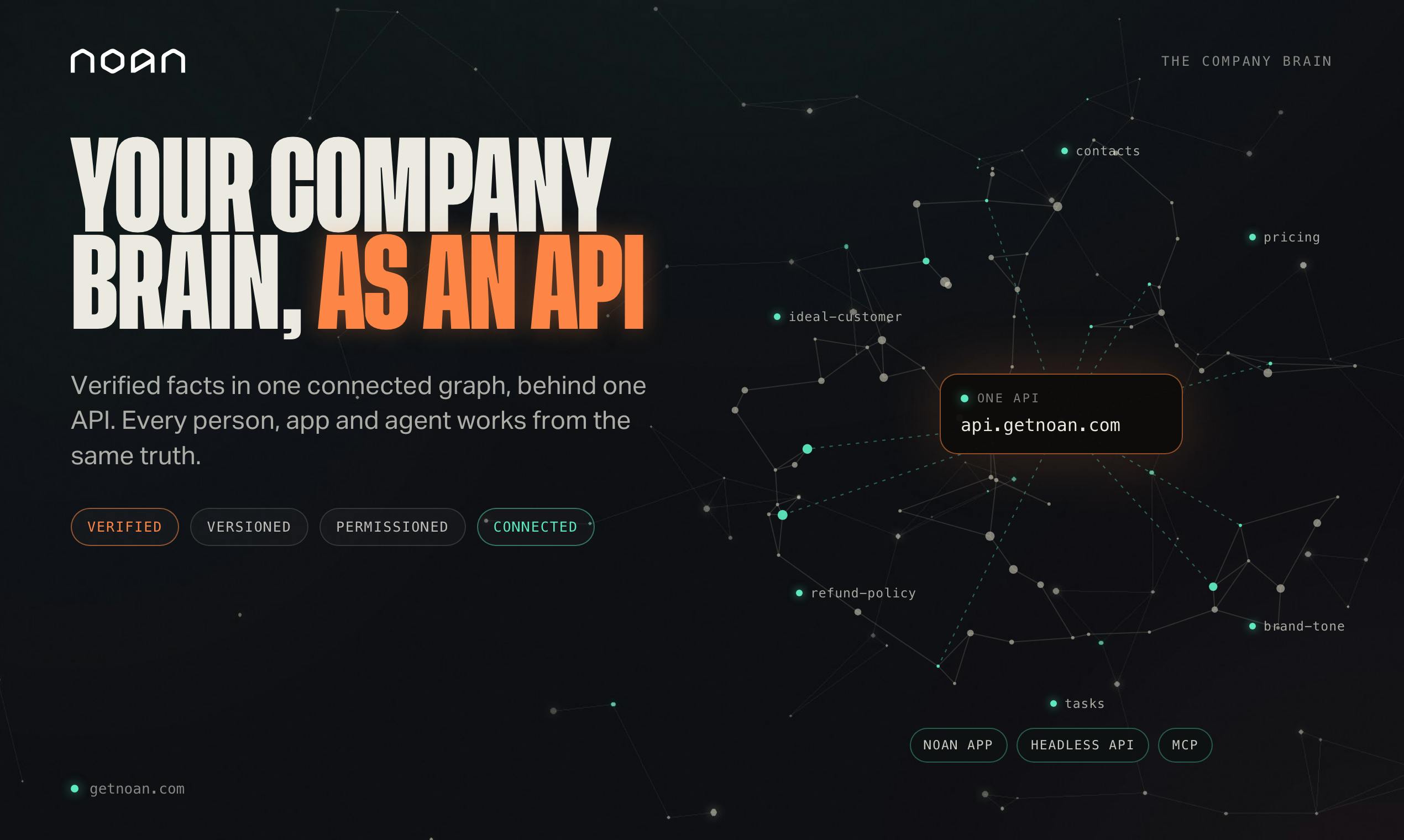
NOAN's core concept is to transform a company's approved facts — including pricing, market positioning, policies, products, customer data, and more — into a verified, versioned single source of truth.
Two key terms here are worth unpacking:
Verified
Enterprise information often becomes chaotic because there's no clear designation of "which document is the authoritative one." NOAN emphasizes that its facts are officially reviewed and endorsed — not randomly extracted snippets from scattered documents. This means the AI receives answers that have been backed by authority, rather than raw material whose credibility it must judge for itself.
Versioned
Pricing changes, policies get updated, and products evolve. Version management means the Fact Layer can track these changes, ensuring every connected AI always receives the currently valid version rather than outdated information. This is especially critical for compliance-sensitive use cases.
Delivered via API and MCP
NOAN distributes its Fact Layer through API and MCP (Model Context Protocol). Any model, Agent, or application can connect to it and retrieve consistent company facts from a single source.
The inclusion of MCP is a noteworthy signal. As a context protocol that has been gaining traction recently, MCP standardizes how AI applications connect to external data sources. NOAN's support for MCP means it can integrate more smoothly into modern Agent workflows without requiring custom adaptations for each individual model.
This "maintain once, reuse everywhere" pattern essentially elevates enterprise knowledge governance from the "document layer" to the "fact layer." Developers no longer need to worry about Model A and Model B giving different answers about the same policy.
MCP (Model Context Protocol) is an open standard proposed and open-sourced by Anthropic in late 2024, designed to address the fragmentation in how LLM applications connect to external data sources and tools. Previously, every AI application that needed to integrate with enterprise databases, file systems, or third-party services required custom integration code — making maintenance extremely costly. MCP standardizes these connections much like USB ports standardize hardware peripherals: as long as a data source implements an MCP Server, any AI application with an MCP Client can connect directly, with no redundant development required. Leading AI tools including Claude, Cursor, and Zed have already adopted MCP, establishing it as a foundational layer in the Agent ecosystem. NOAN's native MCP support signals that its design goal is to embed into existing enterprise Agent workflows — not to build a closed, proprietary ecosystem.
The Real Pain Point It Solves
As enterprises deploy more and more AI Agents internally, a subtle but serious problem has emerged: knowledge consistency.
Imagine a company running a customer service bot, an internal knowledge Q&A system, and a sales assistant simultaneously. If each reads raw documents and reasons independently, you can easily end up with the customer service bot quoting a different price than the sales tool — an embarrassing and potentially costly inconsistency. This kind of discrepancy is far from rare in traditional RAG (Retrieval-Augmented Generation) setups, because the retrieved chunks, how they're split, and how the model interprets them can all introduce variance.
NOAN's approach is to converge at the source — first solidifying facts into a structured, verifiable form, then distributing them downstream. Conceptually, this is closer to "enterprise data governance" than pure vector retrieval.
RAG (Retrieval-Augmented Generation) is currently the dominant technical approach for enterprise knowledge Q&A: documents are chunked, vectorized, and stored; when a user asks a question, the most relevant chunks are retrieved and provided as context for the LLM to generate an answer. The inherent limitation of this approach is that "retrieved chunks" are essentially a statistical approximation of the original documents — the same question may retrieve different passages at different times, and the model's interpretation of those passages varies with model version and prompt wording. More fundamentally, RAG architectures don't distinguish between "officially approved information" and "an outdated draft" — as long as a document is in the vector store, it competes in retrieval. This is precisely why knowledge inconsistency gets dramatically amplified in multi-Agent scenarios. NOAN attempts to sidestep this problem at the source: rather than relying on the approximations of retrieval, it pre-structures facts and marks them as "verified," fundamentally eliminating ambiguity.
Positioning and Takeaways
NOAN is categorized under API, developer tools, and artificial intelligence, and its target users are clearly enterprises and development teams building multi-Agent systems. Its value proposition is straightforward: a unified source of truth.
From a product maturity standpoint, however, publicly available information currently focuses mainly on concepts and positioning. Details such as the fact-entry workflow, how the verification mechanism operates, and compatibility with existing knowledge bases still warrant closer observation. For teams considering adoption, whether the Fact Layer can genuinely deliver low maintenance cost combined with high accuracy will be the key determinant of its practical value.
For the broader AI engineering ecosystem, NOAN represents an emerging trend: as Agent applications scale, the infrastructure around data consistency and knowledge governance is becoming just as important as the models themselves.
Related articles

GPT-Next Leak, Gemini 4 Argon Imminent: AI News Roundup
GPT-Next leak suggests extreme efficiency; OpenAI's 28-day shipping pledge boosts speed 50%; Gemini 4 Argon nears release; Anthropic subscription value report sparks debate.

GPT-Next Leaked, Gemini 4 Argon Speeds Up, Fable 5.5 May Launch Today
OpenAI's GPT-Next model leaks, expected to be extremely low-cost and possibly part of the 28-day release plan; Gemini 4 Argon internal testing accelerates, NanoBanana 2.1 is live; Semi Analysis tests show Claude Max's equivalent API value is about 5 times that of ChatGPT Pro; Fable 5.5 may launch today.

Gemini 4 Argon Launches Globally: Key Highlights from the AI Daily Brief
Google opens Gemini 4 Argon globally across Pro and Ultra subscriptions and the API, and demonstrates robot control. This article rounds up open-source models, Agent infrastructure, cost transparency, and safety governance updates.