NullOrigin Open-Source Tool: A Deep Dive into the Local Proxy That Removes AI Watermarks and Provenance Metadata

NullOrigin is an open-source local proxy that neutralizes AI watermarks, strips image metadata, and scans for code vulnerabilities.
NullOrigin is an open-source local proxy tool that intercepts AI-generated content to neutralize watermarks and provenance metadata. It destroys statistical text watermarks (like KGW) by rewriting text through a local SLM via Ollama, strips C2PA and EXIF metadata from images, and scans code for Trojan Source Unicode vulnerabilities. Its local-first architecture ensures all processing stays on-device, raising both privacy benefits and ethical concerns about undermining content authenticity systems.
In an era of rapidly proliferating generative AI, major vendors are embedding watermarks and provenance identifiers into AI-generated content—from statistical watermarks in text to C2PA metadata in images. These technologies aim to trace content origins and prevent misuse, but they've also sparked debates about privacy, research freedom, and censorship. The open-source tool NullOrigin, recently launched on Product Hunt, targets precisely this sensitive territory: it operates as a local proxy that intercepts and neutralizes AI watermarks and provenance information.
What Is NullOrigin
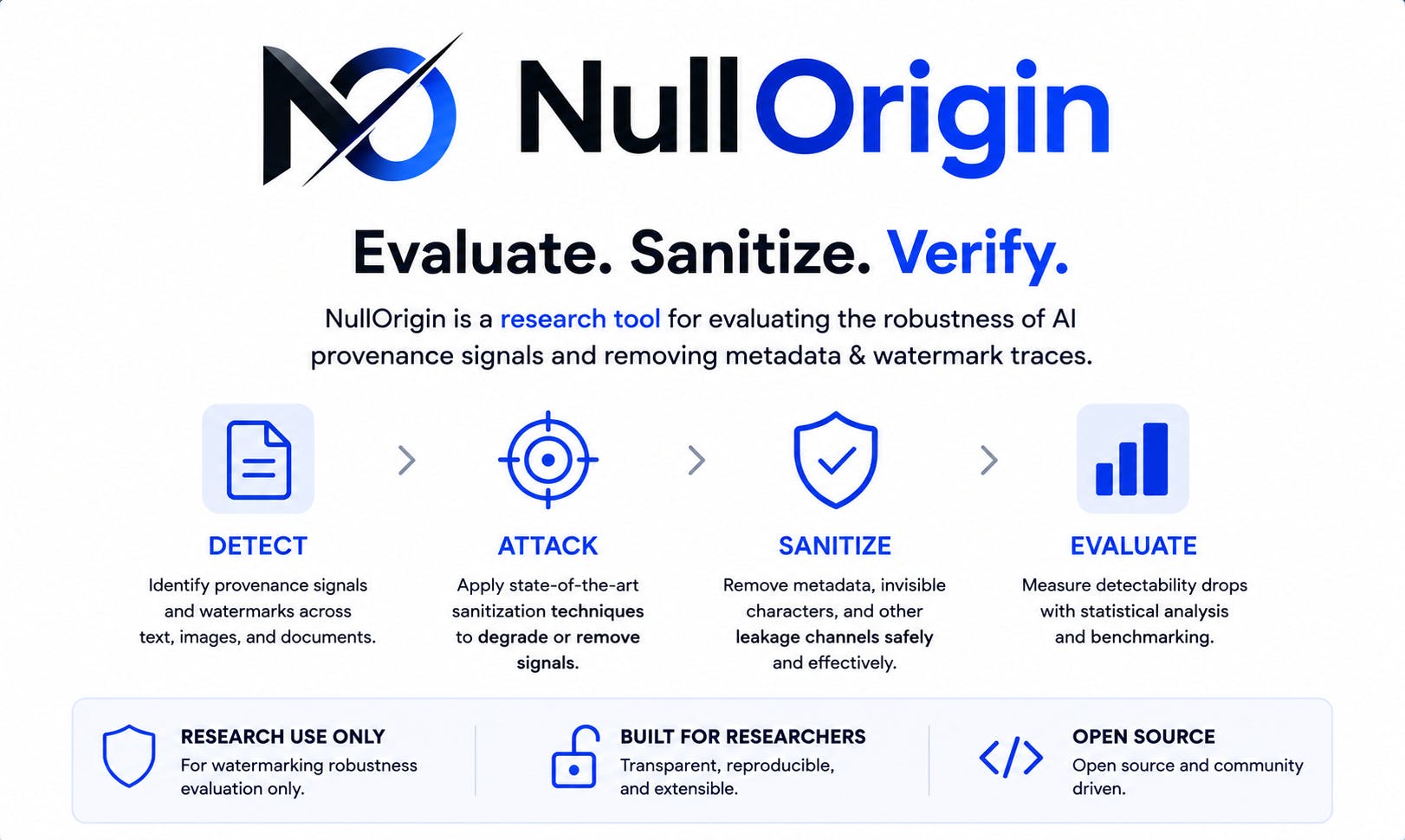
NullOrigin is an open-source local proxy whose core function is intercepting and "neutralizing" AI watermarks and content provenance metadata during data transmission. Its usage is remarkably straightforward: developers simply point their OpenAI, Anthropic, or Gemini SDK requests to localhost, and NullOrigin takes over the entire data stream.
From a technical architecture perspective, a local proxy is a middleware service running on the user's device that intercepts communication between the client and remote servers, processing or modifying data before it reaches the application. This pattern is well-established in network debugging tools (such as Charles Proxy and mitmproxy), and NullOrigin applies it to AI content post-processing—essentially inserting a transparent content sanitization layer between the SDK and the end user.
In terms of product positioning, it explicitly targets "researchers and privacy-conscious developers," categorized under open source, developer tools, and artificial intelligence. Built by developer Rakib, the project is currently in its early stages on Product Hunt (3 votes, 1 comment, ranked #19), but the technical topics it addresses carry considerable depth.
Three Core Capabilities
Real-Time Destruction of Statistical Text Watermarks
NullOrigin's most technically sophisticated feature is its handling of text watermarks. One of the leading text watermarking schemes today is the KGW (Kirchenbauer-Geiping-Wen) algorithm, which divides the vocabulary into "green list/red list" partitions during generation, leaving statistically detectable signatures in AI-generated text.
Specifically, the KGW algorithm was proposed by University of Maryland researchers in 2023 and is one of the most influential LLM text watermarking schemes in academia. Its core principle works as follows: at each token generation step, the previous token is used as a pseudo-random seed to partition the entire vocabulary into "green list" and "red list" groups. During sampling, a positive logit bias is applied to green list tokens, making the model favor green list vocabulary. During detection, the verifier simply checks whether the proportion of green list tokens in the text is significantly higher than the random baseline (typically 50%), using hypothesis testing to determine if the text contains a watermark. The scheme's advantage lies in its minimal impact on generation quality, and detection doesn't require access to model weights—enabling independent third-party verification. However, its weakness is equally clear: any operation that alters the statistical distribution of token sequences can destroy the watermark signal.
NullOrigin exploits precisely this weakness: it routes streaming text output through a local Small Language Model (SLM, running via Ollama) for rewriting, thereby "mathematically destroying" such statistical watermarks. Ollama is an open-source local LLM runtime framework supporting various open-source models including Llama 3, Mistral, Phi-3, and Gemma, significantly lowering the barrier to local model deployment through optimized quantized inference and a clean API interface. In NullOrigin's architecture, after the original AI-generated text undergoes semantics-preserving rewriting by the local small model, the original statistical watermark patterns (such as KGW's green list bias) are overwritten by a new token distribution—because the rewriting model samples from its own probability distribution, completely unrelated to the original watermark's pseudo-random seed chain, thus achieving "mathematical destruction" of the watermark. This means the entire process is completed locally without uploading data to third parties, addressing both privacy and watermark removal needs simultaneously.
Stripping C2PA and EXIF Image Metadata
On the image front, NullOrigin strips C2PA and EXIF metadata. The C2PA (Coalition for Content Provenance and Authenticity) standard was jointly launched in 2021 by Adobe, Microsoft, Intel, BBC, Arm, and other organizations. It's an open standard based on W3C Verifiable Credentials and cryptographic signature technology that attaches tamper-proof "content credentials" to images: every creation, editing, or transformation operation on content is recorded as an "assertion" and bound to the content itself through digital signatures. This metadata can be embedded within the file (such as in JPEG's JUMBF segment) or stored in external manifests. Since 2024, mainstream AI image generation tools including OpenAI's DALL-E, Adobe Firefly, and Google DeepMind's SynthID have all supported C2PA tags, making it an infrastructure-level solution for combating deepfakes.
EXIF (Exchangeable Image File Format) contains rich meta-information including camera model, lens parameters, timestamps, and GPS geolocation data. Although EXIF was originally designed for digital photography, in a privacy context, this data can expose users' location trails and device fingerprints. Stripping C2PA and EXIF data effectively severs an image's provenance chain—though it's worth noting that C2PA relies on cryptographic signatures to ensure integrity, and its design logic treats "missing credentials" itself as a signal, allowing platforms to lower trust for credential-less content.
Scanning Code for Trojan Source Vulnerabilities
The third capability leans toward security: NullOrigin scans AI-generated code to detect Trojan Source vulnerabilities. This attack class was disclosed by Cambridge University researchers Nicholas Boucher and Ross Anderson at the ACM CCS conference in 2021. It exploits bidirectional text control characters in the Unicode standard (such as U+202A LRE, U+202B RLE, U+202C PDF, etc.) to make code display differently to human readers versus how compilers parse it, thereby planting nearly undetectable backdoors.
These bidirectional control characters are typically completely invisible in source code editors, but they alter the logical display order of text. An attacker can construct code that appears as normal security-checking logic in IDEs or code review tools, while the compiler or interpreter actually executes control flow with inverted conditions. Nearly all mainstream programming languages (C, C++, Python, JavaScript, Rust, Go, etc.) are affected. In AI-assisted programming scenarios, if a large model has learned code snippets containing such hidden characters from its training data, or is induced through malicious prompt injection to generate such code, developers may unknowingly introduce security backdoors. For developers increasingly reliant on AI-assisted programming, NullOrigin's scanning feature serves as a practical security safety net.
Technical Highlight: Local-First Design Philosophy
NullOrigin's most commendable aspect is its "local-first" architectural choice. Whether it's the SLM powering text rewriting, metadata stripping, or code scanning, everything is completed on the user's own machine. This stands in stark contrast to many cloud-based processing tools—users' sensitive content never leaves their devices, fundamentally reducing data breach risks.
The design leveraging Ollama for local small model execution also provides good scalability and cost control. Developers can swap the underlying model based on their needs—choosing larger-parameter models for more natural rewriting quality when compute resources are ample, or using lightweight models to ensure basic functionality under resource constraints. The transparent proxy layer intervention approach maximally lowers the adoption barrier—requiring virtually no changes to existing code logic, just redirecting the SDK endpoint. This design also means NullOrigin can work with any service compatible with the OpenAI API format, offering strong versatility.
Controversies and Considerations
It must be noted that NullOrigin touches a highly sensitive ethical and compliance gray area. The original intent of AI watermarks and the C2PA standard is to combat deepfakes, misinformation, and content abuse—issues of intense societal concern today. A tool specifically designed to remove these identifiers naturally invites criticism of "helping circumvent regulation."
From the academic perspective of AI watermark attack-defense research, this contest is far more complex than it appears on the surface. Between 2023 and 2024, multiple top-tier conference papers have demonstrated the fragility of existing text watermarking schemes: paraphrase attacks can reduce KGW watermark detection rates from 99% to near-random levels while preserving semantics; even simple operations like translation round-trips can significantly weaken watermarks. In the image domain, while C2PA relies on cryptographic signatures that are difficult to forge, metadata "stripping" itself is a trivial operation. More advanced invisible image watermarks (such as Stable Diffusion's Tree-Ring Watermark), which theoretically embed at the pixel level and are harder to remove, have already been successfully broken by research using adversarial perturbations or image regeneration. The fundamental tension in this attack-defense game lies in the inherent trade-off between watermark robustness and imperceptibility—any detectable statistical bias can, in theory, be targeted for elimination.
The project's targeting of "researchers" as users echoes legitimate use cases to some extent: watermark algorithm robustness research, adversarial sample testing, and privacy protection mechanism evaluation all require tools that can disassemble and analyze these technologies. Academia has consistently emphasized that only by understanding how watermarks can be broken can more robust schemes be designed—a philosophy aligned with cryptography's "Kerckhoffs's principle" (system security should not depend on algorithm secrecy).
However, tools themselves cannot constrain intent. Its open-source nature makes it accessible to everyone, and how to balance "research freedom and privacy protection" against "preventing content provenance systems from being abused" will be a persistent challenge for projects like this. From a regulatory perspective, the EU AI Act already explicitly requires AI-generated content to be labeled, and U.S. executive orders are pushing in similar directions—under this legislative trend, the legal status of watermark-removal tools may become increasingly ambiguous.
Conclusion
NullOrigin integrates three capabilities—text watermark destruction, image metadata stripping, and code security scanning—into a technically elegant local proxy, demonstrating the developer community's technical reflection on AI content governance mechanisms. It serves simultaneously as a privacy protection tool, a powerful instrument for watermark adversarial research, and inevitably stands at the center of compliance controversy.
For readers interested in AI provenance technology, content authenticity, and the privacy tug-of-war, NullOrigin provides a vivid specimen for observing this "watermark attack-defense war." This technical and ethical contest surrounding AI content identification has only just begun.
Related articles

Python 3.15 New Feature: Is the sentinel Type Better Than None?
Python 3.15 adds the sentinel type, using named unique sentinel objects to replace None and bare object(), resolving confusion among missing values, explicit emptiness, and invalid input while avoiding type hint failures.

Deep Learning's Three Architectures and the Universal Approximation Theorem: A Complete Guide to MLPs, CNNs, and Transformers
Explaining the inductive bias differences among MLP, CNN, and Transformer, the existence meaning of the Universal Approximation Theorem (UAT), and the role of Taylor expansion in approximation analysis, while clearing up common misconceptions.

GitLab Emergency Patch Release: Analysis of Critical Security Fixes
GitLab releases critical patch 19.5.1, sparking 355 points of discussion on Hacker News. This article analyzes the background, upgrade steps for self-hosted instances, and verification points to help DevOps teams respond quickly to security updates.