Ollama + Hermes Local AI Deployment: Building a 100% Private Personal AI Operating System
Build a 100% private, free, unlimited local AI system with Ollama + Hermes—truly own AI instead of renting it.
This article details how to build a fully private local AI operating system using Ollama and the Hermes agent. It covers the value of data ownership, how quantization narrows the performance gap, deployment steps, the importance of a 64K context window, a three-mode hybrid workflow, and enterprise compliance advantages.
Why Local AI Is Becoming the Next Major Trend
Most people use AI through cloud services—ChatGPT, Claude, Gemini—essentially renting intelligence that runs on someone else's infrastructure. Every conversation, every piece of data, passes through the servers of OpenAI or Anthropic. This article explores the exact opposite approach: truly holding intelligence in your own hands, running on your own computer.
Jack, a Bilibili creator and founder of TechStarter, systematically demonstrated in his video how to build a 100% private, permanently free, rate-limit-free local AI operating system using Ollama together with the Hermes agent. He cited a prediction from NVIDIA CEO Jensen Huang: in the future, everyone who uses a computer as a productivity tool—whether engineer or artist—will need an "AI supercomputer."
Huang offered a vivid analogy: in the 90s, the core function of a phone was making calls, yet today we use our phones for nearly everything except making calls. He firmly believes the same shift will happen with computers—everyone will own a locally running AI supercomputer. This is precisely the key entry point for understanding the value of local AI.
The Core Value of Local AI: Data Ownership and Privacy Protection
The philosophy of local AI can be summed up in one word—Ownership. It brings several advantages that cloud services simply cannot match:
-
Your data never leaves your device: Whether it's personal privacy, health information, or company customer data, financial records, code, and intellectual property, everything stays local. This characteristic is equally significant on the legal front—the concept of Data Sovereignty is increasingly being incorporated into legislative frameworks by regulators worldwide, requiring that certain types of data must be stored and processed within specific geographic boundaries. Local AI architecturally eliminates the compliance risk of cross-border data transfer altogether. The successive introduction of the EU's Data Act, China's Data Security Law, and India's Digital Personal Data Protection Act signals that data localization is evolving from a voluntary corporate choice into a legal mandate.
-
Permanently free, zero token costs: No monthly bills, no usage caps, and no "gatekeeper" controlling your access. Tokens are the fundamental billing unit that large language models use to process text, roughly corresponding to 0.75 English words or 0.5 Chinese characters—this conversion ratio stems from differences in how mainstream tokenizers encode characters across languages. English words can typically be split into fewer subword units, while Chinese, with its larger character space, often maps each character to more tokens. Cloud services charge by token consumption, making sustained heavy usage costly. In contrast, inference computation for local models happens entirely on your own hardware, with a marginal cost of zero. To put the actual expense in perspective: calling a GPT-4o-tier API to process a 100,000-word document might cost several dollars per run, and in batch automation scenarios the monthly bill can easily exceed hundreds of dollars. Running an equivalent-scale task locally incurs almost no additional cost beyond electricity.
-
Fully available offline: In disconnected environments—whether mid-flight or in places with unstable networks—the model still runs normally. This characteristic also gives local AI irreplaceable deployment value in network-constrained scenarios such as industrial control, medical devices, and edge computing. The core concept of Edge Computing is to push computing power down to the source where data is generated, avoiding the need to transmit raw data back to the cloud—local AI models naturally fit this architecture, and there are already numerous real-world deployments in industrial internet scenarios with high real-time requirements, limited network bandwidth, or extremely sensitive data.
The video's author shared a personal experience: during a flight from Dubai to Los Angeles, the network went down, and he had to rely solely on local models to keep working. That experience of being "completely independent of any external service" left a deep impression on him.

The author also maintained rare objectivity: he clearly stated that he is not a "privacy fundamentalist" but rather someone who "only pursues what works." When handling the most complex tasks, frontier cloud models still hold the advantage. Local models are an important part of the AI toolbox—not the only option.
How Capable Are Local Models? The Gap With Top-Tier Models Is Under a Year
Many people's first impression of local models is that they are "weak in performance," but reality has changed dramatically. The author provided a clear reference benchmark:
Currently, the best local models lag behind the cutting edge by roughly one year. As a recent example, the strongest local models perform roughly on par with Claude Sonnet 4.

Behind this narrowing gap lies the rapid advancement of model quantization techniques. Quantization is the technique of compressing neural network weights from high-precision floating-point numbers (such as FP32, FP16) into low-bit integers (such as INT8, INT4). Its core principle is that after training, model weights tend to be relatively concentrated in their statistical distribution, and the vast majority of values can be approximated with fewer bits without significant precision loss. Modern quantization schemes (such as GPTQ, AWQ, and GGUF's K-quant series) also introduce mixed-precision strategies: retaining higher bit depths for precision-sensitive layers while applying more aggressive compression to the rest, achieving a better compression ratio at minimal cost to precision. Take Qwen 2.5 as an example: the 7B parameter version requires about 8GB of memory, the 32B version about 24GB, while the original unquantized 72B version requires nearly 100GB—quantization makes it possible for the latter to run on consumer-grade machines equipped with large memory. This means an ordinary laptop can run local intelligence that surpasses older general-purpose GPT models.
The mainstream open-source models in current local deployment scenarios come from multiple camps: Meta's Llama series laid the foundation for the open-source large model ecosystem; Alibaba Cloud's Qwen series excels at bilingual Chinese-English and coding tasks; Mistral AI's series is renowned for its efficient Mixture of Experts (MoE) architecture—the MoE architecture activates only a subset of the model's parameter subnetworks ("experts") during each inference, dramatically reducing the computation per inference while maintaining overall parameter scale, enabling larger-scale models to run efficiently with limited compute. The fundamental difference between MoE and Dense Models is that dense models activate all parameters during each inference, whereas MoE uses a lightweight "Router" network to dynamically decide which expert subnetworks participate in computing the current token—theoretically leveraging N times the parameter scale with 1/N of the computation. In addition, DeepSeekAd, Google's Gemma, and Microsoft's Phi series each have their own strengths. These models are all released under permissive licenses that allow commercial use. Notably, the performance gap between open-source models and closed-source commercial models continues to narrow—a trend driven by the active iteration of the open-source community, strategic corporate open-source investment, and the complete model distribution ecosystem built by platforms like Hugging Face.
The author further predicts: before long, we will have models that run entirely locally on personal computers with performance rivaling the Claude Opus tier.
Of course, the larger and more powerful the model, the higher the hardware requirements and the slower the response speed. Therefore, in practical use, one must strike a reasonable balance among the three factors of privacy, performance, and speed.
Hands-On Tutorial: Running Open-Source Large Models Locally With Ollama
Ollama is the core engine of this local AI solution. From a technical architecture standpoint, Ollama is built on the llama.cpp underlying engine—a high-performance inference framework open-sourced by developer Georgi Gerganov that supports the GGUF quantization format and can fully leverage the hybrid computing capabilities of CPU and GPU.
A key innovation of llama.cpp is the GGUF (GPT-Generated Unified Format)—it packages all necessary information such as model weights, vocabulary, and hyperparameters into a single file, greatly simplifying the model distribution and loading process. GGUF supports multiple quantization precision tiers from Q2_K to Q8_0, allowing users to freely choose the balance between precision and speed based on their hardware conditions. Additionally, llama.cpp supports hybrid CPU-GPU inference (called "Layer Offloading"), which loads part of the model's Transformer layers into GPU memory while keeping the rest in system memory, enabling devices with insufficient VRAM to still benefit from GPU acceleration—a design especially critical for consumer-grade graphics cards with only 8GB or 16GB of VRAM. On top of this, Ollama wraps a friendly command-line interface and model management system, acting as a universal key that unlocks mainstream open-source models like Qwen, DeepSeek, Gemma, and Mistral, all downloaded locally for free operation. Among the many similar tools (such as LM Studio and Jan), Ollama offers the most streamlined onboarding experience.
It's worth mentioning that the birth of llama.cpp was itself a landmark event. In early 2023, Georgi Gerganov completed the initial implementation in just a few days, porting Meta's released LLaMA model to a pure C/C++ environment and getting it to run inference on a MacBook's CPU—proving that large language models could run on consumer-grade hardware without expensive GPUs, thereby igniting the enthusiasm of the entire local AI community and directly giving rise to a series of tools including Ollama and LM Studio. The far-reaching significance of this event lies in the fact that it redefined "the barrier to running AI," bringing this capability down from GPU servers worth tens of thousands of dollars to the laptops of ordinary developers—the true starting point of the local AI ecosystem explosion. Gerganov has continued to maintain the project since then, attracting hundreds of contributors to add support for multiple GPU backends including Apple Metal, CUDA, and ROCm, making it one of the most active open-source AI infrastructure projects today.
Deployment Steps Overview:
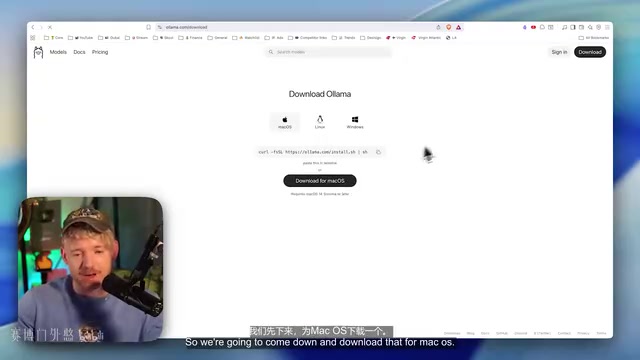
- Visit the Ollama official website and download the installation package for your operating system (e.g., macOS)
- Open the terminal (on Mac, press Command+Space and type "Terminal")
- Copy and run the installation command provided on the official website, and Ollama will complete the installation in the background
After installation, Ollama itself supports direct conversation—you can select an installed model and chat with it just like using a chat application.
How to choose the right model for your computer? The author shared a practical tip: take a screenshot of your system configuration information and send it directly to Hermes or Claude, asking "which model runs best on my machine." The typical recommendation is the Qwen 2.5 series—the 32B version strikes a good balance between overall performance and inference speed, while the 72B version is more powerful but runs slower. Qwen 2.5 is an open-source large language model family developed by Alibaba Cloud, performing especially well in bilingual Chinese-English tasks and code generation, and is currently one of the most highly rated open-source models for local deployment scenarios. Its strong performance on coding tasks partly stems from the inclusion of large amounts of high-quality GitHub code corpora in its training data, as well as a reinforcement learning fine-tuning stage specifically targeting code understanding and generation (Reinforcement Learning from Human Feedback, RLHF). The Qwen series employs inference acceleration techniques such as Grouped Query Attention (GQA), significantly improving local inference throughput while maintaining model quality—one of the technical reasons for its smooth performance on consumer-grade hardware.
Connecting to Hermes: From a Single Model to a Complete AI Operating System
Having the model alone is not enough. The real power lies in connecting it to the Hermes operating system—a scheduling hub that unifies and integrates the AI toolchain.
The Hermes operating system encompasses complete memory management, goal tracking, and connection status monitoring; it supports creating roles and skills, integrates with GitHub, and provides a clear documentation view. Its core value lies in unified management: whether conversing with ChatGPT, writing code with Claude Code, or calling local models, everything can be coordinated within the same interface. From a software engineering perspective, Hermes plays the role of an "AI Routing Layer"—shielding the API differences of various AI services through a unified abstraction interface, so users don't need to worry about the underlying invocation details. They only need to declare the privacy level and performance requirements of a task, and the system automatically assigns the most suitable execution backend. This design pattern is called the "Facade Pattern" in software architecture; its essence is to wrap complex subsystem interactions with a high-level interface, reducing the cognitive burden on the user.
Hermes has already launched a desktop application, greatly lowering the barrier to entry—basic operations can be completed without familiarity with terminal commands. If the desktop application fails to start, it's usually because the version is too old; simply run hermes update in the terminal to update.
Key details for connecting local models: The Hermes agent requires the local model's context window to reach 64,000 tokens to ensure sufficient "working memory" capacity. The Context Window is the maximum amount of text a large language model can process simultaneously in a single conversation or task—64K tokens is roughly equivalent to 50,000 Chinese characters, comparable to the length of a novella.
Understanding the technical logic behind this requirement is equally important: from the perspective of the Transformer architecture, the attention mechanism (Self-Attention) needs to compute pairwise relevance among all tokens in the context, with computation scaling quadratically with context length—meaning the computational overhead of a 64K context is roughly 64 times that of an 8K context, significantly raising hardware requirements. In recent years, the introduction of techniques such as Rotary Position Embedding (RoPE), Sliding Window Attention, and linear attention approximations has been gradually alleviating this "quadratic scaling" bottleneck, making long-context support increasingly feasible on consumer-grade hardware. The core idea of RoPE is to encode positional information into the query and key vectors of attention computation via rotation matrices, enabling the model to generalize better to longer sequences unseen during training—this is also the key technical foundation that allows mainstream models like Qwen to support ultra-long contexts.
From a practical application standpoint, an agent that needs to simultaneously analyze multiple code files, track task execution history, and maintain tool-call records can easily need to process more than 20,000 tokens of information within a single "thinking cycle." A 64K context window is equivalent to providing the agent with a large enough "workbench" to complete complex multi-step, cross-file tasks without losing key information.
On a deeper level, supporting long contexts poses an additional challenge for local models: the KV Cache (Key-Value Cache) is the memory structure that stores intermediate attention results during Transformer inference, and its size grows linearly with context length. Taking Qwen 2.5 32B as an example, the KV cache for a 64K context might consume several additional GB of memory, requiring the running machine to have sufficient RAM and VRAM headroom. Therefore, the default downloaded Qwen model may not meet this requirement, and you need to specifically obtain a version supporting a 64K context (such as the QN3 encoder 64K version).

After downloading, select this model in the bottom-right corner of the Hermes agent, and you can complete various tasks in a completely local, private environment.
Three Working Modes: Flexible Switching Among Private, Background, and Cloud
The author proposed a practical "hybrid workflow" philosophy, assigning work to the most suitable mode based on the nature of the task:
Vault Mode
Specifically for handling the most sensitive private data—customer information, financial records, health information, company confidential code, and intellectual property. This content runs entirely on offline local models, and data is never uploaded. You can simply tell Hermes "send this to the private model for processing," achieving seamless switching.
Round-the-Clock Background Agent
Local models have no token billing, so you can let agents run tasks continuously 24/7 without worrying about any additional cost. This characteristic is especially important for automation workflows that need to run for extended periods—for example, continuously monitoring code repositories, periodically organizing documents, or batch-processing data. With cloud services, token billing would cause the cost of such tasks to accumulate rapidly, whereas the marginal running cost of local models is nearly zero.
In engineering practice, this kind of "always-on local agent" has also spawned a new type of workflow: configuring local models as executors of scheduled tasks (cron jobs), automatically completing work such as data organization, log analysis, and draft generation while the user sleeps, so that processing results are ready by the next morning. This mode is almost infeasible on cloud services due to cost concerns, yet is readily available in a local environment. In terms of implementation, developers can integrate local AI seamlessly into existing automation pipelines through the OpenAI-compatible REST API exposed by Ollama—meaning any script originally connected to the OpenAI API can switch to local models with almost no modification—connecting with databases, file system monitoring tools, or message queues to build fully autonomous local automation pipelines requiring no human intervention.
Cloud Performance Mode
When a task demands quality over privacy—for example, needing to quickly solve a complex problem—switch to a frontier cloud model for the best output.
This "dynamic hybrid" approach is the most core insight of this article: you don't have to choose between privacy and performance—let each task use the most suitable tool.
Enterprise Compliance Scenarios: The Hidden Competitive Advantage of Local Deployment
For enterprises, local private deployment offers another often-overlooked value—regulatory compliance. The author uses his own company, Glider, as an example, mentioning that they are pursuing certifications such as SOC2, GDPR, and ISO 27001.
These three certifications represent the mainstream standards in the current enterprise data security field, and their core logic all points to "proof of data controllability"—that is, an enterprise must be able to clearly record when, how, and where data flows. SOC2 (System and Organization Controls Type 2) is a security audit framework for SaaS enterprises, and its Type II certification requires enterprises to continuously demonstrate that security controls operate effectively over a 6-12 month audit period, with the audit report explicitly listing all third-party data processors and their scope of data access. Article 28 of GDPR (the EU's General Data Protection Regulation) explicitly stipulates that before an enterprise uses any data processor (including SaaS AI tools), it must sign a "Data Processing Agreement" (DPA), and must mandatorily report to the regulator within 72 hours of a data breach—meaning that sending sensitive data to any third-party AI service legally requires additional contractual and audit support. ISO 27001's information asset registration requirement means that every external system processing company data must be included in the risk assessment scope. Local deployment architecturally eliminates the compliance risk point of "third-party data processing," significantly shortening the audit preparation cycle, and holds particular practical significance in strictly regulated industries such as finance, healthcare, and law.
From a more macro industry perspective, this trend is also creating structural impacts on enterprise IT procurement decisions: more and more large enterprises now list "whether private deployment is supported" as a core consideration dimension alongside functionality and price when evaluating AI tools. This directly drives the enterprise-grade feature iteration of local inference frameworks such as Ollama and vLLM (such as multi-user authentication, request queue management, and model hot-swapping), and gives technical teams with local deployment experience stronger bargaining leverage in customer sales negotiations. Notably, some enterprises have already begun treating "AI deployment mode" (cloud SaaS vs. local private deployment) as an independent scoring dimension in vendor evaluation—a shift that signals enterprise AI procurement is evolving from "functionality-oriented" to "governance-oriented," that is, from "what can this tool do" to "how does this tool handle our data."
He raised a noteworthy trend: over the past decade we moved everything to the cloud, but the next phase may be the exact opposite—localized, privatized "company AI brains" will become standard enterprise infrastructure. Teams that master local AI deployment capabilities ahead of time will gain an edge in compliance, data security, and response speed.
Summary: Owning AI, Not Just Renting It
Local AI is not meant to replace cloud services, but rather to provide a brand-new option: when absolute privacy, offline use, or zero-cost long-running operation is needed, we no longer have to "rent intelligence"—we can truly "own intelligence."
Ollama is responsible for unlocking the local operation of open-source models, and Hermes is responsible for integrating everything into a unified management interface. Combined, the two form a set of 100% private, free, and unlimited personal AI infrastructure.
The gap between local models and the frontier level continues to narrow—advances in quantization technology, the active iteration of the open-source community, and the continuous improvement of consumer-grade hardware compute power are jointly accelerating this trend. On the hardware side, the proliferation of Apple's M-series chip Unified Memory Architecture (UMA) is especially critical: in traditional PC architectures, the CPU uses system DDR memory while the GPU uses dedicated GDDR VRAM, with a high-latency PCIe bus bottleneck between them. In contrast, M-series chips integrate the CPU, GPU, and neural network acceleration engine (ANE) within the same package, sharing a unified high-bandwidth memory pool and eliminating the bottleneck of shuttling data between CPU and GPU. This allows 64GB or 128GB of memory to be directly accessed by the GPU at bandwidths of hundreds of GB/s, making it possible to run 70B-scale large models on a single laptop—something that under traditional architectures would require server-grade GPUs like the NVIDIA A100 or H100 with 80GB of VRAM, worth tens of thousands of dollars. NVIDIA's RTX 4090/5090 series and AMD's high-end graphics cards are likewise continuously pushing up the VRAM ceiling of consumer-grade GPUs (the RTX 5090 already reaches 32GB), further broadening the scale boundary of models that can run locally. Investing time now to explore local deployment not only yields immediate benefits in privacy and cost, but also prepares you in advance for the coming "wave of local AI adoption."
Key Takeaways
- The essence of local AI is ownership: Data never leaves the device, it's permanently free, and fully offline—architecturally avoiding the privacy and cost risks of cloud services
- The performance gap has narrowed substantially: The strongest local models currently lag behind the cutting edge by about a year, with quantization techniques (GPTQ/AWQ/GGUF K-quant) being the core driving force
- Ollama + Hermes forms a complete closed loop: llama.cpp provides the efficient local inference foundation, Ollama wraps a unified interface, and Hermes provides the agent scheduling layer
- 64K context is the key threshold for agents: The "working memory" capacity required to support complex multi-step, cross-file tasks; you need to specifically select the corresponding version of the model
- Three-mode hybrid workflow: Vault (offline private), background agent (24/7 free automation), and cloud performance (on-demand for complex tasks) combined flexibly
- Enterprise compliance is a hidden advantage: Local deployment architecturally solves the third-party data processing compliance challenges of SOC2/GDPR/ISO 27001; enterprise AI procurement is shifting from functionality-oriented to governance-oriented
- Hardware trends accelerate adoption: Apple's M-series UMA architecture and the continuous expansion of consumer-grade GPU VRAM are bringing local operation of 70B-scale large models to ordinary users' desktops
Related articles

Free Unlimited Claude Code Solution: Agnes AI + CC Switch Setup Guide
No paid subscription needed — pair the free AI platform Agnes AI with the open-source tool CC Switch to provide a backend for Claude Code, enabling unlimited free calls to text, image, and video models. This guide covers the full setup, test results, and usage boundaries.

A Complete Zero-Cost Guide to Getting Started with Claude Code for Beginners in China
A beginner's guide to Claude Code for users in China: two installation methods (command line and IDE plugin), full configuration steps for replacing the official API with the free domestic LongCat model, and a hands-on demo of building a small tool with natural language, plus tips.

When the NSA Gets Involved: The AI Supply Chain Crisis Behind Open-Source CVEs and API Key Hijacking
Multiple open-source projects disclosed severe CVEs in one day, PHP flaws alarmed the FBI, and Railway and OpenCode were breached with API keys stolen. This article breaks down the vulnerability window, AI-accelerated exploitation, and the AI supply chain crisis behind the API key black market, with a developer defense checklist.