Ollama v0.40.0-rc2 Released: What's New in the Local LLM Tool

Ollama tags v0.40.0-rc2, its second release candidate, as the stable release draws near.
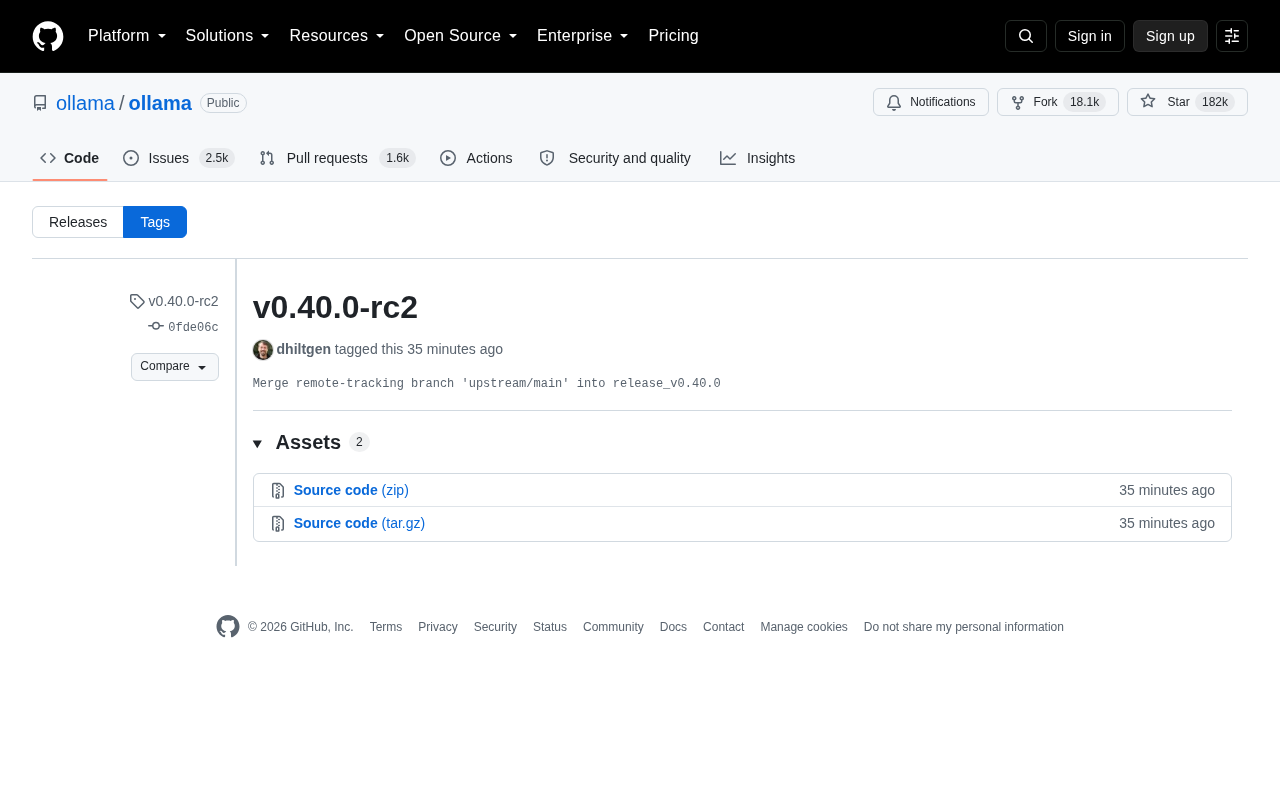
Ollama, one of the most popular local LLM deployment tools with over 182,000 GitHub stars, has tagged v0.40.0-rc2 — its second release candidate. Maintained by dhiltgen, this build merges the upstream main branch into the release branch, signaling the stable release is close but not yet finalized. The RC phase means features are frozen and the focus is on bug fixes; advanced users can try it now, while production environments should wait for the official release.
Ollama Gets a v0.40.0 Preview
The Ollama project has tagged v0.40.0-rc2 (Release Candidate 2) on GitHub. As one of the most popular tools for running large language models locally, Ollama's GitHub repository has accumulated over 182,000 stars and 18,100 forks — a testament to its standing in the local AI deployment space.
This release was tagged by maintainer dhiltgen, with a commit message indicating a merge of the upstream main branch into the release_v0.40.0 branch (Merge remote-tracking branch 'upstream/main' into release_v0.40.0). The rc2 designation means the team is in the final stages of polishing and testing before the stable v0.40.0 release.
What Is a Release Candidate?
For readers less familiar with software release cycles, it's worth explaining what "rc" means. A Release Candidate is a pre-release version where features are essentially frozen, and the focus shifts to gathering feedback and fixing any remaining bugs. rc2 indicates this is the second candidate in the release cycle — typically meaning that issues discovered during rc1 required further adjustments.
These builds are best suited for advanced users who want early access to new features and are willing to test and report issues. For production environments where stability is critical, it's advisable to wait for the official v0.40.0 stable release.
Why Ollama Is Worth Watching
Ollama's core value lies in reducing the complexity of local LLM deployment down to just a few commands. Users can run open-source models like Llama, Mistral, and Gemma directly on their personal computers — no cloud API required — while maintaining data privacy and offline availability.
With a community of over 182,000 GitHub stars, Ollama has become one of the go-to tools for developers experimenting with and integrating LLMs locally. Each major version milestone (such as the jump from 0.3x to 0.40.0) typically brings support for new model architectures, inference performance improvements, and API updates — all reasons to keep an eye on the official release notes.
Under the hood, Ollama relies on llama.cpp as its inference engine — the C/C++ framework developed by Georgi Gerganov that enables quantized large models to run efficiently on consumer-grade CPUs and GPUs. On top of that, Ollama wraps in model management, an HTTP API server, and cross-platform packaging, so users can download and interact with a model using a single command like ollama run llama3. It also exposes an OpenAI-compatible API interface, making it easy for existing applications to switch seamlessly to local inference — one of the key reasons it has built such a large community so quickly.
Usage Recommendations
Since the current release consists only of version tag information without a detailed changelog, specific new features, model support, and performance improvements will need to wait for the official Release Notes accompanying the stable release. Users eager to try it out can visit Ollama's GitHub Releases page to download builds for their platform, and should look for the "pre-release" label on the version.
It's recommended to watch for the upcoming v0.40.0 stable release, which will typically include a complete feature list and upgrade guide.
Related articles

Frontend to AI Agent Development: A Frontline Architect Explains Career Paths and Opportunities
A frontline AI architect explains the industry changes and practical paths for frontend developers transitioning to AI Agent development: why pure frontend jobs are disappearing, why Agent + full-stack has become mainstream in hiring, and three transformation routes—Agent development engineer, FDE, and remote contracting—along with corresponding learning strategies.

How to Choose an AI Agent Development Course: Five Pitfall-Avoidance Guidelines
A mechanical-engineering career changer's two-year pitfall-tested checklist for screening AI Agent development courses: complete delivery pipeline, resume-worthy projects, real development perspective, update frequency, and coaching feedback—with concrete judgment methods and pitfall-avoidance tips.

Coze AI Agent Building for Beginners: A Zero-Code AI Agent Development Guide
Coze, ByteDance's one-stop AI application development platform, supports zero-code drag-and-drop AI agent building. This article outlines Coze's core concepts, three advantages, differences between the domestic and international versions, and the distinction between agents and apps, helping beginners quickly get started with AI Agent development.