Ollama v0.40.5-rc0 Released: MLX Version Bump

Ollama releases v0.40.5-rc0, only bumping MLX backend version with no feature changes; wait for official release.
Ollama released candidate version v0.40.5-rc0 (commit 292d7ce, tagged by maintainer dhiltgen), with the only change being an MLX backend version bump (PR #18993). It's a pure dependency upgrade with no new features, API changes, or user-visible behavior adjustments. MLX is Apple's open-source ML framework for Apple Silicon, and Ollama's integration lets Mac users run local models efficiently on unified memory, so each version bump may bring subtle changes in inference performance, memory footprint, or operator coverage. The `-rc0` suffix marks the first candidate build for community regression testing. The article suggests Apple Silicon users, downstream integrators, and developers focused on local inference performance keep watching, while regular users should wait for the official v0.40.5 release.
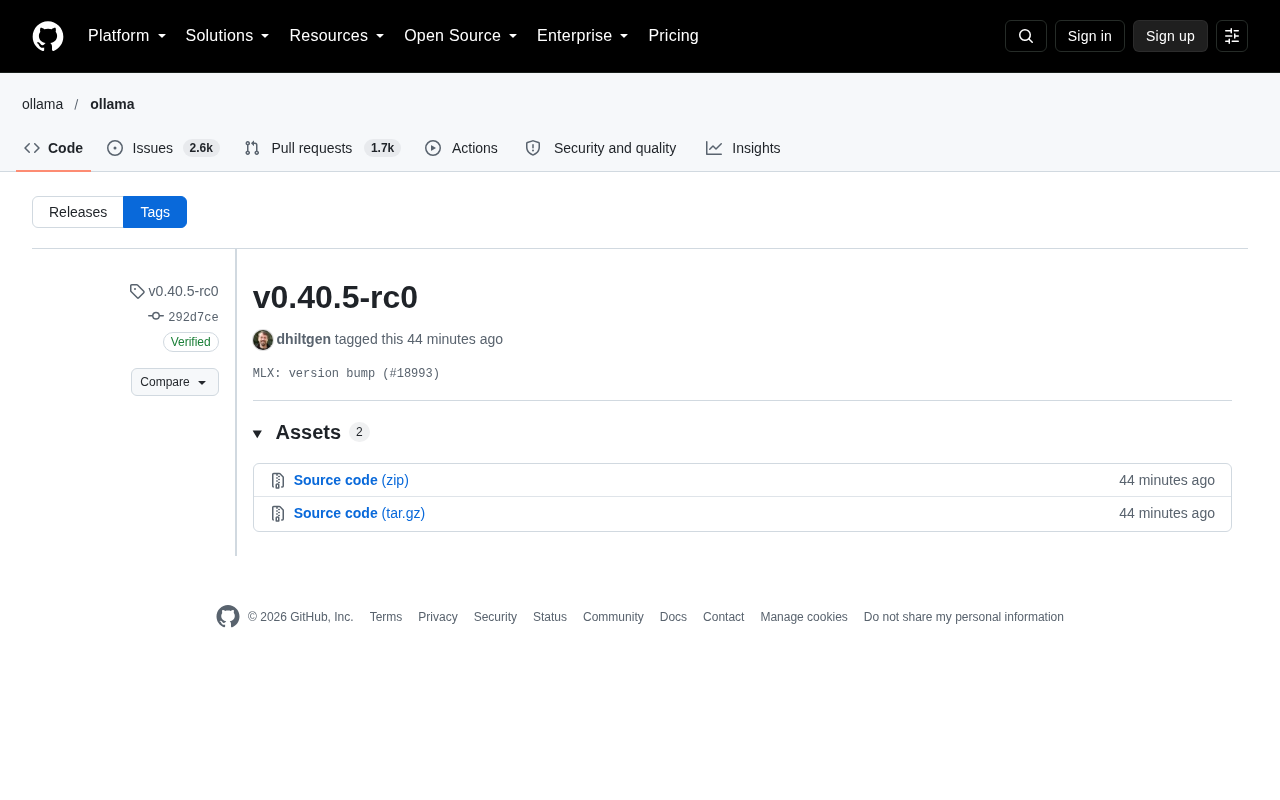
Ollama, the local large model runtime tool, has released candidate version v0.40.5-rc0. The core action of this update is just one thing: an MLX backend version bump (commit #18993).
What Actually Changed in This Update
Looking at the commit history on the GitHub repository, v0.40.5-rc0 was tagged by maintainer dhiltgen, corresponding to commit 292d7ce, with the commit message "MLX: version bump (#18993)". The commit carries a GitHub verified signature (GPG key ID: B5690EEEBB952194).
In other words, this is a pure dependency upgrade candidate release. No new features, no API changes, and no user-visible behavior adjustments.
Why "Just a Version Bump" Is Still Worth Noting
MLX is Apple's open-source machine learning framework built for Apple Silicon chips. By integrating MLX, Ollama enables Mac users to efficiently run local models on the unified memory architecture.
For Mac users, every MLX version update may bring subtle changes in inference performance, memory footprint, or operator coverage—changes that may not stand out in a changelog alone, but show up when actually running models.
What rc0 Means
The -rc0 suffix indicates this is the first candidate build before the official release. Following Ollama's usual cadence, rc versions are released first for community verification, and once no regressions are confirmed, the official version is packaged.
Regular users don't need to rush to switch to the rc version; if you're running Ollama on Apple Silicon and encountering MLX-related inference issues, you may want to keep an eye on this version's official release.
MLX and Unified Memory Architecture: Apple Silicon chips (M series) use Unified Memory Architecture (UMA), where CPU and GPU share memory, and data doesn't need to be copied back and forth between devices. MLX is a framework designed around this characteristic. It uses lazy computation graphs, executing operators only when results are actually needed, and can automatically fuse adjacent operations to reduce memory access. This is fundamentally different from the optimization approach in the CUDA ecosystem, which targets discrete VRAM. After Ollama integrates MLX, running models on Mac can more fully leverage this architectural advantage: VRAM is no longer a separate resource pool you need to carefully budget, but dynamically allocable space shared with system memory. Therefore, operator coverage expansion or memory scheduling improvements brought by MLX version upgrades often translate directly into "can run larger models" or "the same model runs faster".
Semantic Versioning and Pre-release Tags: According to Semantic Versioning (SemVer) conventions, version numbers take the form major.minor.patch, optionally with a pre-release identifier. The -rc0 in v0.40.5-rc0 means "Release Candidate 0", indicating this is the first candidate build for the official 0.40.5 release. Pre-release versions have lower priority than the official release with the same number—that is, 0.40.5-rc0 < 0.40.5. This means package managers, under default rules, typically won't push rc versions to regular users; installation only happens when a version is explicitly specified or a pre-release channel is enabled. For tools like Ollama, the rc stage is a community regression testing window: maintainers want people to verify under real workloads that dependency upgrades haven't introduced performance regressions or crashes, and only then promote to official release.
Who Should Pay Attention
- Apple Silicon Mac users: MLX upgrades directly affect the local inference experience
- Ollama packaging and downstream integrators: need to track dependency version changes
- Developers focused on local inference performance: can watch for benchmark comparisons in the eventual official release
If you just want to run models stably, it's recommended to wait for the official v0.40.5 release before upgrading.
Related articles

Qwen 4 First Test Leaks: Performance Rivals Opus 5.5, DeepSeek V4 Series Surfaces
Early Qwen 4 test outputs leak, with front-end generation said to rival Opus 5.5; DeepSeek V4 Mini, Flash, and Pro names appear in a code repo; Ant Group's Ling-3.1-flash surfaces too. Here's the latest on model tiering and on-device lightweight models.

OpenCode Makes DeepSeek V4.1 Flash Free, AI Daily Roundup
AI daily roundup: OpenCode makes DeepSeek V4.1 Flash free, StepFun Step5 Preview and Ling 3.1 Flash open-sourced, Grok Voice 3.0 tops speech leaderboard, Matrix Game 4.0 open-sourced, and the EU opens its first AI Act enforcement probe into OpenAI and Anthropic.

DeepSeek V4.1 Flash 1017 Released: Reasoning and Coding Upgrades, Search and Fetch API Now Available
DeepSeek releases V4.1 Flash 1017 with major gains in reasoning, coding, and agentic tasks, plus web search and fetch APIs at 5 yuan per 1,000 requests. Tencent Hunyuan open-sources High Memory 2.0, Perplexity open-sources multimodal decision models, and MOFCOM seeks comments on AI export catalog.