Ollama v0.40.6-rc0 Released: --ask Mode Introduces Question Identifiers
Ollama releases v0.40.6-rc0, introducing identifiers for --ask mode question keys to improve stability.
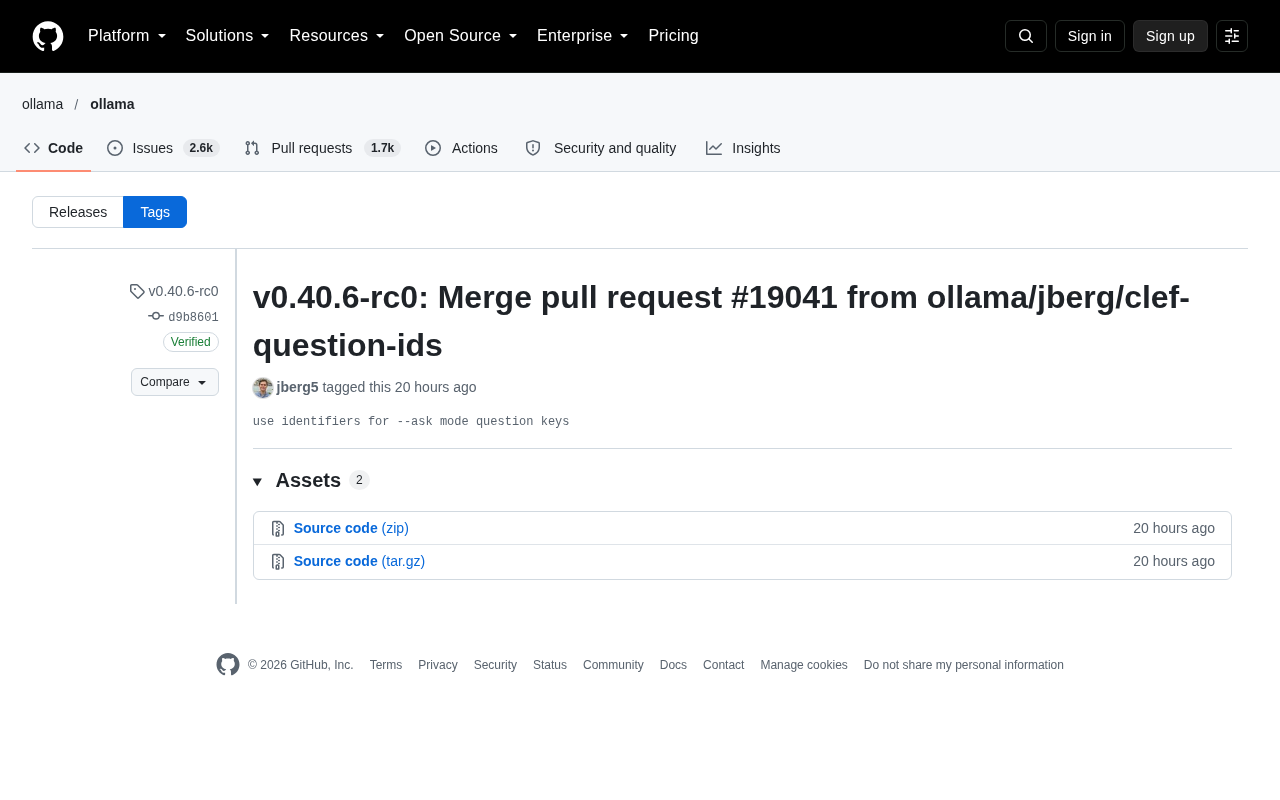
Ollama released candidate version v0.40.6-rc0 with commit hash d9b8601, merged from branch ollama/jberg/clef-question-ids (PR #19041). The core change is "using identifiers for --ask mode question keys," assigning each question a stable unique ID instead of using the question text itself. This prevents cache hit rate drops or answer misalignment caused by differences in spaces, line breaks, and punctuation, improving the reliability of multi-turn conversations, question deduplication, and log tracking. This is the first candidate release, with GitHub-verified signature and 2 downloadable assets, suitable for early adopters to test and provide feedback.
A new release candidate version v0.40.6-rc0 has appeared in Ollama's GitHub repository. This merge comes from the branch ollama/jberg/clef-question-ids, with commit hash d9b8601. According to the commit message, this is a minor improvement centered around --ask mode.
What the Commit Does: Introducing Identifiers for --ask Mode Question Keys
According to the brief description on the repository page, the core action of this commit is "use identifiers for --ask mode question keys."
As a local LLM runtime tool, Ollama's --ask or its interactive question feature typically lets users input a question and then the model responds based on context. If the system internally uses the question text itself as the key for caching, retrieval, or associating conversation history, problems with matching confusion or duplicate processing can easily arise when questions are similar in content, contain special characters, or vary significantly in length.
Switching to identifiers means the system generates a stable unique ID for each question, and subsequent logic references the specific question through this ID rather than relying on the question's original text. Although this change seems unremarkable on the surface, it provides practical benefits for the stability of interactive Q&A.
Why is using text as a "key" prone to problems?
In programming, a "key" is a string used to uniquely identify a piece of data for caching or retrieval. If you directly use the question text as the key, any subtle difference will be treated as a different question: an extra space, different line break positions, or inconsistent full-width/half-width punctuation will all generate different keys. The result is a lower cache hit rate, synonymous questions being processed repeatedly, and even answers getting mismatched with questions.
After switching to identifiers (such as auto-increment IDs or UUIDs), each question is assigned a stable and unique reference at creation time, decoupled from its text content. This way, even if a user rephrases the same question, historical context can be reused through the associated ID, making deduplication and tracking logic more reliable. This approach of using IDs instead of natural language text as keys is common in dialogue systems, logging systems, and database design.
Why This Type of Change Is Worth Noting
Iterations of LLM tools are often overshadowed by new models or new parameters, but what truly affects daily experience is often these small fixes to underlying data structures.
Take --ask mode as an example. When users ask questions consecutively, the tool needs to track which questions have already been processed and which answers correspond to which questions. If text is used as the key, differences in spaces, line breaks, and punctuation will produce different keys, leading to a lower cache hit rate or answers being mismatched. After replacing with identifiers, each question has its own independent and stable reference, making history management and deduplication logic more reliable.
From the PR branch name jberg/clef-question-ids, it can be inferred that this change may be related to CLEF (some kind of log or event format), with the goal of giving questions clear IDs in logs or event records for easier troubleshooting and tracking.
What is CLEF?
The PR branch name mentions clef, which typically refers to Common Log Format or a related structured logging/event convention used to give each log record clear fields and identifiers for machine parsing and retrieval. In LLM tools, recording questions, answers, latency, status, etc. as events with IDs allows quick identification of specific interactions during issue reproduction, performance analysis, and auditing.
The branch name jberg/clef-question-ids suggests this change likely incorporates every question in --ask mode into CLEF-style event records with independent IDs. This way, logs no longer contain natural language question text that is hard to compare, but rather stable referenceable identifiers, which is especially useful for troubleshooting anomalies in multi-turn conversations.
The Positioning of the rc0 Version
v0.40.6-rc0 is a release candidate version, with rc0 indicating this is the first candidate release in the version cycle. Such versions are typically used to collect feedback before the official release and verify that changes haven't introduced regressions.
The commit is signed with a GitHub-verified signature, with GPG key ID B5690EEEBB952194, indicating the code source is trustworthy. The tag was applied by user jberg5 on October 16, consistent with the version iteration rhythm.
The bottom of the page shows 2 Assets (resource files), indicating that in addition to source code, downloadable build artifacts are included for users to test directly.
What is a release candidate?
In the software release process, version numbers often carry suffixes like alpha, beta, rc, etc. to indicate maturity. rc is short for release candidate, meaning a "candidate release version" — a version where features are frozen and expected to be directly releasable as the official version. rc0 indicates this is the first candidate version in the cycle; if issues are found during testing, rc1, rc2, etc. will be released in sequence until there are no blocking defects, then the official version without the suffix (such as v0.40.6) is released.
Compared to official versions, rc versions may still have a few undiscovered edge cases, making them more suitable for users willing to try new things and provide issue feedback. For production environments, it's usually recommended to wait for the official version. Ollama's adoption of this rc release rhythm shows that the project maintains a buffer for collecting community feedback and verifying regressions before official rollout.
What It Means for Users
If you typically use Ollama for local Q&A or scripted calls, the direct changes in this version may not be obvious — no new models, no new parameters.
But it addresses the kind of hidden issues that "emerge over time." After question keys switch to identifiers, scenarios like multi-turn conversations, question deduplication, and log tracking become more predictable. For developers integrating Ollama into automated workflows, stability improvements are more valuable than new features.
Users who want to try it out can download the v0.40.6-rc0 resource files from the releases page of the GitHub repository for testing, and report any issues encountered through issues.
Summary
Ollama v0.40.6-rc0 is an update leaning toward internal robustness, with the core being changing --ask mode question keys from text to identifiers. The change scope is small, but it reflects the project's continued investment in interaction reliability. For developers following the local LLM toolchain, this type of fine-grained improvement is worth noting.
One-line Summary
Ollama releases v0.40.6-rc0, introducing identifiers for --ask mode question keys to improve stability.
Paragraph Summary
Ollama released candidate version v0.40.6-rc0 with commit hash d9b8601, merged from branch ollama/jberg/clef-question-ids (PR #19041). The core change is "using identifiers for --ask mode question keys," meaning the question text itself is no longer used as the key; instead, each question is assigned a stable unique ID. This avoids cache hit rate drops or answer misalignment caused by differences in spaces, line breaks, and punctuation, improving the reliability of multi-turn conversations, question deduplication, and log tracking. This version is the first candidate release, with the commit verified by GitHub signature and 2 downloadable assets included, suitable for early-adopter users to test and provide feedback.
Related articles

Free Unlimited Claude Code Solution: Agnes AI + CC Switch Setup Guide
No paid subscription needed — pair the free AI platform Agnes AI with the open-source tool CC Switch to provide a backend for Claude Code, enabling unlimited free calls to text, image, and video models. This guide covers the full setup, test results, and usage boundaries.

A Complete Zero-Cost Guide to Getting Started with Claude Code for Beginners in China
A beginner's guide to Claude Code for users in China: two installation methods (command line and IDE plugin), full configuration steps for replacing the official API with the free domestic LongCat model, and a hands-on demo of building a small tool with natural language, plus tips.

When the NSA Gets Involved: The AI Supply Chain Crisis Behind Open-Source CVEs and API Key Hijacking
Multiple open-source projects disclosed severe CVEs in one day, PHP flaws alarmed the FBI, and Railway and OpenCode were breached with API keys stolen. This article breaks down the vulnerability window, AI-accelerated exploitation, and the AI supply chain crisis behind the API key black market, with a developer defense checklist.