OnePage: An Open-Source Minimalist E-Reader and AI Terminal

OnePage is a 5mm-thick open-source e-reader that doubles as a voice-controlled AI Agent terminal.
OnePage is an open-source, ultra-minimalist e-reader built by a solo maker in 30 days. At just 5mm thick with a CNC aluminum alloy frame, ESP32-C6 chip, and 4.26-inch e-ink display, it delivers a pure reading experience. An onboard microphone transforms it into an AI Agent voice terminal, connecting to Hermes, Open Claw, and DeepSeek via an external compute box. The project will soon be fully open-sourced.
A Minimalist Reader That Does One Thing Well
In a world where the e-reader market is dominated by major brands, one maker spent 30 days building a device called OnePage from scratch—starting from a web prototype and crafting it into an ultra-minimalist reading device that will soon be open-sourced. This isn't yet another commercial Kindle competitor; it's a full-blown open-source hardware experiment driven by true geek spirit.
The motivation behind the project is refreshingly simple: the creator couldn't find the reader they wanted, so they decided to build one. OnePage is positioned as "a reader that does one thing"—minimalist body, physical buttons, seamless page turning, and minimal feature bloat. The entire device is only about 5mm thick, roughly the height of 2 to 3 stacked coins, making it quite literally "one page."
From a hardware perspective, OnePage is powered by an Espressif ESP32-C6 chip. The ESP32-C6 is a low-power IoT chip based on the RISC-V architecture, supporting both Wi-Fi 6 (802.11ax) and Bluetooth 5 (LE) wireless protocols. It also integrates the IEEE 802.15.4 protocol stack, enabling Thread/Zigbee mesh networking. Compared to earlier ESP32 variants, the C6 offers significant improvements in power management and RF performance. Combined with Espressif's well-maintained ESP-IDF development framework and extensive open-source examples, it has a low barrier to entry and is extremely popular in the open-source hardware community.
Paired with the ESP32-C6 is a 4.26-inch e-ink display. E-ink screens use electrophoretic display technology: microcapsules inside the screen contain positively charged white particles and negatively charged black particles, and an electric field controls their distribution to form images. The key characteristic is bistability—once the display refreshes, the content remains visible even without power, resulting in near-zero standby power consumption. Energy is only consumed during page-turn refreshes. This makes e-ink ideal for readers and equally suitable as an IoT information display terminal. At 4.26 inches, this is a small-to-medium e-ink panel with a typical resolution around 800×480—more than sufficient for clear display of both Chinese and English text.
For the enclosure, OnePage features a CNC-machined unibody aluminum alloy mid-frame, complemented by custom buttons and panels. The project also participated in LCSC's "Spark Program," receiving corresponding support. The Spark Program is a support initiative specifically targeting open-source hardware creators, offering resources such as PCB prototyping, component sourcing, and SMT assembly, with the goal of lowering the hardware entrepreneurship barrier for individual developers and small teams, and fostering the domestic open-source hardware ecosystem.
From PLA to Aluminum: Material Choices at Extreme Thinness
The hardest part of building hardware by hand often isn't the circuitry—it's the structure and aesthetics. The creator went through an extensive material experimentation process: first using 3D printing to refine dimensions and structure, trying everything from PLA and ABS to nylon.
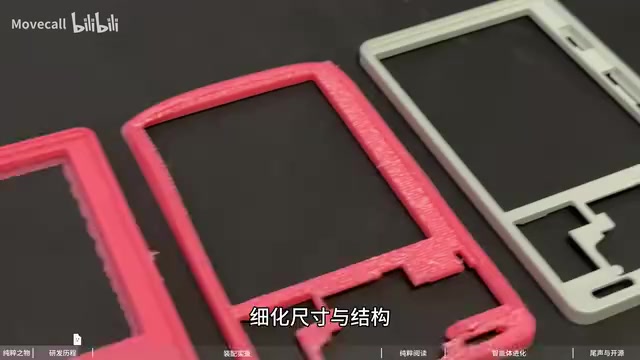
Each of these three materials has its pros and cons. PLA (polylactic acid) is the most common FDM 3D printing material—low printing temperature, minimal warping, and good surface finish—but it has poor heat resistance (softening around 60°C) and is relatively brittle. ABS (acrylonitrile butadiene styrene) offers better toughness and heat resistance than PLA, but tends to warp during printing and emits a pungent odor. Nylon (PA) boasts excellent toughness and wear resistance, but is sensitive to humidity and has higher shrinkage rates, making it more difficult to print. For ultra-thin wall structures (such as sub-5mm enclosures), none of these plastic materials can simultaneously meet rigidity and durability requirements.
For a device pursuing extreme thinness, plastic materials simply couldn't provide adequate strength at such minimal thickness. The creator candidly admitted that "it's just too thin for adequate strength" and ultimately "reluctantly went with premium aluminum alloy," adopting a unibody CNC aluminum mid-frame for robust structural support.
CNC (Computer Numerical Control) machining is a subtractive manufacturing process that uses high-speed rotating cutting tools to perform precision cuts on metal blanks, achieving micron-level machining accuracy. Aluminum alloy is one of the most commonly used metals in CNC machining, with a density of only about 2.7g/cm³ (roughly one-third that of steel), while offering high strength, good thermal dissipation, and excellent machinability. Apple's MacBook Unibody design is a classic example of aluminum alloy CNC craftsmanship. However, per-unit costs are high—tool wear, machining time, and post-processing (such as anodizing) all drive up expenses, so this process is typically reserved for premium consumer electronics or small-batch custom products.
This trade-off reflects a common reality in geek hardware projects: the ideal form factor often requires constant balancing between cost, manufacturing process, and structural strength. CNC aluminum machining costs far more than 3D printing, but at the extreme thinness of 5mm, it's the only option that guarantees chassis rigidity.
Immersive Assembly: Meticulous Engineering Details
One of the video's highlights is the detailed assembly demonstration, showcasing the creator's attention to detail.
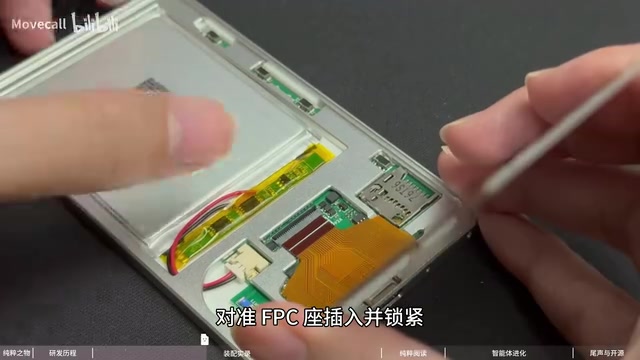
The assembly process flows step by step: first, the mid-frame is secured in a vise, then the side buttons and front directional keys are placed; the mainboard is slid in at an angle via the USB port to snap into position; the front buttons have a satisfyingly crisp feel; after connecting the battery, the mid-frame features dedicated cable routing channels to prevent wire pinching; the inner film is peeled off, and the back panel is aligned and bonded to the mid-frame; the front center button area has a foolproof stepped design; finally, the screen's ribbon cable is slightly pre-bent, aligned with the FPC connector, inserted, and locked down.
Several engineering details here are worth elaborating on. FPC (Flexible Printed Circuit) is a type of circuit board with conductors printed on a flexible substrate, widely used for signal connections between display modules (such as e-ink screens and LCDs) and mainboards. FPC connectors typically feature a flip-lock mechanism—after inserting the ribbon cable, you flip down the lock to secure it. Since FPC ribbon cables are extremely thin and fragile, precise alignment is crucial during insertion; even slight misalignment can damage contact points. That's why the creator "pre-bends" the ribbon cable to reduce stress concentration during assembly. The "foolproof design" (Poka-yoke) is an engineering principle originating from the Toyota Production System that uses physical structures to prevent incorrect operations—for example, the stepped structure at the center button ensures components can only be installed in the correct orientation, preventing reversed or misaligned assembly.
These details—cable routing channels, foolproof steps, ribbon cable pre-bending—are all common engineering practices in mass-produced devices. Seeing them in a personal open-source project demonstrates that the creator invested serious effort in structural design.
During hands-on testing, inserting a TF card loaded with e-books (note: gold contacts facing down), a short press of the wake button starts the reading experience. TF cards (TransFlash, also commonly known as MicroSD cards) are extremely compact flash memory cards measuring only 15mm × 11mm × 1mm, making them ideal for ultra-thin devices with severely limited space. The measured total thickness is exactly 5mm, and the device also supports Bluetooth remote control for "seamless page turning"—made possible by the ESP32-C6's built-in Bluetooth 5 LE protocol stack, which maintains low-power connections with external devices.
More Than a Reader: A Portable AI Agent Voice Terminal
If OnePage were just a reader, it might simply be an elegant DIY project. But the creator integrated a microphone onto the mainboard, transforming it into a portable AI Agent hardware terminal.

An AI Agent refers to an AI system that can autonomously perceive its environment, make decisions, and execute actions. Unlike simple Q&A-style large language models, Agents possess capabilities for tool invocation, task planning, and multi-step reasoning. By connecting to different agents, OnePage can deliver rich voice interaction capabilities:
- Hermes Agent integration: Hermes is an open-source function calling agent framework that excels at parsing natural language instructions into structured API calls. Once connected, it supports natural language queries like "Check tomorrow's weather for me," with results displayed in real time on the e-ink screen.
- Open Claw integration: Open Claw is an action-oriented Agent framework that can execute complex multi-step operations through RPA (Robotic Process Automation) or API interfaces. Simply speak to complete real tasks—for example, "Order me a Luckin Coffee." The Agent automatically understands the intent, calls the delivery API, processes the order flow, and returns a pickup code. This process involves orchestrating multiple APIs, demonstrating the core advantage of Agents over simple chatbots.
- DeepSeekAd API integration: DeepSeek is a large language model series from DeepSeek AI, known for relatively low inference costs and strong Chinese language capabilities. Its API interface is compatible with the OpenAI format, making it easy for developers to integrate quickly. Once connected, it enables real-time conversational interaction for questions about model capabilities, identity, and more.
These three respectively represent three typical scenarios in the Agent ecosystem: "information retrieval," "task execution," and "general conversation."
This combination of "e-ink display + voice + cloud-based Agent" is remarkably imaginative. E-ink screens are low-power and easy on the eyes, ideal for always-on display; voice interaction compensates for the low input efficiency of button-only devices. Together, they give a simple reader genuine "smart assistant" utility.
Lobster Box: The Compute Foundation for Agents
Here's an important detail: none of the three Agent systems run on the OnePage itself—the ESP32-C6 obviously lacks the computing power for large model inference. The ESP32-C6 features a single-core RISC-V processor clocked at 160MHz with 512KB SRAM, suitable for handling sensor data and communication protocol stacks, but for large language models with billions of parameters, it falls short by several orders of magnitude in both compute and memory.
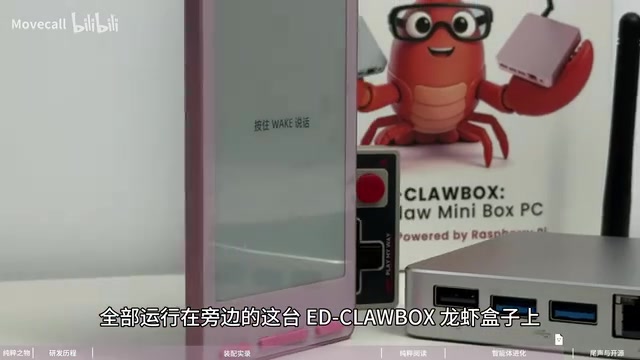
All three Agent systems run on the nearby Add Claw Box (Lobster Box), dispatched and driven in real time via APIs. OnePage essentially serves as a "front-end terminal": capturing voice, sending requests, and displaying results, while compute-intensive inference tasks are handled by the external box.
This is the typical architecture for current edge AI devices—"thin client + thick backend." The terminal device handles sensor data collection (such as microphone audio capture) and result display, while LLM inference, intent understanding, and tool invocation occur on a local gateway or in the cloud. The advantage of this division of labor is that the terminal can maintain extremely low power consumption and a minimal form factor while accessing virtually unlimited AI capabilities over the network. Similar architectures have been widely validated in smart speakers, smartwatches, and other devices. For low-power e-ink devices, this separation ensures both battery life and access to large model capabilities.
Additionally, OnePage can serve as an AI Token usage dashboard, supporting both landscape and portrait display modes, letting developers monitor API call volume at a glance. Tokens are the basic unit of measurement in large language models, roughly equivalent to one Chinese character or half an English word, with API costs typically calculated based on total input and output tokens. For developers who frequently call AI APIs, real-time visibility into token consumption is crucial for cost management—and an always-on, zero-standby-power e-ink screen happens to be the perfect medium for this use case.
Open-Source Plans and Community Involvement
The most exciting aspect of OnePage is its open-source nature. The creator has stated that the project will be "open-sourced soon," with accompanying documentation currently in preparation for imminent release. For hardware enthusiasts and developers, this means the ability to replicate, modify, or even build upon the design using open-source materials. In the open-source hardware space, a complete open-source release typically includes schematics, PCB layout files, BOM (Bill of Materials), enclosure 3D models, and firmware source code—the degree of openness of these materials directly determines the barrier to community-driven secondary development.
On the business side, the creator has adopted a crowdfunding model of "group buy at 100 units, full refund if the minimum isn't met." Fully assembled units will be shipped, though users need to supply their own TF cards. A giveaway has also been announced, where a limited-edition unit will be randomly awarded to one lucky participant.
Conclusion: A Fusion Experiment of Geek Spirit and AI Hardware
The value of OnePage lies not in whether it can compete with commercial e-readers, but in demonstrating what's possible when an individual creator combines hardware, software, and AI. From material experimentation to structural design, from e-ink reading to voice Agents, it merges the "geek maker" spirit with today's hottest AI Agent trend.
As the creator puts it, this is "a pure reader, a fun open-source experiment." At a time when large models are moving to the edge and edge AI hardware is booming, open-source experiments like this can inspire more developers. As more and more creators build AI-capable hardware products using chips costing just a few dollars and open-source frameworks, we are witnessing the dawn of a "personal AI hardware" era.
Related articles

Uber Deploys ChatGPT Work Company-Wide: AI in the Workplace Enters the Scaled Implementation Phase
Uber deploys ChatGPT Work to 30,000+ employees, extending it from engineering to all roles. We analyze its expert-engineer pairing, end-to-end automation, and questions of AI control and power concentration—insights for scaling AI in the workplace.

Shift at Midnight Hands-On: When "ID Verification" Becomes Alien Hunting
Shift at Midnight blends ID verification with horror survival in a four-player co-op game. We break down its inspection mechanics and chaotic humor.

Zelensky Recounts the Outbreak of War: I Need Ammunition, Not a Ride
Zelensky recalls the first day of war in a YouTube interview: farewell to family, rejecting Biden's evacuation offer with "I need ammunition, not a ride," and how Bucha shaped his stance on compromise and peace talks.