Open-Source Tool Sevenbox: Tracing the Causal Chain of AI Agent Decisions

Open-source tool Sevenbox uses Warrant dependency graphs to record Agent decisions and enable traceable backtracking of faulty beliefs.
The article introduces Sevenbox, an open-source tool shared on Reddit, that solves the difficulty of tracing AI Agent errors. Traditional logs only record what happened, not what beliefs drove decisions, making errors hard to locate. Sevenbox records each decision as a Warrant—including the claim, its prior claims, and whether the action is reversible—so faulty beliefs can be traced along the dependency chain. It works with 10+ frameworks like LangGraph, CrewAI, and OpenAI Agents SDK without rewriting existing Agents, and is fully open source.
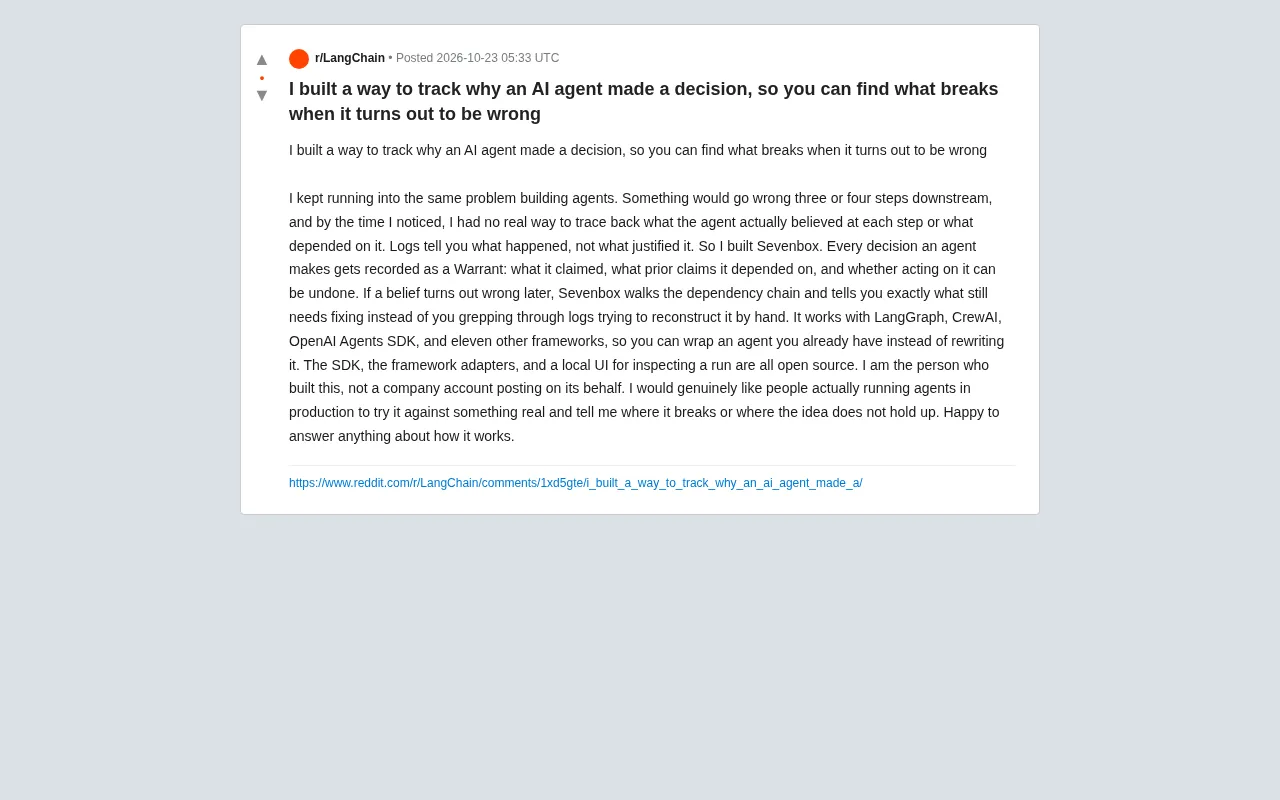
When an AI Agent makes a mistake, the most frustrating part isn't the error itself—it's that you have no idea why it went wrong. Logs can tell you what happened, but they can't tell you what beliefs the Agent was operating on when it made that decision. A developer shared his open-source tool Sevenbox on Reddit, aiming to solve this problem.
The Problem: Logs Can't Reconstruct the "Reasoning" Behind Decisions
People building Agents often run into this situation: an error surfaces three or four steps downstream, and by the time you notice, it's very hard to trace back what the Agent actually "believed" at each step and which subsequent actions depended on that faulty belief.
The original author points out that traditional logs only record "what happened"—they can't record "what supported this decision." When one of the Agent's judgments is later proven wrong, you're left manually digging through logs trying to reconstruct the reasoning path at the time—a process that's both inefficient and prone to gaps.
Sevenbox's Solution: Recording Decisions as Warrants
Sevenbox's core design is to record each Agent decision as a Warrant, containing three key pieces of information:
- What the Agent claimed (the claim)
- Which prior claims it depended on (prior claims)
- Whether acting on that decision can be undone
When a belief is later proven wrong, Sevenbox traces back along the dependency chain to tell you which parts still need fixing, instead of making you search through logs for a needle in a haystack. It's essentially building a traceable causal graph for the Agent's decisions.
Warrant is a term borrowed from epistemology's "theory of justification"—a belief is only valid if it has justification. In the Agent context, a Warrant is not a simple log entry but a structured assertion node: it explicitly declares "the Agent believes P" and connects P to the prior assertions Q1…Qn that support it via directed edges.
The difference from traditional structured logging is that logs are time-series event streams, while Warrants form a dependency graph. A time series can only answer "what happened at step 3"; a dependency graph can answer "which subsequent judgments reused step 3's conclusion, and if it's wrong, which actions must be rolled back along with it." This is also why Warrants need to additionally record "whether the action can be undone"—reversibility determines whether backtracking triggers an automatic rollback or requires manual intervention.
Compatible with Mainstream Frameworks, No Rewriting of Existing Agents
For teams already running Agents in production, migration cost is key. Sevenbox provides an SDK and framework adapters supporting LangGraph, CrewAI, OpenAI Agents SDK, and eleven other frameworks.
This means you can wrap your existing Agent to integrate Sevenbox without rewriting the entire system. The SDK, framework adapters, and a local UI for inspecting runs are all open source.
The LangGraph, CrewAI, and OpenAI Agents SDK mentioned here represent three typical forms of the current Agent orchestration layer: LangGraph organizes nodes and edges as a StateGraph, emphasizing explicit control flow; CrewAI centers on a "role + task" multi-agent collaboration model; OpenAI Agents SDK provides lightweight Agent/Handoff/Guardrail abstractions. What they share is that they all internally generate a series of intermediate decisions (tool calls, routing choices, handoffs).
Framework adapters work by hooking into these frameworks' callbacks or event hooks, translating intermediate decisions that would otherwise be scattered across each framework's internal state into a unified Warrant structure. So "wrapping a layer" doesn't change the Agent's execution logic—it just passively collects decision data without intruding on business code, which is the key reason migration cost is low.
The Author's Intent: Finding Failure Points in Real Scenarios
The original poster explicitly states that he is the tool's builder, not a company account. He'd rather have developers actually running Agents in production test it with real tasks and tell him where the tool fails and in which scenarios this approach doesn't hold up.
This "seeking criticism" attitude is worth noting—for a tool trying to solve Agent interpretability, the complexity of real production environments far exceeds demo scenarios, and early feedback may be more valuable than piling on features.
A Bit of Analysis: Traceability Is Only the First Step
Sevenbox solves the problem of post-decision tracing, but Agent reliability also involves more upstream concerns: how to identify high-risk irreversible operations at the moment of decision, and whether the dependency chain itself might become overly complex due to the Agent's self-corrections. The author's invitation for production users to test may be precisely to expose these edge cases.
For developers debugging complex Agent workflows, this tool offers an approach different from logging—organizing debugging information by dependency relationships rather than chronological order. If you have real scenarios on hand, you might try it as the author suggests and see whether it holds up in your system.
One-line Summary
Open-source tool Sevenbox records Agent decisions as a Warrant dependency graph, enabling traceable backtracking of faulty beliefs.
Paragraph Summary
The article introduces an open-source tool Sevenbox shared by a developer on Reddit, aimed at solving the difficulty of tracing the reasons behind AI Agent errors. Traditional logs only record "what happened" and can't explain what beliefs the Agent was operating on when it made judgments, causing errors to surface several steps downstream and be hard to locate. Sevenbox records each decision as a Warrant, containing the Agent's claim, the prior claims it depends on, and whether the action can be undone—so when a belief is falsified, it can trace back along the dependency chain to identify what still needs fixing. The tool is compatible with over ten frameworks including LangGraph, CrewAI, and OpenAI Agents SDK via SDK and adapters, requiring no rewrite of existing Agents, and all components are open source. The author, as the builder, invites production users to test its failure boundaries.
Related articles

LLM Application Development: A High-Paying Career Guide for Ordinary People
LLM application development offers fresh graduates up to 35K/month, with SP offers reaching 600K. This article explains the core skills, how to break in, and how ordinary people can seize AI opportunities through learning by doing.

Say Goodbye to AI Influencer Faces: A Complete Guide to Creating Visual Assets for AI Comic Dramas from Scratch
Bilibili creator shares a full workflow for zero-basics AI comic drama visual assets: use Doubao Work skills with script-first, visual references, and real-person texture to escape AI influencer faces, then lock character and scene consistency with asset sheet layouts, weapon detail images, scene nine-grids, and cinematic color palettes.

The AI Production Pipeline Behind Great Videos: From Research to Agent Validation
AI video production isn't just a model race. This article breaks down a transferable four-step pipeline: researching professional workflows, organizing a skill checklist, configuring agents, and experimental validation—and explains how general-purpose LLMs like DeepSeek can replace paid tools to run the entire process.