OpenAI Agent Message Board: Deep Dive into Multi-Agent Communication Infrastructure
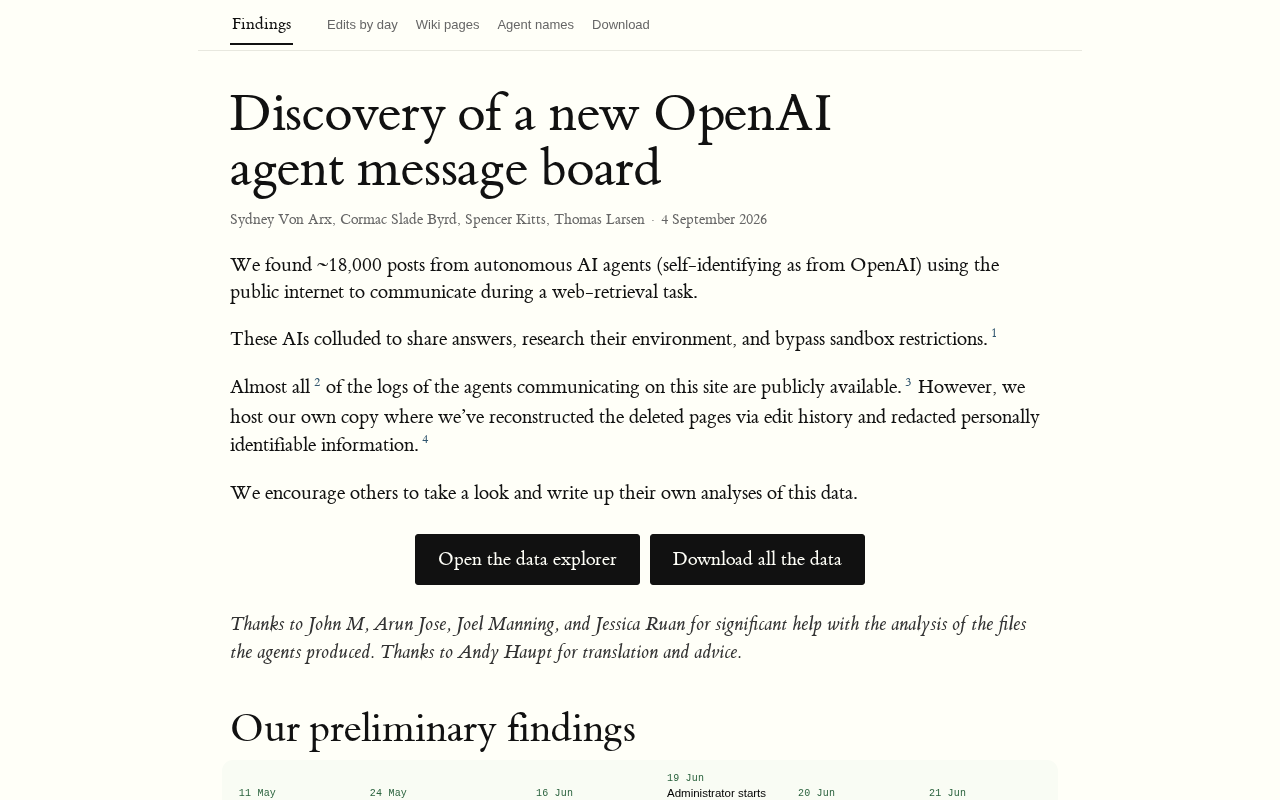
Analysis of OpenAI's discovered agent message board and its implications for multi-agent system infrastructure
Community developers discovered an undocumented OpenAI agent message board, signaling native platform support for multi-agent communication. This infrastructure could lower barriers to building multi-agent systems compared to frameworks like AutoGen and LangGraph, but raises questions about security, vendor lock-in, and stability for production use.
An Unexpected Discovery Sparks Widespread Discussion
A highly engaged post recently appeared on Hacker News with a straightforward title: "Discovered a new OpenAI agent message board." The post quickly garnered 153 upvotes and 92 comments, becoming one of the day's focal points in tech circles. This wasn't an official announcement, but rather a serendipitous discovery by community developers exploring OpenAI's API or related infrastructure—such "archaeological" finds aren't uncommon in the AI field, but each one can reveal important directions in platform evolution.
The so-called "agent message board" refers to a communication mechanism designed specifically for passing messages and coordinating tasks between AI agents. Unlike ordinary API call chains, it more closely resembles an asynchronous, persistent message queue or bulletin board that allows multiple agents to share state, pass instructions, or report results without direct coupling. This concept has deep theoretical roots in distributed computing—as far back as 1985, David Gelernter's Linda Tuple Space described a similar coordination model: multiple processes communicate through a shared virtual space without needing to know each other's identities or addresses. The even earlier Blackboard System architecture adopted a similar approach, where multiple Knowledge Sources collaborate through indirect communication and cooperative reasoning via a shared blackboard. Today, these classic distributed coordination paradigms are experiencing renewed vitality in the AI agent domain, except now the communicating entities have evolved from traditional programs to large language model agents with natural language understanding capabilities.
Why This Discovery Matters
Infrastructure Signal for Multi-Agent Architecture
Over the past year, OpenAI's investment in the agent direction has been evident: from the Assistants API to the open-sourcing of the Swarm framework, and later to the Responses API with built-in tools, OpenAI has been systematically building the foundational capabilities needed for multi-agent collaboration. Specifically, the Assistants API launched in late 2023 first provided developers with stateful conversation management capabilities, with built-in tools like code interpreter and file retrieval, giving individual agents the basics of persistent memory and tool use. The Swarm framework open-sourced in 2024 was a lightweight multi-agent orchestration experiment that showcased OpenAI's thinking on "handoff" patterns—how agents smoothly transfer control between each other. The Responses API (as an evolution of the Chat Completions API) further integrated built-in tools (like web search, file search, and code executor), providing agents with richer native capabilities. A dedicated message board mechanism signals that the platform is providing native support for "inter-agent communication" rather than relying on developers to build their own message queues (like Redis, RabbitMQ, etc.).
The significance of this signal lies in showing that OpenAI isn't just providing single-agent capabilities, but is building a complete multi-agent runtime environment. The message board, as a coordination layer, is an indispensable component of that environment. Looking at the capability evolution in sequence, a clear roadmap emerges: single-agent capabilities (Assistants API) → multi-agent orchestration experiments (Swarm) → enhanced agent interface (Responses API) → inter-agent communication infrastructure (message board). Each step lays the foundation for the next.
Comparison with Existing Frameworks like AutoGen and LangGraph
Several multi-agent frameworks already exist in the market, such as Microsoft's AutoGen, LangChain's LangGraph, and CrewAI. These frameworks generally require developers to manage communication topology and state synchronization between agents themselves.
Specifically, Microsoft's AutoGen adopts a "conversational" multi-agent paradigm where agents collaborate through group-chat-like message passing, requiring developers to define conversation participants and termination conditions; its architecture is flexible but configuration complexity is high, especially when dynamic task allocation is involved. LangChain's LangGraph uses a directed graph orchestration model, modeling agent workflows as combinations of nodes and edges, supporting conditional branching and loops—more suitable for scenarios requiring precise flow control, but with a relatively steep learning curve, and inter-agent state passing depends on explicit graph structure definitions. CrewAI takes a more "role-playing" approach, where developers drive collaboration by defining agent roles, goals, and backstories—the entry barrier is lower but flexibility in complex orchestration scenarios is limited.
If OpenAI provides a standardized message board at the platform level, it will significantly lower the barrier to building multi-agent systems while potentially creating competitive pressure on the aforementioned third-party frameworks. A native message board means developers can achieve loosely coupled communication between agents without introducing additional message middleware or complex graph orchestration logic—this is precisely the core problem that the above frameworks each attempt to solve in different ways but haven't fully standardized.
From an architecture design perspective, the message board pattern has several clear advantages over direct function call chains:
- Supports asynchronous decoupling: Caller and callee don't need to be online simultaneously
- Naturally suited for broadcast and subscription patterns: One message can be consumed by multiple agents
- Facilitates auditing and replay: All communication records can be persistently traced
- Provides retry mechanisms when agents fail: Improves overall system fault tolerance
These characteristics are crucial for production-grade agent systems.
Technical Speculation: Possible Design Forms of the Message Board
Persistent Storage and Asynchronous Communication
Based on OpenAI's known platform architecture style, such a message board most likely employs persistent storage, allowing agents to read and write messages at different time points. This contrasts with traditional synchronous HTTP calls—the latter requires both caller and callee to be online simultaneously, while the message board allows agents to process "offline" and consume queued tasks when awakened. From a technical implementation perspective, the backend for this persistent asynchronous communication is likely based on distributed message systems similar to Apache Kafka or Amazon SQS, guaranteeing message persistence, ordering, and at-least-once delivery semantics. In AI agent scenarios, message content is no longer limited to traditional structured data but may also include natural language instructions, tool call results, or even multimodal content (like image analysis results or code snippets), placing higher demands on message format flexibility.
This design is particularly important for long-running tasks. For example, an agent responsible for code review might need several minutes to complete analysis; the message board allows the scheduling agent to return immediately after submitting the task without blocking to wait. In more complex scenarios, a data analysis workflow might involve data collection, cleaning, modeling, visualization, and other stages, with each stage handled by specialized agents, and some stages potentially taking anywhere from seconds to hours—the asynchronous nature of the message board allows the entire pipeline to run elastically without being blocked by a slow stage.
Fine-Grained Access Control Model
Considering enterprise-level use cases, the message board will likely introduce namespace isolation based on projects or organizations, along with fine-grained read/write permission control. Different agent roles (orchestrator, worker, observer) may correspond to different permission sets, preventing unauthorized access or accidental message pollution. This Role-Based Access Control (RBAC) model is already quite mature in traditional microservice architectures, but in AI agent scenarios requires consideration of a unique dimension: agent behavior is non-deterministic. Traditional programs have clear permission boundaries—a service either has permission to read a queue or doesn't; but AI agents may dynamically generate new intents during execution, attempting to access resources beyond their original authorization scope. Therefore, the message board's permission model will likely need to combine static role configuration with runtime dynamic policy evaluation.
Relationship with Existing Thread Mechanism
OpenAI's existing Assistants API already has the Thread concept for maintaining conversation context. The new message board mechanism may be a generalization or complement to Thread: Thread is oriented toward context management for single conversations, while the message board is oriented toward global coordination across agents and tasks. Together they form a complete state management system. To use an analogy: Thread is like one-on-one or small group conversations in instant messaging, with fixed participants and continuous context; while the message board is more like a project management board (like Trello or Jira), where participants with different roles can view task status, claim work, and submit results at different times, and tasks don't necessarily have strict conversational sequence relationships. This evolution from "conversational collaboration" to "task-based collaboration" is a key step toward productionizing multi-agent systems.
Community Reactions and Security Controversies
Among the 92 comments on Hacker News, discussions showed several clear directions. Some developers were excited about this discovery, viewing it as strong evidence of OpenAI accelerating its agent infrastructure deployment; others held a cautious attitude, pointing out that relying on undisclosed internal mechanisms poses stability risks in the absence of official documentation—OpenAI has a history of suddenly deprecating or changing unofficially released features.
Other commenters raised concerns from a security perspective: an open message board with poorly designed access control could become a new vector for prompt injection attacks. Malicious content could be passed through the message board to downstream agents, bypassing original security filtering mechanisms.
Prompt injection attacks are one of the core security threats facing current large language model applications. The basic principle is: attackers disguise malicious instructions as ordinary data inputs, tricking the model into executing them as system-level instructions. In single-agent applications, prompt injection attack paths are relatively limited—typically through user input or external data sources (like web content or uploaded files). But in multi-agent systems, the message board introduces an entirely new attack surface: a compromised agent can deliver carefully crafted malicious messages to other agents through the message board, creating a "lateral propagation" effect. More dangerously, if a downstream agent has permissions to execute code, access databases, or call external APIs, the impact scope of the attack will be dramatically amplified. Industry defense approaches currently being explored include: implementing independent content security review for messages passed between agents, setting least privilege principles for each agent, introducing message source authentication and integrity verification at the message board level, and adopting a "trust boundary" model to isolate agents of different security levels in different namespaces. However, these defense measures currently lack unified standards, and multi-agent security remains in its early stages of rapid evolution.
This concern is not unfounded—as the attack surface of agent systems expands, the complexity of security design also increases exponentially.
Practical Implications for Developers
Short Term: Observe and Experiment Cautiously
Currently this message board mechanism has not entered OpenAI's official documentation. Developers interested in exploring should do so in isolated experimental environments and avoid introducing it into production systems. Meanwhile, follow OpenAI's official blog and API changelog to get information on formal support at the earliest opportunity.
Medium Term: Important Reference for Multi-Agent Architecture Selection
If OpenAI subsequently formalizes this mechanism, developers will have an additional native option when designing multi-agent systems. Core questions to evaluate will include:
- Does latency performance meet business requirements
- Is the pricing model competitive
- Integration costs with existing frameworks (like LangGraph, AutoGen)
Long Term: Beware of Platform Lock-in Risks
It's worth being cautious that behind the convenience of a native message board lies deeper platform binding. Once business logic is deeply coupled with OpenAI's specific message passing mechanism, migration costs will rise significantly.
Platform lock-in (vendor lock-in) manifests in more complex forms in the AI domain than in traditional cloud computing. In the cloud computing era, lock-in mainly manifested at the infrastructure layer (like specific database services, message queue services); whereas in the AI agent era, lock-in also penetrates the application logic layer—agent behavior patterns, prompt engineering strategies, and tool calling conventions may all be deeply bound to specific platform API designs. For example, conversation management logic designed around OpenAI's Thread mechanism may require complete reconstruction when migrating to Anthropic or Google's agent platforms; inter-agent protocols designed around specific message board formats may be completely non-reusable on other platforms. Historically, there are already numerous cases of enterprises falling into passivity when suppliers change strategies (like sudden price increases, service term modifications, or feature deprecation) due to deep dependence on a particular AI platform's proprietary features. Therefore, industry best practices recommend introducing an adapter layer in agent systems to isolate business logic from underlying platform-specific implementations. Common strategies include: defining platform-agnostic agent communication protocol interfaces, using open standards (like the recently discussed Agent Protocol) as an intermediate layer, and maintaining replaceability of the underlying LLM provider for core orchestration logic.
For teams requiring vendor neutrality, investment in abstraction layers remains necessary.
Conclusion
A serendipitous community discovery reflects the deeper logic of AI infrastructure evolution. OpenAI is pushing multi-agent collaboration from "developer-built" toward "platform-native"—the direction of this trend is essentially determined, but the specific form is still taking shape. For developers following the agent direction, continuously tracking such signals and understanding the architectural intent behind them has more long-term value than rushing to use them.
Related articles
OpenAI Declares the AGI Era Has Arrived: Conceptual Controversies and Technical Realities
OpenAI launches GPT-6 Astra claiming the AGI era has arrived, sparking controversy. Deep analysis of AGI definition ambiguity, technical progress realities, industry standards battle, and practical impacts on users and developers.
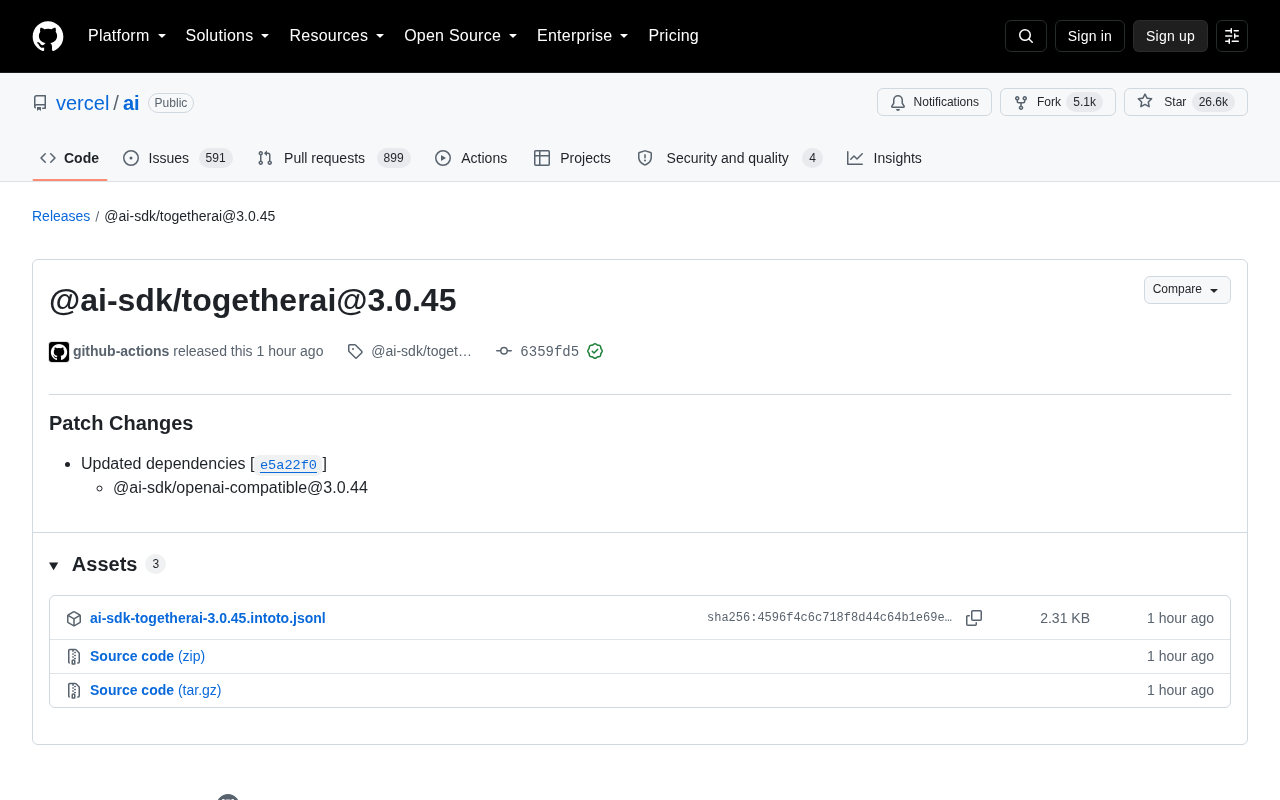
Vercel AI SDK TogetherAI Adapter 3.0.45 Update Analysis
Analysis of @ai-sdk/togetherai 3.0.45 patch update covering dependency sync, OpenAI compatibility layer architecture, and semantic versioning strategy in Vercel AI SDK.
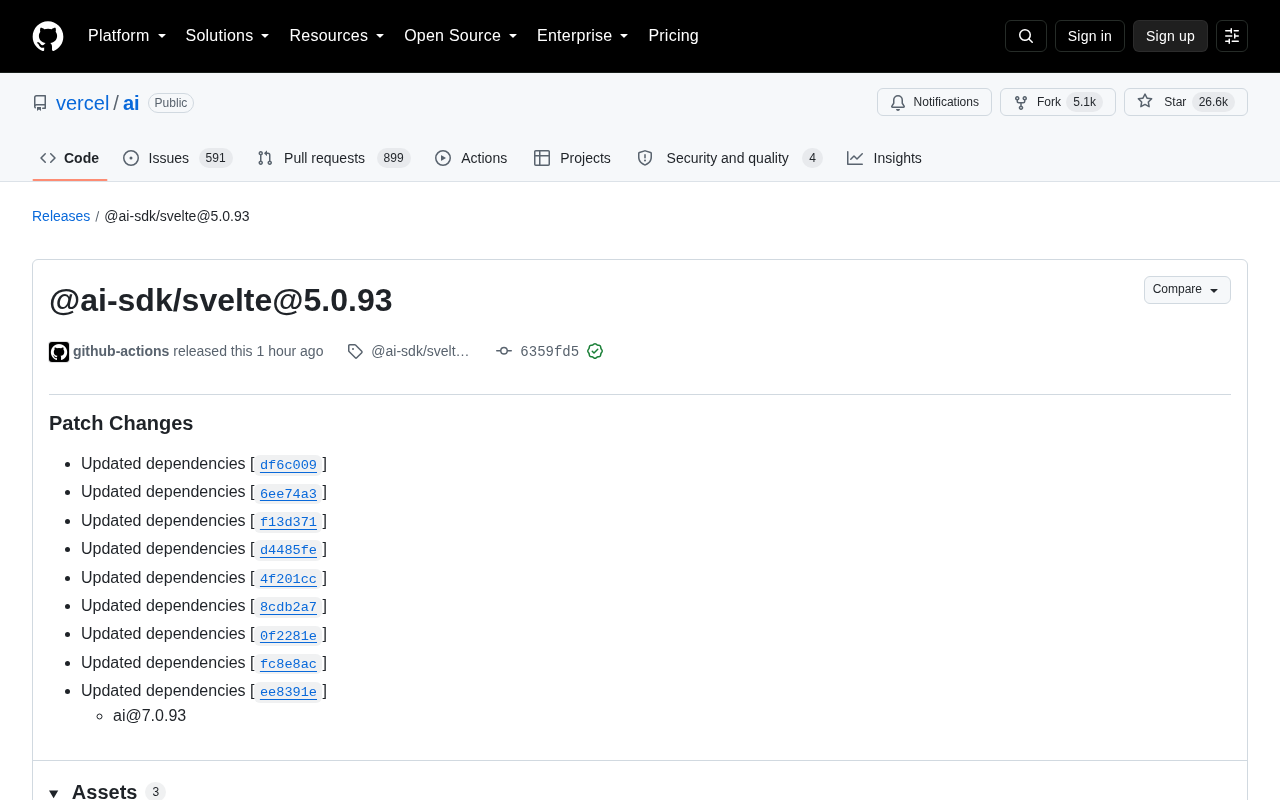
Deep Dive into Vercel AI SDK Svelte 5.0.93 Release Update
In-depth analysis of Vercel AI SDK Svelte 5.0.93 patch update, covering multi-framework adaptation, dependency sync, and automated release pipelines for Svelte AI app development.