OpenAI Eyes the App Store Model: ChatGPT Is Becoming the New Software Gateway

OpenAI is using ChatGPT to build a new software distribution platform for both humans and AI agents.
OpenAI is upgrading ChatGPT from a conversational tool into a software distribution platform, with the core ambition of rivaling Apple's App Store and Google Play. The key differentiator: this platform serves not just human users but also AI agents that can autonomously invoke software — shifting the paradigm from "download-install-tap" to conversational and agent-based access. For developers, it's a potential escape from the 30% platform tax, but also a shift in dependency from Apple/Google to OpenAI. The full ecosystem is still nascent, but the next battle for the software gateway has clearly begun.
OpenAI's Ambition: Reimagining Software Distribution
OpenAI is building infrastructure to replace traditional app stores, positioning ChatGPT as a new platform where software gets discovered and used. Unlike Apple's App Store or Google Play — both designed around human users — OpenAI is targeting a much broader scenario: software that can be consumed by both humans and AI agents.
Underpinning this move is a key conviction: as AI agents increasingly take on the role of acting on behalf of users, the "consumers" of software will no longer be exclusively human. When an AI assistant needs to book a flight, query data, or invoke a service, it needs a software ecosystem it can directly interface with — not a grid of icons designed for touchscreens. ChatGPT is positioning itself to be that new gateway.
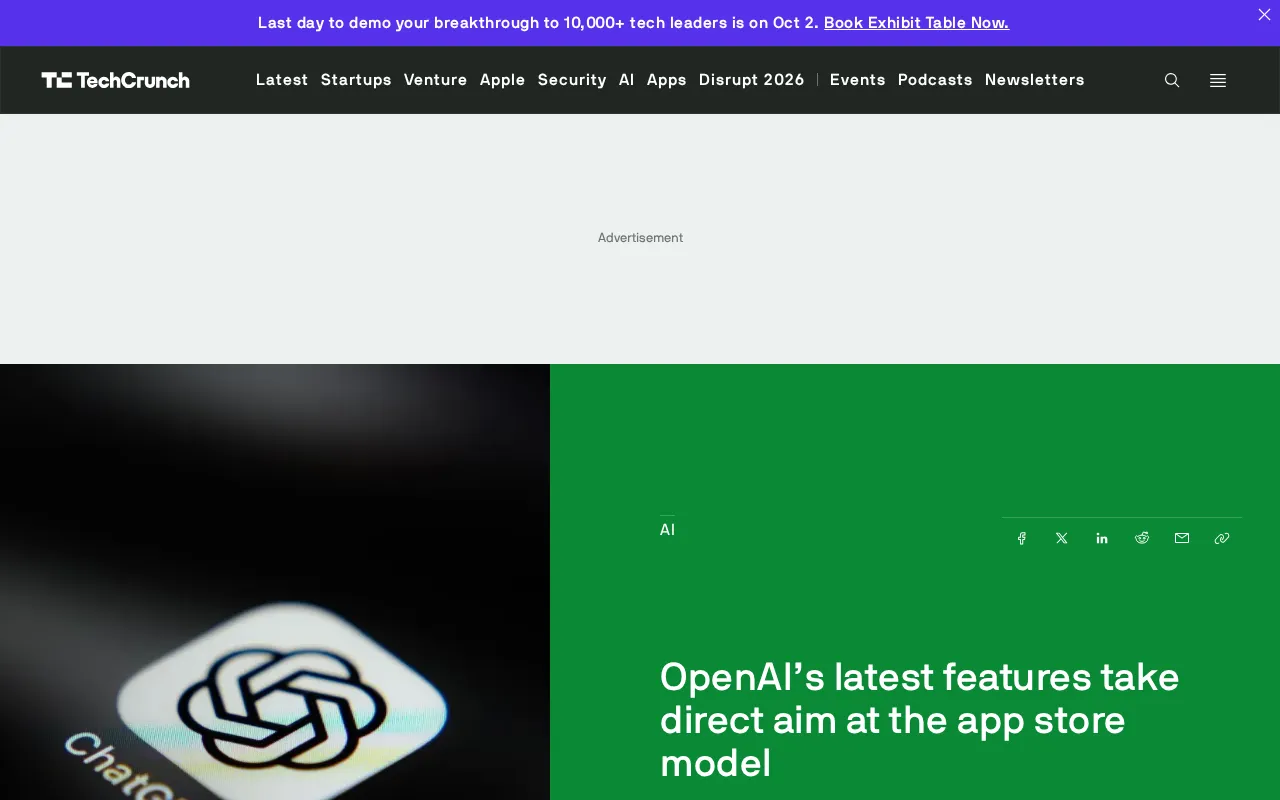
Why This Directly Threatens the App Store Model
The core value of a traditional app store lies in distribution and discoverability — it's the mandatory path developers must take to reach users, and the tollbooth where platform owners collect their cut. OpenAI's approach is to migrate this gateway layer into a conversational interface. Users no longer need to download and install an app; they simply invoke the relevant functionality directly within ChatGPT.
This shift could unsettle several established dynamics:
Redistribution of Distribution Power
If software can be embedded directly into ChatGPT and called up through conversation, the "download → install → open" chain gets dramatically compressed or bypassed entirely. Whoever controls this new distribution layer controls how traffic gets allocated — which is precisely the moat that Apple and Google have maintained for over a decade.
A "Software Marketplace" Built for AI Agents
Even more disruptive is the fact that OpenAI's envisioned audience isn't just humans. When AI agents can autonomously discover and invoke software, a new, machine-readable software ecosystem begins to take shape. This is fundamentally different from the tap-an-icon interaction model — and it's a space that existing app stores have yet to meaningfully address.
Since Apple's App Store launched in 2008, it has evolved into a business model where the platform takes a 30% cut of in-app purchases and subscription revenue — a practice that has triggered sustained antitrust battles, including Epic Games' lawsuit against Apple and the EU's forced intervention under the Digital Markets Act (DMA). Google Play operates similarly. The structural power of this model rests on one reality: developers who want to reach mobile users have virtually no alternative. OpenAI's entry point targets exactly that "no alternative" — by enabling conversational invocation and AI agent proxying, it offers developers a new distribution path that sits above the OS layer and bypasses the app store entirely, fundamentally challenging the legitimacy of this structural lock-in.
What This Means for Developers
For developers, this is both an opportunity and a source of uncertainty. The opportunity: if ChatGPT becomes a mainstream gateway, integrating with its ecosystem means access to a massive potential user base — and possibly a way around the traditional 30% platform tax. The uncertainty: the platform gatekeeper simply changes from Apple or Google to OpenAI. Developers remain dependent on a centralized distribution platform, and the power to set the rules still doesn't rest with them.
The rules around software discoverability, the standards for invocation interfaces, and revenue-sharing mechanisms will all be redefined by this new platform. For developers, understanding and positioning for this new paradigm early may be more strategically valuable than continuing to compete within the old app store model.
A Trend Taking Shape
It's worth keeping a clear head here: what OpenAI has shown so far is more "assembling the puzzle pieces" than a mature, complete alternative. The app store model's moat isn't just technical — it encompasses payment infrastructure, review mechanisms, user trust, and an expansive developer relations network, none of which can be replicated quickly.
But the direction itself deserves attention. As the interaction paradigm shifts from graphical interfaces to conversation and agents, the way software is distributed and consumed will inevitably change alongside it. OpenAI's decision to stake its claim at this inflection point is a bet on the next computing paradigm. The battle for the "software gateway" may have only just begun.
Background
AI agents are AI systems capable of autonomously planning tasks, invoking external tools, and executing multi-step operations — distinct from traditional chatbots that can only passively answer questions. The critical technologies underpinning this ecosystem are standardized interface protocols like Function Calling and MCP (Model Context Protocol), which function as machine-readable "API directories" that allow AI agents to automatically discover, select, and invoke appropriate software or services without human intervention. OpenAI's Plugins, GPTs, and the built-in tools in its latest Responses API are all concrete implementations of this vision. How mature this infrastructure becomes will directly determine whether the "AI agent software marketplace" can move from concept to large-scale reality.
Related articles

AI Compute Is the New Oil, But the Market Mechanism Has Yet to Take Shape
Hacker News compares AI compute to the new oil, noting the lack of price discovery, concentrated supply, and no hedging tools. The article analyzes structural issues in compute trading and explores a possible three-tier market of spot, contracts, and derivatives, plus the real impact on AI practitioners' cost management.

Running Full iOS 16.5 Firmware on Android Devices: Technical Demo or Marketing Gimmick?
A Hacker News post claims full iOS 16.5 firmware can run on Android, with 315 upvotes. This analysis argues it is more likely a web UI simulation than a true firmware port, and explores the value and risks of such projects.

Etsy Cracks Down on AI Slop: Addressing Buyer and Seller Anxieties
Etsy introduces stricter rules limiting AI-generated content in listings, addressing buyer confusion over AI products and seller fears of original work being diluted by AI slop.