OpenAI Releases GPT-6.1 Sol: One-Fifth the Price of Astra, Outperforms It in Some Areas

OpenAI's GPT-6.1 Sol offers near-Astra performance at one-fifth the price, with 95% cache discounts for Agent workflows.
OpenAI has released GPT-6.1 Sol, a developer-focused "daily workhorse" model priced at one-fifth the cost of its flagship Astra, with cached input costs an additional 95% lower than standard pricing. The caching discount is particularly significant for Agent applications, where repeated long-context calls can dominate costs. OpenAI also claims Sol outperforms Astra in certain capability dimensions, challenging the assumption that lower price means lower performance. The release is widely seen as a tactical response to Anthropic's Claude Opus 5.5 — competing not on raw benchmark supremacy, but on making capable AI affordable enough for everyday production use.
Under the mounting competitive pressure from Claude Opus 5.5, OpenAI has chosen to respond with a new model centered on value-for-money. Based on coverage of the announcement, OpenAI has unveiled GPT-6.1 Sol — a high-efficiency model positioned as an "everyday workhorse" that delivers performance close to, and in some areas surpassing, Astra at just one-fifth the price.
Cheaper and Faster: Addressing Two Core User Demands
OpenAI's previously released Astra was positioned as the market's "most capable and most aligned" model, but user feedback consistently pointed to two pain points: can it be cheaper, and can it be faster? GPT-6.1 Sol is a direct answer to both.
According to the announcement, Sol strikes an impressive balance between cost and capability: it delivers "very close to Astra-level" intelligence at one-fifth the price. For developers and enterprises that rely on high-volume API calls, this dramatic cost reduction means the same budget can now accomplish several times the workload.
Deeply Optimized for Agent Scenarios
Perhaps the most notable aspect of GPT-6.1 Sol is its targeted optimization for Agent use cases. The announcement highlighted that Sol's cached input cost is 95% lower than standard input pricing.
The significance of this design lies in how agents operate: they typically need to repeatedly reuse context, iterate on solutions, and handle tasks that span extended periods. The dramatic reduction in caching costs makes it extremely inexpensive for agents to read the same context repeatedly, making long-running, multi-iteration automated workflows far more economically viable.
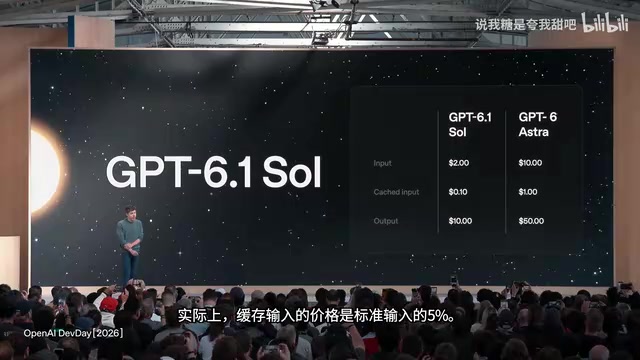
In other words, OpenAI isn't simply cutting prices — it's restructuring its cost model to align with the current Agent boom, actively encouraging developers to build automated systems designed to run for extended periods with frequent API calls.
Cached Input is a pricing mechanism in large language model APIs. When the same context (such as system prompts, long documents, or tool definitions) appears repeatedly across multiple requests, the provider can cache it server-side. Subsequent requests then pay a lower "cache hit" read fee rather than being billed for the full input token count each time. For ordinary conversational use cases, the caching benefit is limited. But in Agent workflows, every step may carry the same task background, tool lists, and conversation history — meaning repeated context can account for a very high proportion of total input. With a 95% cache discount, for example: if 80% of an agent's average API call consists of cached content, the effective cost per call can be compressed to roughly one-fifth of the standard price multiplied by 0.2 — an enormous overall cost reduction. This is why a reduction in caching costs matters far more to Agent developers than to ordinary users.
Coding and Building: Positioned as the Go-To Workhorse
From the official messaging, Sol is explicitly positioned as a tool to help users "code and build." It's described as "your daily workhorse," signaling that OpenAI wants this model to become developers' default choice for high-frequency everyday use — not just a flagship reserved for especially difficult tasks.
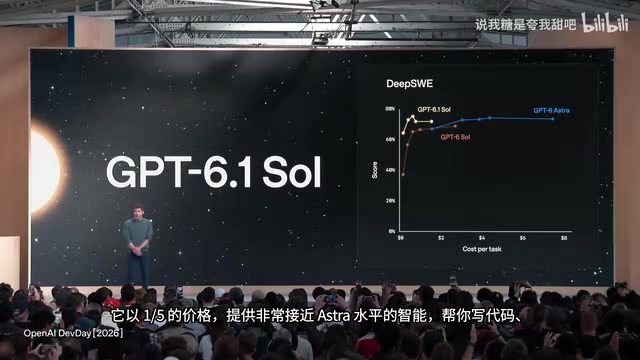
Perhaps even more intriguing is the official claim that Sol is "smarter than Astra in some ways." This challenges the conventional assumption that cheaper means less capable — a lower-priced model outperforming the flagship in certain dimensions suggests that efficiency gains from model iteration are making the trade-off between cost-effectiveness and performance increasingly less zero-sum.

Competitive Context: A Tactical Response to Opus 5.5
As the original title of the announcement implies, this release is widely interpreted as OpenAI's direct response to Anthropic's Claude Opus 5.5. Against a backdrop of intensifying flagship-level competition, reinforcing the developer ecosystem with a highly cost-effective model optimized for Agent and coding use cases is a pointed tactical move.
For developers, the most immediate benefit of intensifying model competition is straightforward: the price for equivalent capability keeps falling. When near-flagship-level intelligence becomes available at one-fifth the cost, stacked on top of a 95% cache discount, the barrier to building sophisticated Agent applications is being rapidly lowered.
Claude Opus 5.5 is Anthropic's flagship model released in 2025, emphasizing deep reasoning, long-context handling, and alignment safety, positioned as the top choice for complex tasks at a relatively high price point. Competition between OpenAI and Anthropic has long focused on flagship model capability rankings — but as AI applications shift from the "experience layer" to the "production layer," developers have become significantly more sensitive to API call costs. The release of GPT-6.1 Sol represents OpenAI expanding its competitive dimensions from "who's smarter" to "who's more affordable to run" — using differentiated pricing to capture developers' everyday workflows rather than merely competing for rankings on top-tier benchmarks. This "flagship for breakthroughs, workhorse for daily use" dual product-line approach is now a widely adopted market strategy among leading AI companies.
Summary
GPT-6.1 Sol's core value proposition comes down to three points: one-fifth the price of Astra, 95% lower cached input costs, and performance that surpasses the flagship in certain areas. It clearly targets a key bottleneck in real-world AI deployment — cost, particularly the cost pressures created by frequent API calls in Agent scenarios.
It's worth noting that the information currently available comes primarily from the announcement itself. Sol's specific benchmark results, actual coding performance, and the precise dimensions in which it "partially surpasses Astra" still await further independent validation. Teams considering deploying it in production environments are advised to conduct scenario-specific evaluations before full adoption.
Related articles
2026 AI Coding Tools Comparison: Claude, ChatGPT, Gemini — Which Is the Best?
A 2026 comparison of five mainstream AI coding tools — Claude Code, ChatGPT Codex, Gemini, DeepSeek, and GitHub Copilot — on real projects, pricing, and code quality, to help you decide where that $20/month should go.

ChatGPT Codex Can Clone Any Software? Testing the Risks and the Truth
YouTube shorts claim ChatGPT Codex or Claude Code can clone Adobe, Excel, and Figma for lifelong free use. We break down the feasibility, legal risks, and DM-funnel tactics—and explain what AI coding tools are truly good for.

Kilo Code Is Free to Install but Charges for API: Cost Estimation and Configuration Guide
Kilo Code is free to install, but connected AI models are billed per token. This guide covers VS Code extension and CLI setup and shows how to estimate API costs.