OpenClaw Agent Skill Development in Practice: From WeChat Official Accounts to Quantitative Trading

A practical guide to developing enterprise-grade Agent Skills from scratch with Codex, Claude Code, and WorkBuddy.
Based on a Bilibili public class by instructor Zhuge, this article explains how to turn AI Agents into "digital employees" through Skill development—encapsulating repetitive work into reusable modules. Using Codex, Claude Code, and WorkBuddy, it demonstrates enterprise-grade Skills for WeChat writing, quantitative analysis, Xiaohongshu publishing, and online troubleshooting, and discusses backend model choices, Agent caching, and beginner advice.
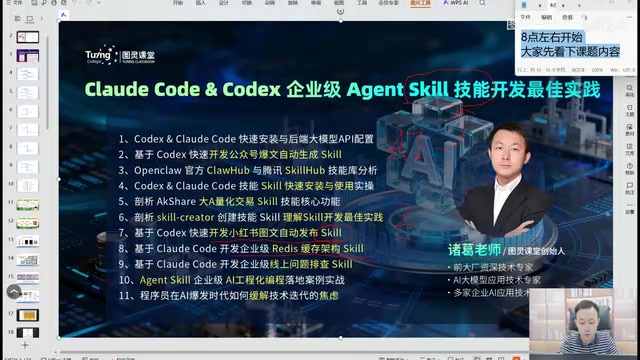
AI Agents are evolving from "chat tools" into "digital employees" that can genuinely do work for you, and Skill development is the key to giving Agents concrete work capabilities. In a public class on Bilibili, instructor Zhuge used three tools—Codex, Claude Code, and WorkBuddy—to demonstrate how to develop enterprise-grade Agent Skills from scratch, covering scenarios such as WeChat Official Account writing, quantitative analysis, automated Xiaohongshu publishing, and online troubleshooting.
Why Skill Development Is Needed
Many people use AI to write articles or look up information, and every time they have to re-enter a long prompt, which is inefficient. The essence of a Skill is to encapsulate repetitive work into a reusable skill module that the Agent can then call directly. In class, instructor Zhuge gave an intuitive example: if you operate 10 Xiaohongshu accounts and each account posts two image-text posts per day, publishing alone would take one to two hours; but after developing an automated publishing Skill, publishing 20 posts can be compressed to one or two minutes.
This approach is equally friendly to non-programmers. The course explicitly targets an audience "from non-programmers to programmers"; the core is not to make you learn programming, but to learn to direct AI to write code and clarify workflows.
The Difference Between Agent Skills and Prompt Engineering
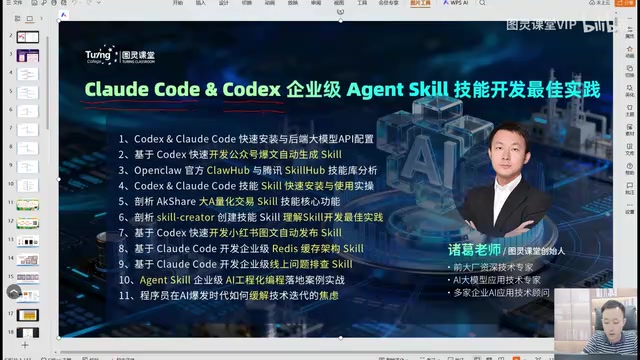
Prompt engineering focuses on "how to ask this time," optimizing the expression of a single round of interaction; Skill development focuses on "how to solidify this type of task," producing a capability unit that can be called repeatedly. A complete Skill usually consists of three parts: task description (under what circumstances it is triggered), execution flow (which tools to call and in what order), and validation rules (whether the output is qualified). This means Skills have software engineering properties such as version management, parameterization, and compositional reuse, rather than just a longer Prompt. The industry often refers to this kind of encapsulation as the upper-layer orchestration of "Tool Use" or "Function Calling"; at runtime, the Agent selects and loads the corresponding Skill based on task semantics, thereby avoiding stuffing all instructions into the context window.
MCP Protocol
The MCP (Model Context Protocol) mentioned in the original text is an open protocol proposed by Anthropic to standardize the connection between large models and external data sources and tools. Before MCP appeared, every Agent tool integrating with the WeChat Official Account API, databases, or publishing platforms had to write separate adapter code; MCP abstracts these capabilities into unified "servers," and the model can discover and call the tools and resources within them through protocol descriptions. For Skill development, MCP standardizes the step of "integrating external tools": developers only need to implement an MCP Server once, and different Agent clients such as Codex and Claude Code can reuse it. This is also why the course materials list MCP as a key note.
How to Choose Among the Three Agent Tools
The practical environment revolves around three AI Agent tools:
- Codex: Connects to GPT models by default; capable, but the backend has a certain threshold.
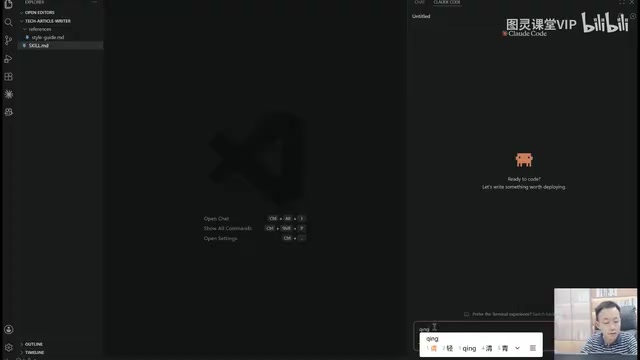
- Claude Code: Used as a VS Code plugin, more suitable for students with a technical background, and can connect to domestic large models such as Zhipu.
- WorkBuddyAd: Produced by Tencent, similar to Codex but with a lower threshold; the backend can choose DeepSeek, offering high cost-effectiveness.
Instructor Zhuge emphasized that the tools themselves do not differ much; the key to capability lies in the backend large model. Domestic options such as MiniMax, Kimi, Tongyi Qianwen, and Hunyuan can all serve as backend choices, and you can pair them according to personal preference.
From a One-Sentence Prompt to a Reusable Skill
The course first breaks the ice with the simplest scenario: entering "Please help me write an introductory article on using Codex" in Codex or WorkBuddy, and observing the quality of the AI's output. WorkBuddy proactively asks about the publishing platform and style, showing that modern Agents already have a certain ability to clarify through interaction.
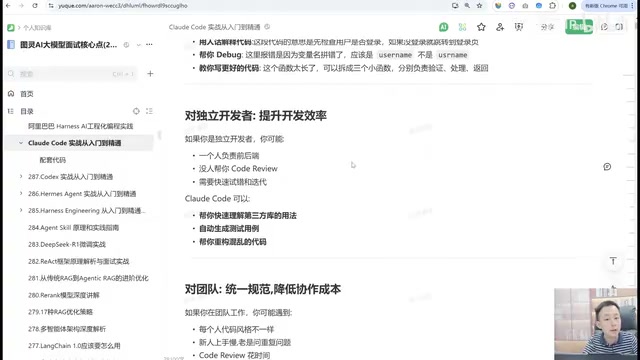
But this is only the starting point. Real Skill development must solidify such tasks into structured skills: define inputs and outputs, encapsulate prompt templates, integrate external tools (such as the WeChat Official Account API, stock data interfaces, and Xiaohongshu publishing interfaces), and let the Agent call them automatically when needed. The course materials shown by instructor Zhuge cover hundreds of pages of documentation for Codex, Claude Code, and WorkBuddy from installation to mastery, as well as notes on related tools such as Cursor, MCP, Hermes, and OpenClawAd, indicating that this methodology already has fairly complete practical accumulation.
The Agent's Ability to Clarify Through Interaction
When WorkBuddy is asked to write an article, it proactively asks about the publishing platform and style. This kind of behavior is usually called "clarifying follow-up questions" or "intent completion." Behind it, the Agent identifies missing key slots (such as platform, audience, word count, and tone) when parsing the task, and thus initiates supplementary questions before generation rather than outputting everything at once based on guesswork. For Skill development, this mechanism can be explicitly designed into the skill flow: declare required parameters and default values in the Skill definition, trigger follow-up questions when user input is incomplete, and enter the execution phase only after the parameters are complete. This both lowers the cost for users to describe tasks each time and reduces rework caused by missing information—an important reason why enterprise-grade Skills are more stable than bare prompts.
Enterprise Scenarios: Cache Architecture and Online Troubleshooting
For students with a technical background, the course further extends to enterprise-grade Agent design. Two typical questions are: how to design the cache architecture for Agent applications, and how to automatically troubleshoot when problems occur online. Traditional troubleshooting may involve seven or eight steps, but after developing an "online problem troubleshooting Skill," the Agent can automatically locate errors, analyze causes, and even provide repair plans. This is a key step for Skill development moving from personal efficiency gains to engineering implementation.
Cache Architecture for Agent Applications
Caching for Agent applications differs significantly from traditional web caching and usually requires layered design. Common practices include: prefix caching (Prompt Caching) for system prompts and tool descriptions to avoid repeated billing on every round of dialogue; setting TTL-based result caching for tool call results (such as stock quotes and WeChat Official Account API returns) to reduce external API calls; and caching embedding results for vector retrieval scenarios. Because an Agent task may generate multiple rounds of model calls, the cache hit rate directly affects response latency and token costs. Therefore, in enterprise implementation, caching strategies are often incorporated into architecture design together with context length management and model routing.
Practical Advice
For readers who want to get started, it is recommended to begin with a single high-frequency task, such as weekly report generation in a fixed format or content publishing, encapsulate the prompt, tool calls, and output validation into one Skill, and then gradually expand after it runs successfully. In terms of tool selection, foreign tools are more capable but have a higher threshold, while the domestic combination of WorkBuddy plus DeepSeek is friendlier to beginners. It should be noted that the content of this course comes from a live transcript, and specific API integration and deployment details need to be practiced in conjunction with official documentation.
One-line Summary
A practical demonstration of developing enterprise-grade Agent Skills from scratch using three tools: Codex, Claude Code, and WorkBuddy.
Paragraph Summary
Based on a public class by Bilibili creator instructor Zhuge, this article introduces how to turn AI Agents from chat tools into "digital employees" that can do work, with the core method being Skill development—encapsulating repetitive work into reusable modules for Agents to call. The course uses three tools—Codex, Claude Code, and WorkBuddy—to demonstrate developing enterprise-grade Skills from scratch, covering scenarios such as WeChat Official Account writing, quantitative analysis, automated Xiaohongshu publishing, and online troubleshooting. The article emphasizes that the tools themselves do not differ much and that capability depends on the backend large model; domestically, MiniMax, Kimi, Tongyi Qianwen, Hunyuan, or DeepSeek can be used. For enterprise users, it also discusses Agent cache architecture and automated problem troubleshooting; for beginners, it recommends starting with a single high-frequency task, with the WorkBuddy plus DeepSeek combination having a lower threshold.
Related articles

Uber Deploys ChatGPT Work Company-Wide: AI in the Workplace Enters the Scaled Implementation Phase
Uber deploys ChatGPT Work to 30,000+ employees, extending it from engineering to all roles. We analyze its expert-engineer pairing, end-to-end automation, and questions of AI control and power concentration—insights for scaling AI in the workplace.

Shift at Midnight Hands-On: When "ID Verification" Becomes Alien Hunting
Shift at Midnight blends ID verification with horror survival in a four-player co-op game. We break down its inspection mechanics and chaotic humor.

Zelensky Recounts the Outbreak of War: I Need Ammunition, Not a Ride
Zelensky recalls the first day of war in a YouTube interview: farewell to family, rejecting Biden's evacuation offer with "I need ammunition, not a ride," and how Bucha shaped his stance on compromise and peace talks.