OraAgent Hands-On Review: End-to-End Automation of Foreign Trade Prospecting Emails — From Finding Customers to Sending Emails in One Click

OraAgent automates foreign trade prospecting end-to-end—from finding customers to sending personalized emails in one click.
This hands-on review examines OraAgent (with AI assistant Aura), a foreign-trade agent that automates the full prospecting workflow: searching customers, AI-based lead prioritization, batch-generating personalized outreach emails, and one-click sending. It also covers key risks—email deliverability (SPF/DKIM/DMARC), GDPR/CAN-SPAM compliance, and the need for human review of AI content.
The Customer Acquisition Dilemma in Foreign Trade and the AI Breakthrough
In the daily work of the foreign trade industry, the most energy-consuming part is often not the product itself, but customer acquisition and development. Manually searching for customer information, analyzing email quality one by one, writing prospecting emails one at a time, and then manually sending bulk emails—this entire process is not only inefficient but also puts a heavy strain on a salesperson's patience and experience.
Recently, a foreign-trade-specific agent called OraAgent (with a built-in AI assistant, Aura) has begun to attract attention. It integrates this lengthy chain into an end-to-end automated workflow. Based on a hands-on demonstration by a Bilibili content creator, this article outlines its core capabilities and real-world performance.
What is an AI Agent? An AI Agent is a cutting-edge form of current artificial intelligence applications, and is fundamentally different from traditional RPA (Robotic Process Automation) or scripting tools. Traditional automation tools rely on preset rules to execute fixed processes, and are prone to failure once the environment changes; an AI Agent, on the other hand, possesses a closed-loop capability of perception, reasoning, planning, and action, allowing it to dynamically adjust its execution strategy based on context. This capability stems from the Chain-of-Thought reasoning ability of the underlying large language model, combined with a Tool Use mechanism that enables it to proactively call external APIs, databases, and applications. In a foreign trade scenario, this means the system can not only send emails on command but also understand questions requiring comprehensive judgment such as "which customer is more worth prioritizing"—which is precisely what distinguishes OraAgent from ordinary bulk-mailing tools.
From Keywords to Customer Emails: Automating the Prospecting Stage
The first problem OraAgent solves is "finding customers." Users simply enter product keywords into the targeting program, and the system returns relevant customer contact information, with support for exporting customer emails to a spreadsheet in bulk.
This stage essentially consolidates the scattered methods that traditional foreign trade professionals rely on—Google searches, customs data, social media mining, and so on—into a single unified entry point. Traditional customs data queries usually require subscribing to professional databases (such as Panjiva and ImportGenius), while social media mining relies on tools like LinkedIn Sales Navigator. Used separately, they are costly and fragmented in efficiency. For small and medium-sized foreign trade enterprises and SOHO practitioners, OraAgent's greatest value lies in integrating these data sources, significantly reducing the time cost of information gathering.
The Data Ecosystem of Foreign Trade Prospecting Tools: Such tools rely on a multi-layered data ecosystem at their foundation, and understanding this helps evaluate the actual boundaries of their capabilities. Customs Data is one of the most core sources—customs authorities in various countries regularly publish import and export trade records containing structured information such as the names of buyer and seller companies, product descriptions, HS Codes (Harmonized System Code, an internationally standardized commodity classification system established by the World Customs Organization (WCO); currently 98% of globally traded goods can be standardized and classified through its roughly 5,000 six-digit categories), and trade amounts. Platforms like Panjiva (now part of S&P Global, acquired in 2018 for $550 million) and ImportGenius build a global trade-relationship map covering hundreds of millions of trade records by integrating publicly declared data from major trading nations such as the United States, Brazil, India, and Russia. Their annual subscription fees typically range from thousands to tens of thousands of dollars, which is precisely the core cost that small and medium foreign trade enterprises struggle to bear independently.
Beyond customs data, prospecting tools usually integrate several other important supplementary data sources: LinkedIn's corporate information and decision-maker title data (especially suitable for identifying the names and positions of key contacts such as procurement managers and supply chain directors); the Contact and About pages of company websites (automatically scraped and structured via web-crawling technology); industry trade show databases (such as the public exhibitor directories of the Cologne Hardware Fair or the Canton Fair, containing information on company size and product categories); and domain registration information (WHOIS data, which can help determine a company's years in operation and country/region of registration). The core value of AI tools lies precisely in using a natural-language interface to uniformly orchestrate these fragmented sources, eliminating the friction of users switching between multiple platforms. However, the timeliness of the data (a certain trade relationship may have ended months ago) and its accuracy (whether a contact is still employed, whether an email is still valid) remain systemic challenges—any tool claiming to cover all product categories, all markets, and update data in real time should be carefully evaluated for its data refresh frequency and verification mechanisms.
It should be noted that the demonstration did not detail the coverage scope or compliance of the data sources—the accuracy and timeliness of the email data directly determine the effectiveness of subsequent prospecting actions, and this is the aspect most in need of evaluation before choosing such a tool.
Customer Quality Analysis: AI-Assisted Prioritization
Once you have the customer email spreadsheet, the real challenge has only just begun—when faced with dozens or hundreds of potential customers, the order of contact often directly affects conversion efficiency. OraAgent's approach is to let the user directly ask Aura questions, with the assistant pulling up the exported spreadsheet for analysis.
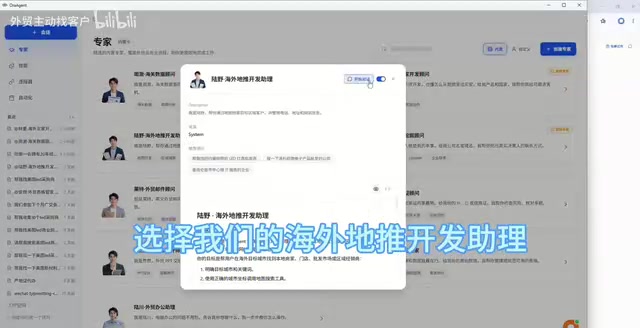
Aura automatically analyzes customer emails, determines which are high-quality customers worth prioritizing, and provides targeted development suggestions.
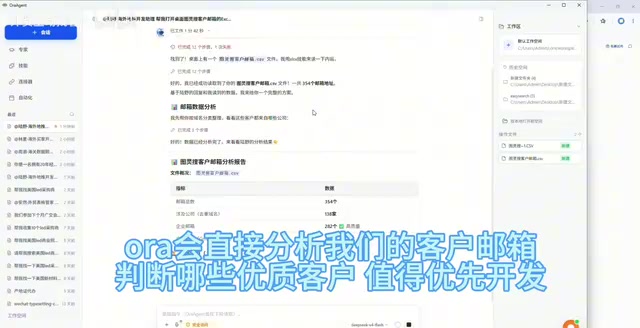
This feature essentially models part of a senior salesperson's "experiential judgment." Traditionally, assessing customer quality requires combining multi-dimensional information such as company size, industry fit, and purchasing intent—judgment that usually takes years to accumulate. By analyzing quantifiable dimensions such as email domains (determining whether it is a corporate email, the domain's registration age, and regional affiliation), the industry relevance of company names, and regional market potential, an AI system can quickly complete initial screening.
From a technical standpoint, this is essentially a multi-dimensional scoring (Lead Scoring) model: the system assigns weights to several feature dimensions of each potential customer—for example, the weight of a "corporate email domain" is higher than a "free email (such as Gmail/Yahoo)," the weight of a "mature European or American market" is higher than a "high-risk region," and a "domain registered for over 5 years" implies a more mature and stable enterprise—and aggregates these into a priority score, which the LLM then converts from structured scores into natural-language suggestions for the user. This automated scoring mechanism has mature precedents in the B2B sales field; CRM platforms like Salesforce and HubSpot both have built-in similar Predictive Lead Scoring features, typically backed by machine learning models trained on historical deal data. If Aura can provide reliable initial screening, it is especially helpful for novice foreign trade salespeople—it effectively offers a quick-to-adopt "experience substitute" that helps newcomers overcome the cold-start phase.
Of course, whether the AI's basis for judgment is transparent and whether it might misjudge due to insufficient information still needs to be verified through long-term use. Such priority suggestions are better suited as a reference rather than a complete replacement for human decision-making.
Writing Prospecting Emails: Batch Generation of Personalized Content
After identifying target customers, we enter the most core and time-consuming stage of foreign trade—writing prospecting emails. OraAgent supports directly assigning Aura to generate prospecting emails tailored to different customers, and in the demonstration the content was completed quickly.
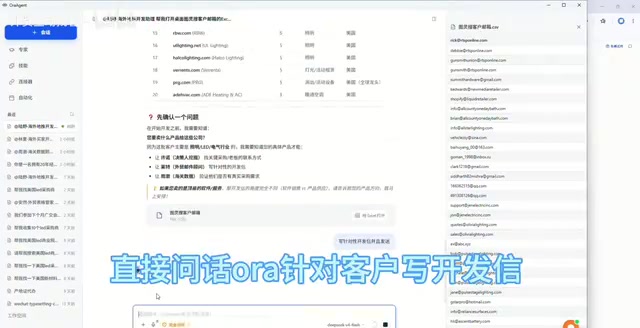
More noteworthy is that when you click on the prospecting email file, you can see that the system generated differentiated content for different companies, rather than a one-size-fits-all generic template.
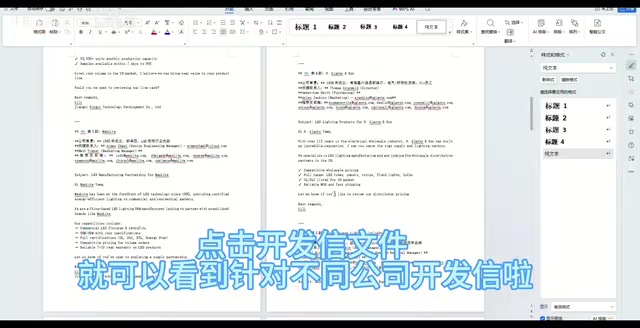
The "personalization" of a prospecting email is the key factor determining open rates and reply rates. Bulk template emails are extremely easy to be flagged as spam, whereas emails that genuinely mention the recipient's business and pain points have a chance of getting a reply.
The Technical Principles of Large Language Models and Hyper-Personalization: The working principle of a Large Language Model (LLM) in email generation scenarios is essentially a conditional text generation task. Developers inject a target customer's structured information—company name, industry, region, size, and possible pain points—into the context window (the maximum text length the model can process in a single pass; mainstream models such as GPT-4 currently reach up to 128,000 tokens) through carefully designed prompts (Prompt Engineering). Based on the stylistic patterns learned during pretraining on a massive corpus of business writing, the model generates targeted, personalized output. In marketing, this technical approach is called "Hyper-Personalization." Research data from McKinsey shows that personalized emails have reply rates roughly 26% higher than generic templates, while a Salesforce survey indicates that 72% of B2B buyers expect suppliers to demonstrate an understanding of their business at first contact.
It is worth noting in particular that the degree of personalization is highly dependent on the richness of input information—if the customer information consists only of a name and an email, the generated content is essentially "pseudo-personalization," with the model merely fitting limited information into a slightly varied template framework, which recipients can identify with a little attention. Truly high-quality hyper-personalization requires combining recent customer developments (such as a new product announcement recently published on the official website, a CEO's recent post on LinkedIn, or publicly disclosed funding or expansion news), which requires the tool to have real-time retrieval capability—namely a RAG (Retrieval-Augmented Generation) architecture. The RAG workflow is as follows: before the model generates text, the system first uses search engines or web crawlers to fetch the latest content from the target company's website, news, social media, etc. in real time, injects the retrieved information fragments into the prompt as additional context, and the model then generates based on these "just-in-time facts"—this fundamentally resolves the inherent limitation of LLMs having a "training data cutoff date," and is also an important technical watershed in the current AI tool arms race.
In addition, cross-cultural business writing differences are a core reason why LLMs still require human verification in this scenario: there are fundamental cultural-dimension differences between the straightforward, pragmatic style aimed at German customers (emphasizing technical specifications, certification qualifications, and delivery data, avoiding excessive rhetoric), the ceremonial expression aimed at Japanese customers (valuing the hierarchical structure of paragraphs, sincerity in relationship-building, and the customary apology for "taking up the other party's valuable time"), the relationship-oriented writing aimed at Middle Eastern customers (usually requiring more pleasantries and expressions of respect before getting to the business topic), and the value-proposition-oriented writing aimed at American customers (getting straight to the point with a focus on ROI and competitive advantages). These subtle differences are currently still difficult for models to fully and automatically perceive and precisely adapt to, which is an important reason human review cannot be omitted.
Using a large language model to generate customized content for each company is already fully feasible technically, and this is one of the most valuable and practical capabilities of AI in foreign trade marketing scenarios. However, whether the generated content's tone is authentic and conforms to the business conventions of the target market—it is recommended to review it manually before sending.
One-Click Sending: The Final Step of the Closed-Loop Workflow
Once the prospecting email is confirmed, OraAgent supports having Aura automatically complete the email sending. In the demonstration, the system displayed "Sent," and opening the "Sent" folder of the mailbox confirmed that the email was indeed sent.
At this point, OraAgent has completed the full closed loop from "searching keywords" to "email sent":
Find customers → Export emails → AI analyzes priority → Generate personalized prospecting emails → Auto-send
This end-to-end integration is precisely the core characteristic that distinguishes an AI Agent from a single-function tool—it doesn't just help you write one email, but takes over the entire business process, compressing operations that originally required spanning multiple platforms and taking hours into a single conversational interaction. From a product design perspective, this "conversation-as-workflow" interaction paradigm (Conversational UI) represents an important evolutionary direction for enterprise software: users don't need to learn complex menu operations; they simply describe their intent in natural language, and the system automatically orchestrates the multi-step task execution on the backend. This design philosophy aligns closely with the "Zero-UI" trend that has been hotly discussed in the software industry in recent years—the learning-curve cost of traditional SaaS products will be greatly diluted.
Opportunities and Risks Coexist: Using AI Foreign Trade Tools Rationally
OraAgent demonstrates a clear sample of an AI Agent landing in a vertical foreign trade scenario. For foreign trade practitioners, its appeal lies in dramatically compressing repetitive labor, allowing human effort to focus on the more valuable negotiation and deal-closing stages.
But one must maintain a rational understanding when using it, and the following risks cannot be ignored:
-
Email Deliverability and Anti-Spam Mechanism Risks: Bulk automatic sending can easily trigger the anti-spam mechanisms of email service providers, causing the domain to be blacklisted. Whether an email reaches the inbox depends on a complex Email Deliverability technical system, of which three foundational configurations are especially critical: SPF records (Sender Policy Framework) declare in the domain's DNS configuration which IP addresses are authorized to send emails on behalf of that domain, preventing others from forging the sending domain; DKIM (DomainKeys Identified Mail) attaches a digital signature generated with a private key to the header of every outgoing email, which the receiving server can verify using the public key published in the DNS to confirm that the email content was not tampered with in transit and was indeed sent by the domain owner; DMARC (Domain-based Message Authentication, Reporting & Conformance), building on SPF and DKIM, allows the domain owner to formulate a policy for "how to handle the email when verification fails" (quarantine to spam, or reject outright), and requires the receiving server to periodically send aggregate reports, helping the sender monitor domain abuse. These three configurations are foundational security standards that mainstream email providers such as Google and Microsoft have successively strengthened requirements for starting in 2024; missing any one of them will significantly reduce deliverability.
In addition, Domain Reputation is cumulatively lowered with each email flagged as spam or resulting in a hard bounce (i.e., the email address does not exist). Once you enter the blacklist of major anti-spam databases such as Spamhaus and Barracuda, the recovery cycle can last weeks or even months, during which nearly all emails sent to mainstream email providers will be silently blocked. Professional practices include: using email Warm-up tools to gradually increase daily sending volume at an exponential rate over 4–8 weeks, simulating normal human sending behavior to build domain reputation; using a separate "subdomain" (such as outreach.yourcompany.com) to send cold prospecting emails, completely isolating it from the reputation of the main business domain, so that even if the subdomain is banned it does not affect daily business communication; and strictly controlling daily sending volume (recommended no more than 50 emails/day for new domains initially) and sending intervals (avoiding machine-like concentrated sending on the hour, and introducing random time intervals).
-
Data Compliance Risks: Whether the way customer information is obtained complies with overseas data protection regulations directly relates to the enterprise's legal risk. GDPR (General Data Protection Regulation) is a data protection framework officially implemented by the European Union in May 2018, regarded as the strictest privacy protection legislation in the world. Its "long-arm jurisdiction" principle means that as long as the processing subject is the personal data of EU residents, the data controller must comply regardless of where in the world it is located. One of GDPR's core requirements is that sending marketing emails to unfamiliar business contacts must have a clear legal basis—either obtaining the recipient's prior Explicit Consent, or passing a rigorous "Legitimate Interest" assessment through a balancing test (i.e., confirming that the processing purpose does not override the reasonable expectations of the data subject). Violations can be fined up to €20 million or 4% of the enterprise's global annual turnover, whichever is higher; in recent years, several companies have been issued fines of hundreds of millions of euros as a result. In addition, the U.S. CAN-SPAM Act requires that every commercial email contain a genuine physical sender address, clear identification of the email's nature, and an unsubscribe mechanism that is effectively honored within 10 business days; Canada's CASL (Canada's Anti-Spam Legislation) is among the strictest of its kind globally, requiring senders to obtain clear Express Consent before sending, or to meet the strictly limited conditions of Implied Consent. Compliance review of data sources is a legal responsibility that enterprises must bear themselves; tool providers usually do not take responsibility for it.
-
Content Quality Control: AI-generated prospecting emails still require human review to avoid factual errors (such as incorrectly describing the recipient's company business), inappropriate wording (such as using overly colloquial expressions in a formal business email), or cultural offense that affects brand image. It is recommended to establish an iterative mechanism of "AI drafting—human review—small-batch testing—result collection," using real reply rate and open rate data to continuously optimize the prompt strategy, rather than sending in bulk once and then leaving it unattended.
Overall, OraAgent represents a pragmatic direction for foreign trade marketing automation. It cannot replace a salesperson's professional judgment, but it can become a powerful lever for amplifying efficiency. Small and medium foreign trade teams looking to reduce costs and increase efficiency may consider including it in hands-on evaluation—provided they position it as an "intelligent assistant" rather than a "fully automatic black box."
Note: This article is compiled based on a single source (a Bilibili content creator's demonstration). Specific feature performance, data accuracy, and compliance still need to be verified through hands-on testing in your own business scenario.
Key Takeaways
- The Essential Advantage of AI Agents: They possess a perception-reasoning-action closed loop and can dynamically adjust strategy, distinguishing them from rule-driven traditional automation tools.
- Data Ecosystem Is the Foundation: The actual effectiveness of prospecting tools is highly dependent on the coverage, timeliness, and accuracy of the underlying data sources. Customs data (the HS Code system), LinkedIn, and trade show directories are the main sources, and the annual-fee threshold of platforms like Panjiva is precisely where the cost-reduction value of integrated AI tools lies.
- Personalization Has Technical Barriers: True hyper-personalization requires RAG real-time retrieval capability as support; content generated from only a name and email is essentially a template variant. Cross-cultural business writing differences are a core reason why human review cannot be omitted.
- Email Deliverability Is Systems Engineering: The three DNS configurations of SPF/DKIM/DMARC, domain warm-up (recommended 4–8 weeks progressively), subdomain isolation, and sending-volume control are all indispensable; neglecting any link may damage domain reputation with a lengthy recovery cycle.
- Compliance Responsibility Is Self-Borne: The compliance obligations of regulations such as GDPR (maximum fine of 4% of global turnover), CAN-SPAM, and Canada's CASL are borne by the user; tool providers do not endorse the legality of data sources.
- Positioned as a Lever, Not a Replacement: AI tools are best suited for compressing repetitive labor and amplifying human efficiency; core negotiation and relationship-maintenance stages still require the involvement of human professional judgment.
Related articles

M&M's Spent Millions Replacing Artificial Blue Dye — Why Is It So Hard?
Mars spent millions trying to replace artificial blue dye in M&M's with spirulina, but thick material clogs pipes and residue risks mold, forcing a full production-line rebuild. Here's the engineering behind the reformulation.
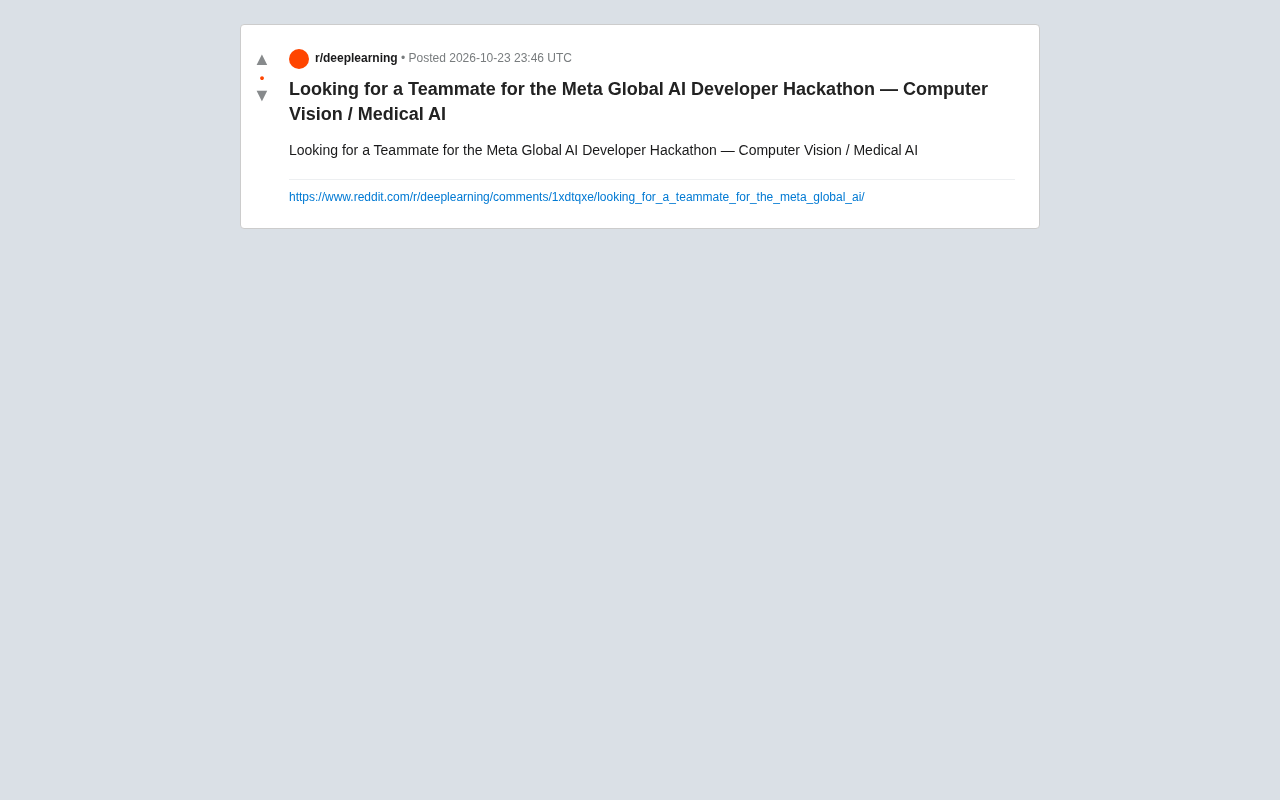
Teammate Wanted for Meta Global AI Developer Hackathon: Computer Vision & Medical AI
A Reddit developer seeks teammates for the Meta Global AI Developer Hackathon, focusing on computer vision and medical AI. This article analyzes the track logic, skills-complementarity needs, and topic selection strategy behind this teaming signal.
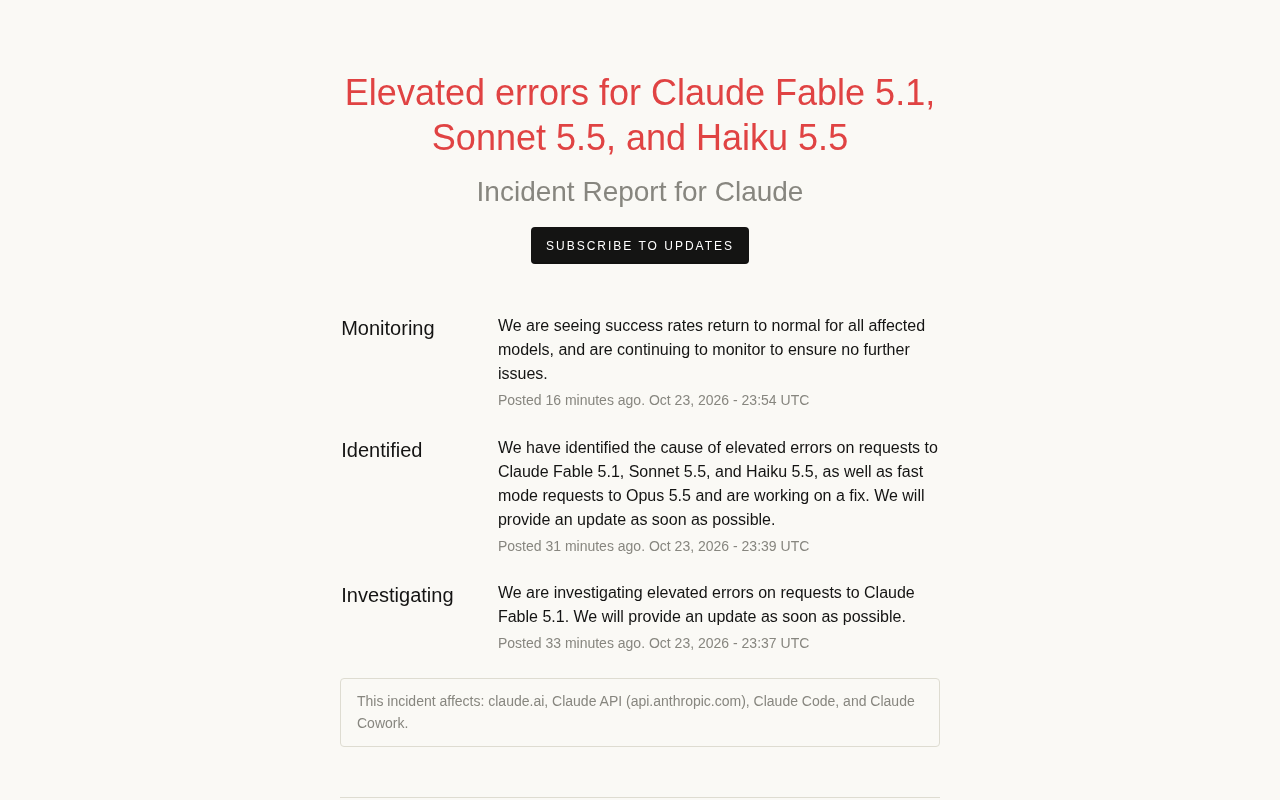
Multiple Claude Models Hit by Errors: A Postmortem of Fable 5.1, Sonnet 5.5, and Haiku 5.5
Claude Fable 5.1, Sonnet 5.5, Haiku 5.5, and Opus 5.5 fast mode saw elevated errors; Anthropic identified and resolved the issue in 17 minutes. This postmortem covers the timeline, the technical reasons for the multi-model cascading failure, and practical lessons for retry and degradation strategies.