oxpecker: Pinpointing the Exact Lines of Code Broken by Vendor API Changes
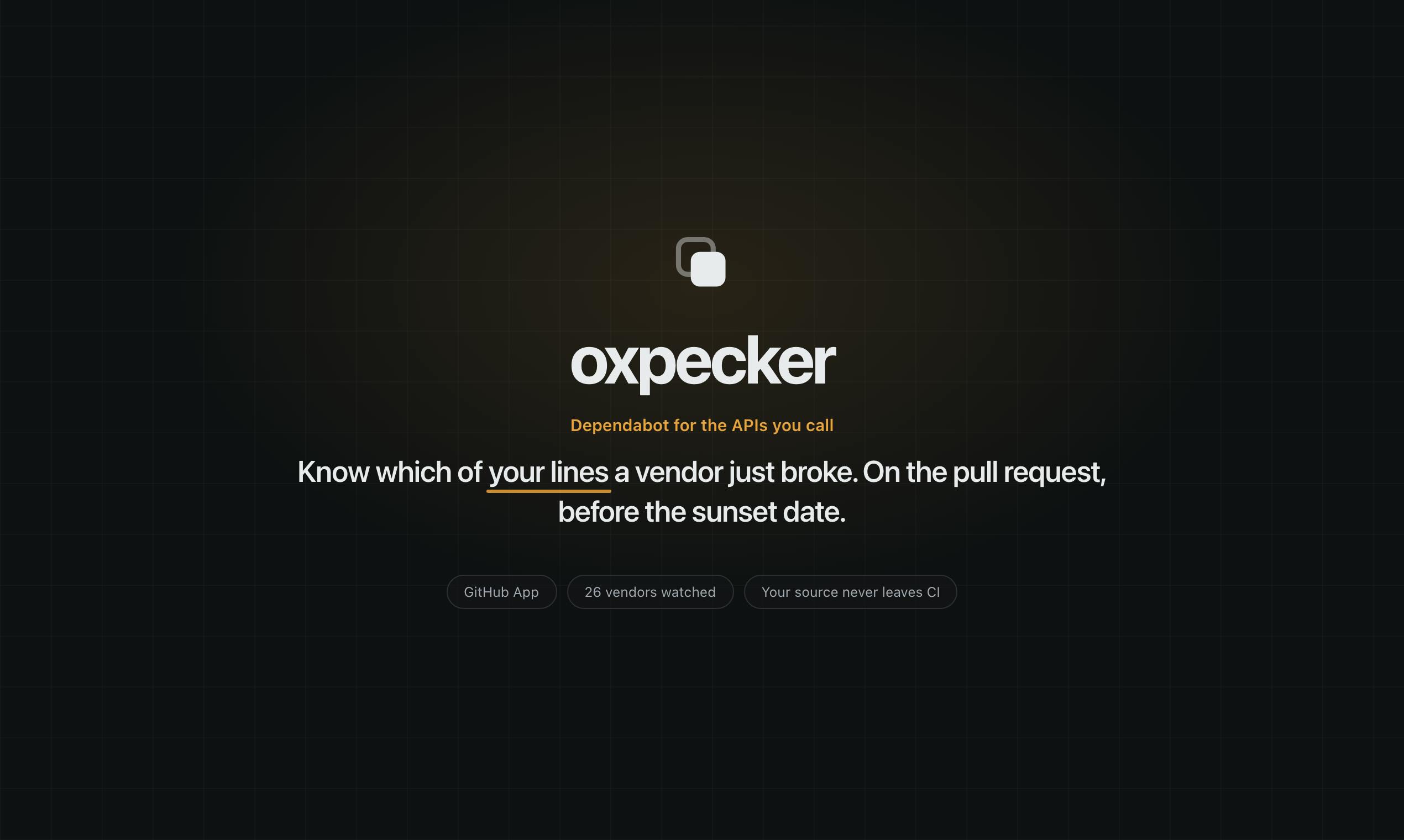
oxpecker pinpoints the exact code lines affected by vendor API changes, catching issues at PR time.
oxpecker is a developer tool that goes beyond simple API change notifications by identifying the specific lines of code impacted by vendor API changes. Integrated into CI/CD workflows at the PR stage, it monitors 26 vendors while keeping source code within your CI environment. This shift-left approach helps teams proactively fix breaking changes before deprecation deadlines, filling a critical gap between dependency management tools and API monitoring services.
When Vendor API Changes Become a Developer's Nightmare
For any modern software team that relies on third-party services, vendor API changes are practically an unavoidable reality. Stripe tweaks a payment endpoint, Twilio deprecates a certain route, AWS modifies a response format — these changes happen every day. The problem isn't the changes themselves, but the fact that developers often don't realize their code has been silently broken until something goes wrong in production or a sunset date is just around the corner.
In API lifecycle management, a "sunset date" is the final deadline by which a vendor commits to discontinuing a specific API version or endpoint. This concept originates from the HTTP Sunset Header (RFC 8594) proposed by the IETF, which allows API providers to declare a resource's planned retirement date in the HTTP response headers. Major vendors like Stripe use rolling version strategies, typically issuing deprecation notices 12–24 months in advance, while AWS manages changes through versioned APIs and service announcements. In practice, however, many development teams don't actively subscribe to these changelogs — or even if they do, they lack a systematic impact assessment process, leaving them scrambling as deadlines approach.
Recently launched on Product Hunt, the developer tool oxpecker offers an elegantly targeted solution for this exact pain point. Its tagline cuts right to the heart of the matter: "know which of your lines a vendor just broke." After launch, it received 68 upvotes, ranking 18th for the day, and was categorized under SaaS, Software Engineering, and Developer Tools.
oxpecker's Core Philosophy: From "Notifying Changes" to "Pinpointing Impact"
oxpecker draws a critical distinction in its product positioning. As the official description puts it: "Six products will tell you Stripe changed. oxpecker tells you which of your lines it broke."
The Limitations of Traditional API Change Notification Tools
There are already quite a few services on the market that monitor vendor changes. Most of them stop at the "notification" level: a certain API is being deprecated, a field has changed, a service will be discontinued on a specific date. While this information is valuable, it's still only half the story for developers — you still need to manually comb through your codebase, checking each call that might be affected. In large projects, this is an extremely tedious and error-prone task.
The root cause of this problem is that, unlike open-source package dependencies, changes to SaaS APIs — these "runtime dependencies" — aren't reflected in lock files or dependency trees. Their impact is hidden within the specific calling patterns in your business logic code: a renamed field, a deprecated endpoint, or a restructured response can cause runtime errors without any warning. While tools like Dependabot, Snyk, and Renovate have done an excellent job solving version updates and security vulnerability management for open-source package dependencies, the industry has long lacked mature automation tools for runtime dependency changes at the API level. This is precisely the toolchain gap oxpecker aims to fill.
oxpecker's Differentiator: Precision Down to the Line of Code
oxpecker's core competitive advantage lies in pushing monitoring granularity down to specific lines of code. It doesn't just tell you "Stripe changed" — it points directly to "line xx in your code will break because of this." More importantly, this detection is shifted to the Pull Request (PR) stage, meaning problems are surfaced before merging into main, before deploying to production, and before deprecation deadlines arrive.
This "shift-left" detection philosophy aligns precisely with the direction championed by modern DevOps practices. Shift-Left was first proposed by Larry Smith in 2001, and its core idea is to move activities like testing, security checks, and quality validation from later stages of the software development lifecycle (deployment and operations) to earlier stages (coding and integration). Typical shift-left practices include integrating static analysis in the IDE, running automated tests at the PR stage, and executing security scans in CI pipelines. Research shows that the earlier a defect is discovered, the lower the cost to fix it — fixing a bug in production can cost 10 to 100 times more than during the development phase. By embedding vendor API compatibility checks into the PR workflow, oxpecker represents a concrete application of this philosophy in the domain of API dependency management.
Monitoring 26 Vendors, With Source Code Never Leaving Your CI
oxpecker currently claims to monitor changes across 26 vendors. Although the official materials don't list them all individually, given the prominent mention of Stripe, it's reasonable to infer these vendors span the mainstream platforms developers rely on most heavily — payment, communications, cloud services, and more.
Security by Design: Your Source Code Never Leaves Your CI
In an era of heightened data security sensitivity, oxpecker places special emphasis on one point: "your source never leaves your CI." This design choice is crucial for enterprise users.
CI/CD (Continuous Integration/Continuous Deployment) is the core infrastructure of modern software delivery, with major platforms including GitHub Actions, GitLab CI, Jenkins, CircleCI, and others. When running code analysis tools in these environments, the storage location and transmission of source code is a topic of intense focus for enterprise security teams. Traditional SaaS code analysis tools require uploading source code to cloud servers for scanning, which under compliance frameworks like SOC 2, HIPAA, and GDPR may constitute a data breach risk. As a result, an increasing number of code analysis tools in recent years have adopted a "local execution, remote reporting" architecture — the analysis engine runs as a CLI tool or Docker container within the customer's own CI environment, transmitting only analysis results (not source code) back to the SaaS platform for display.
oxpecker adopts exactly this architecture, completing analysis within the customer's own CI environment. This ensures detection capability while eliminating concerns about source code leakage. This design is particularly friendly to industries with strict code confidentiality requirements, such as finance and healthcare, and makes it easier to pass security reviews during enterprise procurement decisions.
Native Integration Designed for CI/CD Workflows
Looking at how the product works, oxpecker is essentially a detection step deeply embedded in CI/CD workflows. Its value delivery path roughly follows this pattern:
- Continuous Monitoring: Tracks API changes, field modifications, and deprecation plans across 26 vendors in the background;
- PR-Level Detection: Automatically scans code and cross-references affected vendor calls when a developer submits a Pull Request;
- Precise Pinpointing: Directly flags which lines of code will break due to vendor changes;
- Early Warning: Issues alerts before deprecation deadlines, giving teams ample time to fix issues.
This model transforms what was previously passive, reactive "firefighting" operations into proactive, upstream quality assurance, significantly reducing the risk of production incidents caused by third-party API dependency changes. From a technical implementation perspective, oxpecker likely uses static code analysis (AST parsing) combined with API schema diffing — first parsing the patterns of external API calls in the code (endpoint URLs, request parameters, response field references, etc.), then matching them against vendor API change records, and finally locating the specific affected code positions.
Conclusion: Solving the Last Mile of API Dependency Management
oxpecker was built by independent developer Ibrahim Chhipa and is a quintessential developer tool that "solves a specific, real pain point." Rather than trying to be an all-encompassing platform, it focuses on doing one thing deeply and thoroughly: pinpointing the impact of vendor changes.
For teams that heavily depend on third-party APIs, this type of tool can eliminate potential disruption risks before code is even merged — and the stability gains it delivers often far outweigh its cost. Of course, as a newly launched product, its actual detection accuracy, coverage of niche vendors, and performance in complex codebases still await validation through broader real-world use. But from a product philosophy standpoint, oxpecker has undoubtedly identified a "last mile" problem overlooked by mainstream tools — between open-source dependency management (Dependabot/Snyk), API monitoring (Postman/Datadog), and change notification services, there exists a gap for line-level impact analysis. oxpecker targets this precise niche and is well worth a try for development teams focused on supply chain dependency management.
Related articles
Cursor Tutorial: Building a Python Student Management System from Scratch with AI
Learn Cursor AI editor's Agent, Ask, and Manual modes with a hands-on demo building a Python student management system using Claude, from tech stack selection to deployment.
NotebookLM Usage Limits Are Here: A Complete Guide to Google's Flexible Quota System
Google introduces flexible usage limits for NotebookLM. Learn how the new quota system affects free and paid users, and what it means for the AI industry's shift toward sustainable operations.

AI Agent Performance Optimization in Practice: Three Key Upgrades That Dramatically Improved Output Quality
Deep dive into three key AI Agent upgrades: eliminating silent failures, setting approval gates, and sub-agent parallel processing. Practical tips for building trustworthy automated workflows.