Periscope: Wrap Any Work into an API with AI

Periscope uses AI Agents to simulate screen operations on a cloud desktop, wrapping natural language tasks into callable API endpoints.
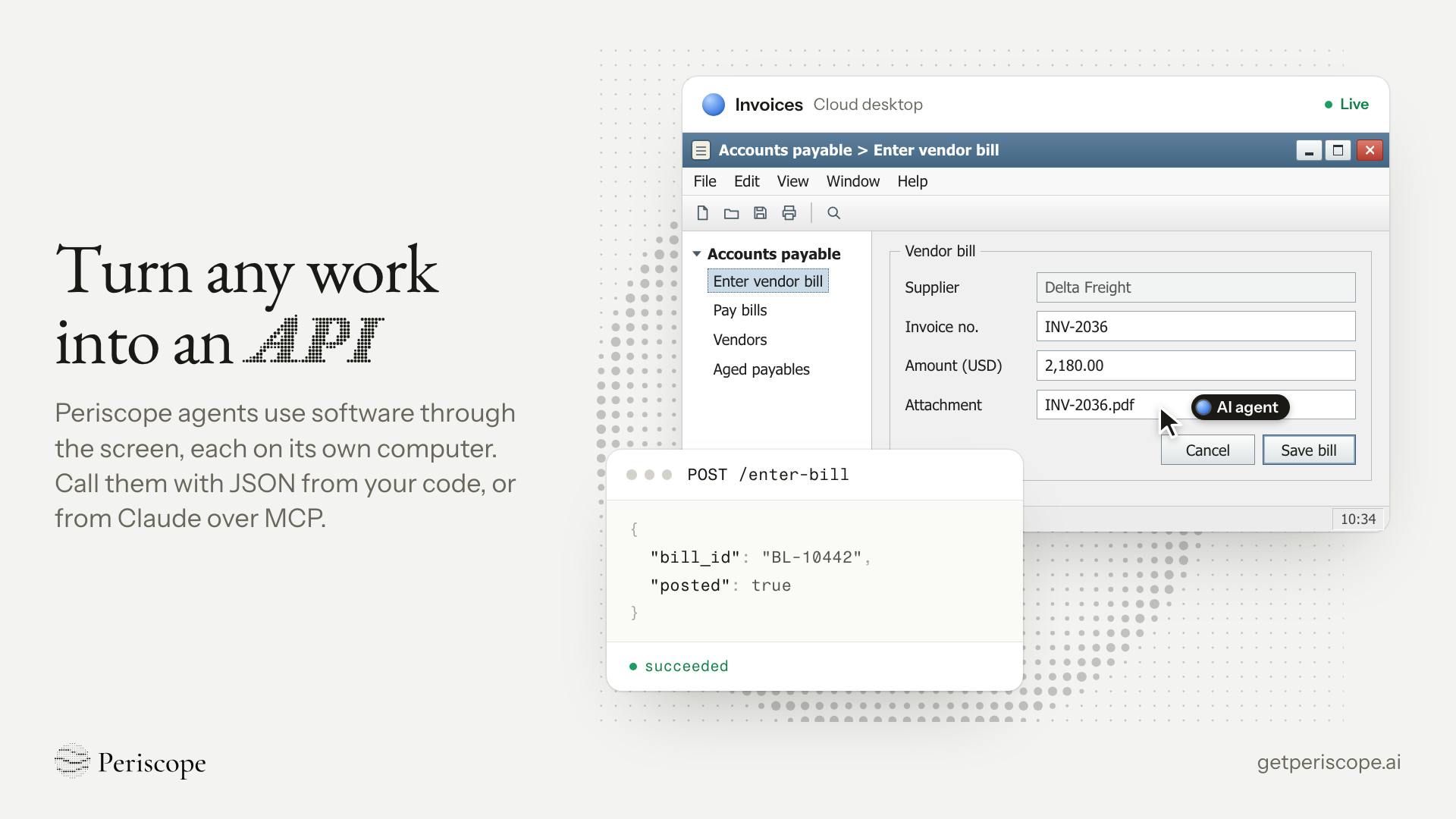
Periscope is a product launched on Product Hunt with the tagline "Turn any work into an API." After users describe a task in natural language, Periscope generates a dedicated REST API endpoint, also triggerable via the MCP protocol from tools like Claude, ChatGPT, or Cursor. The AI Agent operates target software through screen interaction in a cloud desktop, simulating human clicking, typing, and navigation, so it doesn't rely on the target software providing an open API and is theoretically applicable to any software, old or new, including legacy systems with only a graphical interface. It received 99 upvotes, ranked 4th, targets developers and technical teams, and offers a free plan with no credit card required. Its vision is to reduce the cost of building automated workflows, but the screen-operation model still faces practical challenges in interface changes, stability, and observability.
Core Concept: Wrapping Tasks into APIs with AI Agents
Periscope launched on Product Hunt with the tagline "Turn any work into an API." Its core logic is simple: a user describes a task, and Periscope returns a directly callable API endpoint. The AI Agent behind it operates the screen like a human on its cloud desktop to complete the task.
This approach breaks away from the limitations of traditional RPA or tool integration platforms that rely on underlying interfaces, attempting to replace API integration with "visual operation" so that any software—old or new—can become a programmable service.
RPA (Robotic Process Automation) is a technology that uses software robots to simulate human operations on a computer (such as clicking, typing, copy-pasting) to execute repetitive tasks. Traditional RPA typically relies on recording user interface elements (such as button IDs or coordinates) to drive automation, making it sensitive to interface changes and often requiring separate configuration for each application. The "AI Agent + screen visual operation" approach represented by Periscope can be seen as an intelligent evolution of RPA: it does not rely on pre-recorded scripts or fixed interface element localization, but instead uses computer vision and large language models to understand screen content in real time and decide the next action. The advantage of this approach is stronger generalization capability—it can handle unseen interfaces and workflows; the cost is that execution speed and stability may not match the deterministic scripts of traditional RPA, and it is more prone to errors in complex or dynamic interfaces.
How It Works: An Automation Agent on a Cloud Desktop
According to the official description, Periscope's workflow can be summarized in three steps:
- Describe the task: The user explains the operation to be performed in natural language, such as "download the latest report from a certain backend system" or "create a record in the CRM."
- Generate an endpoint: Periscope creates a dedicated API endpoint for the task, which users can call via REST or trigger from tools like Claude, ChatGPT, or Cursor through the MCP protocol.
- Agent execution: The AI Agent runs in the cloud desktop provided by Periscope, operating the target software through screen interaction, simulating human clicking, typing, and navigation.
This "watch the screen and operate" approach means it does not require the target software to provide an open API, nor does it require the software to be a modern web application—even legacy clients with only a graphical interface can theoretically be driven by the agent.
Key Features and Positioning
Periscope received 99 upvotes and 6 comments on Product Hunt, ranking 4th, categorized under API, Developer Tools, and Artificial Intelligence. These tags indicate that its target users are developers and technical teams, especially those who need to connect internal tools or legacy systems into automated workflows.
Notably, it supports both REST and MCP invocation methods. MCP (Model Context Protocol) is a protocol that has recently emerged in the AI ecosystem, allowing AI models to securely call external tools. By exposing its capabilities in MCP form to Claude, ChatGPT, and Cursor, Periscope means users can naturally trigger workflows through conversation without writing additional integration code.
Additionally, Periscope offers a free plan with no credit card required, lowering the barrier to trial. For teams wanting to validate whether a specific workflow is feasible, this is a low-risk entry point.
MCP (Model Context Protocol) is an open protocol launched by Anthropic in late 2024, designed to provide a standardized way of connecting AI models with external tools and data sources. MCP can be understood as the "USB-C interface for AI applications": developers only need to implement an MCP server according to the protocol, and AI clients that support it (such as Claude Desktop, Cursor, etc.) can securely discover and call these tools without writing separate integration code for each client. By exposing its capabilities in MCP form, Periscope means users can describe their needs directly in a conversational interface, and the AI model automatically calls the API endpoints generated by Periscope to complete tasks, seamlessly connecting "conversation" with "operating software." This lowers the barrier for non-technical users to use automation capabilities and aligns with the trend of standardizing tool invocation in the AI ecosystem.
Potential and Challenges
Periscope's vision is appealing: using AI agents to bridge the gaps between software, turning "a person operating a screen" into a programmable API. If mature, it would significantly reduce the cost of building automated workflows, especially for systems that lack APIs, have incomplete documentation, or whose vendors are uncooperative.
However, this model also faces inherent challenges. Screen operation relies on computer vision and UI understanding; when faced with interface updates, complex interactions, or unexpected pop-ups, the agent's stability may not match direct API calls. In addition, cloud desktop latency, authorization compliance, and observability of task execution are all concerns for developers. Whether Periscope can provide sufficiently reliable results in real-world scenarios still needs more user practice to verify.
Judging from the Product Hunt feedback, the community has expectations for the direction of "using AI agents to replace traditional integration." Periscope's free plan is a good starting point, but whether the product can ultimately win developers' trust depends on its success rate and debuggability in real workflows.
Computer vision and UI understanding are the core technical支撑 for Periscope-style agents. The agent needs to capture screen images of the cloud desktop in real time, identify interface elements such as buttons, input fields, menus, and pop-ups, and understand their semantics and hierarchical relationships in order to decide where to click and what to input. This typically involves optical character recognition (OCR), object detection, image segmentation, and the visual question-answering capabilities of multimodal large models. Compared with direct API calls, the advantage of the visual approach is its strong generality—any software that can be displayed on a screen can be operated; but the challenges are also obvious: interface resolution, scaling, dynamic loading, non-standard controls, pop-up occlusion, and other factors all affect recognition accuracy. In addition, the agent needs a certain amount of "world knowledge" to understand business context (for example, knowing that a "Submit" button usually means completing a form) and to fall back or ask for help when encountering exceptions. The maturity of these capabilities directly determines Periscope's success rate in real workflows.
One-line Summary
Periscope uses AI Agents to simulate screen operations on a cloud desktop, wrapping natural language tasks into callable API endpoints.
Paragraph Summary
Periscope is a product launched on Product Hunt with the tagline "Turn any work into an API." After users describe a task in natural language, Periscope generates a dedicated REST API endpoint, which can also be triggered from tools like Claude, ChatGPT, or Cursor through the MCP protocol. The AI Agent behind it operates the target software through screen interaction in a cloud desktop, simulating human clicking, typing, and navigation, so it does not depend on the target software providing an open API and is theoretically applicable to any software, old or new, including legacy systems with only a graphical interface. The product received 99 upvotes, ranked 4th, positions itself for developers and technical teams, and offers a free plan with no credit card required. Its vision is to reduce the cost of building automated workflows, but the screen-operation model still faces practical challenges in interface changes, stability, and observability.
Related articles

A 19-Year-Old's Rental Horror Story: Ceiling Collapse, Bug Infestation, and the Lessons It Taught Me
At 19, my first off-campus rental brought bug infestations, no heat, a collapsed ceiling, and a ruined laptop with no renter's insurance. Here are the hard-won lessons for first-time student renters.

Veda Nurse's Cranial Nerve Exam: Why ASMR Role-Play Is Going Viral
Bilibili creator Veda's cranial nerve exam ASMR video goes viral, blending humor and sensory triggers through nurse role-play. This article analyzes its unique appeal and the audience psychology behind ASMR role-play.

LG Cinebeam AI Review: 120-Inch Giant Screen + 3000 Lumens, a New Choice for the Living Room Theater
LG Cinebeam AI projector review: 3000 ANSI lumens, 4K, 100 inches from about 8 cm and 120 inches from about 18 cm. Built-in webOS, AI Concierge voice recommendations, AI Sound Pro 11.1.2 virtual surround, and Game Optimizer—positioned for fixed living room installation, complementing the portable Cinebeam S.