Playwright's Three Test Agents: A Deep Dive into Planner, Generator, and Healer

Playwright launches Planner, Generator, and Healer agents to automate the full testing lifecycle.
Playwright introduces three AI-powered Test Agents—Planner for test design, Generator for script creation, and Healer for auto-repairing broken locators. Deeply integrated with VS Code, Claude Code, Codex, and OpenCode via the MCP protocol, these agents transform automated testing from tool-assisted to agent-collaborative, significantly reducing script writing and maintenance burden for test engineers.
Playwright Introduces Three Test Agents
For test engineers, writing and maintaining automated test scripts has always been a time-consuming and tedious task. Playwright's latest Test Agent feature aims to reshape this workflow using AI agents. This update introduces three purpose-built agents — Planner, Generator, and Healer — which together form a complete automation pipeline from test design to script generation and failure repair.
Background: Playwright and Modern Testing Frameworks Playwright is a modern end-to-end testing framework developed by Microsoft and open-sourced in 2020. It supports three major browser engines — Chromium, Firefox, and WebKit — and has quickly become a strong competitor to Selenium in the automated testing space. Compared to traditional frameworks, Playwright offers advanced capabilities such as auto-waiting, network interception, multi-tab support, and mobile emulation, with native support for TypeScript, JavaScript, Python, Java, and .NET. Its core design philosophy centers on reducing test flakiness through a stable Locator mechanism — Playwright's Locator API re-queries the DOM on every action, avoiding common errors like
StaleElementReferenceExceptionfound in traditional WebDriver implementations. This is also the technical foundation that enables the Healer Agent to function effectively. Notably, Playwright differs fundamentally from Selenium in its underlying communication protocol: Selenium relies on the WebDriver protocol to communicate with browser drivers via HTTP, while Playwright directly uses the Chrome DevTools Protocol (CDP) and native debugging protocols for each browser, achieving lower latency and richer browser control capabilities.
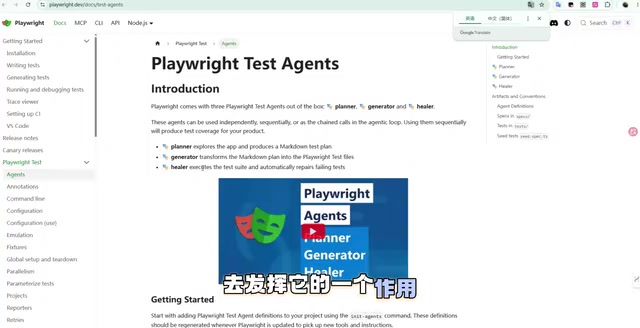
More importantly, these three Agents don't operate in isolation — they're deeply integrated into mainstream programming agent environments. Currently supported platforms include VS Code, Claude Code, Codex, and OpenCode. This means developers can invoke these capabilities directly from their familiar development environments without switching toolchains.
Background: The Programming Agent Ecosystem VS Code, Claude Code, Codex, and OpenCode represent the current mainstream AI programming agent ecosystem. VS Code has become the most widely used host for AI-assisted programming through GitHub Copilot and various extensions; Claude Code is Anthropic's command-line AI programming assistant, excelling at large-scale codebase understanding and modification; OpenAI Codex is a language model service optimized specifically for code generation; and OpenCode is an open-source AI programming agent for the terminal. Deeply integrating Test Agents into these environments means testing capabilities can be embedded as "Tool Use" within existing development workflows, rather than requiring a separate testing platform. This significantly lowers the adoption barrier and aligns with the industry trend of "Shift-Left Testing" — discovering and resolving quality issues as early as possible in the development cycle.
Technical Deep Dive: MCP Protocol and the Test Agent's Tool Invocation Mechanism The deep integration between Playwright Test Agents and programming agent environments relies on the MCP (Model Context Protocol), an open protocol standard. MCP was proposed and open-sourced by Anthropic in late 2024, aiming to establish standardized communication interfaces between AI models and external tools and data sources — similar to what the USB protocol means for hardware devices. MCP's core design includes three roles: the MCP Host (the host, i.e., programming environments like VS Code or Claude Code), MCP Client (responsible for communicating with tool services), and MCP Server (the capability provider, i.e., Playwright Test Agent). These three interact through standardized JSON-RPC message formats, enabling AI models to invoke testing tools, retrieve page states, and receive execution results in a structured manner. Through MCP, Playwright's three Agents can be called as standard "Tools" by any compatible AI programming environment without developing a separate adaptation layer for each platform. This design gives Test Agents excellent extensibility — even if new programming Agent platforms emerge in the future, they can seamlessly integrate Playwright's testing capabilities as long as they support the MCP protocol. This is the underlying reason Playwright can simultaneously support VS Code, Claude Code, Codex, and OpenCode.
The Division of Labor Among the Three Agents
Concept Explained: AI Agents and Automated Testing An AI Agent is a software entity capable of perceiving its environment, making autonomous decisions, and executing actions to achieve goals. Unlike purely generative AI models, it can not only answer questions but also invoke tools, access external systems, and complete multi-step tasks. An Agent's core loop is typically described as "Perceive-Reason-Act": for Playwright Test Agents, "Perceive" corresponds to reading the page DOM and accessibility tree, "Reason" corresponds to the LLM's understanding of test intent and page semantics, and "Act" corresponds to generating locator code or performing repair operations. Introducing Agents into software testing isn't an entirely new concept, but breakthroughs in Large Language Models (LLMs) have given them the genuine ability to understand page semantics and generate structured code. Other testing platforms in the industry, including Applitools, Testim, and mabl, are also actively exploring similar directions, signaling that automated testing is evolving from "rule-driven" to "intent-driven."
It's worth noting that Playwright's three Agents employ a clear separation of responsibilities rather than a single "do-it-all Agent" handling every aspect. This division has sound engineering rationale: a single Agent would need to simultaneously maintain test design knowledge, code generation capabilities, and failure diagnosis logic within its context window, which could easily lead to degraded reasoning quality. Specialized Agents can optimize their prompt templates and tool invocation strategies for their respective tasks, maintaining cross-Agent semantic consistency through structured context passing (Planner's test plan → Generator's code baseline → Healer's diff comparison). This aligns with the "Single Responsibility Principle" in software engineering.
Planner: Analyzing the Product and Creating Test Plans
Planner is the starting point of the entire workflow. Its responsibility is to analyze the application under test, understand the page structure and business logic, and output a detailed test plan. Taking an e-commerce order page as an example, users simply need to invoke Planner in Codex with a simple prompt describing the test objective, and the Agent can quickly produce a structured test plan document.

The value of this step lies in transforming test design — an activity that traditionally relies heavily on engineer experience — into standardized output that can be assisted by AI. Testers can adjust the prompts according to actual business needs to obtain test plans that better fit their scenarios.
Deep Dive: The Role of Prompt Engineering in Testing Scenarios Prompt Engineering refers to carefully designing natural language instructions given to AI models to guide them toward producing more accurate outputs that better match expectations. In testing scenarios, prompt quality directly determines whether the test plan generated by Planner covers critical business paths, boundary conditions, and exception scenarios. A vague prompt might only produce generic "happy path" tests, while a prompt designed with business scenarios in mind can guide the AI to consider permission validation, data boundaries, concurrent operations, and other in-depth scenarios. Experienced test engineers can leverage classic test design methodologies to structure their prompts: Equivalence Partitioning (grouping input data by processing method and taking representative samples from each group) can guide the AI to cover typical representatives of both valid and invalid inputs; Boundary Value Analysis (focusing on testing values near boundaries) can explicitly require coverage of critical conditions like "inventory exactly at zero" or "amount reaching the upper threshold"; and Decision Table Testing is suitable for guiding the AI to systematically identify multi-condition combination scenarios, such as the different handling paths for "unauthenticated user attempts checkout" versus "authenticated user with insufficient balance." Migrating these traditional test design skills into prompt design capabilities is a key path for test engineers to maintain their core competitiveness in the AI era — the skill focus is shifting from "knowing how to write XPath selectors" to "being able to accurately express test intent and verify the reasonableness of AI output."
Generator: From Test Plans to Executable Scripts
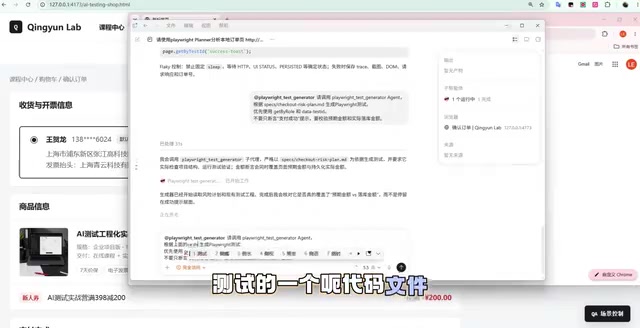
Once a test plan is in place, Generator is responsible for transforming it into actual executable test code. Interestingly, Generator doesn't work like traditional "record and playback" — it doesn't simply record user click actions. Instead, it automatically inspects the page structure, understands page elements, and generates test scripts based on that understanding.
Technical Comparison: Record & Playback vs. Understanding-Based Generation Traditional "Record & Playback" was the earliest implementation approach for automated testing: tools capture the user's mouse clicks, keyboard inputs, and other operation sequences, then convert them into replayable scripts. This approach has a low barrier to entry, but the generated scripts are highly dependent on absolute coordinates or specific attributes of UI elements — they're extremely prone to breaking whenever the interface changes, resulting in poor maintainability. Typical tools like early Selenium IDE recorded scripts heavily relied on fragile XPaths such as
//div[@class='btn-primary'][3], which would completely fail with even minor changes to the component hierarchy. "Understanding-based generation" leverages the LLM's comprehensive understanding of page DOM structure, ARIA semantic tags, and visual layout, prioritizing semantic locator strategies (such asgetByRole('button', { name: 'Submit Order' }),getByLabel('Shipping Address')). The generated scripts more closely resemble how human test engineers think and are more resilient to UI adjustments. Additionally, record-and-playback scripts typically lack meaningful assertions — the tool only records operations without knowing what the "correct state" should be after each action. Understanding-based generation can automatically infer what page states should be verified based on the test plan's intent, generating meaningfulexpectassertions.
Technical Deep Dive: The Underlying Mechanism of Page Understanding — DOM Parsing and the Accessibility Tree Generator's ability to "understand" page structure relies on comprehensive parsing of both the DOM (Document Object Model) and the Accessibility Tree. The DOM is the browser's structured representation of an HTML document, containing hierarchical relationships and attribute information for all elements. The Accessibility Tree is a further semantic refinement that browsers derive from the DOM, specifically designed to help assistive technologies like screen readers identify the role, name, and state of page elements. The Accessibility Tree follows the WAI-ARIA (Web Accessibility Initiative - Accessible Rich Internet Applications) specification, defining standardized role semantics for each type of UI component: for example,
<button>elements correspond torole="button", and<nav>corresponds torole="navigation". Even when the frontend uses custom<div>components, the Accessibility Tree can still identify their semantic roles as long as ARIA attributes are correctly added. Playwright has built-in native access to the Accessibility Tree (via thepage.accessibility.snapshot()interface), enabling the AI Agent to prioritize semantic selectors likegetByRole('button', { name: 'Submit Order' })when generating locators, rather than fragile CSS paths or XPaths. Semantic locators are more stable because even if the frontend refactors the button's styling or DOM hierarchy, the locator remains valid as long as the button's accessible name and role stay unchanged. This mechanism is also the technical prerequisite for Healer's ability to intelligently identify element changes — Healer can compare accessibility tree semantic snapshots to determine whether an element has "truly disappeared" or has simply "changed its locator but still exists."
This "understanding-based generation" is more intelligent than record and playback, and the generated scripts typically offer better readability and robustness. In the actual demo, Generator created corresponding test case files based on the order page's test plan, and all tests passed upon execution. While the quality of generated scripts still needs further validation in real-world projects, this automated approach has already significantly lowered the barrier to script writing.
Healer: Automatically Repairing Failed Test Cases
Among the three Agents, Healer is probably the one that most directly addresses test engineers' pain points. One of the most frustrating problems in automated testing is test failures caused by frontend element locator breakage — whenever the frontend modifies an element's locator attributes, related tests can fail en masse.

Deep Dive: Locator Breakage and Test Maintenance Costs Locators (Locator/Selector) serve as the "bridge" between automated test scripts and the application under test, typically identifying target elements based on attributes like element ID, CSS class names, XPath paths, or
data-testid. In real projects, frontend iterations are frequent — UI refactoring, component library upgrades, or simple styling adjustments can all cause locator breakage, triggering massive "false failure" reports across test cases. The industry refers to these as "Flaky Tests," and according to some research data, the time spent maintaining locators can account for 30%-50% of a testing team's total investment. Typical locator breakage scenarios include: the frontend changing a button from<button id="submit-btn">to<div data-testid="order-submit">(ID change); CSS modularization refactoring changing class names from.btn-primaryto.Button_primary__3xKj(hashed class names); and React or Vue component library version upgrades altering DOM hierarchy structures (XPath path invalidation). Playwright's Healer Agent specifically targets this pain point by using AI to automatically identify element changes and update locator strategies, automating work that previously required manual investigation one by one. Its core capability is to compare the current page's accessibility tree snapshot against the original locator's semantic intent when a test fails, searching for functionally equivalent new locator paths rather than simply "finding the most similar element."
Extended Understanding: Systemic Causes of Flaky Tests and the Boundaries of Healing It's important to note that locator breakage is only one cause of "flaky tests." The complete causal landscape also includes: asynchronous race conditions (tests attempting to interact with elements before they've finished loading, commonly seen during route transitions in single-page applications); environment differences (variations in CPU performance and network latency between local and CI environments causing animation timing changes); state pollution between tests (cookies, LocalStorage, or dirty database data left by a previous test affecting subsequent cases); and unstable third-party services (tests depending on external APIs being affected by network fluctuations). The Healer Agent currently addresses primarily the locator breakage category; other types of flakiness still require engineering teams to address on a case-by-case basis — for example, introducing explicit waits (
waitForSelector) to replace fixed delays (sleep), sandboxing test data (creating independent test accounts and datasets for each test case), and using Mock Service Worker to intercept and simulate third-party dependencies. Understanding these capability boundaries helps testing teams set reasonable expectations for Healer and avoid placing all hopes for test failure resolution on AI auto-repair. A healthy Flaky Test governance strategy should position Healer as an "automated tool for locator maintenance" rather than a "universal test stability solution."
In the demo, the author simulated a typical scenario: manually modifying a button's test ID, then restarting the service, which predictably caused the test case to get stuck at the corresponding step. Invoking Healer at this point, it was able to identify that the test ID had changed and automatically repair the locator. After the repair, running the tests again showed all cases passing. This capability has real significance for reducing maintenance burden and improving test stability.
Practical Implementation Experience
Looking at the entire demo workflow, the usage path for Playwright's three Agents is quite clear: first use Planner for test design → then use Generator to create scripts → use Healer to repair when failures occur. The installation process is also straightforward — the author chose to install on Codex, with simple commands and fast setup.
The biggest highlight of this workflow is that it delegates the three most time-consuming aspects of automated testing — test design, script writing, and failure maintenance — to dedicated agents. The ability to automatically repair broken locators is particularly valuable, as it can relieve testing teams of a significant amount of repetitive work.
When implementing in practice, one dimension worth paying attention to is the review mechanism for AI-generated code. While Generator's test scripts can pass on the first run in feature demos, in real projects, the AI may misunderstand business logic — for example, misinterpreting "verify order status is 'paid'" as "check that the page contains the word 'payment'," resulting in assertions that are too loose and allow actual defects to slip through. It's recommended that teams establish a Code Review mechanism alongside Test Agent adoption, subjecting AI-generated test scripts to the same review standards as business code to ensure assertion semantic accuracy and coverage adequacy.
A New Direction for Automated Testing Evolution
Playwright's update reflects the trend of automated testing evolving from "tool-assisted" to "Agent-collaborative." Traditional testing frameworks provide APIs and execution engines, while Test Agents go a step further, taking on responsibilities of understanding, decision-making, and repair.
This evolution is highly aligned with the "Shift-Left Testing" philosophy in software engineering — by embedding test design and execution into the development workflow as early as possible, it reduces the cost of defects being discovered late. The emergence of Test Agents means this "shift left" no longer requires engineers to spend extensive time manually writing preliminary test cases — instead, tests can be generated and maintained instantly as feature development progresses.
Historical Context: The Evolution of Shift-Left Testing and Its New Agent-Driven Phase The concept of "Shift-Left Testing" was proposed by Larry Smith around 2001. Its core idea is to move testing activities from later stages of the software development lifecycle forward to the requirements analysis and coding stages, discovering defects earlier at lower cost. Historically, shift-left testing has gone through several typical phases: Phase 1 was the popularization of unit testing culture (the rise of TDD/BDD methodologies, with tests written alongside code); Phase 2 was automated test gating in CI/CD pipelines (automated tests triggered on every commit to prevent regressions); Phase 3 was quality assurance for microservice interfaces through Contract Testing (e.g., the Pact framework, where interface changes between services are caught before integration). The emergence of Playwright Test Agents marks the arrival of Phase 4 — "Agent-driven shift-left": testing no longer requires engineers to spend dedicated time writing test cases after feature completion. Instead, AI Agents can generate and maintain tests in real-time alongside the feature development process. The deeper implication of this shift is that the marginal cost of testing activities drops dramatically — theoretically, every feature increment can be accompanied by corresponding automated verification, refining quality gates down to the individual commit level. From an economics perspective, defect repair costs increase exponentially with how late they're discovered — defects found during requirements cost approximately 1x, during coding approximately 6x, during testing approximately 15x, and after release approximately 100x. Agent-driven shift-left, by compressing the time gap between "feature complete" and "test ready," can theoretically significantly reduce overall quality costs.
For test engineers, this represents both opportunity and challenge. On one hand, tedious script writing and maintenance work can be delegated to AI, freeing engineers to invest their energy in higher-value test strategy and quality governance. On the other hand, how to write effective prompts, how to review AI-generated scripts, and how to judge whether Healer's repairs are reasonable in critical scenarios are becoming essential new skills. This transformation closely parallels the evolution in Site Reliability Engineering (SRE) — SRE engineers evolved from manual operations executors to automation system designers and reliability strategy architects. Test engineers similarly face a role transition from "script writers" to "quality strategists," with core competitiveness reflected in precise expression of test intent, critical review of AI output, and systematic management of overall quality risk.
Overall, Playwright's three Test Agents represent a direction well worth deep study and practical implementation for test engineers. They may not immediately replace manual work, but they genuinely open up new possibilities for improving automated testing efficiency. Interested readers can consult the official documentation and try it hands-on with their own project scenarios.
Related articles

Cloudflare Wallets: Technical Analysis and Future Prospects of Programmable Wallets for AI Agents
Deep dive into how Cloudflare Wallets provides programmable wallet capabilities for AI agents, using rule-driven payment authorization to solve trust and efficiency challenges in the agentic internet.

DeepSeek V4 Pro: Why the Open-Source LLM Community Is Eagerly Waiting
DeepSeek V4 Pro sparks open-source community buzz. Analysis of DeepSeek's V2-to-V3 evolution, MoE architecture cost advantages, and what developers should expect from the next-gen open-source LLM.

The Real Efficiency Bottlenecks for AI Developers: It's Not the GPU — It's These Overlooked Areas
AI developers often think a bigger GPU will boost efficiency, but the real bottlenecks are often RAM, storage, networking, and workflow. Discover the overlooked upgrades that deliver the highest ROI.