Pomerado: Turn Any Website into an Agent-Callable API

Pomerado turns websites into MCP tools or APIs, letting AI Agents bypass browser automation to directly call external services.
Pomerado is the #5 ranked open-source tool on Product Hunt that converts websites lacking official APIs — such as Google Flights, Zillow, and Instacart — into MCP tools or native APIs, letting AI Agents access external services like local functions. It offers all-in-one integration lifecycle management covering build, host, authenticate, and maintain, aiming to bypass the pain points of fragile DOM selectors and anti-scraping mechanisms in traditional browser automation. The article argues that its elevated abstraction aligns with the direction of Agent toolification, but the real test lies in long-term maintenance capability — whether it can continue running reliably after website redesigns still needs real-world validation.
When Browser Automation Meets MCP: What Problem Does Pomerado Solve?
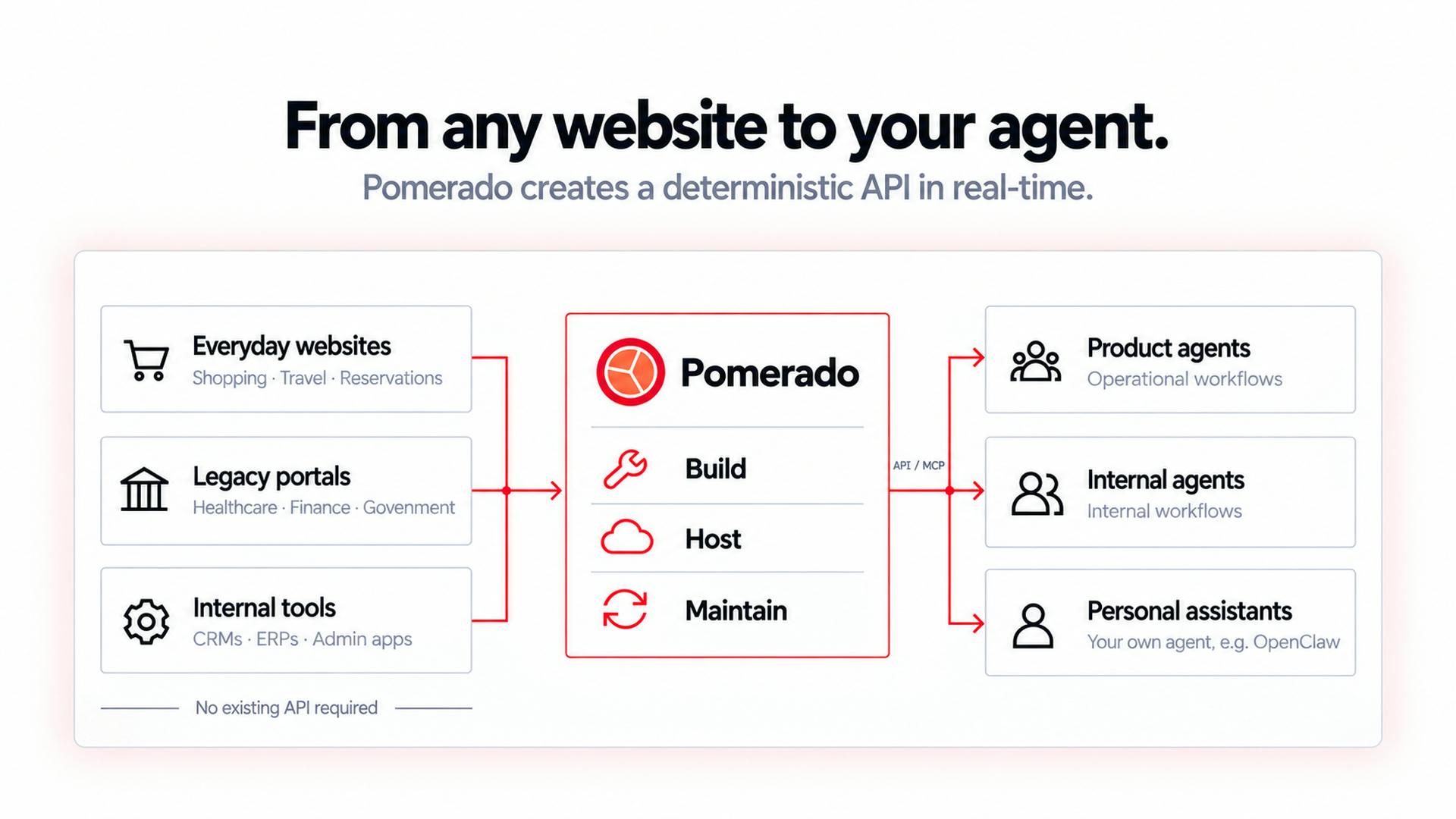
Having an AI Agent operate web pages sounds wonderful in theory, but in practice it's often frustrating. Traditional browser automation approaches either rely on fragile DOM selectors or are constrained by anti-scraping mechanisms. Once the target website is redesigned or tightens its risk controls, the entire automation pipeline can collapse.
Pomerado, ranked #5 on Product Hunt, attempts to sidestep these troubles with a different approach: rather than having the Agent "click" through web pages in a browser, it directly converts websites into MCP (Model Context Protocol) tools or native APIs, letting the Agent access external services the same way it calls local functions. In their own words, they turn "previously inaccessible" websites like Google Flights, Zillow, Instacart, and various legacy portals into native tools for Agents.
This positioning hits a real pain point — an Agent's capability boundary is largely determined by how many external services it can reach.
MCP (Model Context Protocol) was introduced by Anthropic at the end of 2024. It's an open protocol that standardizes how large language models interact with external tools and data sources. Before MCP, connecting an Agent to external services typically required writing custom function calling logic for each tool — formats varied and reusability was poor. By defining unified interfaces for context description, tool invocation, and resource retrieval, MCP allows the same Agent framework to plug and play different tool services. The industry often compares it to the "USB-C port of the AI application layer." Pomerado's choice to output MCP tools rather than proprietary API formats means it can directly integrate with clients already supporting MCP, such as Claude Desktop and Cursor, eliminating adaptation costs.
Core Mechanism: Build, Host, Authenticate, Maintain — All-in-One
Pomerado emphasizes a complete integration lifecycle management, not just a conversion tool.
According to its description, this open-source tool handles four stages: Build (converting target websites into APIs/MCP), Host (running these integrations), Authenticate (handling login and credentials), and Maintain (responding to website changes). This means developers don't need to build their own scraping infrastructure or continuously track structural changes on target sites.
For Agent applications that depend on external data sources, the "maintenance" stage is often the most labor-intensive and most easily underestimated hidden cost. Website redesigns, API changes, CAPTCHA upgrades — each of these can break automation workflows. Pomerado incorporating this work into the tool's own responsibilities captures a genuine need for long-term operations.
As an open protocol championed by Anthropic, MCP is becoming one of the de facto standards for Agent-to-external-tool connectivity. Pomerado's choice of MCP as its primary output format shows it's targeting the mainstream integration approach in the current Agent ecosystem, rather than building a proprietary protocol from scratch.
Faster Browser Use: Bypassing Selector Hell
The other half of the product tagline is "Faster & reliable browser use." This suggests Pomerado's underlying execution doesn't completely abandon the browser, but rather seeks a better balance between reliability and speed.
Traditional approaches are slow because they're slow at "simulating humans" — waiting for elements to load, retrying clicks, handling pop-ups. Every step consumes time. Once a website is abstracted into an API, the caller only needs to care about inputs and outputs, while the underlying browser interactions are encapsulated and hidden. This layered design makes the Agent's calling logic cleaner and makes failure retries more systematic.
Of course, there's a boundary that needs to be viewed objectively: converting a website into an API is essentially still programmatic access to the target site. The target site's terms of service, anti-automation policies, and data compliance requirements remain unavoidable prerequisites. Pomerado's existence doesn't change these constraints — it merely reduces the friction of technical implementation.
DOM selectors are the core mechanism of browser automation. Scripts use CSS selectors or XPath to locate page elements (such as buttons and input fields) and trigger actions. The problem is that selectors are highly dependent on page structure. Once the frontend is redesigned, class names change, or element hierarchy is adjusted, the original selectors fail, causing the entire workflow to collapse — this is what the community calls "selector hell." Additionally, modern websites heavily use frameworks like React and Vue for dynamic rendering, making element appearance timing uncertain and requiring extra waiting and retry logic. Pomerado's approach is to have the underlying program absorb this instability, exposing only stable API semantics to the upper-layer Agent, thereby encapsulating fragility on the maintenance side.
Who Should Pay Attention to This Tool
Based on its positioning, Pomerado's ideal users are developers building Agent applications who struggle with not having stable external data access channels. Typical scenarios include travel price comparison, real estate information aggregation, grocery e-commerce ordering, and other tasks that require obtaining data through existing websites rather than official APIs.
For teams already using MCP to build Agent workflows, Pomerado provides a ready-made connector infrastructure layer. For teams still hardcoding scraping logic in scripts, it represents an opportunity for architectural upgrade.
Currently, the project has received 120 votes and 10 comments on Product Hunt. The community feedback volume isn't particularly large, and actual stability and maintenance effectiveness still need more real-world use cases to verify. Its open-source nature allows developers to try it on a small scale first, evaluating whether it can truly withstand long-term changes in target websites.
Product Hunt rankings and votes reflect community热度 on the product launch day, not long-term market performance. 120 votes is a medium-to-low level, indicating Pomerado hasn't yet attracted large-scale attention. The sample size is limited, and comments mostly focus on conceptual aspects rather than empirical data. When evaluating such tools, it's more worthwhile to pay attention to GitHub issue response speed, adaptation success rates for target websites, and whether there are public stability metrics. For production use, it's recommended to first select one or two non-critical target websites for several weeks of gray-scale validation, observing maintenance frequency and failure recovery capabilities, before deciding whether to include it in the core pipeline.
Commentary: Clear Concept, Success Hinges on Maintenance
Pomerado's approach is to transform "uncontrollable browser operations" into "controllable API calls." This elevation of abstraction aligns with the broader direction of Agent toolification. Its approach of packaging the integration lifecycle as a service also genuinely responds to developers' need for convenience.
But the real test isn't in the build stage — it's in maintenance. The proposition of converting websites to APIs has never lacked solutions that can run a demo; what's lacking are systems that can still work reliably months later. If Pomerado can truly deliver on "maintains your integrations," its value extends far beyond being just a conversion tool.
Related articles

AI Reverse-Engineers Monitor Firmware in 15 Minutes — Has the Hacking Barrier Been Flattened?
A security researcher used AI to reverse-engineer Dell monitor firmware in 15 minutes—entropy analysis, key extraction, MD5 verification—revealing encryption design flaws.

Mistral Voxtral 3: Real-Time Voice at 4 Cents per Minute, Challenging OpenAI
Mistral Voxtral 3 cuts real-time voice agent costs to 4 cents per minute, bundling three speech recognition models, a speech generation model, and a real-time voice toolkit, supporting 50+ languages and self-hosting. This article analyzes its pricing structure, sub-second response performance, and its strategic divergence from OpenAI and Gemini on data privacy versus out-of-the-box convenience.

WebMCP: Every Website as Its Own MCP Server, So AI Agents No Longer Rely on Screenshots
WebMCP lets websites expose tools via the document.modelcontext API, becoming directly callable MCP servers. This article explains its architecture, the Claude Code remote-debugging demo, Chrome's current support stage, and its impact on the agent ecosystem.