Python or JavaScript for LangChain Development? A Must-Read for Web Developers
Web developers learning AI Agents: ship with TypeScript first, treat Python as a long-term investment.
A JavaScript-savvy web developer wants to learn LangChain and LangGraph to build AI Agents, torn between Python and TypeScript. LangChain and LangGraph both grew up in the Python ecosystem first, with Python versions leading in docs, examples, release cadence, and community contributions—new features typically land in Python first. AI/ML job postings still assume Python, but TypeScript suits full-stack AI integration in existing products. The most pragmatic strategy is dual-stack: use TypeScript to quickly build a first Agent prototype and reuse existing engineering experience, while treating Python as a long-term skill to follow cutting-edge frameworks and research features. What truly determines success is understanding of Agent orchestration, state management, and tool calling—not the language itself.
A Web Developer's Real Dilemma
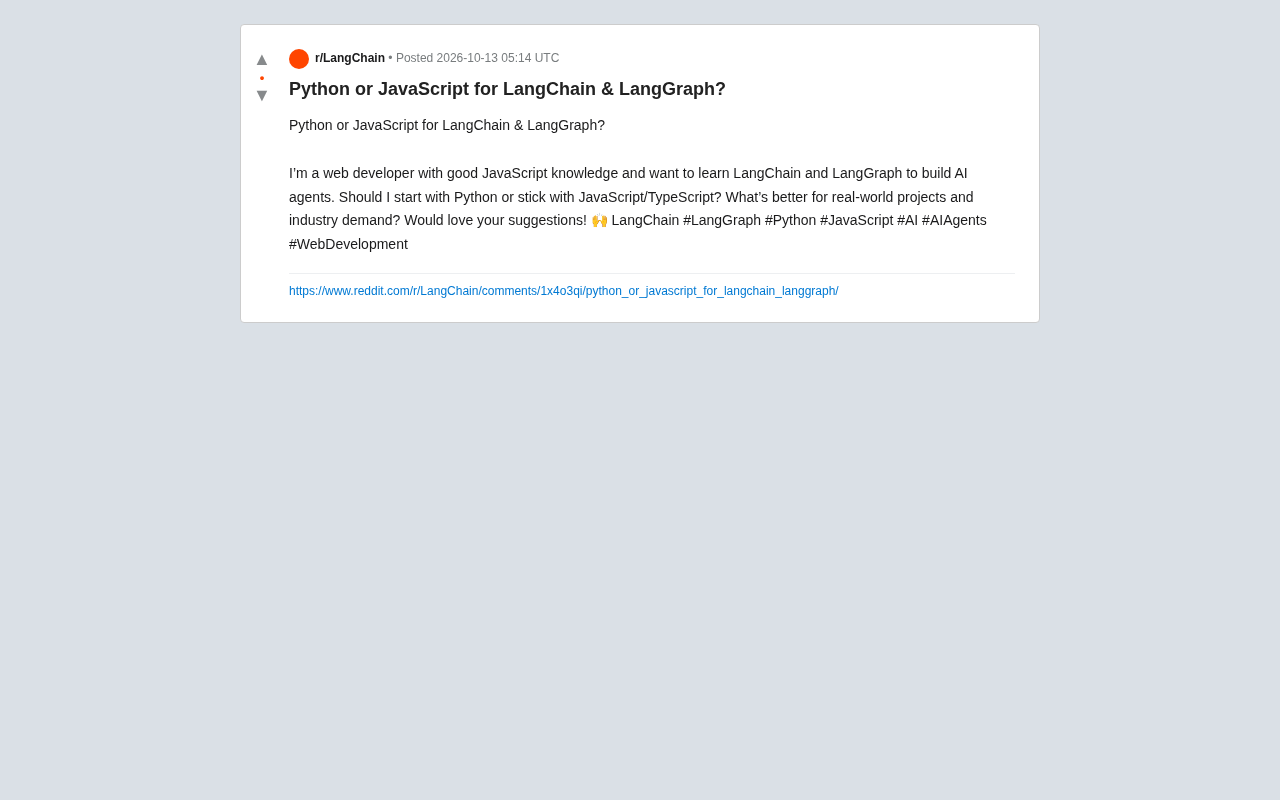
A developer on Reddit posed a very representative question: he's a web developer with a solid JavaScript foundation who wants to learn LangChain and LangGraph to build AI Agents, but isn't sure whether to start with Python or stick with JavaScript/TypeScript. What he cares about most is: which is better suited for real projects? Which aligns better with industry demand?
This question isn't just about "picking a language." Behind it lies ecosystem maturity, hiring market demand, framework support, and whether your existing tech stack can be directly reused.
Framework-Level Support Differences
LangChain and LangGraph both grew up first within the Python ecosystem. The Python versions typically have more complete documentation, richer examples, a faster feature release cadence, and a larger pool of community contributions. Many new features tend to land on the Python side first, then gradually get ported to the JavaScript/TypeScript versions.
This doesn't mean the JS version is unusable. For web developers familiar with TypeScript, LangChain.js and LangGraph.js can already support many common scenarios. But if your goal is to dive deep into Agent orchestration, complex state graphs, and keeping up with the latest research-oriented features, Python's first-mover advantage will persist.
LangChain is an open-source framework for building large language model (LLM) applications. It provides modular components such as model invocation, prompt management, memory, retrieval-augmented generation (RAG), and tool calling, helping developers organize scattered LLM calls into maintainable pipelines. LangGraph is an advanced framework introduced by the LangChain team, specifically designed for building stateful, multi-step Agent workflows. It models an Agent's execution logic as a State Graph: nodes represent specific processing steps (such as calling a model or executing a tool), edges represent the transition conditions between steps, and it supports loops, branching, human-in-the-loop, and persistent checkpoints. Compared to traditional chain-based invocation, LangGraph is better suited for complex Agent scenarios that require repeated reasoning, tool calls, and dynamic decision-making based on results—which is why it's regarded as a core tool for Agent orchestration.
Industry Demand and Hiring Reality
From a job demand perspective, AI/ML-related positions are still predominantly Python-based. In areas like data science, model fine-tuning, RAG pipelines, and Agent framework R&D, job descriptions almost universally assume Python proficiency. If you want to join an AI engineering team, Python is essentially unavoidable.
But web developers also have their own advantageous path. If your goal is to add AI capabilities to an existing product—such as integrating a conversational Agent into a Next.js app or building full-stack AI features—then TypeScript lets you accomplish the task within a single tech stack, reducing the cost of switching languages.
RAG (Retrieval-Augmented Generation) is one of the most common implementation patterns in AI applications today: before the model generates a response, it first retrieves document fragments relevant to the question from an external knowledge base (such as a vector database), then feeds those fragments as context to the model along with the question. This grounds the answer in real, up-to-date materials rather than relying solely on what the model memorized during training. A RAG pipeline typically involves document chunking, vector embedding, similarity retrieval, and prompt assembly. This kind of engineering is often tightly coupled with data science and backend services, so mainstream implementations and job requirements are largely centered around the Python ecosystem; although TypeScript has corresponding libraries, it still lags behind in maturity and community examples.
Already Have a JS Foundation—How Should You Choose?
If you're short on time and want to quickly ship a production-ready product, starting with LangChain.js in TypeScript is a reasonable choice. You can reuse your existing engineering experience, deployment pipeline, and debugging habits.
But if you plan to delve deep into AI Agents for the long haul, or want to participate in more cutting-edge framework development and research, it's advisable to pick up Python. Not to abandon JavaScript, but to build capabilities across both ecosystems. Many senior developers' approach is: use TypeScript for products and integration, and use Python for experimentation and keeping up with new capabilities.
For web developers, full-stack integration cost is an easily overlooked but crucial factor. Introducing AI capabilities into an existing Next.js or Node.js project with Python requires maintaining an additional backend service, cross-language interface definitions, and a separate deployment and debugging pipeline; with TypeScript, you can do it all within the same runtime, the same type system, and the same build process, and the frontend and Agent logic can even share type definitions. This "no language switching" advantage is especially pronounced in small teams and fast-iterating products. The trade-off, however, is that when you need newer model SDKs, fine-tuning tools, or research-oriented capabilities, you often have to wait for the JS version to catch up—or build the wrappers yourself.
Conclusion: It's Not Either-Or
For this web developer, the most pragmatic answer might be: start with TypeScript, build your first Agent prototype; at the same time, treat Python as a long-term investment. The framework capability gap will narrow as the ecosystem develops, but the industry's preference for Python won't disappear in the short term. What truly determines whether you can build great AI Agents isn't the language itself, but your understanding of Agent orchestration, state management, and tool calling.
One-line Summary
For web developers learning AI Agents: ship with TypeScript first, then treat Python as a long-term investment.
Paragraph Summary
A web developer with a solid JavaScript foundation wants to learn LangChain and LangGraph to build AI Agents, torn between Python and TypeScript. The article notes that LangChain and LangGraph both grew up first in the Python ecosystem, with the Python versions leading in documentation, examples, release cadence, and community contributions—new features usually land in Python first. In the hiring market, AI/ML roles still assume Python proficiency, but TypeScript is well-suited for full-stack AI integration in existing products. Therefore, the most pragmatic strategy is to work across both stacks: use TypeScript to quickly build your first Agent prototype and reuse existing engineering experience, while treating Python as a long-term skill to develop so you can keep up with cutting-edge frameworks and research-oriented features. What truly determines success is your understanding of Agent orchestration, state management, and tool calling—not the language itself.
Related articles

Gmod TTT: Boba's Winning Streak and Game Design Insights
An in-depth analysis of Gmod TTT's role system, creative items, and social gameplay mechanics, exploring the relationship between randomness design and game balance through Boba's winning streak phenomenon.

FlexBudget: Fair Comparison of KV Cache Eviction Strategies Under a Unified Compute Budget
AMD engineer proposes FlexBudget at PyTorch Conference: a training-free fair comparison method for KV cache eviction rules using fixed kernels and memory budgets, all in core PyTorch.
