quick-sandbox: A Lightweight Code Sandbox for Safe Execution in the AI Programming Era

quick-sandbox offers fast, lightweight code isolation designed for the AI programming era.
quick-sandbox is a lightweight code sandbox tool designed for AI programming workflows, providing sub-second startup times and isolated execution environments. It addresses the growing need for safe execution of AI-generated code, serving use cases including AI Agent code execution, programming education, and untrusted code testing. The tool balances isolation strength with developer convenience, representing the community's pursuit of fast, safe, and easy-to-use code execution infrastructure.
Introduction: From Quicksand to Sandbox
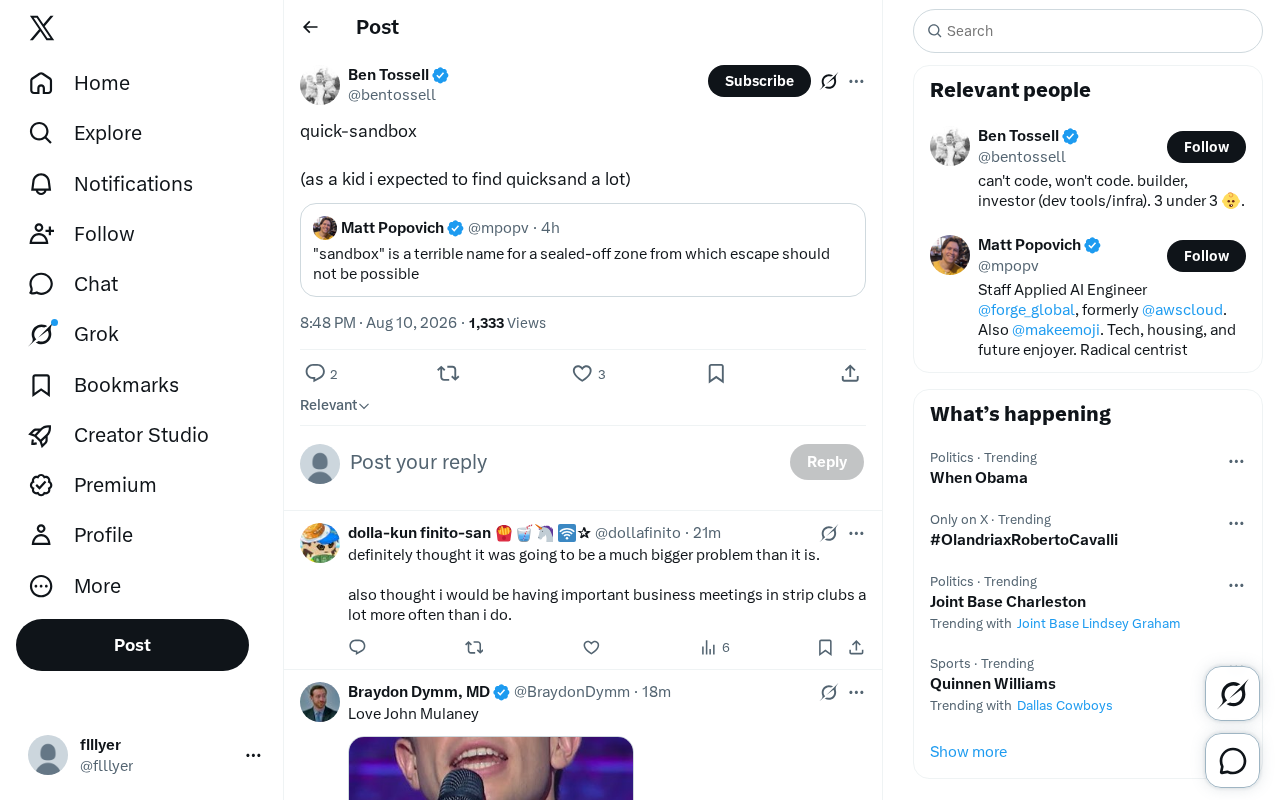
Recently, a tool called quick-sandbox has sparked discussion in the developer community. The tool's author even cracked a joke in their tweet: "As a kid, I always thought I'd encounter quicksand way more often" — a pun that both explains the tool's name origin and hints at its lightweight, convenient product positioning.
In today's world where AI programming and automated code execution are becoming increasingly prevalent, "sandbox" has evolved from a specialized term into an essential item in every developer's daily toolkit. The sandbox concept originally comes from the computer security field, inspired by children's playground sandboxes — a bounded area for safe play. In computer science, the earliest sandbox practice dates back to the chroot mechanism in 1970s Unix systems, which restricted a process's file system access by changing its root directory. Since then, sandbox technology has evolved from process-level isolation (such as seccomp, AppArmor) to OS-level virtualization (such as Linux containers, Docker) and then to hardware-assisted virtualization (such as KVM, Firecracker). Each generation of technology seeks a new balance between isolation strength and performance overhead.
Whether it's running untrusted code, testing AI-generated scripts, or building isolated experimental environments, a fast, lightweight code sandbox solution is becoming increasingly important.
Why We Need Fast Code Sandboxes
The Security Execution Demands of AI-Generated Code
As large language models (LLMs) rapidly improve their code generation capabilities, an unavoidable question emerges: How do we safely execute AI-generated code?
When we ask Claude, GPT, or other models to generate a Python script, running it directly in our local environment carries obvious risks — the code might contain flawed logic, unintended file operations, or even potentially malicious behavior. The security risks of LLM-generated code fall into several categories: First, unintentional destructive operations — for example, the model might generate commands containing rm -rf or disk formatting. Second, Prompt Injection attacks, where attackers craft inputs to trick the model into generating malicious code. Third, supply chain attack risks, where the model might suggest installing packages with backdoors (such as typosquatting attacks with lookalike package names). Research from 2023 shows that approximately 40% of code generated by mainstream LLMs contains some degree of security vulnerability, making execution environment isolation particularly critical.
This is where an isolated sandbox environment becomes a crucial security barrier.
Traditional sandbox solutions are often too heavyweight: full container orchestration, complex virtualization configurations, or dependence on cloud services. Among sandbox implementation technologies, Docker containers and microVMs represent two different technical approaches. Docker achieves process-level isolation based on Linux kernel namespace and cgroup mechanisms — it starts quickly (typically in milliseconds) but shares the host kernel, creating risks of kernel vulnerability escapes. MicroVMs like AWS's Firecracker provide hardware-level isolation where each instance has its own kernel, offering higher security but with startup times typically ranging from hundreds of milliseconds to seconds. There's also a class of WebAssembly (Wasm)-based sandbox solutions, such as Wasmtime and WasmEdge, which achieve near-native-speed safe execution through compile-time security checks and runtime boundary detection, with startup times as low as microseconds. For fast-iteration development scenarios, the startup costs and configuration complexity of traditional solutions are simply too high.
Sub-Second Startup Is the Core Value
The name quick-sandbox directly states its core proposition: fast startup. In AI-assisted programming workflows, code execution is a high-frequency operation — generate, run, verify, correct — this cycle needs to repeat constantly. If launching a sandbox requires waiting dozens of seconds or longer each time, the entire development experience suffers significantly.
An ideal fast sandbox should achieve: sub-second startup, out-of-the-box usability, low resource consumption, while ensuring adequate code isolation. This is precisely the pain point quick-sandbox aims to solve.
Typical Use Cases for Code Sandboxes
Code Execution Environments for AI Agents
Today's hottest AI Agent applications almost invariably require code execution capabilities. Whether it's data analysis, automation tasks, or code debugging, Agents need a controlled environment to run their generated instructions.
In modern AI Agent architectures, the Code Execution Layer is the critical bridge connecting reasoning capabilities with actual actions. Typical Agent frameworks like LangChain, AutoGPT, and OpenAI's Code Interpreter all have built-in code execution components. These systems typically employ a "Plan-Code-Execute-Observe" loop: the Agent first plans the task, then generates code, executes it in a sandbox, and finally observes the output to decide the next step. This architecture imposes special requirements on sandboxes — they need not only security isolation but also support for state persistence (preserving variables and files), network access control (some tasks require internet access), and resource limits (preventing infinite loops from exhausting system resources).
Lightweight sandboxes can provide independent isolated spaces for each Agent session, both avoiding interference between different tasks and preventing potential security issues from spreading to the host system.
Programming Education and Online Judging
For programming education, online judge (OJ) platforms, and various technical experiments, sandboxes are equally indispensable. Learners can freely try all kinds of code in a fully isolated environment — even if they write infinite loops or dangerous operations, the real system remains unaffected.
Online code judging systems represent one of the most mature application scenarios for sandbox technology. From early platforms like SPOJ and UVa to modern ones like LeetCode and Codeforces, these platforms process millions of code submissions daily. They typically employ multi-layered defense strategies: limiting CPU time and memory usage through cgroups, filtering system calls through seccomp-bpf, and isolating networks and file systems through namespaces. Some platforms like Judge0 have even open-sourced their judging engines, supporting safe execution of over 60 programming languages. These practices provide rich engineering experience for lightweight sandbox tools.
Safe Execution of Untrusted Code
In the open-source community, we frequently need to run code from unfamiliar repositories. A fast sandbox gives developers an extra layer of protection when evaluating third-party code — observe its behavior in an isolated environment first, then decide whether to trust it.
The Design Philosophy of Lightweight Sandboxes
Balancing Isolation and Convenience
Sandbox tool design always faces a tradeoff: the more thorough the isolation, the heavier and slower it tends to be; the more lightweight, the more blurred the security boundaries may become.
The approach of tools like quick-sandbox is to minimize the barrier to use while ensuring basic isolation. It's better suited for scenarios that don't require military-grade isolation but demand high startup speed and ease of use — such as a developer's daily experiments, or intermediate execution steps in an AI toolchain.
Developer Experience First
From the tool author's slightly humorous communication style, we can see that quick-sandbox is more like a practical tool born from actual developer pain points, with a focus on user experience. This "scratch your own itch" open-source spirit often produces products that best fit real-world needs. "Scratch your own itch" is the open-source development motivation described by Eric Raymond in The Cathedral and the Bazaar — the best software often emerges from developers solving their own practical problems. The Linux kernel, Git version control system, and Ruby on Rails framework are all classic products of this philosophy. Linus Torvalds created Git because he was dissatisfied with existing version control tools; DHH built Rails because of the tedium of web development. This pain-point-driven development approach often produces tools that better fit real workflows, because the developer themselves is the most demanding user.
Conclusion: Sandboxes Are Infrastructure for AI Programming
As AI programming assistants evolve from "generating code" to "executing code," secure isolated execution environments are becoming critical infrastructure in the AI toolchain. Lightweight sandbox solutions like quick-sandbox represent the community's ongoing exploration of "fast, safe, and easy-to-use" code execution environments.
For developers, choosing the right sandbox tool requires comprehensive consideration of isolation strength, startup speed, resource consumption, and integration difficulty. For the industry as a whole, the maturation of such foundational tools will pave the way for more reliable and secure AI automation applications.
It should be noted that this article is based on analysis and expansion of the tool author's brief tweet. The specific technical implementation details of quick-sandbox await further verification through official documentation and community feedback. Interested developers are encouraged to try it themselves and form their own judgment.
Related articles

Apple HomeView Hands-On Review: Is the $300 Smart Home Hub Worth It?
Apple HomeView hands-on: a $300 smart home hub with facial recognition for quick account switching, but no App Store or voice recognition. Is the wall-mounted version worth it? Should you buy the first generation?

Meta Muse Wonder Launch: What It Means for Meta's Return to the Frontier AI Race
Meta releases Muse Wonder and WonderFull, benchmarks reach the frontier, community feedback is polarized. An in-depth look at Meta's return to the frontier AI race, its personal agent strategy, and Zuckerberg's different path.

Apple Home Smart Home Lineup Leaked: LG and Schneider Team Up, UWB Door Lock on Board
Apple Home ecosystem gains new LG and Schneider devices: UWB smart lock with proximity unlock, 2.5K dual-camera doorbell, privacy indoor camera, and AirPods-like seamless pairing.