RAG Enterprise Knowledge Base in Practice: A Complete Guide from Principles to Optimization
A practical breakdown of RAG pipelines — from vector databases and chunking to reranking — for enterprise knowledge bases.
This article systematically covers the principles and engineering practice of RAG (Retrieval Augmented Generation). RAG addresses LLM hallucinations and data recency limits by retrieving relevant content from an external knowledge base before generation. The pipeline is broken into two phases: knowledge base construction (data loading, chunking, embedding, vector storage) and query response (retrieval, reranking, LLM generation). A key insight emphasized throughout: unlike traditional CRUD development, getting an AI pipeline to run is just the starting point — the real work lies in continuously optimizing accuracy and recall. Chunking strategy, retriever combinations, and reranking are the three critical quality factors, all built on the vector database as the core infrastructure.
What Problem Does RAG Actually Solve
RAG (Retrieval Augmented Generation) is essentially a framework for supplying large language models with external knowledge. LLMs have inherent limitations in terms of training data recency and coverage — they often struggle with a company's internal data or industry-specific knowledge, and can produce answers that sound plausible but are factually wrong. This phenomenon is known as "hallucination."
The core idea behind RAG is straightforward: organize enterprise data (and data from other sources) into a knowledge base, retrieve relevant content from that knowledge base when the model needs to answer a question, and then have the model generate its response based on the retrieved results. This directly improves accuracy and reliability on knowledge-intensive tasks, minimizing the chance of hallucinations.
It's worth emphasizing that the knowledge base can contain both structured data (such as a company's relational databases) and unstructured data (local PDF, Word, Markdown, or TXT files). This diversity of data formats is precisely where the engineering complexity of RAG begins.
The Basic RAG Pipeline: Simple on the Surface, Full of Hidden Details
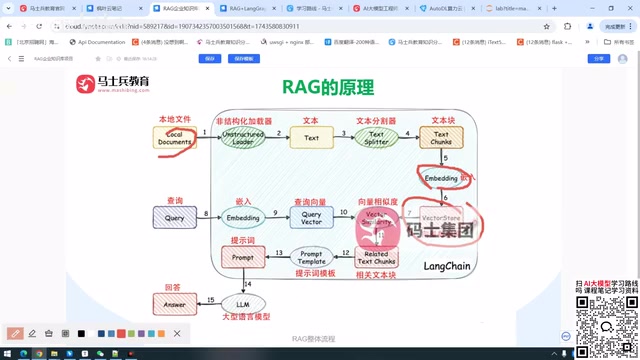
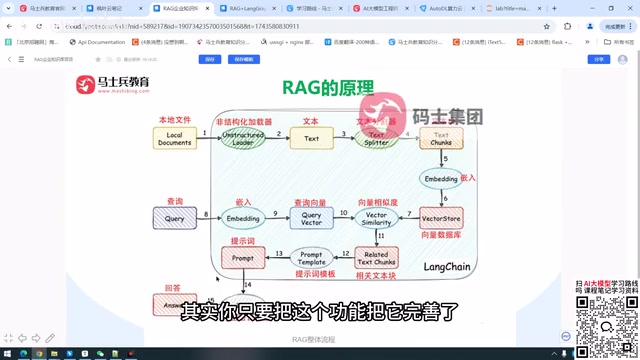
A fundamental RAG pipeline can be broken into two phases. The first is knowledge base construction: raw data is processed, text is split into chunks, those chunks are converted into vectors via embedding, and the vectors are stored in a vector database. The second is query response: when a user submits a question, the system retrieves relevant results from the vector database, combines them with a prompt, and passes everything to the LLM, which generates the final answer.
A question beginners often ask: can vector databases store images? The answer is yes. A vector database fundamentally stores vectors — images can be converted into vectors, just like text can. Two important caveats, though: image embedding requires a dedicated image embedding model, not a text embedding model; and image vectors and text vectors should be stored in separate collections (the vector database equivalent of a "table"), otherwise retrieval becomes unwieldy.
Also note that text needs to be split into chunks before storage, while images do not — an entire image is converted directly into a single vector. After hearing all this, many people think RAG sounds simple. But once you actually start building a project, you quickly realize every single step hides a mountain of details that need careful attention.
Embedding is the technique of converting text into high-dimensional numerical vectors, with the core principle that semantically similar text should be positioned closer together in vector space. For example, "Apple iPhone" and "iPhone" would have a much smaller distance in vector space than "Apple iPhone" and "Apple Inc. earnings report" — even though the latter two both contain the word "Apple." Vector databases exploit this property by computing the distance between a query vector and all stored vectors (commonly using cosine similarity or Euclidean distance) to rapidly surface the most relevant document chunks. This semantic retrieval capability is RAG's core advantage over traditional keyword search — it understands meaning rather than just matching literal strings.
Why AI Projects Are Different from Traditional Development
One key observation from real-world experience deserves special attention: developers coming from a Java or traditional backend background are most likely to fall into the trap of carrying over old mental models. In a typical CRUD (Create, Read, Update, Delete) project, once the features are implemented and tests pass with no bugs, the project is essentially done.
AI projects are completely different. With RAG, getting the pipeline to run is only step one. The real challenge is this: can the system's answers meet the accuracy and recall requirements the business actually needs? If not, the RAG system must be continuously optimized and tuned. This is also why AI project requirements are often stated in a single sentence — "Build a customer service system where users ask questions and AI responds" — but the actual workload is entirely concentrated in making that pipeline reliable and precise enough.
In other words, everyone understands the principles of RAG, but the gap between different RAG systems shows up entirely in the quality of the optimization work.
Key Areas for RAG Optimization
Optimizing RAG means providing better solutions at each stage of the pipeline to minimize hallucinations in the final output. Here are the core areas to focus on:
Choosing a Vector Database
The right vector database depends on the scale of your data. This course uses Milvus, which appears to be the most widely adopted professional vector database in large-scale production projects. The course covers both local and server deployment, as well as its advantages over other options.
Data Loading and Chunking
Local files come in many formats — PDF, Word, Markdown, TXT — and each requires a different loading approach and chunking strategy. Chunking is absolutely not as simple as splitting by a fixed character count. Tools like Dify default to fixed-length splits (e.g., 200 characters per chunk), but this approach frequently breaks semantic coherence.
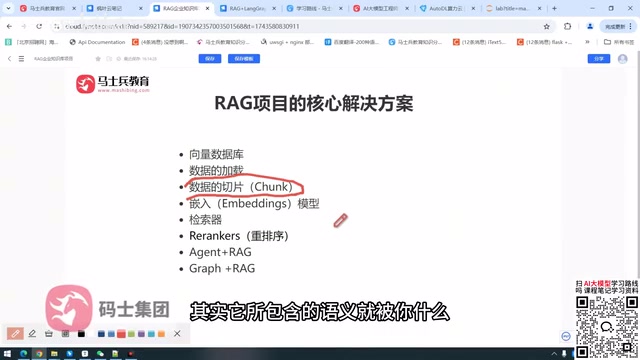
More sophisticated chunking strategies split by punctuation, by semantic units, or by paragraphs. PDFs can be split by page; Markdown files can be split by heading. If chunking is done poorly — if a complete sentence gets cut in half — the semantic information is lost, and the final RAG output becomes much more prone to hallucinations.
Text and Image Embedding Models
Embedding models include both commercial options (OpenAI, Zhipu, Tongyi Qianwen, etc.) and open-source options from HuggingFace. The course covers both, with clear distinctions between which embeddings are used for text and which are used for images.
Retrievers: The Core Battleground of RAG Optimization
A basic RAG system uses only similarity search (returning results ranked by similarity score), but there are many more retriever types available. Range retrieval, grouped retrieval, hybrid retrieval, full-text search — in practice, multiple retrievers are often used in combination to ensure retrieval quality.
Reranking
Retrieval typically returns a Top-10 or Top-5 result set. These results are ranked by similarity, but high similarity doesn't necessarily mean high relevance. That's why a separate reranking model is introduced to reorder results by actual relevance.
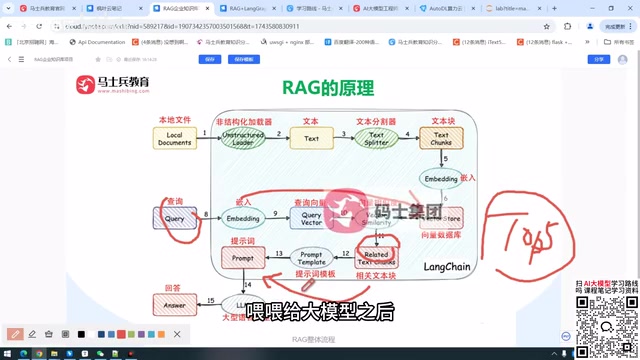
Only after reranking are the results placed into the prompt and sent to the LLM, which then generates a more precise answer based on the ordered context. Skipping reranking increases the likelihood of hallucinations.
Reranking models (Rerankers) differ fundamentally in architecture from the Embedding models used for vector retrieval. Embedding models encode documents and queries into separate independent vectors and then compute similarity — fast, but with some loss of precision. Rerankers typically use a Cross-Encoder architecture, where the query and candidate document are concatenated and fed into the model together, allowing the two texts to interact through the attention layers and producing a more accurate relevance score. The trade-off is significantly higher computational cost, making it impractical to run over the full dataset. This is why the industry standard is a two-stage approach: coarse retrieval (vector recall Top-50) followed by fine ranking (Rerank to Top-5), balancing performance and accuracy.
Combining with Agents and Workflows
A complete RAG system is often integrated with Agents and graph-based workflows, further expanding its capabilities. These are essential pieces of the puzzle in moving RAG from "functional" to "genuinely useful."
The core value of an Agent in a RAG context is giving the system decision-making capability: when faced with a complex question, the Agent can determine whether retrieval is needed, which knowledge base to query, and whether multiple rounds of retrieval or external tool calls (such as a calculator or a database query API) are required. Workflows (Graph/Pipeline) orchestrate multiple steps into a directed graph, supporting conditional branching, parallel processing, and iterative loops. Together, they enable RAG systems to handle complex multi-step reasoning tasks like "first query the financial database, then check the policy documents, then synthesize both into a recommendation" — far beyond a simple single-round retrieve-and-generate. Frameworks like LangGraph and LlamaIndex Workflows are designed precisely for these scenarios.
Why Start with the Vector Database
Once you map out the full pipeline, it becomes clear that chunking, embedding, retrieval, and reranking — though they seem like independent steps — all revolve around a single core component: the vector database. Without it, there's nowhere to store the chunks, no way to perform retrieval, and reranking has nothing to work with.
This is why the tutorial series starts with Milvus. By laying this foundation first, the subsequent steps — data loading, chunking, embedding, retrieval, and reranking — can be built on top of a solid understanding. It's a learning path grounded in engineering logic, and it helps beginners build a clear mental model of the RAG architecture as a whole.
For developers looking to build private knowledge bases or enterprise-grade Q&A systems, internalizing one key insight may matter more than any individual technical skill: RAG isn't just about getting the pipeline to run — it's a continuous engineering optimization effort.
Related articles

LynnReal-Omni: 32B Unified Video Diffusion Model Goes Open Source with Multi-Task Coverage in Four Steps
LynnReal-Omni is a 32B unified video diffusion model on MiniMax H3, covering text-to-video, pose guidance, style transfer, restoration in 4 steps. Flash version generates 540p video in 377ms on one H100.

Anthropic Co-Founder: AI 'Kill Switch' May Need to Be Mandatory by Law
Anthropic's co-founder tells the BBC that AI 'kill switches' may need to be legally mandated. We analyze the industry logic, technical challenges, and the tension between regulation and innovation.

The AI Data Center Boom Is Colliding With Cities Scarred by Heavy Industry
The AI data center boom is clashing with post-industrial communities. Philadelphia's case reveals structural conflicts between AI growth, energy use, water, and environmental justice.