Replit User Automates User Guide Generation Through Conversation

A Replit user automates user guide generation through conversation, showing AI programming tools evolving into full-stack workbenches.
The article presents a case in which real Replit user Angelina automates user guide generation through conversation. She transformed a manual documentation process into an interactive conversation with Replit, using AI Agent to understand requirements and generate structured content. This model lowers the barrier for non-technical users to produce professional documents and may incorporate document generation into CI/CD pipelines to help teams maintain documentation in sync. The article also notes that the case lacks specific operational details and samples, and the quality, consistency, and accuracy of generated content still require human review. Overall, it reflects that AI programming tools are evolving from writing code to understanding intent and producing complete deliverables, with document automation becoming a new scenario.
From Conversation to Documentation: Replit's New Automation Approach
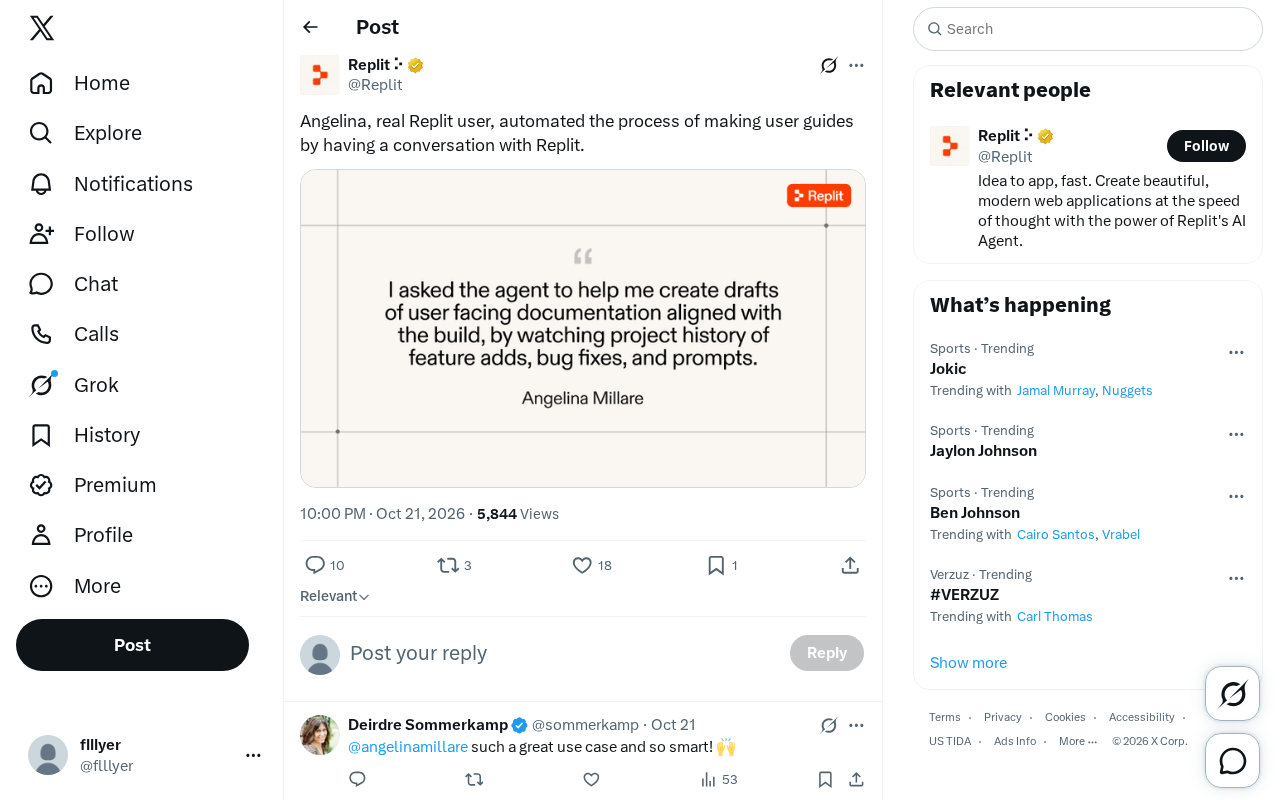
Recently, a real Replit user named Angelina demonstrated a novel workflow: she automated the generation of a user guide through a conversation with Replit. This may sound simple, but it reflects a broader shift: AI programming tools are evolving from "writing code" to "understanding intent and producing complete deliverables." According to a share on Twitter, Angelina transformed a user guide process that previously required manual writing into an interactive conversation with Replit—she described the requirements, and Replit generated structured document content. This is not just an efficiency gain but a paradigm shift: document creation moves from "humans write" to "humans guide AI to write."
The Core Logic of Conversational Automation
Traditionally, creating a user guide requires a product manager or technical writer to sort out features, take screenshots, and write steps. Angelina's approach simplifies this process into a conversation with Replit. Although the original tweet did not disclose specific technical details, it can be inferred that she leveraged Replit's AI Agent capabilities—using natural language instructions to let the AI understand the guide's structure, target audience, and content scope, and then generate a draft. The key to this model is "conversation": rather than inputting all requirements at once, it refines requirements step by step, much like communicating with a colleague. This lowers the barrier to entry and enables non-technical users to quickly produce professional documents.
AI Agent refers to an AI system capable of perceiving its environment, making autonomous decisions, and executing actions to achieve goals. Unlike traditional single-turn question-answering models, an Agent typically has task decomposition, tool invocation, and memory capabilities, and can progressively advance complex tasks through multi-turn interactions. In the context of Replit, an AI Agent can understand a user's natural language instructions, automatically plan steps, invoke tools such as the code editor, terminal, and file system, and ultimately generate a runnable application or structured document. This capability makes "conversational document generation" possible: users do not need to write scripts or templates; they only need to describe requirements, and the Agent can complete the entire process from content organization to format output.
Significance for Developers and Teams
For development teams, maintaining user guides is often time-consuming and easily overlooked. Angelina's case shows that with platforms like Replit, teams can generate documentation synchronously during development and even incorporate document generation into CI/CD pipelines. For example, when an API changes, a guide update can be triggered through conversation. This not only reduces documentation lag but also allows developers to focus more on core code. However, automatically generated content still requires human review to ensure accuracy and tonal consistency.
CI/CD (Continuous Integration/Continuous Delivery) is a software development practice that uses automated pipelines to frequently integrate, test, and deploy code changes to production environments. Incorporating document generation into CI/CD pipelines means that whenever code or APIs change, the system can automatically trigger documentation update tasks—for example, by calling Replit's AI Agent through a webhook to regenerate the user guide based on the latest code comments or interface definitions. This helps keep documentation in sync with code and reduces manual maintenance costs, but it requires well-designed trigger conditions and review mechanisms to avoid generating outdated or inaccurate content.
Replit's AI Capabilities from Multiple Perspectives
Although Angelina's share is a single source, combined with Replit's continued investment in the AI Agent direction in recent years, this use case is plausible. Replit has launched Agent features that allow users to build complete applications through natural language, including frontend, backend, and database. As part of application delivery, document generation can naturally also be included in the scope of automation. According to discussions in some developer communities, Replit's AI performs well in understanding project context, which provides a foundation for conversational document generation.
Potential Limitations and Points to Be Verified
One additional point: Angelina's tweet did not provide specific operating steps or sample generated guides, so we cannot evaluate the quality and reusability of the generated content. In addition, conversational generation may face consistency challenges: after multiple rounds of dialogue, can the AI still maintain a unified document style? For complex products, user guides often require precise terminology and screenshots. Can the AI reference them accurately? These questions await verification by more practitioners.
Project context refers to all the information about the current project that AI can use when generating content, including code structure, configuration files, dependencies, comments, commit history, and previous conversation records. Replit's AI Agent can read and understand this context, thereby referencing the correct function names, parameters, and examples when generating documentation. For example, when a user asks for an API guide, the Agent can scan the project's route definitions and model code to automatically extract endpoints, request methods, and response formats. This context-awareness is key to the quality of conversational document generation, but it is also limited by the completeness of project information and the size of the AI's context window.
Conclusion: A Signal of the Future of Document Automation
Although Angelina's practice is small, it points to a trend: AI programming tools are absorbing non-coding tasks in the software development lifecycle. From code generation to document generation, platforms like Replit are becoming "full-stack AI workbenches." For content creators and technical writers, this is both an opportunity and a challenge—learning to collaborate with AI may become an essential skill for the next generation of technical writers.
Related articles

Frontend to AI Agent Development: A Frontline Architect Explains Career Paths and Opportunities
A frontline AI architect explains the industry changes and practical paths for frontend developers transitioning to AI Agent development: why pure frontend jobs are disappearing, why Agent + full-stack has become mainstream in hiring, and three transformation routes—Agent development engineer, FDE, and remote contracting—along with corresponding learning strategies.

How to Choose an AI Agent Development Course: Five Pitfall-Avoidance Guidelines
A mechanical-engineering career changer's two-year pitfall-tested checklist for screening AI Agent development courses: complete delivery pipeline, resume-worthy projects, real development perspective, update frequency, and coaching feedback—with concrete judgment methods and pitfall-avoidance tips.

Coze AI Agent Building for Beginners: A Zero-Code AI Agent Development Guide
Coze, ByteDance's one-stop AI application development platform, supports zero-code drag-and-drop AI agent building. This article outlines Coze's core concepts, three advantages, differences between the domestic and international versions, and the distinction between agents and apps, helping beginners quickly get started with AI Agent development.