Running Kimi K3 in 29GB of RAM: The Trade-offs and Costs of Extreme Quantization

Running Kimi K3 in 29GB RAM reveals the impossible triangle of local LLM deployment.
A Hacker News post about running Kimi K3 in just 29GB of RAM at 0.5 tok/s highlights the fundamental trade-offs in local LLM deployment. Through extreme quantization, MoE sparse activation, and memory mapping, massive models can technically run on consumer hardware—but at devastating speed costs. The article explores why memory bandwidth is the true bottleneck and offers practical guidance for balancing model capability, hardware cost, and inference speed.
A Thought-Provoking Technical Challenge
Recently, a post titled "Run Kimi K3 using 29 GB of RAM at 0.50 tok/s" caught the attention of the Hacker News community. The title itself is full of tension—running a massive model that typically requires hundreds of gigabytes of VRAM in just 29GB of memory, at the staggering cost of generating only 0.5 tokens per second.
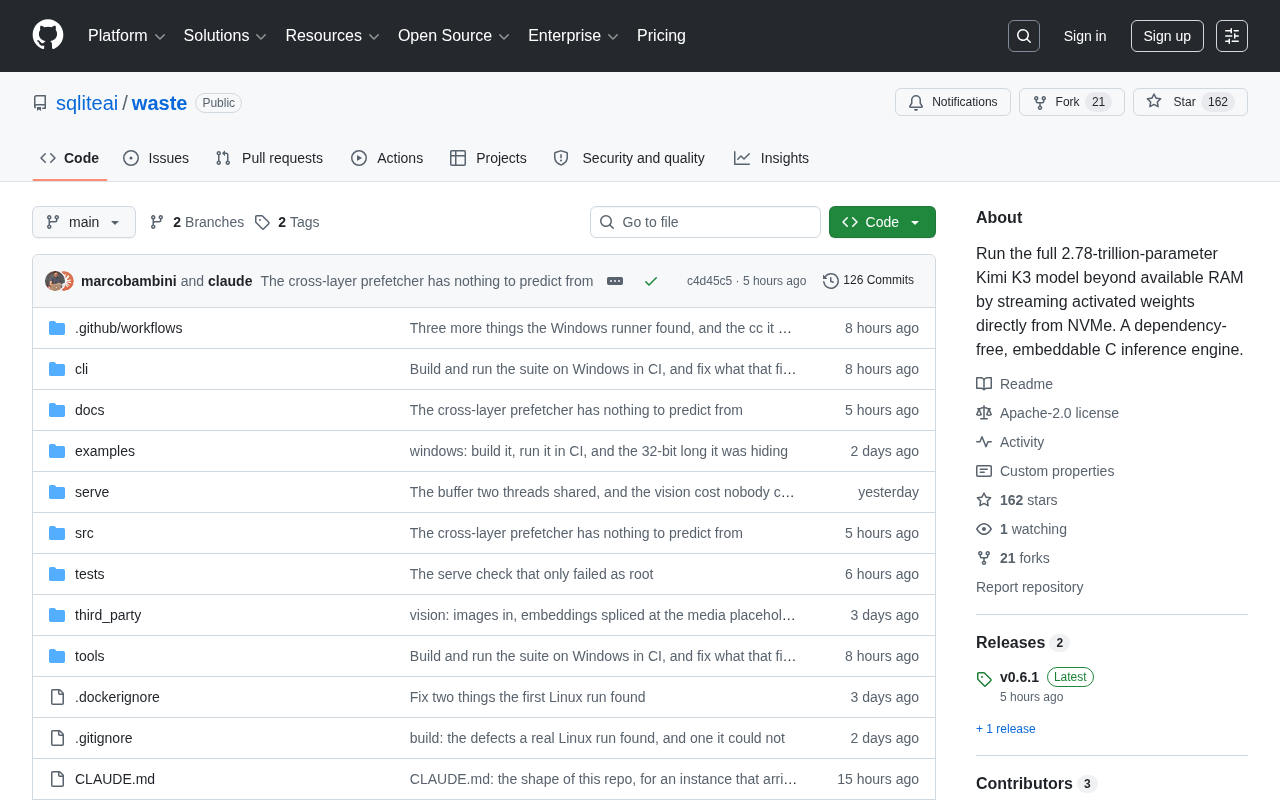
This may seem like an "impractical" experiment, but it precisely touches on the most fundamental contradiction in local LLM deployment today: With limited hardware resources, how far can we compress a model? And what performance cost must we pay?
Why 29GB of RAM Can Run a Massive Model
What Is Kimi K3
Kimi K3 is the latest version in the large language model series from Moonshot AI. Founded in 2023 by Professor Yang Zhilin from Tsinghua University, Moonshot AI is one of the most heavily funded startups in China's LLM space. The Kimi model series is known for its long-context processing capabilities, with early versions supporting ultra-long text inputs of up to 200,000 Chinese characters. As the latest evolution of their technology, K3 features significant improvements in parameter scale and reasoning capabilities, adopting a MoE (Mixture of Experts) architecture to balance model capacity with computational efficiency.
The Power of Extreme Quantization
As a major player among Chinese-developed large models, Kimi's large-parameter versions typically reach hundreds of billions of parameters. At FP16 precision, model weights alone can consume over a hundred gigabytes or more of storage—far beyond what ordinary consumer-grade devices can handle.
Let's explain the basics of FP16 and quantization. FP16 (half-precision floating point) uses 16 binary bits to represent a number, with each parameter occupying 2 bytes. A 100-billion-parameter model requires approximately 200GB of storage at FP16. The core idea behind quantization is to represent weight values using fewer bits: 4-bit quantization compresses each parameter to 0.5 bytes, reducing memory usage to one-quarter of FP16; 2-bit quantization further reduces it to one-eighth. Common quantization methods include GPTQ (layer-wise quantization based on second-order information), AWQ (activation-aware quantization), and the k-quant methods used in the GGUF format, each seeking an optimal balance between compression ratio and accuracy loss through different strategies.
To squeeze Kimi K3 into 29GB of memory typically relies on a combination of the following techniques:
- Low-bit quantization: Compressing weights from FP16/BF16 down to 4-bit, 2-bit, or even lower—this is the primary reason for the dramatic reduction in memory usage.
- MoE sparse activation: If the model uses a Mixture of Experts (MoE) architecture, although the total parameter count is enormous, only a subset of experts are activated during each inference pass, reducing actual computation and memory residency pressure. MoE is a conditional computation paradigm first proposed by Jacobs et al. in 1991, recently brought back into the mainstream by Google's Switch Transformer and Mistral's Mixtral models. In MoE architectures, the model contains multiple parallel feed-forward networks (i.e., "experts"), and during each inference pass, a gating network (Router) selectively activates only a few of them. For example, an MoE model with 1 trillion total parameters that activates only 2 out of 8 experts each time has an effective computation footprint of roughly 25% of the total.
- Memory mapping and on-demand loading: Using mechanisms like mmap to keep some weights on disk and load them into memory only when needed, trading disk IO for memory space. mmap is a memory-mapped file mechanism provided by the operating system that allows programs to map disk files directly into virtual address space without loading the entire file into physical memory. The OS uses page fault mechanisms to read the corresponding memory pages from disk only when the program actually accesses specific data segments. Inference frameworks like llama.cpp extensively use mmap to load model files, allowing programs to run normally via virtual memory mechanisms even when physical memory is insufficient to hold the complete model—at the cost of significantly slower inference due to frequent disk IO.
It is precisely the combination of these techniques that makes "running a massive model in 29GB" theoretically possible.
The Performance Reality Behind 0.5 tok/s
Speed Is the Biggest Compromise
What does 0.5 tokens per second actually mean? In LLM inference, a token is the basic unit of text processing—in English, one token corresponds to roughly 4 characters or 0.75 words; in Chinese, typically 1-2 characters correspond to one token. Normal human reading speed is about 4-5 tokens per second, and the industry generally considers 10-30 tok/s to be the comfortable range for streaming conversation, with 5 tok/s as the minimum usable threshold. Commercial API services like GPT-4 typically deliver 30-80 tok/s output speeds.
By comparison, 0.5 tok/s means generating only one token every 2 seconds—producing a 100-word response could require three to four minutes of waiting. For any interactive application, this speed is virtually devoid of practical value.
This figure clearly reveals the "impossible triangle" of local LLM deployment:
- Model capability (large parameters, strong reasoning)
- Hardware cost (low memory, consumer-grade devices)
- Inference speed (usable response latency)
All three cannot be achieved simultaneously. When we force a massive model into 29GB of memory, speed is inevitably sacrificed.
Memory Bandwidth: The Hidden Critical Bottleneck
Understanding why speed drops so dramatically requires recognizing that LLM inference is fundamentally a memory-bandwidth-bound task, not a compute-bound one. During the autoregressive generation phase, generating each token requires reading all (or most of) the model's weights from memory once. For example, DDR5 memory typically offers bandwidth of 50-80 GB/s, while NVIDIA H100 GPU's HBM3 bandwidth reaches 3.35 TB/s—this is the fundamental reason GPUs are far faster than CPUs for inference tasks.
When model weights need to be read from NVMe SSDs (typical bandwidth 3-7 GB/s) or even SATA SSDs (approximately 0.5 GB/s), inference speed drops further and dramatically. In this case, 29GB of physical memory cannot fully contain the model weights, and frequent disk paging reduces effective bandwidth to extremely low levels—this is the key bottleneck causing the 0.5 tok/s result. The additional decoding computation overhead introduced by extreme low-bit quantization further slows the inference process.
This Is an Experiment, Not a Product
It's important to be clear: the value of demonstrations like this lies not in being "usable" but in "testing the boundaries." It proves how low the barrier to running massive models can be pushed through extreme software-level optimization. This has reference value for researchers studying quantization loss and memory scheduling strategies, but ordinary users should not expect to use it for daily work.
Practical Lessons for Local LLM Deployment
Quantization Is Not a Free Lunch
While low-bit quantization compresses memory usage, it often comes with degraded model output quality. 2-bit level quantization is particularly likely to cause noticeable capability degradation—models may exhibit logical confusion, increased factual errors, and reduced long-text coherence. Academic research shows that 4-bit quantization typically preserves over 90% of a model's original capabilities, while dropping to 2-bit can result in 20-40% capability loss, with degradation severity varying significantly across task types. Therefore, "being able to run" and "running well" are two entirely different concepts. Users pursuing extreme compression need to make careful trade-offs between memory, speed, and output quality.
Realistic Hardware Expectations
For developers and enthusiasts hoping to run large models locally, this case offers a pragmatic reminder:
- If you want usable interactive speeds (10+ tok/s), choose small to medium-scale models that match your hardware (e.g., 7B-14B parameters), or apply moderate quantization levels (4-bit or 5-bit) to larger models;
- If your hardware is limited but you still want to experience massive models, accept extremely low generation speeds and treat it as a validation experiment rather than a productivity tool;
- GPU VRAM, memory bandwidth, and disk IO speed collectively determine the actual inference experience—none can be neglected. A single RTX 4090 with 24GB of VRAM (bandwidth ~1 TB/s) is often an order of magnitude faster for inference than a CPU-based solution with 128GB of system memory.
Conclusion
An experiment like "running Kimi K3 in 29GB of RAM at 0.5 tok/s" is less a practical solution than a mirror—it reflects the current technical ceiling and real-world constraints of local LLM deployment. As quantization algorithms, inference frameworks, and hardware continue to evolve, the boundaries of this "impossible triangle" may keep shifting. But for now, maintaining a clear-eyed understanding of the capabilities and costs of local deployment remains essential for every practitioner.
(Note: Due to limited information in the original post, the technical analysis in this article is based on general principles of LLM quantization deployment. Specific implementation details are subject to official or author disclosures.)
Related articles

Deep Dive into Row-Bot's Multi-Agent Orchestration Architecture: Parent-Child Agent Collaboration and Concurrency Control
Deep analysis of Row-Bot's multi-agent orchestration: parent-child Agent collaboration, Git worktree concurrency safety, state persistence, and fault recovery design for production AI Agent systems.

Unsloth Desktop Released: An All-in-One Desktop App for Local Model Inference and Training
Unsloth Desktop is an open-source cross-platform app combining model inference, fine-tuning, and deployment. Supports Mac/Windows/Linux with 2x training speed, 70% VRAM savings, and zero telemetry.

Graduate Student Proves Quantum Uncertainty Principle on Fractals: A Breakthrough Bridging Fourier Analysis and Geometry
A graduate student proved the quantum uncertainty principle on fractals, establishing quantitative constraints between function concentration on fractal sets and Fourier transforms, opening new research directions.