skills.sh Hits One Million Agent Skills in Seven Months: A Look at the AI Agent Skills Ecosystem

skills.sh reached 1M agent skills and 280M installs in 7 months, signaling the arrival of a modular agent capability ecosystem.
The skills.sh registry reached one million agent skills and nearly 280 million installs just seven months after launch — a milestone that validates the emergence of a real ecosystem around reusable agent capabilities. Agent skills are modular, installable components that package specific tasks, much like npm packages or mobile app store apps. This growth is closely tied to the maturation of LLM tool-calling capabilities. The article also urges caution: install counts don't equal retention, rapid growth often brings low-quality content, and long-term ecosystem health hinges on quality review, security, and sustainable creator incentives — not raw scale alone.
The Explosive Growth of an Emerging Ecosystem
The skills.sh skills registry has released a striking set of numbers: just seven months after launch, the number of agent skills on the platform has surpassed one million, with cumulative installs approaching 280 million. For a nascent developer ecosystem, that kind of growth curve is remarkably steep — and it's a telling sign that "equipping AI agents with reusable capabilities" has become a genuine need within the developer community.
An "agent skill" can be thought of as a modular capability unit that an agent can invoke. It packages a specific task — such as calling an API, performing a type of data processing, or integrating with a tool — into a standardized, installable, and distributable component. Developers don't need to write prompts or integration logic from scratch; they simply "install" a skill to give their agent the corresponding capability. This model closely mirrors the logic of app stores and package managers like npm.
Three Signals Behind One Million Skills
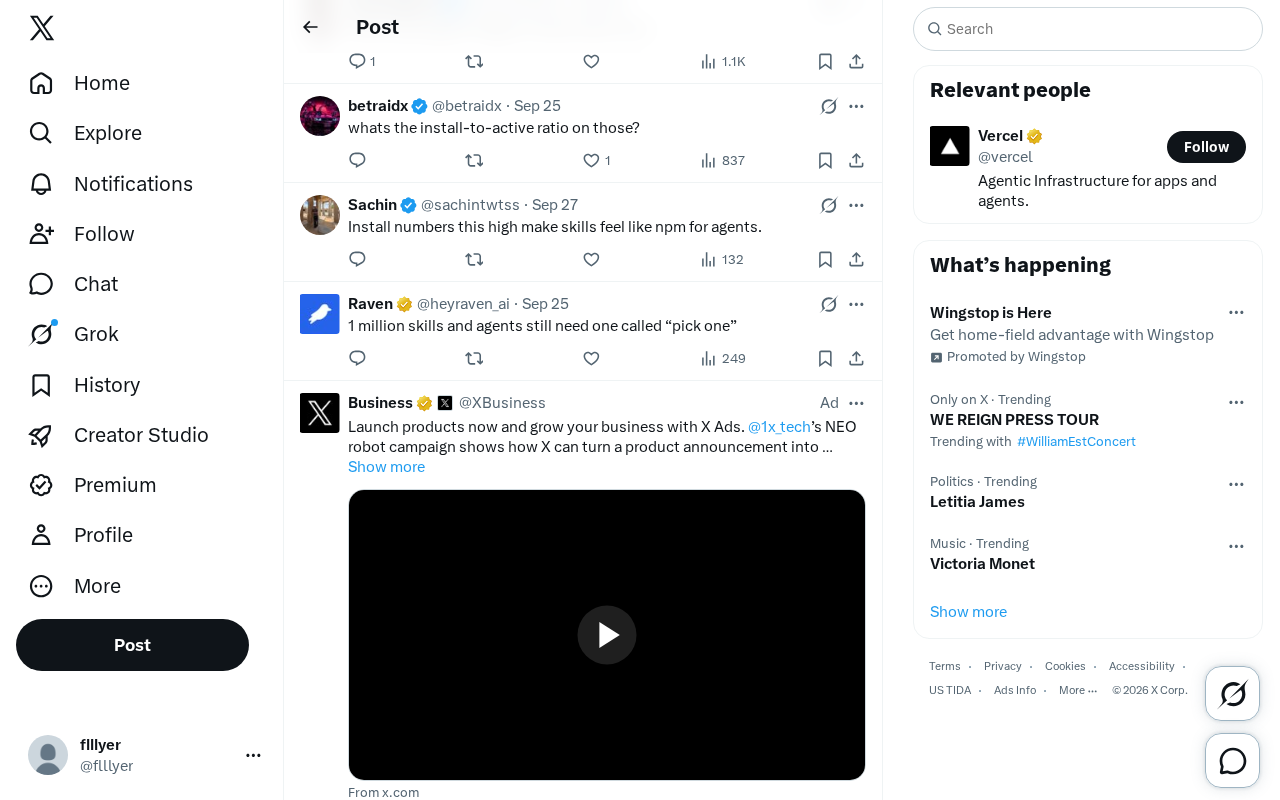
The two numbers — one million skills and 280 million installs — each point to different dimensions of ecosystem health. Skill count represents the richness of the supply side, indicating that a large number of developers are willing to package their capabilities and share them publicly. Install count, on the other hand, represents real demand-side usage. Nearly 300 million installs means these skills aren't just sitting dormant in a repository — they're being repeatedly invoked and deployed.
The average of roughly 280 installs per skill, while subject to a clear long-tail effect (a small number of popular skills account for the bulk of installs), still points to a self-reinforcing ecosystem: people are producing, people are consuming, and both sides are expanding simultaneously. This is precisely the defining characteristic that separates a "platform" from a mere "tool."
Why Seven Months?
The speed of growth is inseparable from the concentrated explosion of the agent paradigm over the past year. As tool calling and function calling capabilities in large language models have matured, building agents capable of autonomously executing multi-step tasks has moved from concept to reality. Developers urgently needed a standardized way to reuse and share these capabilities, rather than reinventing the wheel in every project. Registries like skills.sh have filled exactly that gap.
Tool calling represents a pivotal milestone in the evolution of large language model capabilities. Early language models could only generate text and had no ability to interact with external systems. Once models gained the ability to "call functions," they could dynamically request external tools during inference — querying a weather API, executing SQL, invoking a calculator — and incorporate the results into subsequent reasoning. OpenAI formally introduced Function Calling in the GPT series in 2023, and major model providers quickly followed suit. This capability rapidly became foundational infrastructure for agent architectures. It is precisely the standardization of this underlying capability that gave the abstraction layer of "skills" real meaning: a skill is essentially an encapsulation of a set of tool-calling logic, allowing models to invoke skills through a unified interface without needing to understand the underlying implementation details.
What Are People Teaching Agents to Do?
Based on the platform's positioning, skill types appear to span several categories: integrations with external tools and services (search, databases, third-party APIs); task automation within specific domains (code generation, document processing, data analysis); and coordination and orchestration between agents. Together, these skills form the capability foundation that transforms agents from "able to chat" to "able to get things done."
The significance of a skills ecosystem lies in lowering the barrier to building. An ordinary developer doesn't need to become an expert in every domain — they can simply find the relevant skill in the registry, install it, and give their agent cross-domain execution capabilities. This "composable capability" approach may well become the dominant paradigm for agent development going forward.
Implications for Developers and the Industry
For developers, skills registries represent both an opportunity and a signal. On one hand, they offer a new path to productizing and distributing specialized expertise — much like early open-source package authors, creators of high-quality skills stand to gain influence and potentially commercial returns. On the other hand, they also remind practitioners to pay close attention to standardization: when skills need to be reused across platforms and models, unified interface specifications and security mechanisms will become critically important.
Some caution is warranted, however. Official growth figures alone are insufficient to assess the long-term quality of an ecosystem. High install counts don't necessarily mean high retention rates, and a large number of skills can easily be accompanied by a significant volume of low-quality or duplicated content. A healthy ecosystem ultimately competes not on absolute scale, but on quality review, security protections, and sustainable incentives for creators.
The "unified interface specification" required for cross-platform reuse is currently an area of competing proposals. Anthropic's MCP (Model Context Protocol) attempts to define a standard communication protocol between models and external tools; OpenAI's Actions specification describes tool capabilities in OpenAPI format; and agent frameworks like LangChain and AutoGen each maintain their own internal tool abstraction layers. This fragmentation of standards means that a skill published on one platform today may not run seamlessly on another framework or model. This is a deeper challenge that skills registries must confront beyond mere scale: without cross-ecosystem interoperability, the ceiling for an "agent app store" will fall far short of what mobile app stores have achieved.
Conclusion: The Agent Ecosystem's "App Store Moment"
The data from skills.sh reads more like a milestone marker in the development of the agent ecosystem than a definitive verdict. It confirms a trend: agents are no longer just showcases for a single model's capabilities — they are forming a distribution network built around "reusable abilities." If 280 million installs can be read as a collective vote, developers have already made their position clear with their actions: modular, shareable agent capabilities are the direction they're betting on.
How far this path leads will depend on whether the platform can establish long-term mechanisms for quality and safety assurance after its explosive growth. But at the very least, the agent ecosystem's "app store moment" appears to have arrived.
Related articles

Big Tech AI Engineering Interview: Full-Chain Observability from Frontend Monitoring to Agents
From PerformanceObserver metrics collection and onerror/unhandledrejection exception capture, to RAG pipeline reranking and context compression for token cost control, to designing a full-site AI full-chain observability system benchmarked against LangSmith and Sentry—breaking down the three progressive layers of big tech AI engineering interviews.

WorkBuddy Step-by-Step Guide: Build Your Own AI Agent Work Assistant
WorkBuddy step-by-step guide: starting from the limits of chat models like Doubao, learn to build your own AI Agent work assistant for batch local file processing and automation—no programming required.

Building a Local Knowledge Base with LangChain-Chatchat + DeepSeek on Windows
This article, based on a Bilibili tutorial, details the full workflow of building a local knowledge base on Windows using LangChain-Chatchat and DeepSeek, including Anaconda environment setup, Ollama model management, mirror acceleration, and common error solutions, helping you quickly implement RAG Q&A.