Spring AI 2.0 + DeepSeek in Practice: Mastering Tools, MCP, Skills, and Agents in One Go

A Spring AI 2.0 tutorial connects Tools, MCP, Skills, and Agent through an airline customer service project.
Based on a Spring AI 2.0 tutorial on Bilibili, this article uses the Turing Airlines intelligent customer service project to outline the complete engineering path for Java developers integrating large model capabilities. It distinguishes Tools for controlled exposure of internal business APIs, MCP for standardized external service integration (e.g., Baidu Maps), Skills as maintainable reusable units encapsulating prompts and constraints, and Agent for orchestrating these capabilities into business workflows. The author argues that model capabilities have converged, and the outer engineering layer—prompt engineering, Tools, MCP, RAG, and Skills—determines application quality. Fine-tuning is viewed pragmatically as costly, with SMEs better served by context engineering. Suitable for Java developers seeking a systematic overview of AI applications.
As the barrier to AI application development keeps dropping, Java developers face a practical question: how to move from traditional business systems to quickly integrating large model capabilities, rather than stopping at the stage of "calling an API for a chat." A Spring AI 2.0 tutorial on Bilibili, mentioned by many learners, uses an airline intelligent customer service project to connect scattered concepts like Tools, MCP, Skills, and Agent into a complete engineering chain. This article, based on that tutorial's content, outlines the technical threads and learning path within.
Seeing the Real Value of AI Applications Through a Refund Conversation
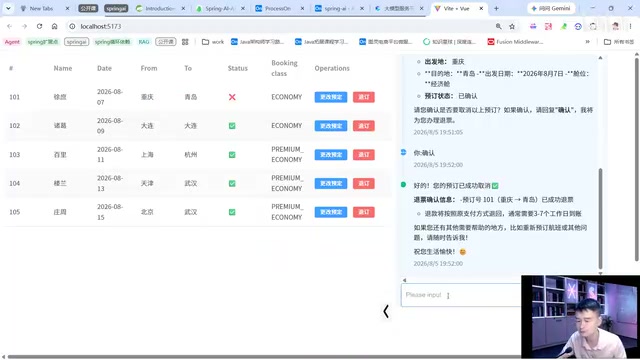
The tutorial opens with a demo of a Turing Airlines assistant: in a traditional system, refunding a ticket requires users to find the menu themselves, click buttons, and fill in the reservation number and name; under AI interaction, users simply say "help me refund my ticket," and the model proactively asks the user for necessary information, then indirectly calls the system's internal refund business method. In this process, the large model itself does not have the ability to call enterprise APIs—it is Tools that give it a channel to "perceive the outside world."
This logic can be transferred to any industry with business systems, such as healthcare, education, and government affairs. For novice users, being unable to find function menus is the norm; if intelligent customer service can understand intent and directly perform operations on their behalf, the experience improvement is orders of magnitude. This is also the point the tutorial repeatedly emphasizes: the value of AI applications lies not in how well the model chats, but in whether it can truly land on specific business actions.
Tools and MCP: Two Channels for Internal APIs and External Services
The tutorial clearly distinguishes the positioning of Tools and MCP. Tools are aimed at the API methods of the developer's own system, such as internal business logic like refunding tickets and querying reservations; MCP is aimed at external services—the example in the tutorial is calling Baidu Maps' route planning capability so the model can help users plan a self-driving route from Chongqing to Qingdao.
This distinction has practical significance for architecture design. Internal APIs usually involve permissions, data, and transactions, making them suitable for controlled exposure via Tools; external services are better integrated through MCP Server in a standardized way, avoiding writing a separate adapter for each external capability. The Baidu Maps MCP configuration demonstrated in the tutorial shows the convenience brought by this decoupling: the model side only needs to know which tools are available, and the specific invocation details are encapsulated by the MCP Server.
MCP (Model Context Protocol) is a communication protocol open-sourced by Anthropic at the end of 2024, aiming to establish a unified interface between large models and external tools and data sources. Before this, each external capability (maps, search, databases) required separate adapter code, and the model side could not reuse it. MCP defines two ends: Server and Client. Service providers implement MCP Server to expose capabilities in a standard way, and any model or Agent that supports MCP can plug and play. This is similar to the significance of the USB interface for the hardware ecosystem—once the protocol is unified, tool developers and users are decoupled, and the ecosystem can scale. For this reason, the article emphasizes that MCP is more suitable for external service integration rather than replacing Tools.
Skills: Turning Prompts and Skills into Maintainable Assets
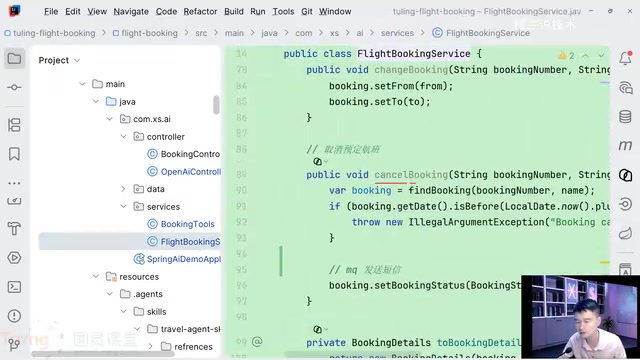
In the itinerary planning scenario, the tutorial introduces the concept of Skill. The user asks the assistant to plan a destination trip, and the system calls a "private travel butler" skill to complete the itinerary arrangement. According to the tutorial, Skills can be understood as cultivable skill units that can reuse existing external skills or be used to maintain prompts in a more standardized way.
This point is worth expanding. Many AI applications initially scatter prompts throughout the code, and as features increase, control is gradually lost. Skill provides an organizational approach: package the goals, constraints, available tools, and output format of a certain type of task into a manageable unit, loaded by the model as needed. Compared with simply piling up system prompts, this has clear advantages in maintainability and reusability, especially suitable for customer service systems with multiple coexisting scenarios.
A system prompt is a global instruction injected once at the beginning of a conversation, shared by all requests, suitable for role settings and general constraints; but when features increase, stuffing all rules into the system prompt causes context bloat and mutual interference between instructions. The Skill approach is on-demand loading: each skill encapsulates its own description, callable tools, and input/output format, and is activated only when the model determines that this type of task needs to be handled. This "lazy loading" mechanism saves context window space and allows skills to iterate independently—modifying one skill does not affect other scenarios. In customer service systems with multiple coexisting scenarios, Skill actually plays the role of business modularization.
The Realistic Path for Java Developers Entering AI Applications
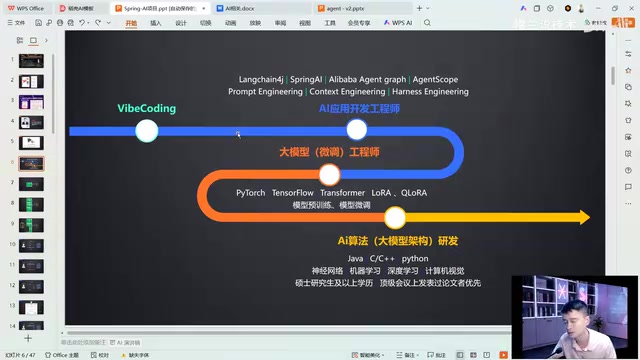
The tutorial includes a career discussion for Java programmers with high information density. The author splits the direction into two: one is using AI to empower coding efficiency, that is, AI-assisted programming with tools like Codex and Claude Code; the other is becoming an AI application development engineer, using frameworks like Spring AI to build lightweight Agents, chatbots, and multi-Agent systems based on process orchestration.
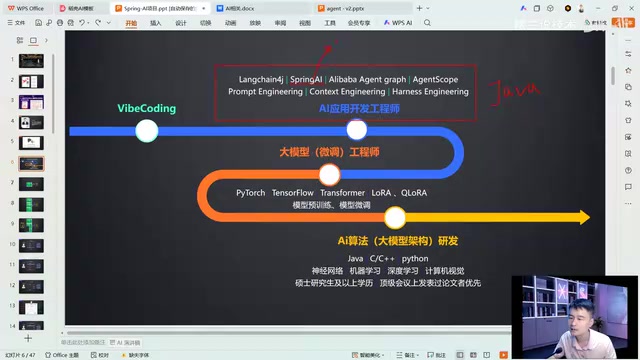
One of the author's judgments is: the score gap between mainstream large models is no longer large, and the key to whether an AI application is good or not lies not in the model itself but in the engineering capabilities outside the model—prompt engineering, Tools, MCP, RAG, Skills, and the self-evolution capability that makes applications smarter the more they are used. This view is basically consistent with current industry practice: against the backdrop of model convergence, the engineering layer is where differentiation lies.
Regarding fine-tuning, the tutorial's attitude is pragmatic: fine-tuning can inject enterprise vertical data into the base model, but the cost in manpower and time is high. Small and medium-sized companies prefer context engineering combined with Tools, MCP, RAG, and Skills to compensate for the model's lack of external knowledge, while large companies are more likely to consider fine-tuning. As for the algorithm engineer direction, the author bluntly says it is unfriendly to ordinary undergraduates, with high thresholds for academic credentials and papers, and does not recommend blindly switching.
Who This Tutorial Is For
From the content structure, it is more suitable for developers with a Java foundation who want to systematically understand the full picture of AI application engineering. The project practice covers the complete chain from conversational interaction and tool invocation to external service integration, and also provides guidance from scratch for those who have not touched Spring AI. It should be noted that the tutorial is mainly demonstration-oriented, and parts such as RAG are not expanded due to time constraints; those who want to go deeper into a certain link still need to consult official documentation and practice hands-on.
Overall, the value of this content lies in placing concepts like Tools, MCP, Skills, and Agent—which are easily scattered when taught—into the same project, so learners can see what problems each solves and how they collaborate. For Java developers looking for an entry point into AI application development, it is a reference route that avoids detours.
One-line Summary
A Spring AI 2.0 tutorial uses an airline customer service project to connect the engineering chain of Tools, MCP, Skills, and Agent.
Paragraph Summary
Based on a Spring AI 2.0 tutorial on Bilibili, the article uses the Turing Airlines intelligent customer service project as the main thread to outline the complete engineering path for Java developers to integrate large model capabilities. The core distinction is: Tools are used for controlled exposure of internal enterprise business APIs, MCP integrates external services such as Baidu Maps via a standardized protocol, Skills encapsulate prompts and task constraints into maintainable and reusable skill units, and Agent orchestrates these capabilities into executable business processes. The author believes that large model capabilities have converged, and what determines the quality of AI applications is the outer engineering layer, including prompt engineering, Tools, MCP, RAG, and Skills. The attitude toward fine-tuning is pragmatic: high cost, and small and medium-sized enterprises are better off replacing it with context engineering. Overall, it is suitable for developers with a Java foundation who want to systematically understand the full picture of AI applications.
Related articles

A 19-Year-Old's Rental Horror Story: Ceiling Collapse, Bug Infestation, and the Lessons It Taught Me
At 19, my first off-campus rental brought bug infestations, no heat, a collapsed ceiling, and a ruined laptop with no renter's insurance. Here are the hard-won lessons for first-time student renters.

Veda Nurse's Cranial Nerve Exam: Why ASMR Role-Play Is Going Viral
Bilibili creator Veda's cranial nerve exam ASMR video goes viral, blending humor and sensory triggers through nurse role-play. This article analyzes its unique appeal and the audience psychology behind ASMR role-play.

LG Cinebeam AI Review: 120-Inch Giant Screen + 3000 Lumens, a New Choice for the Living Room Theater
LG Cinebeam AI projector review: 3000 ANSI lumens, 4K, 100 inches from about 8 cm and 120 inches from about 18 cm. Built-in webOS, AI Concierge voice recommendations, AI Sound Pro 11.1.2 virtual surround, and Game Optimizer—positioned for fixed living room installation, complementing the portable Cinebeam S.