Step X Agent Phone Development Guide: Anyone Can Write Skills

Step X builds its own system and interface-level interactions, letting users develop and distribute Skills in natural language.
Jin Yue Xing Chen's Step X agent phone builds its own OS from the ground up while remaining Android-compatible, making the agent the device's central hub rather than an accessory app. It completes cross-app interactions by calling apps' exposed MCP and A2A interfaces, avoiding the recognition errors and risk-control issues of screen-reading solutions, and maintains complete cross-app memory and context. Hardware additions include an AI physical button and a rear Mini LED dot-matrix display to visualize the agent's status. Most importantly, Step Studio lets users select connectors and generate Skills in natural language, test on real devices, and publish to the AMOLE Store, forming a develop—test—distribute loop. Its differentiation lies in opening development permissions to non-developers, potentially fostering a long-tail capability ecosystem, though maturity still needs real-world validation.
Step X Agent Phone: Redefining Human-Computer Interaction
The Step X agent phone released by Jin Yue Xing Chen is fundamentally different from other products on the market. Rather than simply layering an agent app on top of Android, it builds an independent operating system from the ground up while remaining backward-compatible with the Android ecosystem. This architecture means the agent is no longer an "accessory feature" of the phone but the "central nervous system" of the entire device.
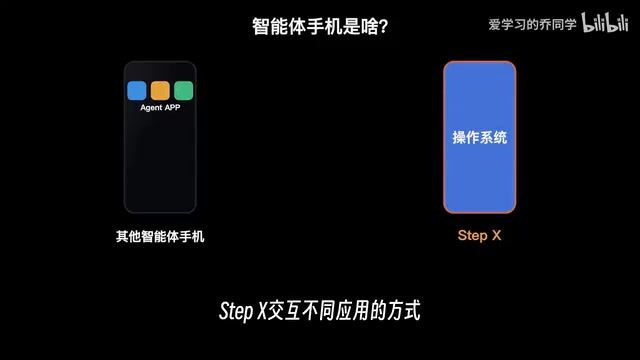
Traditional agent phones typically rely on screen reading or accessibility services to obtain app information, a method that not only has a high recognition error rate but also easily triggers apps' risk-control mechanisms. Step X changes this approach: it directly calls the MCP (Model Context Protocol) and A2A (Agent-to-Agent) interfaces exposed by apps, completing cross-app interactions in script form. This "interface-level" operation fundamentally reduces recognition errors and risk of being blocked, while enabling the device to maintain a complete cross-app memory and context system—something screen-reading solutions struggle to achieve.
- MCP (Model Context Protocol): An open protocol proposed by Anthropic, aimed at standardizing how large language models connect with external tools and data sources. It encapsulates various app capabilities as model-callable "tools," and the model requests services through structured interfaces rather than simulating clicks or reading the screen. MCP reduces integration complexity, enabling agents to reliably execute tasks across apps while facilitating permission control and auditing.
- A2A (Agent-to-Agent): An inter-agent communication protocol that defines how agents discover each other, negotiate tasks, and exchange results. In the phone context, A2A lets agents within different apps collaborate via standard messages to complete cross-app workflows. Unlike MCP, which focuses on "model calling tools," A2A focuses on "agent calling agent"; the two are complementary and together support Step X's interface-level cross-app interactions.
Hardware Also Changes for Agents
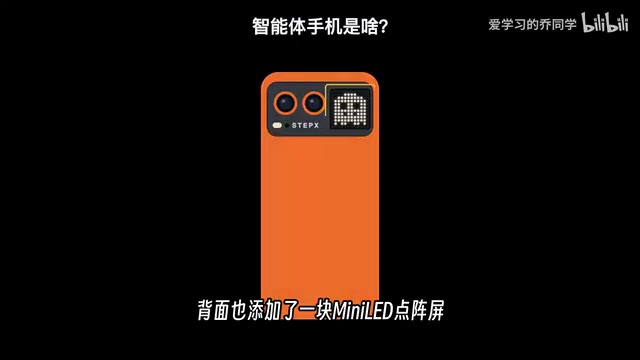
Step X's hardware-level changes are equally noteworthy. An AI physical button has been added to the side of the body, and a Mini LED dot-matrix display is embedded on the back, specifically for showing the AI's thinking process and working status. These designs may seem minor, but they send a clear signal: the agent is no longer an invisible program hidden in the background but a device entity that users can perceive and interact with.
Step Studio: A Zero-Barrier Skill Development Tool
Step X's most striking capability is letting ordinary people participate in writing and publishing Skills. This process is completed through Step Studio, and the workflow is not complicated.
After opening Step Studio, enter the skill builder from the top-left corner; first you need to select "connectors." A connector is essentially the list of Step X pre-installed app interfaces that your Skill can call. You can think of it as the "permission bridge" between the Skill and the apps—whichever connectors you select, the Skill can reach the capabilities of those apps.
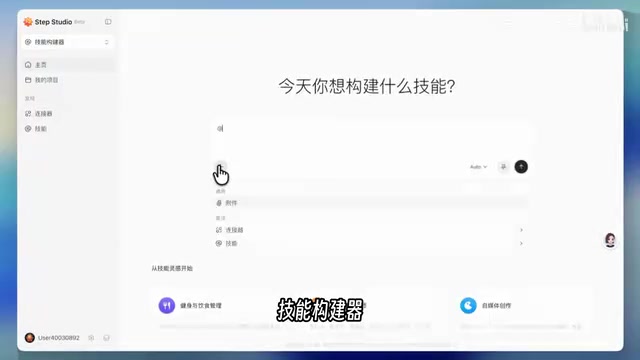
After selecting connectors, simply input your requirement in natural language, such as "recommend clothes based on tomorrow's weather," press Enter, and the agent will automatically generate the corresponding Skill logic. Once generation is complete, you can enter the real-device testing phase to verify the Skill's actual performance. The entire process requires no traditional coding—natural language is the development language.

After testing passes, the Skill can be published to the AMOLE Store, and other Step X users can download and install it via their phones. A complete "develop—test—distribute" loop is thus formed, with the participation barrier lowered to a level ordinary users can reach.
- Skill: In the agent context, a Skill refers to a reusable capability module that encapsulates specific task logic, typically including trigger conditions, the tools/connectors it calls, execution steps, and output format. Unlike ordinary functions, Skills can be generated from natural language descriptions and tested and distributed on real devices. Step X treats Skills as user-producible, shareable assets, making them the basic unit of the ecosystem.
- Connector: A connector is the permission and capability bridge between a Skill and pre-installed apps—essentially the list of interfaces exposed by apps and their access authorization. Selecting connectors defines the scope of apps a Skill can reach, ensuring both functionality and security boundaries. The breadth of connector coverage directly determines the task complexity a Skill can accomplish and is a key indicator of a platform's openness.
Why This Matters
Step X's real differentiation lies not in hardware specs or agent capabilities themselves but in opening development permissions to non-developers. In the past, the "intelligence" of agent phones was defined by manufacturers, and users could only use preset features. Step X hands the tools for producing Skills to users through Step Studio, substantially lowering the barriers of hardware and system.
The imagination space of this model lies in long-tail needs: everyone's life scenarios differ, and manufacturers cannot anticipate all usage patterns, but users themselves know. When enough users start writing and sharing Skills, the AMOLE Store could evolve into a user-driven capability ecosystem—this is the most noteworthy aspect of Step X compared with other agent phones. Of course, whether the ecosystem can truly take off still depends on the smoothness of the development experience, the breadth of connector coverage, and the effectiveness of community distribution mechanisms—all of which require actual use to judge.
One-line Summary
Step X builds its own system and interface-level interactions, letting users develop and distribute Skills in natural language.
Paragraph Summary
Jin Yue Xing Chen's Step X agent phone builds its own operating system from the ground up while remaining Android-compatible, making the agent the device's central hub rather than an accessory app. It completes cross-app interactions by calling the MCP and A2A interfaces exposed by apps, avoiding the recognition errors and risk-control issues of screen-reading solutions, and maintains complete cross-app memory and context. On the hardware side, it adds an AI physical button and a rear Mini LED dot-matrix display to visualize the agent's status. Most importantly, Step Studio lets users select connectors and generate Skills in natural language, then test on real devices and publish to the AMOLE Store, forming a develop—test—distribute loop. Its differentiation lies in opening development permissions to non-developers, potentially fostering a long-tail capability ecosystem, though ecosystem maturity still requires real-world validation.
Related articles

Free Unlimited Claude Code Solution: Agnes AI + CC Switch Setup Guide
No paid subscription needed — pair the free AI platform Agnes AI with the open-source tool CC Switch to provide a backend for Claude Code, enabling unlimited free calls to text, image, and video models. This guide covers the full setup, test results, and usage boundaries.

A Complete Zero-Cost Guide to Getting Started with Claude Code for Beginners in China
A beginner's guide to Claude Code for users in China: two installation methods (command line and IDE plugin), full configuration steps for replacing the official API with the free domestic LongCat model, and a hands-on demo of building a small tool with natural language, plus tips.

When the NSA Gets Involved: The AI Supply Chain Crisis Behind Open-Source CVEs and API Key Hijacking
Multiple open-source projects disclosed severe CVEs in one day, PHP flaws alarmed the FBI, and Railway and OpenCode were breached with API keys stolen. This article breaks down the vulnerability window, AI-accelerated exploitation, and the AI supply chain crisis behind the API key black market, with a developer defense checklist.