The Cambridge Analytica Scandal Revisited: The Privacy Questions Raised by Zuckerberg's 2017 Remarks
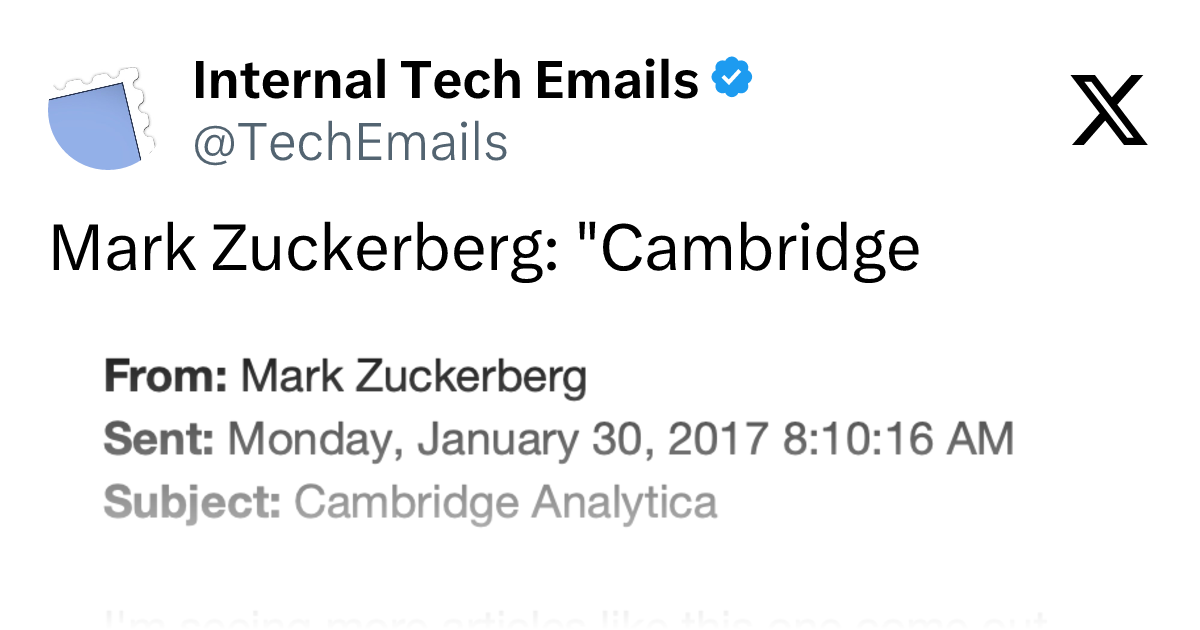
Cambridge Analytica revisited: how data misuse reshaped the tech industry's approach to privacy governance.
Hacker News recently rekindled discussion around Mark Zuckerberg's early statements on Cambridge Analytica, drawing renewed attention from the tech community. At the heart of the scandal: a political data firm exploited Facebook's open API to harvest data from roughly 87 million users without their knowledge, using it for micro-targeted political advertising. The affair made "data as power" concrete, exposing how social platform profiles could be weaponized to sway public opinion and interfere with democratic elections. Debates over platform responsibility, the gap between corporate promises and actions, and the real-world effectiveness of data regulation continue to this day — reflecting the industry's ongoing tension between self-regulation and external oversight.
A Piece of History Dug Back Up
The Hacker News community recently revisited Mark Zuckerberg's early statements regarding Cambridge Analytica. The post garnered 104 upvotes and 15 comments, reflecting how this data privacy scandal continues to fuel reflection in the tech world, even years after the fact.
Unfortunately, the original source material is limited in detail — it provides only a headline and community engagement metrics, without the full text of Zuckerberg's remarks or the specifics of the community discussion. The following draws on the publicly documented background of the Cambridge Analytica affair to help readers understand why this topic continues to generate attention.
The Core Narrative of the Cambridge Analytica Scandal
Cambridge Analytica was a political data consultancy that was exposed for improperly obtaining personal data from tens of millions of Facebook users through a third-party application, then using that data for micro-targeted political advertising. The central controversy was this: users' behavioral data was being used to influence political outcomes entirely without their knowledge.
The case became a landmark precisely because it made the abstract concept of "data as power" tangible. The user profiles held by social platforms could be leveraged not just for commercial gain, but to manipulate public opinion — cutting straight to the nerve of democratic governance.
The Debate Over Platform Responsibility
After the scandal broke, one question has never stopped being debated: to what degree should a platform be held responsible for third-party misuse of data? Facebook's open API policy at the time allowed developers to access vast amounts of data on users and their friends — a "convenience-first" design that planted the seeds of the problem. When data flows out through legitimate channels and is then misused, whether the platform's role is victim, enabler, or co-conspirator remains unanswered to this day.
Why These Remarks Are Still Being Discussed
Hacker News, as a community of technology practitioners, tends to revisit this kind of history as a way of drawing comparisons to the present. Looking back at how early tech giants responded to privacy issues, many users contrast those reactions with today's increasingly stringent data regulation environment — GDPR, various data protection acts, and so on.
These retrospective discussions typically center on a few questions: whether a company's early statements were consistent with its subsequent actions, whether the industry has genuinely learned its lessons, and whether personal data protection mechanisms have substantively improved. The 104 upvotes suggest these questions still resonate strongly within the technical community.
From Scandal to Industry Turning Point
The Cambridge Analytica affair is widely seen as a watershed moment for privacy governance in the tech industry. It directly drove greater regulatory scrutiny of large platforms, gave rise to stricter data compliance requirements, and helped transform "Privacy by Design" from a slogan into an actual constraint on product development. For developers, this has meant tighter API permissions, a stronger emphasis on the principle of data minimization, and greater transparency in user authorization flows.
What This Means Today
Regardless of what was specifically said, this history serves as a reminder to the industry: the expansion of data capabilities must be matched by a corresponding expansion of responsibility. When the information a platform holds about its users is sufficient to shape commercial outcomes — or even political ones — transparency, accountability, and user control are no longer optional.
For ordinary users, the enduring echo of this event is also a warning: when using free services, understanding the hidden cost of the "data-for-service" trade-off matters more than ever before.
Note: This article is based on publicly available background information. Because the original source material contains only a headline and community engagement data — without the full text of Zuckerberg's remarks or specific comment threads — this piece does not include direct quotations or assessments of any specific statements.
Related articles
LangChain Agent Web Scraping: DIY vs. Managed API — A Practical Comparison
DIY scraping vs. managed APIs for LangChain Agents: compare Playwright/bs4 self-builds against Firecrawl and context.dev on cost, anti-bot maintenance, and when to switch.
Local AI Video Generation Workflow: The Real Challenges of Stitching Short Clips Together
Why local AI video generation is stuck at 5-second clips, and how creators stitch fragments into longer videos using segmented workflows, frame bridging, and editing tools.
YC's Latest Demo Day: The 9 Most Exciting Startups in VCs' Eyes
VCs spotlight 9 standout startups from YC's latest summer Demo Day, including floating reactors and brain chips — signaling a hard tech comeback in venture capital.