The Complete Guide to Agent Skills: Principles, Structure & Practical Applications
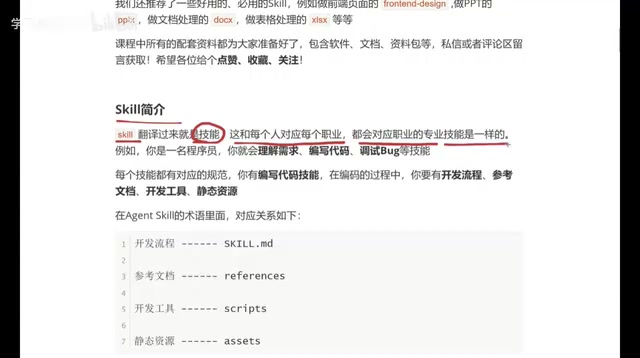
A comprehensive guide to AI Agent Skills covering principles, structure, and real-world applications.
This article provides a thorough breakdown of AI Agent Skills—from their technical origins in the ReAct paradigm and modern multi-agent frameworks to the four-component structure (SKILL.md, references, scripts, assets). It explains how Skills differ fundamentally from simple prompts by being modular, reusable, and version-controlled, and explores practical applications including frontend generation, PPT creation, and document processing.
What Are Agent Skills
With the rapid adoption of AI programming and automation tools like Claude Code, Cursor, and Hermes Agent, "Skill" has become an essential concept in the Agent ecosystem. Many developers are confused when they first encounter it: What exactly is it? How is it different from a regular prompt?
To understand why Skills matter, you first need some technical background on AI Agents. From early single-step reasoning based on the ReAct (Reasoning + Acting) paradigm to today's multi-agent collaboration frameworks represented by LangGraph, AutoGen, and Claude Code, Agent capabilities have undergone a fundamental shift from "single-step reasoning" to "multi-step planning and execution."
Introduction to the ReAct Paradigm: ReAct was jointly proposed by researchers at Princeton University and Google in 2022. Its core idea is to interleave a language model's "Reasoning" and "Acting"—at each step, the model first generates a Chain-of-Thought, then decides which action to take. The result of that action is fed back to the model for the next round of reasoning. This paradigm was the first to give LLMs the ability to interact with external environments, laying the design foundation for modern Agent frameworks. Compared to pure reasoning approaches, ReAct significantly reduces hallucination rates and enables Agents to handle complex tasks requiring multi-step information gathering.
Modern AI Agent frameworks have introduced "Tool Use" and "contextual memory" mechanisms—the former allows LLMs to dynamically invoke external APIs or code interpreters during reasoning, while the latter is divided into short-term working memory (the current conversation window) and long-term vector storage (external knowledge bases), collectively enabling Agents to continuously execute complex tasks. This paradigm shift—from single-turn conversations to autonomous execution—is precisely the technical soil from which Skills emerged. As "capability encapsulation units," Skills give Agents reusable, composable professional abilities, similar to function libraries or microservices in software engineering. They are the critical infrastructure that transforms Agents from "able to chat" to "able to work."
MCP Protocol and the Standardization Trend for Skills: With Anthropic's release of the Model Context Protocol (MCP) in late 2024, Skill interoperability has reached a standardization milestone. MCP is essentially an open protocol that defines communication standards between AI models and external tools and data sources—similar to what the USB interface is to the hardware ecosystem. A unified interface standard allows Skills developed by different vendors to be reused across platforms. Developers only need to package their Skills according to the MCP specification, and they can run directly in any Agent framework that supports MCP (Claude Desktop, Cursor, Zed, etc.), breaking the previous fragmented landscape where each Agent framework operated in isolation with incompatible Skills. This standardization trend is highly analogous to the birth of the HTTP protocol in the early days of the Web—it was the unified communication protocol that gave rise to the thriving internet application ecosystem. The widespread adoption of MCP foreshadows the emergence of an open "Skill marketplace" in the future, where developers can reuse professionally crafted Skills as conveniently as installing npm packages, dramatically lowering the barrier to building Agent capabilities.
The essence of a Skill isn't complicated. As the name suggests, it means "skill," and its logic closely mirrors human professional skills: students can write assignments in language arts, math, and English; programmers can understand requirements, write code, and debug. Agent Skills abstract these professional capabilities into functional modules that AI can invoke and reuse.
In other words, however many types of skills humans have, an Agent can be configured with that many Skills. This analogy may seem simple, but it precisely captures the core design philosophy—distilling the complete execution methodology for a category of tasks so that the Agent automatically invokes it when encountering the corresponding scenario.
The Four Components of a Skill
To truly understand the power of Agent Skills, the key is to see their internal structure. The four-directory design of Skills embodies the classic principle of "Separation of Concerns" in software engineering—a principle proposed by computer science pioneer Edsger Dijkstra in 1974. Its core idea is to decompose a system into functionally independent, single-responsibility modules, widely applied in microservice architectures, frontend MVC layering, and beyond. Skills completely decouple execution logic, domain knowledge, tool scripts, and static resources, allowing each dimension to evolve independently: when business rules change, you only need to update SKILL.md; when tools are upgraded, you only need to replace scripts—no need to refactor the whole thing. This greatly improves skill maintainability and team collaboration efficiency.
Using the programmer profession as an example, completing a development task requires four types of core elements:
Development Workflow (SKILL.md)
Before writing code, you need to fully map out the business logic—what to do first, what to do next, which module to write first, and how the modules relate to each other. This is the development workflow. In the Agent Skills terminology, it corresponds to the SKILL.md file, which serves as the "brain" of the entire skill and is the only required component.
Reference Documentation (references)
Writing code is inseparable from reference materials—whether API documentation or business requirements documents. In a Skill, these materials are organized under the references directory, available for the Agent to consult at any time during execution.
The references directory addresses the inherent limitations of large language models—"knowledge cutoff" and "lack of domain-specific knowledge." LLM training data has a temporal cutoff and cannot cover proprietary knowledge such as internal enterprise standards or private APIs. By injecting the latest API documentation, internal business specifications, and industry standards into the execution context, Agents can achieve near-expert-level performance in specialized domains without retraining the model.
The Technical Origins of RAG and references: Retrieval-Augmented Generation (RAG) was proposed by Meta AI in 2020. Its core approach is to dynamically retrieve from an external knowledge base during model inference, concatenating retrieved document fragments into the prompt so the model can "reference in real-time" information beyond its training data. The Skill references directory shares the same lineage as RAG but adopts an "explicit packaging" strategy better suited to Agent scenarios—developers pre-select and structurally organize documents to ensure the Agent always gets the most relevant and authoritative context when executing a specific skill, avoiding the noise and instability that dynamic retrieval might introduce. The essential difference is: RAG is "on-demand dynamic retrieval," while references is a "pre-curated document library." The latter often provides higher execution stability in domain-specific scenarios. Notably, as LLM context windows have expanded from an early 4K tokens to Claude 3.5's 200K tokens and Gemini 1.5 Pro's 1 million tokens, the volume of documentation that the references directory can accommodate continues to grow. "Putting an entire business manual into the context" is moving from aspiration to reality.
Development Tools (scripts)
Nobody uses a plain text editor to write complex projects. Just as doctors need the right instruments, Agents also need tools to boost execution efficiency. This corresponds to the scripts directory, used to store executable scripts for automated operations.
The scripts directory is essentially the Agent's "toolbox," deeply integrated with the LLM's "Function Calling" capability. Function Calling was first introduced by OpenAI in June 2023, and subsequently adopted by Anthropic Claude, Google Gemini, and other major LLMs as an industry standard. The core mechanism works as follows: developers declare a set of callable functions with structured descriptions to the model; during inference, the model autonomously decides whether to call a function, which function to call, and generates the parameters; the host program then executes the actual call and returns the result to the model.
The Evolution of Function Calling: Early Agent systems relied on hardcoded prompts to guide models into outputting specific formats (like JSON), which were then parsed and executed by programs—an approach with poor stability and high error rates. The standardization of Function Calling fundamentally changed this landscape—model-level support for structured tool declarations and calls significantly reduced parsing failure rates. In 2024, with Anthropic's release of the Tool Use API and OpenAI's introduction of Parallel Function Calling, Agents can now trigger multiple tools in a single inference step, dramatically improving execution efficiency for complex tasks. The Skill scripts directory exists precisely within this technical context, providing Agents with a set of predefined, directly callable "tool collections."
Agents can dynamically decide when to invoke which script during reasoning, organically fusing AI's language understanding capabilities with the precise execution capabilities of traditional programs—forming the optimal solution for human-AI collaboration.

Static Resources (assets)
Building a webpage requires images, audio, video, and other materials—collectively known as static resources, corresponding to the assets directory.
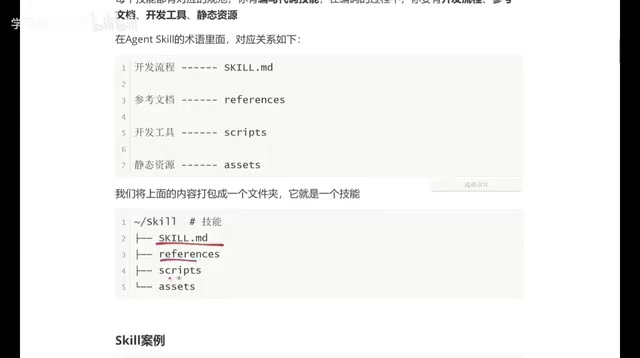
Packaging these four types of elements into a single folder constitutes a complete Agent Skill. The standard directory structure is as follows:
skill-name/
├── SKILL.md      # Development workflow (required)
├── references/   # Reference documentation
├── scripts/      # Development tools
└── assets/       # Static resources
It's important to emphasize: only SKILL.md is required; the other three directories can be included or omitted based on actual needs. The simpler the task, the fewer directories needed; the more complex the task, the more likely all three will be used.
SKILL.md File in Detail
SKILL.md is the core product of Structured Prompt Engineering. Early prompts were primarily unstructured natural language, relying on human experience for tuning, with poor stability and reproducibility. Structured prompting introduced standardized fields such as Role, Task, Constraint, and Format, significantly improving output consistency.
The Evolution of Prompt Engineering: Prompt engineering as a systematic discipline has evolved from "intuitive parameter tuning" to "scientific design." Google's 2022 paper on Chain-of-Thought Prompting first demonstrated that guiding models to "reason step by step" can dramatically improve accuracy on complex tasks, igniting a wave of structured prompting research. Subsequently, techniques like Few-Shot example design, Role Prompting, and Self-Consistency sampling were systematically validated. SKILL.md stands on the shoulders of this evolution, further combining prompt engineering with version control and document management, upgrading it from "personal technique" to "team asset"—marking prompt engineering's formal entry into the software engineering phase.
Unlike traditional prompts that focus on single-conversation quality, SKILL.md further combines structured prompting with version control and document management, forming a version-manageable, team-collaborative "capability specification document"—similar to an API Spec in software engineering. It not only describes "what to do" but also specifies "how to do it" and "what format to output," fundamentally ensuring the consistency and predictability of Agent behavior.
As the only required file, SKILL.md carries the core logic of the entire Skill and typically consists of two major parts.
Metadata
At the top of the file is metadata, primarily containing the skill's name and functional description. For example, a restaurant marketing material design Skill might have this description: "Generate brand-aligned creative designs for a restaurant. When a user requests specific materials (such as posters, roll-up banners, packaging boxes, etc.), output the corresponding design plan."
Metadata serves to make the Agent clearly understand "what this skill can do and when to invoke it"—it's the core basis for the skill triggering mechanism. In complex Agent systems with multiple Skills working together, metadata also takes on the responsibility of "skill routing"—the Agent's orchestration layer (Orchestrator) performs semantic matching between user intent and each Skill's metadata, automatically selecting the most appropriate skill combination to complete the task, without requiring manually hardcoded trigger rules.
Orchestrator Pattern and Skill Routing: In multi-Agent system architectures, the Orchestrator is the core component responsible for task decomposition and skill scheduling, drawing design inspiration from the Service Mesh concept in distributed systems. When a user issues a compound request, the Orchestrator first performs intent recognition, breaks the task into multiple sub-goals, then matches each sub-goal against registered Skills' metadata through semantic similarity computation, ultimately orchestrating the optimal execution path. This process is similar to an API Gateway in microservice architecture—receiving requests uniformly and intelligently routing them to the corresponding services. The quality of metadata descriptions directly affects routing accuracy; vaguely worded metadata may cause the Orchestrator to incorrectly invoke the wrong skill—which is why the industry emphasizes that metadata should precisely and unambiguously describe a skill's applicable boundaries. Notably, with the maturation of vector databases (such as Pinecone and Chroma) and embedding models, modern Orchestrators increasingly use "semantic retrieval" rather than "keyword matching" for skill routing. This means metadata writing styles are also evolving toward more natural semantic descriptions rather than keyword stuffing.
Instructions
After the metadata come the specific execution instructions. Just like each natural language sentence we use when conversing with an LLM, the instructions in a Skill are systematically organized to form a complete execution specification.

Using the restaurant material Skill as an example, instructions typically include three levels:
- Brand Core Elements: Brand name, visual style, IP character, primary color palette, slogan, etc.
- Task Execution Rules: How to generate brand-consistent plans when users request different types of materials
- Output Format Specifications: How to present themes, visual styles, composition, and detailed suggestions
There's one key lesson worth remembering: the more detailed the instructions, the more the generated content matches expectations. This principle is known as "Constraint-Driven Generation" in prompt engineering. From a technical perspective, LLMs essentially perform token-level autoregressive sampling in a high-dimensional probability space, and the output distribution is extremely broad in an unconstrained state.
The Mathematical Essence of Autoregressive Sampling and Constraints: The generation process of large language models is a conditional probability chain: P(token_n | token_1, token_2, ..., token_{n-1}), meaning each token's generation is conditioned on all preceding tokens. "Constraints" are mathematically equivalent to re-normalizing the conditional probability distribution—by introducing precise structural descriptions in the prompt, the probability distribution for each generated token concentrates toward the target output, suppressing the probability of irrelevant outputs. This has an intrinsic connection to "rate-distortion theory" in information theory: constraints are equivalent to adding redundancy check bits during information transmission, trading moderate "information redundancy" for higher transmission reliability. In practice, this explains why for the same task, prompts with detailed output format examples are often 10x more stable than vague descriptions—constraints compress the model's sampling space from the full probability distribution to the target subspace.
By introducing precise structural constraints, you can significantly increase the probability density of target outputs while compressing the sampling space for low-quality outputs. Therefore, vague instructions yield vague results—only structured, sufficiently granular instructions enable Agents to consistently produce high-quality outputs.
Skill Quality Assessment and Continuous Optimization: Building high-quality Skills is a continuous iterative engineering process. The industry is gradually adopting "Evals-Driven Development" (Evaluation-Driven Development) as a best practice—before formally writing SKILL.md, first define a "Golden Dataset" covering typical scenarios and edge cases, containing representative input-output pairs. After each modification to SKILL.md, automatically run an evaluation pipeline, measuring iteration effectiveness through quantitative metrics like Pass Rate, consistency scores, and Human Preference Scores, transforming Skill optimization from subjective feelings to data-driven engineering decisions. This methodology borrows from Test-Driven Development (TDD) in software engineering, forming a virtuous cycle of "define acceptance criteria first, then optimize implementation," effectively preventing the common trap of "fixing one problem while introducing three new ones." For enterprise-level Skill libraries, it's recommended to include Evals test sets alongside Skill files in version control, ensuring every commit has a quantifiable quality baseline for comparison.
The Fundamental Difference Between Agent Skills and Prompts
Looking at the contents of SKILL.md, many people's first reaction is: "Isn't this just a prompt?"
This observation isn't wrong, but Agent Skills' capabilities far exceed those of regular prompts. The core differences are:
- Prompts are one-time use: You input some text, get a single response, use it once and discard it—it can't be reused. Each use depends on the user manually typing input, lacks stability, and the quality of results is highly dependent on the user's prompt-writing ability.
- Skills are modular, reusable, and extensible: Beyond SKILL.md, Skills can mount documentation, tools, and resources through references, scripts, and assets, enabling automation far more complex than simple text prompts. More importantly, Skills can be version-controlled through Git, shared and iterated within teams, and integrated with CI/CD pipelines—truly entering the production cycle of software engineering.
The Engineering Advantages of Skills: From Prompt to Product: Once Skills are incorporated into a Git version control system, teams can track the effectiveness differences of every instruction modification (similar to A/B testing), conduct peer reviews through Pull Request mechanisms, and automatically test Skill output quality in CI/CD pipelines. This engineering path is highly aligned with the GitOps philosophy—the concept of Infrastructure as Code extends to the AI capability layer, forming a new paradigm of "AI Capability as Code." For enterprises, this means Skill libraries can be audited, rolled back, and compliance-managed just like code repositories, bringing the uncertainty of AI applications into a controllable engineering framework—something ordinary prompts simply cannot achieve.
Skill Orchestration in Multi-Agent Collaboration: In multi-agent frameworks like LangGraph and AutoGen, Skills are not only invoked by a single Agent—a more common pattern is "expert Agents" with their own dedicated Skills collaborating to form a clearly defined AI team. For example, a complete software delivery pipeline might involve four types of roles: a requirements analysis Agent (equipped with business understanding Skills), a code generation Agent (equipped with programming language Skills), a testing Agent (equipped with quality assurance Skills), and a deployment Agent (equipped with DevOps Skills). Each Agent focuses on its core competency domain, coordinated by an Orchestrator. This "Skill specialization + Agent division of labor" pattern is highly isomorphic to how functional teams collaborate in enterprises: just as product, development, testing, and operations each play their part, the core competitive advantage of each expert Agent in an AI-native organization lies precisely in its equipped set of high-quality Skills. As Agent frameworks mature, the depth and breadth of an enterprise's Skill library will become an important indicator of its degree of AI adoption.
To put it simply: a prompt is "saying one sentence," while an Agent Skill is "equipping AI with a complete professional capability package that can be invoked at any time." This is also why, as the Agent ecosystem continues to mature, the strategic value of Skills will become increasingly prominent.
Practical Application Scenarios for Skills
After understanding the principles, the value of Skills ultimately manifests in specific business contexts. With a simple natural language instruction like "Help me create a promotional poster for a restaurant's Wellington steak at $38, first come first served," a properly configured Skill will automatically combine brand style, target audience, core selling points, and other dimensions to generate a complete design plan.
The industry has already seen numerous mature and usable Agent Skills emerge:
- Frontend Page Generation Skill: Rapidly produce responsive web interfaces
- PPT Creation Skill: Automatically generate structurally complete presentations
- Document Processing Skill: Batch process and organize various text documents
- Spreadsheet Processing Skill: Automated data cleaning and organization
From a broader perspective, these Skills are driving enterprise AI applications from "POC demos" to "production deployment." When an organization accumulates enough validated Skills, it has effectively built its own "AI capability asset library"—following the same logic as traditional software enterprises accumulating code repositories and middleware, this is a crucial component of organizational core competitiveness in the AI era.
The Strategic Value of Externalizing Tacit Knowledge: Management scholar Michael Polanyi divided knowledge into explicit knowledge (which can be documented and taught) and tacit knowledge (which exists in personal experience and intuition, difficult to articulate). The most valuable knowledge in enterprises is often the tacit knowledge accumulated over years by experienced employees—how to handle edge cases, how to prioritize amid ambiguous requirements, how to balance quality and efficiency. The Skill design process is essentially a "knowledge externalization movement": through systematic instruction writing, this knowledge that previously existed only in human minds is transformed into explicit specifications that AI can execute. This process not only enables core organizational capabilities to be preserved and passed on but also makes them infinitely replicable and deployable at scale, fundamentally changing the boundaries of "capability bottlenecks." It's worth noting that the knowledge externalization process itself carries a risk of "encoding distortion"—when compressing complex expert judgments into written specifications, some subtle contextual information will inevitably be lost. Excellent Skill designers need to strike a balance between "rule completeness" and "contextual flexibility," leaving sufficient room for the model's autonomous judgment rather than writing Skills as rigid process scripts.
Every high-quality Skill is a crystallization of the organization's deep understanding of a specific business process. Its essence is transforming human experts' tacit knowledge into explicit specifications that AI can stably execute—this "knowledge externalization" process itself carries enormous strategic value.
Conclusion
The learning path for Agent Skills is actually quite clear: Understand Skills → Customize Skills → Use Skills effectively. The barrier to entry isn't high—at its core, it's about abstracting human professional skills into structured, reusable modules.
For developers looking to seize the initiative in the AI Agent wave, mastering the design and writing of Skills means being able to truly harness the next generation of automation tools—making AI execute efficiently according to your own business logic rather than just staying at the chat level. As Agentic AI infrastructure continues to mature, engineers who excel at designing and composing Skills will become one of the most valuable technical roles in the AI-native era.
Related articles
Claude Code Adds Agent View: A Research Preview for Unified Session Management
Claude Code's new Agent View feature (research preview) consolidates all coding sessions into a unified list, advancing AI tools toward multi-agent orchestration.
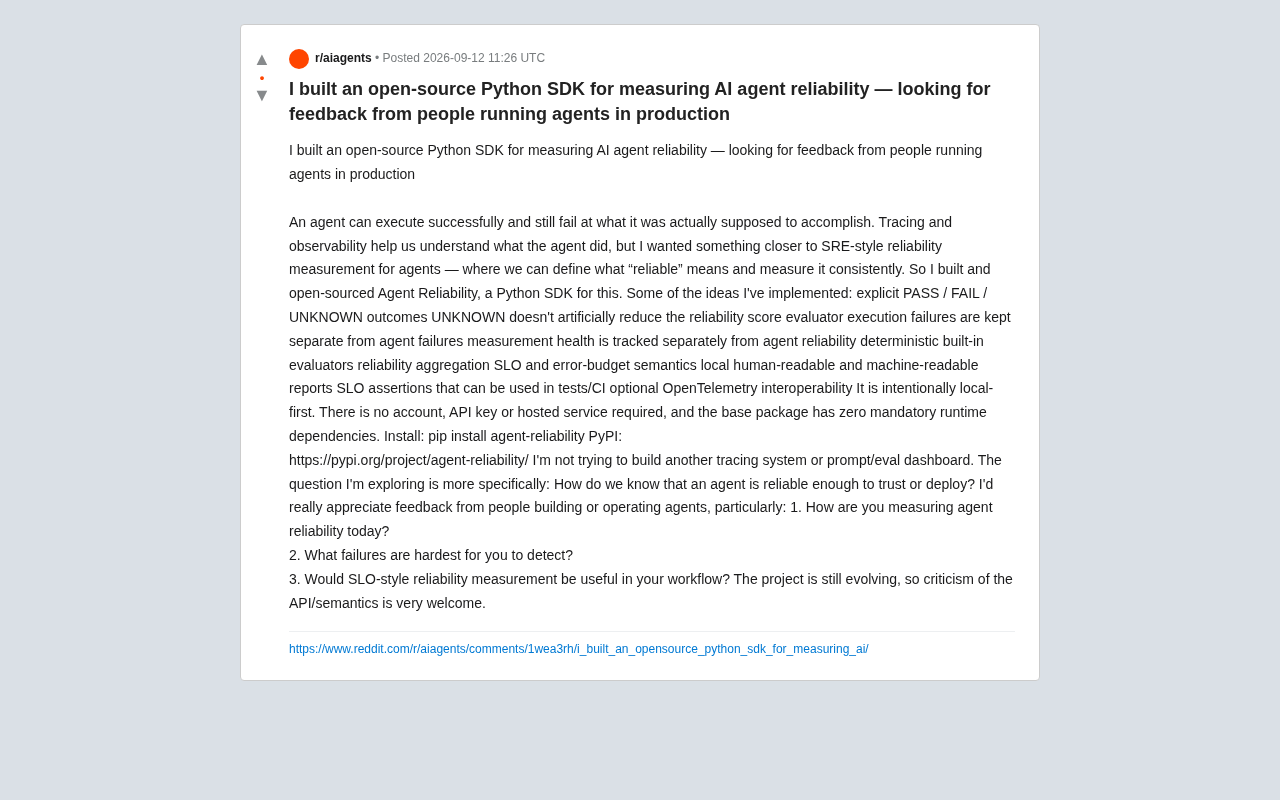
Open-Source Python SDK: Measuring AI Agent Reliability with SRE Principles
Agent Reliability is an open-source Python SDK that applies SRE's SLO and error budget concepts to AI Agent evaluation, with PASS/FAIL/UNKNOWN states, CI assertions, and zero forced dependencies.
MiniMax RefMod: A Complete Guide to Training-Free Reusable Identity Workflows
MiniMax RefMod offers training-free reusable identity workflows for image, video, and audio generation. Includes Runpod template and tutorial for quick setup.