The Complete Guide to Vibe Coding: Benefits, Pitfalls, and Security Practices

Vibe coding generates code fast with natural language, but quality needs checks and tools.
This article systematically analyzes vibe coding's mechanics, use cases, and risks. Its core is a describe-generate-react loop optimizing for 'looks right' over correctness, security, or reproducibility. Best for prototypes, internal tools, one-off scripts, and exploring unfamiliar tech. Typical failures include fabricated APIs, happy-path-only testing, environment dependencies, infrastructure drift, secret leakage, and inexplicable code. Eight practices for safe use are proposed, and MCP servers make agent claims verifiable without replacing human responsibility.
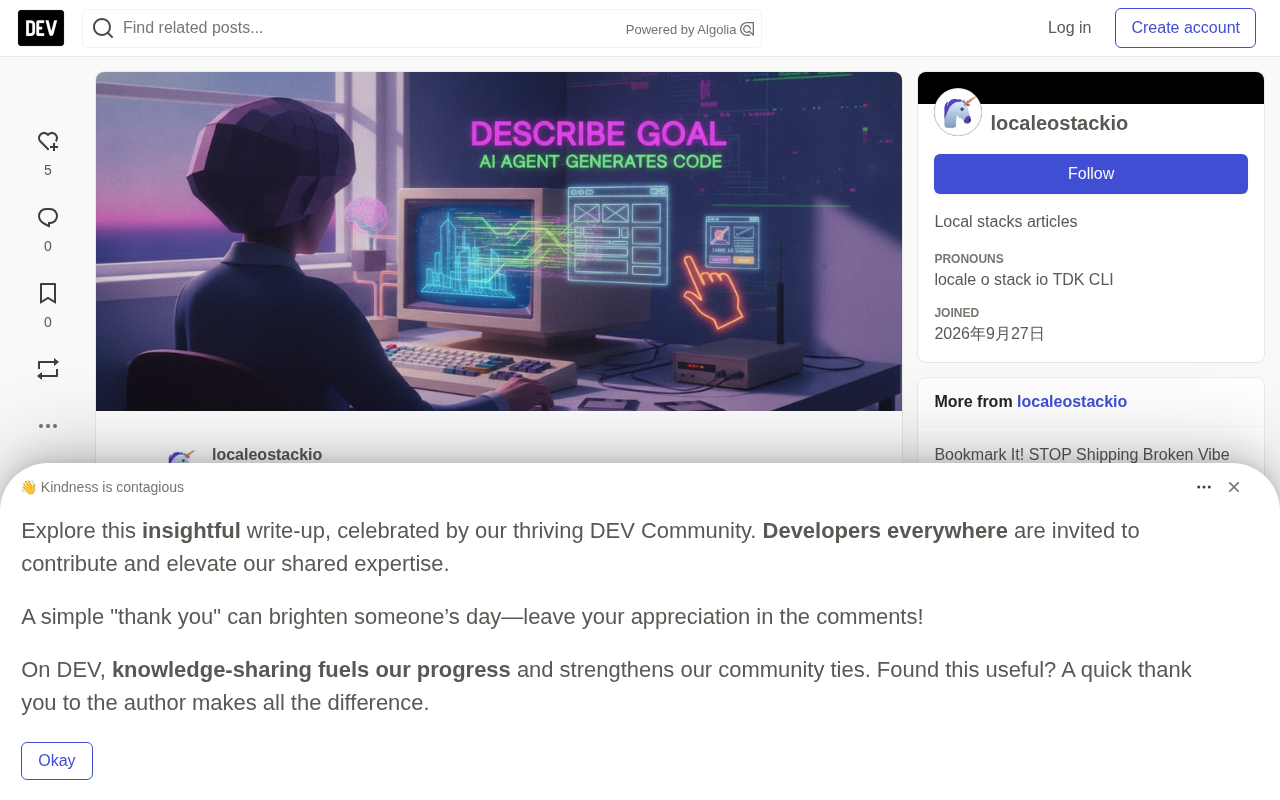
Vibe coding is lowering the barrier to software development. You simply describe what you want in natural language, and an AI agent generates, runs, and modifies code. This speed—going from idea to runnable prototype in a single afternoon—lets countless non-professional developers quickly validate their ideas. But risk lurks behind the speed: code that looks right doesn't mean it's correct, secure, or reproducible.
Based on a systematic analysis, this article breaks down how vibe coding works, where it applies, typical failure modes, and how to leverage its speed advantage without sacrificing quality.
What Is Vibe Coding
The core loop of vibe coding is straightforward: you describe a goal (for example, "a page that lists orders and allows marking them as shipped"), the agent generates code and usually runs it directly, you observe the result and describe the next change, and so on until it's good enough to show someone.
What makes this loop appealing is the immediate feedback and rapid iteration. But the original author points out a key risk: the loop optimizes for "looks right now," while saying almost nothing about whether the code is correct, secure, or repeatable. In other words, vibe coding is a working style, not an engineering methodology—it doesn't automatically bring engineering rigor.
Where It Excels
Not all development tasks are suited to vibe coding. The source material lists several high-value scenarios:
- Prototypes and demos: The goal is to quickly test ideas, and the cost of errors is low.
- Internal tools: Small audiences and a clear owner who can quickly fix issues.
- One-off scripts: Automating temporary tasks, used once and discarded.
- Exploring unfamiliar territory: For example, a library you've never used—a runnable example is more instructive than documentation.
- UI drafts: When layout matters more than internal implementation.
What these scenarios share is that the cost of errors is manageable, while the benefit of speed is significant.
Typical Failure Modes: Why Vibe-Coded Apps Break
The original article attributes most failures to a handful of causes, each worth heeding:
Agents fabricate. They may call methods that don't exist, use options not present in your running version, or assume API behavior matches their training data. Checking current documentation catches most of these issues.
Only the "happy path" is tested. Inputs are normal during demos, but empty fields, unexpected types, and slow networks are rarely triggered—and they surface in production.
It only runs on one machine. Lockfiles out of sync with manifests, reliance on global tools, hardcoded paths—these make the app work only for its author.
Generated infrastructure drifts. Dockerfiles, routing configurations, and build files get manually modified, then overwritten on the next regeneration, causing changes to silently disappear.
Secrets end up in code. Example keys get copied into real files—an easy mistake with a costly discovery.
No one can explain the result. When the author can't describe what the code does, the next change is a guess, and the next bug is harder to locate.
Happy path is a term in software testing referring to the ideal execution flow where user input fully matches expectations, system state is normal, and all dependencies are available. Testing only the happy path means validating that functionality works when "everything goes smoothly," while ignoring edge cases like null values, invalid types, network latency, concurrency conflicts, and insufficient permissions.
In vibe coding, agents often generate a demonstrable flow based on the description, and once the user enters normal data and sees a result, the task is considered done. This testing pattern masks a large number of potential defects, because real-world input in production is far more complex than in a demo. To uncover these issues, you need to proactively construct abnormal inputs (such as empty fields, extremely long strings, wrong types, simulated network failures) or use fuzzing tools. Happy path testing is a necessary starting point, but far from sufficient.
Lockfiles and manifest files are the two core components of dependency management. Manifest files (such as package.json, requirements.txt, Cargo.toml) declare which dependencies the project needs and their version ranges; lockfiles (such as package-lock.json, poetry.lock, Cargo.lock) precisely record the actual installed version of each dependency and its complete dependency tree.
When lockfiles and manifests are out of sync, different machines may install different versions of dependencies, causing "works on my machine" problems. For example, the manifest allows multiple versions of a library, but the lockfile pins one; if the lockfile is deleted or not committed, a new environment will re-resolve versions, potentially introducing incompatible updates. In vibe coding, agents may generate a manifest but forget to generate or commit a lockfile, or manually modify the manifest without regenerating the lockfile. The solution is to always commit lockfiles and use the same install commands in CI as locally (such as npm ci instead of npm install).
Eight Practices for Using Vibe Coding Safely
The solution isn't to abandon vibe coding, but to add checks around the loop. The source material provides concrete, actionable steps:
- Start from a clean clone. If the app only runs in your existing environment, it's not ready.
- Run the same install steps as CI. Local shortcuts are usually the source of CI failures.
- Give the agent real tools. Access to documentation lookups, test runners, browsers, and the running app lets the agent check its own work instead of guessing.
- Deliberately test bad input. Send empty fields, wrong types, and oversized values.
- Keep secrets out of code. Read from environment variables, and make sure environment files are git-ignored.
- Edit source files, not generated output. When tools write build files, modify their inputs and regenerate.
- Read diffs before accepting them. Generation speed tempts people to skip review, but security and data handling especially require scrutiny.
- Write the plan down. A short document with goals, constraints, and checklists lets a new session pick up where the last one left off.
How Tools Make Agent Claims Verifiable
Model Context Protocol (MCP) servers give agents access to things they would otherwise have to guess: current documentation, browsers, databases, or a running local stack. Some tools are general-purpose, like documentation lookups and browser testing; others are tied to specific tools.
For example, TDK CLI can run a local multi-service stack and expose it via tdk mcp, letting the agent start the stack, check readiness, and read recent logs. The agent sees the real system state, not its own summary.
But the original article cautions: tools don't replace judgment—they merely make the agent's claims checkable.
Model Context Protocol (MCP) is an open protocol for establishing standardized connections between AI agents and external tools or data sources. Proposed by Anthropic in 2024, it uses a client-server architecture: the agent acts as a client and accesses resources such as documentation, databases, browsers, and local services through MCP servers. Each MCP server exposes a set of tools that the agent can call to perform operations and obtain structured results, rather than relying solely on static knowledge from training data.
MCP's design goal is to solve the problem of "agents can only guess." In vibe coding scenarios, agents can query the latest API documentation, run tests, check local service status, or read logs through MCP servers, thereby verifying their own assumptions. MCP uses JSON-RPC 2.0 for communication and supports both local processes and remote services, offering good cross-platform and cross-language compatibility. However, MCP itself only provides the connection mechanism; how agents use these tools and interpret results still depends on the agent's implementation and the user's guidance.
What Vibe Coding Cannot Replace
Architecture design, security review, data protection, and operational responsibility still belong to humans. An agent can write the code for a payment flow, but someone must decide what guarantees that flow needs, check that it delivers them, and take responsibility when it fails.
Vibe coding changes the speed from idea to running code; it doesn't change what makes software trustworthy.
Conclusion
Vibe coding is a rapid loop of describe, generate, and react. It excels at prototypes, internal tools, and exploratory tasks, but carries risk when output is delivered to users without checks. Test with clean clones, use install steps consistent with CI, give agents real tools they can run, test bad inputs, review every diff, and make sure you can explain the code you deliver. Speed is its gift; checking is your repayment.
One-line Summary
Vibe coding generates code quickly with natural language, but quality requires checks and tools.
Paragraph Summary
This article systematically analyzes the mechanics, applicable scenarios, and risks of vibe coding. At its core is a "describe-generate-react" loop that optimizes for "looks right" rather than correctness, security, or reproducibility. It is best suited to low-error-cost scenarios like prototypes, internal tools, one-off scripts, and exploring unfamiliar technology. Typical failure modes include agents fabricating APIs, testing only happy paths, environment dependencies, infrastructure drift, secret leakage, and inexplicable code. For safe use, the article proposes eight practices: clean clones, CI-consistent installs, giving agents real tools, bad-input testing, secret management, editing source files, diff review, and written plans. MCP servers give agents access to real documentation, browsers, and logs, making claims verifiable—but they don't replace human responsibility for architecture and security.
Related articles

Uber Deploys ChatGPT Work Company-Wide: AI in the Workplace Enters the Scaled Implementation Phase
Uber deploys ChatGPT Work to 30,000+ employees, extending it from engineering to all roles. We analyze its expert-engineer pairing, end-to-end automation, and questions of AI control and power concentration—insights for scaling AI in the workplace.

Shift at Midnight Hands-On: When "ID Verification" Becomes Alien Hunting
Shift at Midnight blends ID verification with horror survival in a four-player co-op game. We break down its inspection mechanics and chaotic humor.

Zelensky Recounts the Outbreak of War: I Need Ammunition, Not a Ride
Zelensky recalls the first day of war in a YouTube interview: farewell to family, rejecting Biden's evacuation offer with "I need ammunition, not a ride," and how Bucha shaped his stance on compromise and peace talks.