The Essential Difference Between AI Agents and Traditional AI: From Functions to Autonomous Task Executors
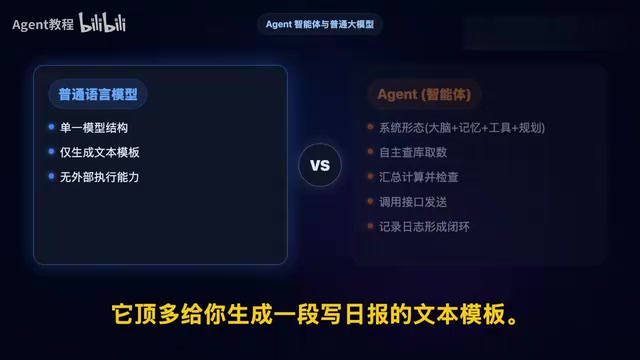
An Agent is a system form with an LLM as the brain and external memory, tools, and planning; dynamic decision-making authority is its essence.
The article systematically sorts out the definition, structure, and boundaries of AI Agents. An Agent is not a new model with a specific structure, but a complete execution system with an LLM as the brain and external memory, tools, and planning modules, containing six core components: goal, perception, reasoning and planning, memory, action and tool invocation, and feedback loop. Its fundamental difference from traditional AI is: traditional AI is a capability component that only outputs results; an Agent is a task executor that can output actions and change environment state. The article also distinguishes the boundaries between Agents, Chatbots, and Workflows—whether the execution path is dynamically decided at runtime is the key criterion for judging an Agent. Traditional AI will not be replaced, but will be integrated by Agents as tools, forming layered complementarity. Engineering implementation must value human-in-the-loop, safety boundaries, and observability.
1. What Is an Agent: From "Function" to "Goal-Driven System"
If you're used to thinking of an AI model as a function—input some text, output other text, or input an image, output a classification label—then Agent will completely refresh that understanding. According to the definition in the tutorial, a traditional model is essentially a function: it has no state, doesn't actively do work, and doesn't remember anything. An Agent is completely different: it is a system that operates around a clear goal, with the ability to perceive the environment, reason and plan, invoke tools to execute, and adjust direction based on results.
A more intuitive example: suppose you tell the system "compile a sales report for this week and send it to my supervisor." A plain language model would at best generate a text template for the report; but an Agent would query the database itself, extract data, aggregate and calculate, write the report, check for anomalies, call the email API to send it, and even log its own execution. This closed loop from receiving a goal to completing a series of actions is precisely the essence of an Agent.
The tutorial particularly emphasizes a common misconception: an Agent is not a new model with a specific structure, but a system form. What the industry usually calls an Agent defaults to using an LLM as the brain, with memory, tools, and planning modules attached on the periphery. In other words, an Agent is not a "bigger model" but a "more complete execution system."
2. The Standard Structure of an Agent: Six Core Components
A complete Agent typically contains six indispensable core components:
- Goal: receives and maintains the task the user wants it to accomplish;
- Perception: obtains external input, such as assembling context or pulling API data;
- Reasoning and planning: the core brain that figures out what to do next;
- Memory: remembers state across steps, including short-term context and long-term vector store memory;
- Action and tool invocation: actually influencing the external world;
- Feedback loop: evaluates results and decides the next goal.
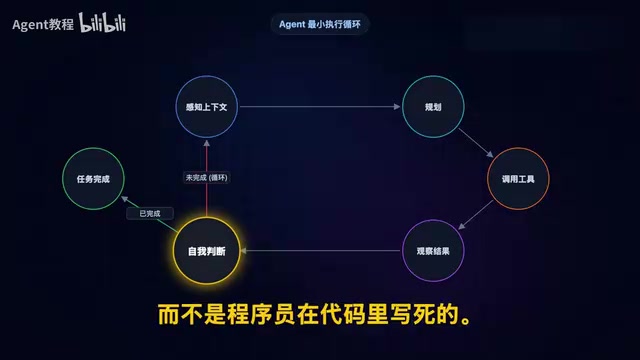
Abstracting these six components gives a classic minimal execution loop: perceive context with a goal, plan, select actions, invoke tools, get results, observe, then ask itself "is this done yet"—and if not, continue the loop. The most critical point is that whether it's done is judged by the Agent itself, not hard-coded by the programmer in code. This dynamic decision-making authority is the fundamental difference between an Agent and an ordinary workflow.
3. Traditional AI vs. Agent: Capability Components and Task Executors
The tutorial divides traditional AI into two categories: symbolic AI (rule engines, expert systems) and traditional machine learning (classification, regression, recommendation, ranking, risk scoring). Their common trait is a clear task boundary, fixed input and output, and a pre-designed behavioral path. They are strong at single points—recognizing a face or calculating conversion rates—but absolutely cannot decompose a complex goal and execute it on their own.
In summary, the core differences can be understood as follows:
- Traditional AI is a capability component; an Agent is a task executor.
- Traditional AI targets a single output (label, score, text), receives input entirely passively, and errors usually require human takeover; an Agent's goal is open-ended, can be decomposed and iterated, and its control flow is decided dynamically at runtime.
- Traditional AI only outputs results; an Agent also outputs actions and changes environment state, with tool invocation as a core capability.
- Traditional AI errors need manual intervention; an Agent can retry, reflect, or switch strategies on its own.
Simply put, traditional AI solves local cognition problems, while an Agent solves end-to-end tasks, connecting cognition, decision-making, and execution in one chain.
4. Several High-Frequency Boundary Questions: Agent, Chatbot, and Workflow
The tutorial mentions several boundary questions frequently probed in interviews; answering them well demonstrates the depth of your understanding of Agents.
What's the difference between an Agent and a Chatbot?
A Chatbot leans toward "talking," with the core being generating natural language replies; an Agent leans toward "doing," with the core being getting things done. If a chatbot is equipped with tools, memory, and a task loop, then it is itself an Agent.
Human-in-the-loop is a key design pattern in the engineering implementation of Agents, referring to reserving nodes for human intervention within the Agent's autonomous execution flow. Typical implementations include: approval confirmation before action execution (e.g., high-risk operations like sending emails, making deductions, or deleting data require a human to click confirm), interruption and takeover during execution (users can pause the Agent at any time and modify its plan), and proactive requests for help in exceptional situations (the Agent initiates clarification requests to humans when confidence is insufficient). It is the opposite of full automation, with the core idea being to dynamically divide the autonomy boundary according to the risk level of actions—low-risk, reversible operations are completed autonomously by the Agent, while high-risk, irreversible operations are left to human gatekeeping. This mechanism preserves the Agent's efficiency advantages while keeping potential losses within an acceptable range, and is standard design in current enterprise-grade Agent products (such as customer service, operations, and office assistants).
What's the difference between an Agent and a Workflow?
There is only one criterion: whether the execution path is decided at runtime. A workflow's path is hard-coded in advance, and the LLM only works at a fixed node; but what an Agent does next is decided by the system itself based on current observations. Even if you chain multiple LLMs into a fixed execution chain, or simply invoke a tool once, as long as there is no dynamic decision-making authority, it cannot be called an Agent.
Observability originates from the field of distributed systems operations, referring to the ability to infer a system's internal state from its external outputs, usually consisting of the three pillars of logging, metrics, and tracing. In Agent scenarios, the importance of observability is further amplified: because the reasoning process of LLMs is essentially a black box, and the Agent's execution path is dynamically generated at runtime, once goal drift, tool misuse, or infinite loops occur, it is very difficult to locate which step the problem is at based solely on the final result. Therefore, engineering requires complete recording of each round's input context, model reasoning output, tool invocation parameters and returns, and decision basis, forming a traceable execution trace. This is not only the foundation for debugging and troubleshooting, but also a prerequisite for cost monitoring (token consumption), security auditing (accountability for unauthorized behavior), and effectiveness evaluation (success rate analysis). An Agent system lacking observability is nearly impossible to maintain in a production environment.
Must an Agent be based on an LLM?
In a broad sense, no—for example, policy networks in reinforcement learning or robot controllers are broadly also Agents. But in the current LLM context, everyone defaults to the form with an LLM as the brain. In an interview, being able to point out this contextual difference is definitely a plus.
A policy network in reinforcement learning is a typical representative of a broad-sense Agent: the agent observes states in the environment, selects actions according to a policy, obtains rewards, and updates parameters, maximizing cumulative return through repeated interaction with the environment. Classic cases such as AlphaGo's move-selection policy network and motion policies in robot control all belong to the "perception–decision–action" closed-loop Agent form. The fundamental difference from LLM Agents is that policy networks are usually trained for a single, closed task environment, have limited generalization ability, and lack natural language understanding and general reasoning capabilities; whereas LLM Agents,借助 pre-training world knowledge and language capabilities, can dynamically plan on open tasks. However, at the architectural abstraction level, both share the same Agent paradigm—goal, perception, decision, action, feedback. Understanding this homology helps demonstrate a complete grasp of the Agent concept lineage in interviews, rather than being limited to a single technical route.
Is an Agent fully automated and unattended?
Quite the opposite. Agents that actually run in production environments always have mechanisms for human participation, commonly known as human-in-the-loop: low-risk actions run on their own, high-risk actions require human confirmation, and uncertain situations trigger proactive requests for help. Autonomy within appropriate boundaries is the real deployment form of an Agent.
5. Will Traditional AI Be Replaced? Layered Complementarity Is the Truth
The answer is no. More commonly, traditional AI gets "wrapped in": vertical capabilities like OCR recognition, recommendation ranking, and risk scoring all become tools in the Agent's hands. The Agent is responsible for figuring out how to combine them to complete tasks, while traditional AI is responsible for maximizing each single-point capability. The two are in a layered, complementary relationship, not a replacement relationship.
6. Keys to Engineering Implementation: Safety Boundaries and Observability
When asked about the biggest engineering risks of Agents, the tutorial suggests always bringing up the two keywords big tech cares most about: safety boundaries and observability. Common risks include: LLM reasoning errors causing goal drift; misuse of tools leading to infinite loops that burn through resources; unauthorized execution; sensitive data being placed in prompts and leaking. The stronger the capability, the more the bottom line must be upheld.
At the end of the answer, you can use three criteria to quickly judge whether a system is an Agent: first, is the goal open-ended; second, is the path decided dynamically at runtime; third, is there a feedback loop that can handle failures on its own. If all three are satisfied, it is a true AI Agent.
For developers learning LLM application development, understanding this layer of definition and boundaries of Agents is more important than memorizing the API of any particular framework. It determines whether you are "calling a model" or "building a system."
Related articles

DeepSeek SuperAgent Architecture Explained: A New Multi-Task Concurrent Agent Paradigm
DeepSeek Harness proposes SuperAgent architecture: a Router+Worker two-layer team model solving context confusion, loop blocking, and local sleep in multi-task Agents.

AI Now Generates GIFs Directly: The Era of Unlimited Custom Stickers Has Arrived
AI can now generate GIFs directly. Learn how to use GPT's Images 2.6 to create sticker GIFs with reference images and story prompts, plus sprite sheet frame-level editing, real-person performances, and chat log generation.

Burned Through 1.3 Billion Tokens and Tens of Thousands of Yuan to Build 500 Websites with AI
Bilibili creator Yu Pi built Vibefather, an AI website template library with 270+ templates and 500+ live sites, consuming over 1.3 billion tokens. Each template includes full prompts and design docs, open-sourced and integrable via Claude Code, Cursor, and more.