The Five Pillars of Production-Grade AI Agents: A Battle-Tested Guide from Demo to Deployment

A five-pillar framework for taking AI Agents from demo to production, illustrated by a £85K banking failure case.
Databricks tech lead Sandy distills a battle-tested framework for production-grade AI Agents built on five pillars—evaluation, observability, data foundation, multi-agent orchestration, and governance. Using a retail bank's £85,000 failed POC as a case study, it reveals the three gaps that doom most AI projects and how to bridge them.
Article Content
In the midst of the AI Agent hype, countless enterprises have poured huge sums into building flashy demos, only to fail when it comes time to actually deploy them to production. Sandy, Data & AI technical lead at Databricks, shared a battle-tested production-grade AI deployment framework at the AI Engineer conference. Having spent five years at AWS as a Principal Architect for Data & AI, over the past two years he has focused on helping clients in B2B software, finance, and other highly regulated industries move AI from demo to production. The value of this framework lies in the fact that it precisely targets the root causes behind why the vast majority of AI projects fail.
Background: AI Agents and the Demo-to-Production Gap
An AI Agent refers to an LLM-powered system capable of autonomously perceiving its environment, planning multi-step actions, and invoking external tools to complete complex tasks—fundamentally different from a chatbot handling single-turn Q&A. Since 2023, as large models like GPT-4 and Claude have made dramatic leaps in capability, the Agent wave has swept across the globe. Yet Gartner research indicates that over 85% of AI proof-of-concept projects fail to successfully make it into production deployment. The root cause: demo environments are closed and controllable, while production environments face the infinite long-tail inputs generated by real users, constantly changing data sources, and unpredictable failure scenarios. This structural gap has given rise to specialized engineering disciplines such as MLOps (Machine Learning Operations) and LLMOps (Large Language Model Operations), and Sandy's five-pillar framework is precisely a systematic distillation of LLMOps best practices.
The Three Gaps Between Demo and Production
Two years ago, nearly every client conversation followed the same pattern: enormous top-down pressure to "do something with AI," so the team's first move was to agonize over "should we use GPT or Claude?" Once a model was chosen, they piled on features, built a beautiful demo in a controlled environment (predictable datasets, limited scenarios), and leadership signed off to launch. Then a few weeks later, the problems came flooding in—"What is the AI actually doing? Why are its answers completely different from the demo?"
This pattern not only fails to deliver ROI, but results in a double loss of money and energy. From hundreds of client conversations, Sandy has distilled three core gaps:
- The Observability Gap: If you can't trace every decision the AI makes, it is worthless in production.
- The Evaluation Gap: Everyone talks about accuracy, latency, and reliability, but never defines "the one metric that truly matters to the business," nor builds a system to continuously measure it.
- The Governance Gap: When the AI breaks at 3 a.m., who is responsible? Who owns the data assets fed to the AI? When the AI hallucinates and damages customer relationships, who is accountable?
It is precisely these three gaps that gave rise to the following five-pillar framework, which has been validated in deployment across multiple enterprises.
The Five Pillars: A Complete Framework for Production-Grade AI Agents
Sandy emphasizes that these five pillars are questions you must think through clearly before launching a project, then build out step by step in order (though in reality it is often hard to follow strictly). They are: Evaluation, Observability, Data Foundation, Orchestration, and Governance.
Pillar One: Evaluation First
Evaluation is essentially the "specification document" for an AI system. It is not empty talk about accuracy, but rather defining success with concrete numbers—how high does accuracy need to be for the business use case? How many false positives can be tolerated? In the case of a retail banking chatbot, the core objective was "deflection rate": routing simple queries to the AI to relieve pressure on human agents, which required precisely tracking the number of such queries.
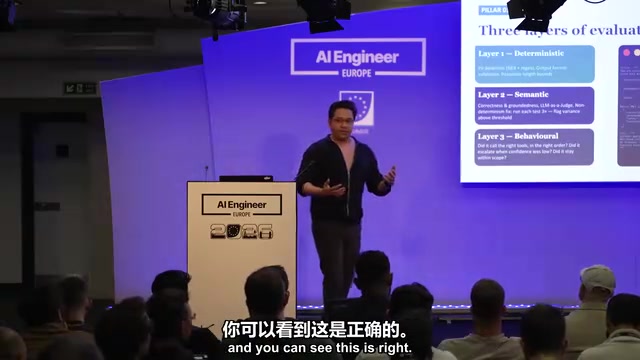
The AI Agent evaluation system comprises three architectural layers:
-
The Deterministic Layer: Checking formats (regex for email addresses and phone numbers), using classic ML models for named entity recognition, intent classification, PII detection, and so on. These are cheap and mature techniques that should be prioritized.
-
The Non-Deterministic Layer: Handling semantically-related reliability issues, with the core being "LLM as Judge"—using an independent judge model to evaluate the main model's output, scoring across dimensions such as safety, reliability, and answer relevance.
Deep Dive: The Principles and Known Biases of LLM as Judge
LLM as Judge was systematically introduced by Stanford University in its 2023 MT-Bench and Chatbot Arena papers. The core idea is to use a powerful LLM (typically GPT-4 or Claude) in place of human annotation to score the output quality of another LLM. Compared to traditional NLP metrics based on lexical overlap such as BLEU and ROUGE, an LLM judge can understand more complex quality dimensions like semantic equivalence, logical consistency, and harmful content. However, its known biases deserve attention: position bias (tending to give higher scores to the first candidate answer), verbosity bias (tending to give higher scores to longer answers), and self-enhancement bias (models from the same company tending to give each other higher scores when evaluating one another). Engineering countermeasures include: randomizing the order of candidate answers, designing chain-of-thought prompts that require the judge to output reasoning before giving a score, and calibrating the judge model's scores against human-annotated data.
It's worth noting that LLM as Judge involves an inherent tension between cost and scalability: invoking a GPT-4-class judge model to evaluate every production log will cause costs to spiral out of control in high-concurrency scenarios. In engineering practice, a tiered strategy is typically adopted—sampling production traffic for evaluation (e.g., 1%~5%), triggering full judge evaluation only for conversations with satisfaction scores below a threshold, and exploring the use of distilled, small, specialized judge models in place of general-purpose large models to reduce marginal cost.
The core advantage of this approach is its ability to evaluate semantic quality that traditional metrics like BLEU and ROUGE cannot measure, but production-grade applications require carefully designed evaluation prompts and calibration mechanisms to correct for these biases.
-
The Behavioral Layer: This is the most easily overlooked layer, focusing on tool-calling behavior. For example, a user asks "What is my account balance?", the Agent gives the correct answer, but a behavioral check reveals it actually called the database API three times. Three calls don't matter in a demo, but in production, multiplied by thousands of calls per day, this becomes an enormous waste of money.
Pillar Two: Observability (Tracing)
The core of observability is tracing—collecting all decisions made by the Agent. Sandy illustrates this with a real retail banking case: a user complains "I was charged an overdraft fee, can it be waived?" The Agent will sequentially perform intent classification, connect to the customer database to retrieve account details, retrieve overdraft policy documents from a RAG vector database, perform reasoning, and finally run guardrail checks and reply.
RAG (Retrieval-Augmented Generation) mentioned here is one of the most mainstream technical architectures for enterprise AI deployment today: it splits an external knowledge base into text chunks, converts them into high-dimensional vectors via an embedding model, and stores them in a vector database. When a user asks a question, it first retrieves the most semantically similar text chunks, then injects them as context into the LLM to generate an answer. This architecture allows the LLM to access up-to-date private knowledge without expensive retraining, but the core operational risk is: the knowledge base's embeddings must stay synchronized with the source documents, otherwise the model will confidently produce incorrect answers based on outdated information—which is precisely the root cause of the problem in the banking case discussed later.
Deep Dive: The Engineering Challenges of Vector Databases and Embedding Synchronization
In a RAG system, a vector database (such as Pinecone, Weaviate, Milvus, or pgvector) stores not raw text, but numerical representations produced after an embedding model (such as text-embedding-3-large, BGE, etc.) maps text into a floating-point vector space typically ranging from 768 to 3072 dimensions. Semantically similar texts lie close together in this vector space, and retrieval completes semantic search within milliseconds via approximate nearest neighbor algorithms (ANN, such as HNSW, IVF). However, embedding synchronization faces two challenges: the first is incremental updates—when source documents are added or modified, the embeddings of affected document chunks must be recomputed and the index updated; if you rely on scheduled batch jobs rather than event-driven real-time updates, queries during the window will be based on outdated knowledge. The second is model version lock-in—once vectors generated by a particular embedding model are stored in the vector database, switching to a new embedding model requires re-embedding the entire database, otherwise the mismatched semantic spaces of old and new vectors will cause severe degradation in retrieval results. Together, these two points constitute the most underestimated technical debt in the ongoing operation of RAG systems.
If you haven't built a tracing system, when a customer raises a dispute, you have absolutely no way to verify what the AI did, and end up giving the customer a discount just to close the matter. This is exactly why regulators (especially in Europe and highly regulated industries) list tracing and observability as a mandatory prerequisite for launching AI.
Going further, through online monitoring you can detect duplicate or failed calls in real time in production and apply fallback strategies—for example, retry no more than three times, and if exceeded, escalate to a human.
Pillar Three: Data Foundation
Sandy candidly admits that in a typical project he spends 60% of his time on the data foundation. The reason is profound: data has historically been built for humans, and humans are forgiving—if they find the data is wrong, they can request a correction. But an Agent is not forgiving. It will confidently give a wrong answer using wrong data, and you'll be none the wiser.
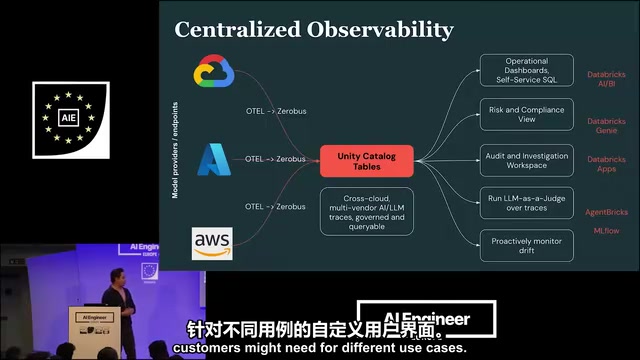
The data foundation has two parts: first, question data (data serving the AI's output, including pre-training/post-training data and data accessed via APIs), and second, trace data (observability data). The latter requires a complete strategy, especially when hundreds of Agents are running within an organization—how to design the schema, how to serve auditing and regulatory needs, and how to run the LLM judge all require systematic planning.
In the Databricks technology stack, the bottom layer is cloud storage, on top of which Delta Lake endows raw data with database-like properties.
Deep Dive: Delta Lake and the Lakehouse Architecture
Delta Lake was open-sourced by Databricks in 2019 as a systematic solution to the "write-and-lose-control" problem of traditional data lakes. Traditional Parquet/CSV data lakes lack transactional support—concurrent writes can corrupt files, and once erroneous data is written it is hard to roll back, forming what is known as a "data swamp." Delta Lake introduces a Transaction Log on top of the Parquet format, enabling four key capabilities: ACID transactions guarantee concurrency safety; Time Travel allows querying any historical version of the data (extremely valuable for versioned management of AI training data); Schema evolution ensures adding fields doesn't break downstream reads; and Change Data Feed supports incremental data processing. In the specific context of AI systems, the Time Travel capability can help engineers precisely trace back to the data state corresponding to "the last time it performed well" when a model's behavior degrades, providing crucial evidence for root cause analysis. Apache Iceberg and Apache Hudi are competing open-source formats of the same class; together, the three are known as the three major open formats of the Lakehouse era.
One layer up, Unity Catalog provides unified access control, data sharing, and metadata tagging. The core value of Unity Catalog lies in unified governance across workspaces and clouds: table owners, access permissions, and PII column labels only need to be defined once and take effect everywhere. Once these labels are applied, AI queries can directly read column descriptions to understand field semantics, while PII column labels can automatically trigger redaction before data enters the LLM context, forming the technical foundation of the governance pillar.
Deep Dive: The Engineering Practice of PII Detection and Redaction
PII (Personally Identifiable Information) is strictly protected under regulations such as GDPR, CCPA, and China's Personal Information Protection Law. In AI systems, there are three main risk paths for PII leakage: PII contained in user input being recorded verbatim into trace logs; PII in a RAG knowledge base being injected into the LLM context after retrieval; and the LLM leaking other users' information learned from context when generating answers. Engineering protection is divided into two stages—detection and redaction: the detection layer typically combines regular expressions (capturing fixed-format ID numbers and credit card numbers), BERT-based named entity recognition models (identifying unstructured PII such as names and addresses), and rule engines; the redaction layer chooses, depending on the scenario, either pseudonymization (replacing with reversible tokens, preserving traceability for business logic) or anonymization (irreversible deletion). The 47 detected PII leakage cases Sandy mentioned demonstrate that even a reviewed system requires dedicated testing for PII protection and cannot rely on the model's own "awareness not to leak."
Enterprises often run AI across multiple frameworks and multiple cloud platforms, so a centralized trace data collection layer is needed to uniformly serve various scenarios such as operations dashboards, front-line support, and drift monitoring.
Pillar Four: Multi-Agent Orchestration
A single Agent runs well, but when you plug in five Agents, complexity rises exponentially. The theoretical foundation of multi-agent orchestration architecture comes from distributed systems and microservices design patterns, and mainstream frameworks today (such as LangGraph, AutoGen, CrewAI) all have built-in support for multiple orchestration patterns. Sandy introduces three mainstream orchestration patterns:
-
Orchestrator-Worker Pattern: A central orchestrator controls and distributes tasks to specialized Agents, similar to the classic Master-Worker parallel computing model. The central orchestrator (usually a more capable LLM) is responsible for task decomposition, context management, and result integration. All requests pass through the orchestrator, giving it central control capability; when problems arise, you can inspect the orchestrator's logs, and debuggability is its greatest advantage.
-
Choreographic Pattern: Each Agent is autonomous and independent, listening for events of interest via a message bus (such as Kafka or RabbitMQ), and can run in parallel. For example, in a mortgage application scenario, one Agent queries customer details while another queries approval details, processing in parallel to reduce latency. This pattern naturally supports horizontal scaling, but debugging difficulty increases significantly.
Deep Dive: The Critical Role of Distributed Tracing in Multi-Agent Debugging
Distributed Tracing originates from the observability practices of microservices architecture, with its foundation laid by Google's Dapper paper in 2010, and OpenTelemetry is the current open-source standard. Its core mechanism is to generate a unique Trace ID for each request, and as the request flows through different service nodes, context propagation links all Spans (operation segments) into a complete call tree, enabling engineers to see the full execution path and time distribution of a request across a distributed system. In a choreographic multi-agent system, a single user request may trigger multiple parallel sub-agents, each of which in turn calls the LLM API, vector database, and business APIs. Without a Trace ID threading through the entire chain, engineers will have no way to pinpoint the issue when hallucination or latency anomalies occur at any link. LLMOps platforms such as LangSmith, Arize AI, and Langfuse have all built dedicated tracing solutions for LLM calls based on the OpenTelemetry standard, making distributed tracing technology indispensable in this scenario.
In actual deployment, the two orchestration patterns are not mutually exclusive but are often used in combination: the outer layer uses the orchestrator-worker pattern to maintain global controllability, while the inner layer adopts the choreographic pattern for latency-sensitive parallel sub-tasks. The three core trade-off dimensions for selection are: latency (choreographic parallelism outperforms the serial distribution of a central orchestrator), consistency (the orchestrator pattern more easily guarantees consistency of context across Agents), and observability cost (the choreographic pattern requires more thorough investment in distributed tracing to achieve equivalent debugging efficiency).
-
Human-in-the-Loop: When an Agent's confidence falls below a threshold, human review is brought in.
Sandy points out that when designing a multi-agent system, key attention must also be paid to state management and fault tolerance mechanisms (how to recover when failures occur).
Pillar Five: Governance
Governance here does not refer to data governance (that is a given requirement), but rather approaches things from an AI perspective: is there a complete regulatory audit trail? Has personal information been pre-validated? In Sandy's project, this layer detected 47 PII leaks in the testing phase alone.
Governance also includes several key practices:
- Prompt version management must be treated like code change management—not just simple Git commits, but recording why changes were made and which failure scenarios were fixed.
- Model change management—when a model provider upgrades a version, official benchmark leaderboards are not reliable for your enterprise scenario. You must test which model performs better using your own evaluation dataset, while maintaining the flexibility to switch between different models to mitigate risk.
Deep Dive: Prompt Version Management and the Systemic Risk of Model Changes
Prompts play a role in LLM systems similar to a "software configuration file," but their impact often far exceeds that of traditional configuration changes. Research shows that even subtle differences in wording (such as changing "please" to an imperative tone) can cause measurable changes in the style and accuracy of model output; and migrating prompts across LLM versions is an even more severe challenge—users reported needing to adjust prompts to maintain original performance during OpenAI's upgrade from GPT-4 to GPT-4o and Anthropic's from Claude 2 to Claude 3. Systematic prompt version management requires at least three elements: storage (Git or a dedicated prompt management platform such as PromptLayer), linkage (each prompt version linked to the failing evaluation case that triggered its modification), and rollback capability (the ability to switch back to the previous version with one click when metrics drop after a new version goes live). Model change management follows the same logic—the ideal state is to parameterize model selection so that A/B testing and canary releases (Canary Release: first switching 5% of traffic to the new model, then gradually scaling up after confirming no metric anomalies) become standard release procedures, rather than requiring code-level refactoring every time the model is swapped.
Case Retrospective: The £85,000 Lesson in Failure
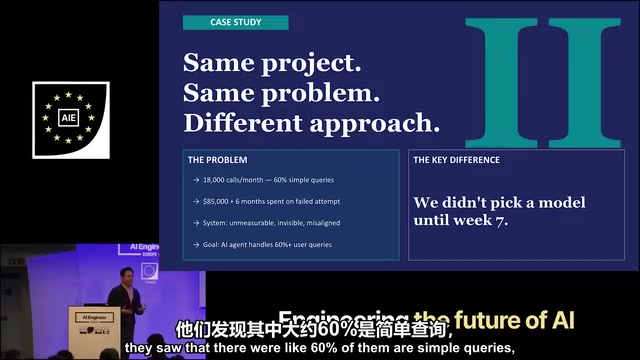
The most illustrative example is a retail banking chatbot case. The client received about 20,000 customer calls per month, 60% of which were simple queries like "What's my account balance?" or "How do I handle an overdraft?", and they hoped to deflect these with AI. They had previously spent six months and burned through £85,000 on a POC, only to fail—no one knew why it broke in production, no one could measure the cause of failure, and no one was clear on who was accountable.
After Sandy's team took over, they completely reversed the eight-week POC process:
- Weeks 1-2: Build the evaluation layer. Collect 200 real cases of human agents answering simple queries, define success metrics (85% accuracy target, deflection rate, latency, etc.), and set up an automated evaluation pipeline.
- Week 2 (Data Foundation): Validate API connections, tracing mechanisms, and distributed storage, and during testing discovered the root causes of duplicate API calls and declining customer satisfaction.
- Weeks 7-8: Only then did they begin selecting the model. Since the evaluation dataset already existed, they could quickly run different models to compare against expected answers and compute accuracy—model selection that previously took weeks to decide could now be done in hours.
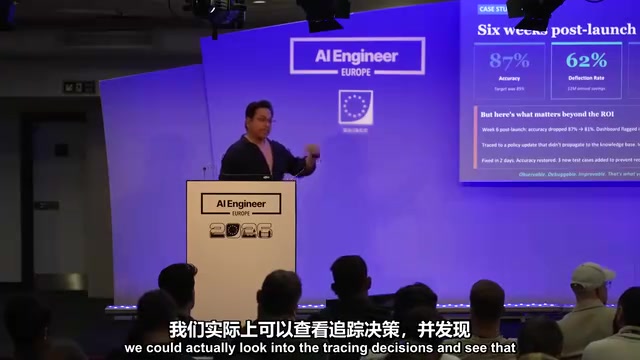
Six weeks after launch, the system demonstrated its real value: the bank changed its interest rate policy and sent notifications to customers, but customers couldn't get correct answers when querying the chatbot, and gave one "thumbs down" after another. Because there was a measurement system in place, the decline in customer satisfaction was detected in time, and the team traced it back to find the Agent was still reading outdated policy documents—the embeddings of the new policy had not been updated into the vector database. The issue was quickly pinpointed and fixed. This case perfectly confirms the core operational risk of the RAG architecture: synchronizing knowledge base embeddings is not a one-time task, but a critical link that must be incorporated into ongoing operations.
Actionable Recommendations
Sandy closed by sharing several battle-tested lessons that are easily overlooked.
The evaluation dataset is a "living system"—start with 200 cases and continuously expand it as production runs; bigger is better, but it requires clear governance and ownership, and should be categorized and managed by categories such as security and login.
Prompt version management requires proper commit messages, recording the reason for changes and the failure scenarios fixed, not just simple code commit records.
Behavioral layer evaluation is relatively costly, so you can test with only a small subset in the CI pipeline and only run the full suite when merging to the main branch, to reasonably control costs.
He also emphasized an often-overlooked production incident response playbook:
- Detect anomalies via the evaluation dashboard
- Diagnose root causes via the tracing system
- Contain impact via fault tolerance mechanisms such as prompt version control, human triage, and circuit breakers
- Fix issues using the test case library, and add new cases into the living system for continuous improvement
After launch, you also need to integrate with the enterprise's existing ITSM system (IT Service Management system, such as ServiceNow, Jira Service Management, etc.) to enable precise alerting. Connecting AI Agent alerts to the enterprise's existing ITSM framework means AI failures can follow the same response process as traditional IT failures: automatically creating tickets, routing to the appropriate team by severity level, tracking remediation progress, and archiving into a historical knowledge base. For highly regulated industries such as finance, this is also a standardized path to meeting regulators' requirements for "a complete audit trail for AI system failures."
As for the first step you can take tomorrow, Sandy's advice is simple and powerful: start by defining success—not success in the technical sense, but success in the business sense. Collect a few sample examples of "good answers," build a dataset, and then set up an automated comparison pipeline with simple Python code. When AI goes from being "visible, measurable, and accountable" to reality, that is when it truly moves into production.
Key Takeaways
Related articles

"Black October": Did AI Uncover 3% of All Critical Vulnerabilities Ever?
A Reddit post claims 3% of all critical software vulnerabilities ever were found in the past month, dubbed 'Black October.' We break down the statistical issues, how AI-assisted code auditing accelerates discovery, and how developers should respond.

Microsoft Project Gecko: Using AI to Bridge Language Gaps for African Farmers
Microsoft's Project Gecko launches PharmaChat, letting African farmers ask questions in their native language and get precise video clips and farming book chapters via AI. The project also releases three interactive manuals to advance inclusive AI.

Musk's Space Dominance: How Starlink Throttling Undermines Ukraine's Defense
SpaceX's Starshield throttling disabled Ukraine's high-speed interceptor drones, exposing how Musk's private control over low Earth orbit communications affects battlefield dynamics and national security, and highlighting the risks of commercial space militarization and space governance dilemmas.