The Most Comprehensive AI Agent Course on Bilibili: Seven Days from Zero to Job-Ready

A breakdown of a 748-episode AI Agent course: four-part path, three projects, and a call to enter rationally.
The article examines a Bilibili AI Agent course advertised as 748 episodes, opening with data on tripling Agent job postings and a median salary of about 25,000 to ask whether it's still timely to enter. Aimed at programmers lacking engineering methodology and non-technical workers seeking efficiency, it covers fundamentals, LangChain/AutoGen, Function Calling, RAG, evaluation, three resume-ready projects, and job-hunting advice—while warning that the seven-day promise conflicts with the course's volume, that salary data lacks methodology, and that beginners can't quickly close the algorithm gap. It should be treated as an introductory map, not a job guarantee.
The number of Agent job postings on recruitment apps has nearly tripled year-over-year, with a median salary reaching 25,000, while traditional development roles are contracting—these figures, from the opening of an AI Agent course on Bilibili, put a question many people have been quietly asking right on the table: is it still too late to get in?
This collection, advertised as 748 episodes, tries to answer that question with a four-part structure: from fundamentals to advanced topics, then hands-on projects, and finally employment. It aims to give people from different backgrounds a way in. We broke down its content design and also discuss who it suits—and who it doesn't.
Two Types of People Should Watch: Programmers and Office Workers
The collection opens by segmenting users, pointing to two typical predicaments.
The first is traditional programmers who have spent years writing Java, frontend, or testing code. Their coding ability is more than sufficient; what holds them back is engineering methodology: how to choose a framework, how multi-agent systems collaborate, how to implement RAG, and how to troubleshoot when things go wrong. These aren't syntax problems but architecture and design-pattern problems.
The second is office workers with no technical background. They work in admin, finance, healthcare, or operations, can't read code, but their jobs are full of repetitive tasks. They want to seize the AI opportunity but worry they won't be able to learn it. For these users, the collection uses analogies to explain concepts like ReAct, planning and reasoning, and memory mechanisms, and includes a session on getting the first Agent demo running—building intuition first, then diving into details.
Four-Part Structure: Concepts, Frameworks, Projects, Job Hunting
The entire course is divided into Fundamentals, Advanced, Hands-On, and Employment sections, progressing step by step.
Fundamentals: Making Intimidating Concepts Clear
What is an Agent, and how does it differ from chatting with a large model? Terms like ReAct, planning and reasoning, and memory mechanisms—many introductory materials just pile on jargon from the start. This section's strategy is to use analogies so beginners understand instantly, then guide learners through running their first Agent demo, experiencing firsthand what it feels like to have an intelligent agent do the work. Intuition first, theory second—this order is friendlier for users with no background.
ReAct stands for Reasoning + Acting. The core idea is to have the large model advance a task in a "think—act—observe" loop: first output a reasoning step explaining what to do next, then call a tool (such as search, a calculator, or a database query), and after getting the result, continue reasoning until a final answer is reached. It turns the large model from "one-shot text generation" into "thinking while doing," and is the foundational paradigm for most Agent frameworks. Planning and reasoning focuses on breaking complex goals into executable subtasks and ordering them; common approaches include task decomposition, reflection, and replanning. Memory mechanisms address the limited context window, typically divided into short-term memory (the current conversation) and long-term memory (vector stores or external storage), allowing the Agent to remember key information across multiple turns. Understanding these three is essential to making sense of how various Agents are organized in the later framework chapters.
Advanced: Frameworks and Engineering Skills
The Advanced section covers hands-on work with LangChain and AutoGen, multi-agent collaboration, Function Calling tool invocation, hybrid RAG architectures, and evaluation, debugging, and security boundaries. Each section includes practical code, with course materials provided as a package.
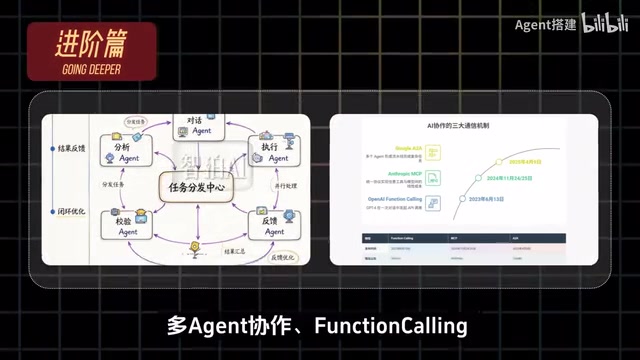
This is the area where programmers should invest the most effort. There's no standard answer for framework selection: LangChain has a large ecosystem but many abstraction layers, while AutoGen is more direct for multi-agent conversation orchestration; real projects often mix the two. The difficulty of RAG has never been in the vector store but in document chunking, retrieval quality evaluation, and hallucination control. The course lists evaluation/debugging and security boundaries as separate topics, showing the designers understand where the engineering pain points lie.
LangChain is a development framework for orchestrating large-model applications, providing components such as model wrappers, prompt templates, tool calling, retrieval pipelines, and Agent executors. Its ecosystem is vast but has many abstraction layers, making it easy to get lost in layer upon layer of wrapping when debugging. AutoGen, released by Microsoft, focuses on multi-agent conversational collaboration, defining each intelligent agent as a configurable conversation participant that completes division of labor and negotiation through message passing—more intuitive in scenarios requiring multiple roles. Function Calling refers to the large model outputting structured function-call requests (function names and parameters) based on user intent, with an external program actually executing them and returning results to the model. It is the key channel for Agents to connect to real systems (databases, APIs, business systems). RAG (Retrieval-Augmented Generation) first retrieves relevant snippets from a knowledge base, then passes them along with the question to the model to generate an answer, mitigating outdated knowledge and hallucination; the engineering challenges center on document chunking strategy, retrieval quality, and answer faithfulness evaluation.
Hands-On: Three Projects You Can Put on a Resume
The Hands-On section features enterprise-grade projects, including an intelligent customer service Agent system (from intent recognition to automatic ticket routing), an automated data analysis Agent (upload an Excel file and get reports and charts automatically), and a multi-agent collaborative production line (multiple intelligent agents dividing work like a team).
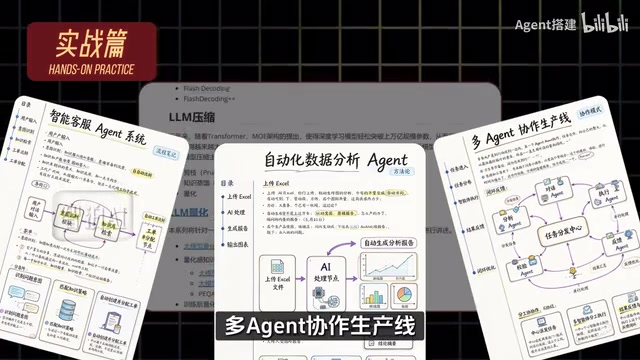
The logic behind choosing these three projects is worth noting: the customer service system covers intent recognition and process automation, the data analysis Agent addresses high-frequency office scenarios like Excel reports, and multi-agent collaboration demonstrates orchestration capability. Completing all three should theoretically produce concrete answers you can demo to an interviewer on the spot.
Intent recognition is the first step in intelligent customer service: determining whether a user's sentence is a consultation, complaint, progress inquiry, or request for a human agent. It is typically implemented with a classification model or by having a large model output structured labels; recognition accuracy directly determines the subsequent flow. Automatic ticket routing means that once the intent is clear, the Agent automatically fills in ticket fields, matches the processing queue, and triggers notifications or escalation rules—essentially codifying human judgment rules into an orchestratable process. Multi-agent collaboration emphasizes role division: for example, one agent decomposes tasks, one executes, and one reviews, coordinating through message passing or shared state to complete production-line-style work; it tests orchestration design and conflict-handling skills. These three projects correspond to three types of capability—recognition, process automation, and collaborative orchestration—which are also common focal points for employers hiring for application development roles.
Employment: From "Learned It" to "Done It"
The Employment section talks directly about money and jobs: what Agent-related roles exist, what capabilities are needed for algorithm, engineering, product, and application development positions respectively, how to rewrite a resume from "studied" to "project experience," how to explain things clearly in interviews, plus salary negotiation and job selection tips.
The selling point of this course isn't technical depth but bundling the learning path together with employment outcomes. For people with a clear goal of switching roles, this offers more direction than pure technical courses.
Several Issues to View Calmly
The 748-episode volume is itself a barrier. The promise of going from beginner to expert in seven days sounds more like marketing speak; the real learning curve doesn't flatten just because the collection is long. Beginners can easily get a demo running, but independently designing a multi-agent system requires extensive project iteration—something watching videos cannot replace.
The median salary of 25,000 and the tripling of job postings come from the course's opening, without stating the statistical methodology or sample source. Recruitment platform data is heavily influenced by city, experience, and industry; when using it as a reference, it's advisable to search Agent positions on recruitment apps in your target city and decide your direction based on the requirements.
The course emphasizes "job-ready upon completion," but the actual bar for Agent roles varies greatly. Application development roles may value LangChain and RAG implementation experience, while algorithm roles require model fine-tuning and evaluation skills—beginners will find it hard to catch up on the algorithm side in a short time. When choosing a direction, understanding job requirements first is more efficient than blindly following a course.
Median salary is the middle value when a batch of job salaries is arranged from low to high. Unlike average salary, it is less affected by extreme high-paying positions, but it depends heavily on the sample's city distribution, experience requirements, and job definitions. If algorithm research roles and application development roles are mixed together, or if the sample is concentrated in a few tier-one cities, the resulting figure will be noticeably inflated. Job postings doubling likewise needs to be examined for methodology: is it the number of newly posted positions on recruitment platforms, or does it include internships and outsourced roles? The statistical period and deduplication method can both change the conclusion. Therefore, when seeing such data, the safer approach is to filter similar positions yourself on mainstream recruitment platforms by target city and years of experience, look at the real requirements and salary ranges, and then decide the direction and depth of your learning investment.
Who It Suits, Who It Doesn't
Suits: developers with some programming foundation who want to fill in engineering methodology; office workers with clear repetitive-task scenarios at work who want to use Agent tools to boost efficiency; career switchers who need project experience to support their resumes.
Doesn't suit: people expecting to independently do algorithm R&D after seven days of quick study; people without a real project environment for practice who only plan to watch videos. Many pitfalls in Agent engineering surface during deployment, debugging, and evaluation; just watching courses without writing code will significantly reduce the effectiveness.
"Opportunities wait for no one" is true, but how you enter matters more than how fast. Treating this course as a systematic introductory map, combined with hands-on project work, is far more realistic than treating it as a job guarantee.
One-line Summary
A breakdown of a 748-episode AI Agent course: four-part path, three types of projects, and a reminder to enter rationally.
Paragraph Summary
The article centers on a Bilibili AI Agent course advertised as 748 episodes, opening with data showing Agent job postings have tripled and median salaries are around 25,000, raising the question of whether it's still timely to enter. The course targets two groups: traditional programmers lacking engineering methodology and non-technical office workers wanting to use Agents for efficiency. It is divided into Fundamentals, Advanced, Hands-On, and Employment sections, covering concepts like ReAct and memory mechanisms, then LangChain, AutoGen, Function Calling, RAG, and evaluation/debugging, followed by three projects—intelligent customer service, automated data analysis, and multi-agent collaboration—to support resumes, and finally job selection and interview presentation. The article also notes the tension between the 748-episode volume and the seven-day quick-study promise, the lack of statistical methodology behind the salary and job data, and the difficulty for beginners to catch up on algorithm skills in a short time—arguing the course should be treated as an introductory map, not a job guarantee.
Related articles

500,000 Robots to 'Refreeze' the Arctic? Real Ice's Wild Plan
A startup called Real Ice plans to use 500,000 underwater drones to thicken Arctic ice, with test-area ice already 50 cm thicker. This article breaks down the technology, the 4-million-fold scale gap, the controversial $10 billion annual cost, and the window before an ice-free summer in the 2030s.

T3 Code: One Tool Aggregates All AI Coding Assistants and Models
T3 Code aggregates multiple AI models and coding assistants like Claude and DeepSeek into one interface, enabling mid-conversation switching with automatic context handoff. This article covers its core selling points, hands-on switching flow, and use cases.

Why Did The New York Times Ban Photographers From Using the Latest Version of Photoshop?
The New York Times told photographers not to use the latest Photoshop, a ban that reflects photojournalism's caution toward AI-generated content and authenticity. This article analyzes the logic behind the ban, its impact on photographers' workflows, and the long-term struggle between tools and ethics in the news industry.