The Most Detailed Codex Tutorial on Bilibili: AI Coding Agents from Beginner to Practice

Codex is a coding agent that autonomously operates projects, fundamentally different from ChatGPT's Q&A-style assistance. Developers need to learn to submit requirements and review AI output.
Drawing on a popular Bilibili tutorial, this article clarifies the core difference between OpenAI Codex and ChatGPT: ChatGPT is like a teacher who talks and gives suggestions, while Codex is like a programmer sitting next to you who edits code, runs tests, and executes commands. The article notes that the development model in the AI era has shifted from hand-writing code to "submitting requirements + reviewing AI output," making clear requirement expression and code quality control the core skills rather than coding speed. The tutorial covers installation, project practice, and Skills and MCP integration, but public material only shows the conceptual part. The author reminds readers that agents remain assistive tools—understanding project context, judging complex business logic, and final quality control still require developer involvement, and the more automated the tool, the higher the demand on judgment.
Recently, a hands-on tutorial about OpenAI Codex has gained traction on Bilibili, with the uploader claiming, "This is absolutely the most detailed AI coding agent tutorial on Bilibili." The title may be a bit exaggerated, but the content does raise a key question: what exactly is the difference between Codex and ChatGPT? And why do programmers need to specifically learn a "coding agent"? This article combines the video's content with my own understanding to clarify the matter.
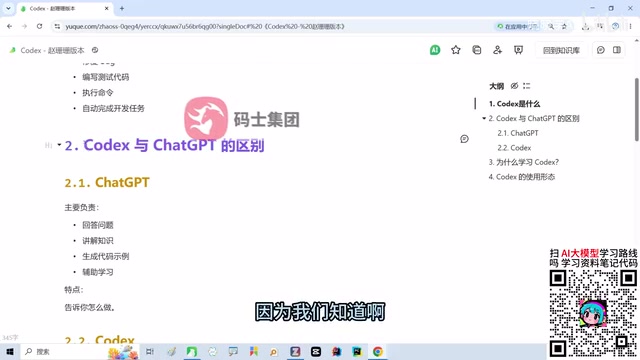
Codex Isn't a Chat Tool—It's a "Programmer" That Does the Work for You
The video establishes Codex's identity right from the start: it's an AI coding agent released by OpenAI. What is an agent? Simply put, it can autonomously do work for you. In the coding context, Codex can read code, understand code, fix bugs, run tests, and even execute commands and scripts.
This is completely different from ordinary code generation tools. When you use Doubao or DeepSeekAd to generate a piece of code, you still have to copy and paste it into your IDE and debug it manually. Codex's goal is to operate directly within your project, finish the work, and then report back to you. The uploader's analogy in the video is vivid: ChatGPT is like a teacher who talks; Codex is like a programmer sitting next to you who does the work.
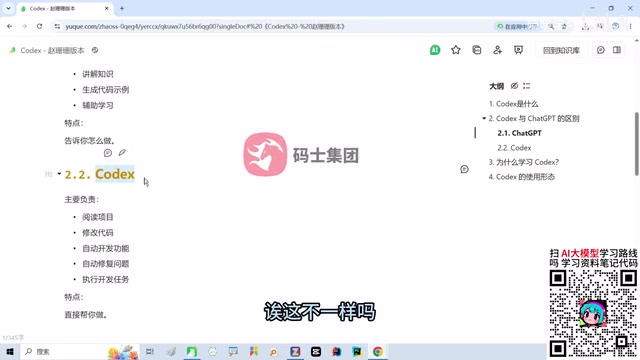
This difference determines the use cases. If you just want to ask "How do I implement a login feature in Spring Boot?" ChatGPT will explain the principles and paste code, but implementation is up to you. With Codex, you simply say "Build the login feature for me," and it will read the project structure, modify code, run tests, and tell you "Done" once everything passes.
AI Coding Agent differs from traditional code completion or code generation tools in one key way: the former has a closed-loop capability of "perceive—plan—act—feedback." Specifically, an agent can read the project file system, understand directory structure and dependencies, autonomously decide which files to modify, invoke terminal commands (such as npm test, git diff), and adjust subsequent actions based on command output. This capability relies on the model's understanding of long contexts, tool calling (function calling) mechanisms, and a sandboxed execution environment. Currently, mainstream coding agents include OpenAI Codex, Claude Code, Cursor Agent, etc., which usually exist as command-line tools or IDE plugins rather than web chat windows. Understanding this architectural difference helps explain why agents are better suited for "getting the work done" rather than "just giving suggestions."
Why Learn Tools Like Codex Now?
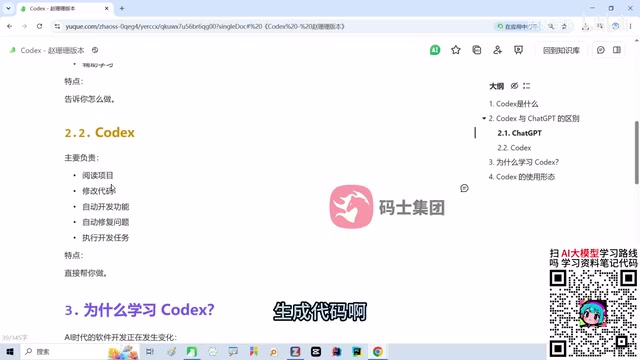
The video has a section on "why learn this" that I think is more noteworthy than the technical details. The uploader mentions that the development model in the AI era has changed: previously, programmers wrote code line by line; now, programmers submit requirements, AI agents handle most of the coding, and programmers are responsible for review and optimization.
This doesn't mean programmers will be replaced. The video puts it bluntly: if you know nothing about programming, can you review the code AI generates? Can you optimize it? So the core capability of the future isn't typing speed, but the ability to clearly express requirements to AI and to review AI output. People who can develop with AI will be significantly more efficient than those who write code purely by hand.
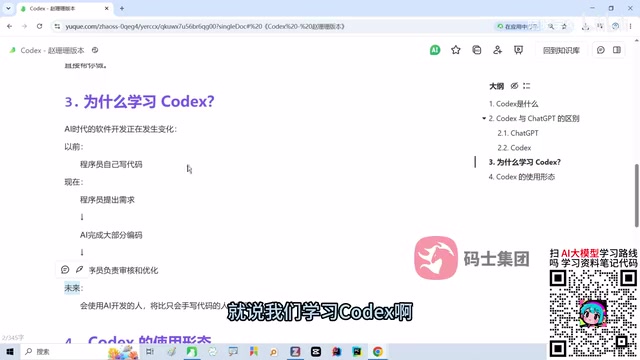
This also explains why the uploader emphasizes that Codex is just "one means of assisted programming." Like Claude Code and Cursor, it's a product of this new development paradigm. The purpose of learning them isn't to abandon programming skills, but to shift energy from repetitive coding labor to requirement definition and quality control.
What Does the Video Tutorial Cover?
According to the title and description, this tutorial covers the complete pipeline from download and installation to hands-on project development, including the integration and use of Skills and MCP. This means it's not just a conceptual overview but includes practical exercises.
Skills and MCP are fairly critical parts of the Codex ecosystem. Skills can be understood as preset capability modules for the agent, while MCP (Model Context Protocol) is a protocol that lets models connect to external tools and data. These two topics are often glossed over in most Codex tutorials, so if the video truly explains integration, installation, and practical use in depth, it would indeed be valuable for developers who want to go deeper.
However, it's worth noting that the publicly available material only covers the conceptual explanation at the beginning of the video. Specific installation steps, project practice details, and Skills/MCP operations are not reflected in the text content. If you're looking for "all substance," I suggest going straight to the hands-on chapters of the original video; the uploader has already explained the conceptual parts quite clearly.
MCP (Model Context Protocol) is an open protocol proposed by Anthropic in late 2024, aimed at standardizing the connection between large models and external tools and data sources. In agent scenarios like Codex, MCP allows the model to access file systems, databases, Git repositories, API services, etc. through a unified interface without writing separate adapter code for each tool. You can think of it as the "USB-C port of the AI world": as long as a tool implements an MCP server, the agent can plug and play. Skills, on the other hand, are more like preset "capability packs" or workflow templates, typically containing prompts, tool configurations, and operational steps, making the agent perform more reliably in specific tasks (such as code review or deployment). Combined, the two can significantly expand the agent's usable boundaries in real projects.
A Calm Assessment
Agents like Codex are indeed changing programming workflows, but their current positioning is still "assistance." The video's analogy of ChatGPT and Codex as "talking" and "doing" helps understand product differences, but it can also lead people to overestimate the agent's autonomy. In actual use, understanding project context, judging complex business logic, and final quality control of code still require developer involvement.
Another noteworthy point is that the uploader repeatedly emphasizes in the video that "programmers are responsible for review and optimization." This is actually the most grounded statement in the entire tutorial. The more automated the tool, the higher the demands on the user's judgment—because you need to know whether it did it right.
If you already know how to write code with ChatGPT, the next step is to try letting an agent operate your project directly. If you haven't encountered such tools yet, the conceptual part of this Bilibili tutorial can serve as a starting point, and for the hands-on part, I recommend following along with the video and running it yourself.
Related articles

The Essence of AI Agents: Model, Tools, and Loop
AI Agents consist of three core parts: a decision model, callable tools, and an execution loop. This article breaks down the basic structure and discusses how to define permission boundaries and stop conditions to avoid losing control.

Claude Pro vs Max: Is the $200/Month Max Worth It?
Claude Pro vs Max in depth: Max at $200/month unlocks no models Pro can't reach—it only sells capacity. 5X/20X are multiples of Pro's session quota, and going from $100 to $200 quadruples capacity. We break down the two limit jars, Fable 5.1 billing, API credit conditions, the $80 upgrade dividing line, and scenario-based buying advice.

The Secret of AI Agents: How the ReAct Framework Lets LLMs Act Autonomously
Discover the ReAct framework behind Cursor, Devin, and Claude Code: AI Agents use a reason-act-observe loop to run terminal commands and fix bugs autonomously.