The Open Source AI Stack Explained: Decoupling Models, Inference, and Tools

Decompose your AI workflow into five independent layers for fast, painless open source model upgrades.
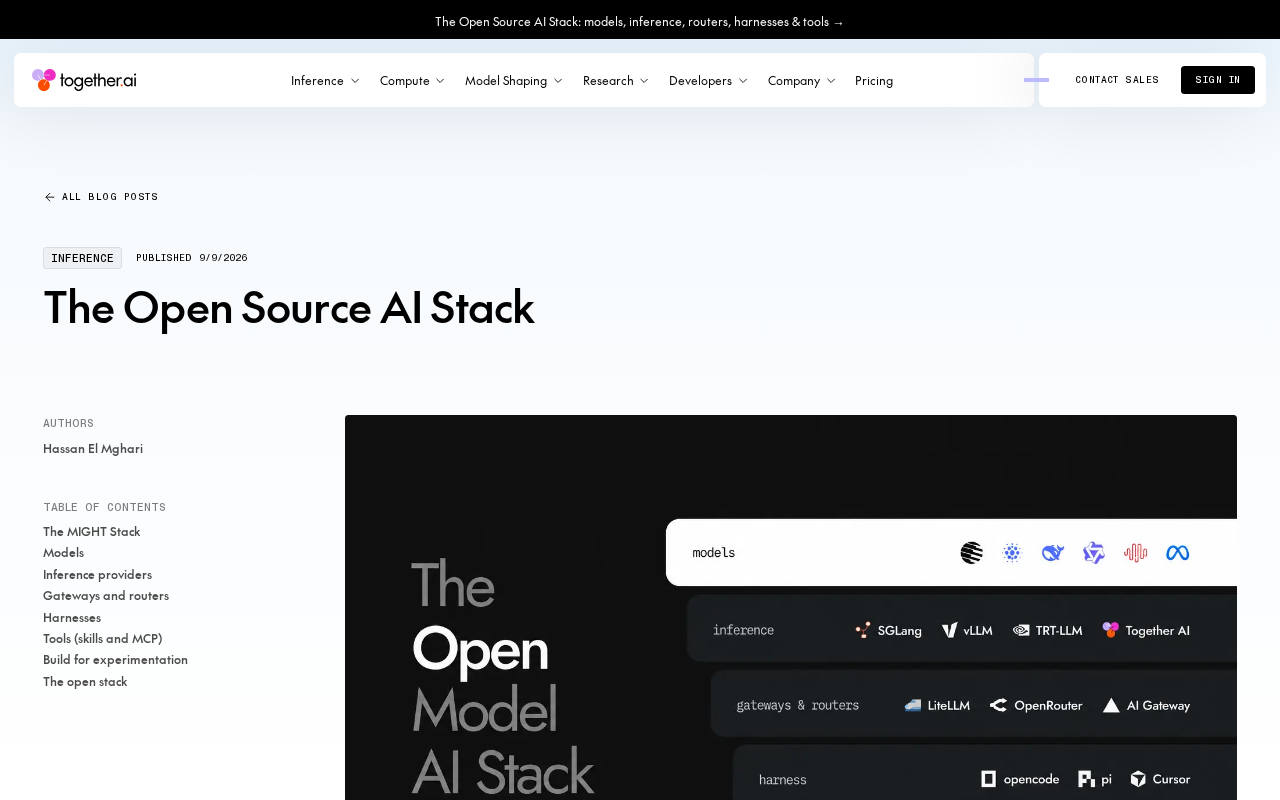
This article presents a layered architecture philosophy for open source AI applications, dividing the AI workflow into five independent layers: model, inference, gateway/router, harness, and tools. Each layer connects via standard interfaces, so replacing any one layer doesn't affect the others. The core value is agility — in a world where open source models refresh capability benchmarks every few weeks, this decoupled design lets teams evaluate and integrate new models in minutes rather than bearing the cost of a full-system migration.
Why the Open Source AI Stack Matters
AI application development is shifting away from dependence on a single closed-source API toward a more flexible open source stack. The core idea is straightforward: break the entire AI workflow into independent layers, each of which can be swapped out on its own. When a more capable open source model drops, you can integrate it in minutes — no need to tear down and rebuild your entire workflow.
This architectural philosophy is especially valuable today, when open source model capabilities refresh benchmark leaderboards almost every few weeks. If your system is deeply coupled to a specific model, every upgrade carries a steep migration cost. Decoupling is the key strategy for hedging against that uncertainty.
The Five Core Layers of the Stack
A complete open source AI stack can be divided into five layers: model, inference, gateways and routers, harness (execution framework), and tools. Each layer has a distinct responsibility, and they connect through clean, well-defined interfaces.
The Model Layer
The model layer is the core source of capability for the entire stack. In the open source ecosystem, this means you can freely choose from a wide range of open-weight models — Llama, Qwen, Mistral, DeepSeekAd, and many others. Keeping the model layer independent means that when a new open source model tops the benchmarks, the layers above don't need to know anything changed. As long as the interface stays consistent, upgrading is painless.
The Inference Layer
The inference layer is responsible for actually running the model and generating outputs. Common inference engines include vLLM, SGLang, and TGI, each with different trade-offs in throughput, latency, and GPU memory utilization. Separating the inference layer from the model layer means you can choose the most appropriate inference solution for your deployment environment — local, cloud, or edge — without being locked into a specific hardware platform or framework.
vLLM is currently one of the most widely adopted open source inference engines. Its core innovation is PagedAttention — borrowing the concept of virtual memory paging from operating systems to manage the KV cache, significantly improving memory utilization and concurrent throughput. SGLang excels in multi-step and multi-turn inference scenarios, using RadixAttention to enable KV cache reuse across requests. TGI (Text Generation Inference) is Hugging Face's officially maintained inference serving framework, deeply integrated with the model ecosystem on Hugging Face Hub and relatively easy to deploy. All three support the OpenAI-compatible API format, meaning upper-layer applications can switch between inference engines freely — without modifying any business logic — simply by targeting the standard interface.
The Gateway and Router Layer
The gateway and router layer acts as a traffic dispatcher. It exposes a unified entry point externally while routing requests internally to different models or inference backends. This layer makes multi-model collaboration possible — lightweight models handle simple tasks to save cost, while more capable large models take on complex ones. A unified interface layer also dramatically reduces the burden of adapting business code.
Representative open source projects in this layer include LiteLLM, RouteLLM, and OpenRouter. LiteLLM provides a unified Python interface and proxy service that can forward requests to hundreds of different model backends (including OpenAI, Anthropic, local vLLM instances, and more), while centrally handling authentication, rate limiting, and logging. RouteLLM focuses specifically on the intelligent routing problem: using a lightweight classifier to predict the complexity of a request before inference, automatically deciding whether to call a strong or weak model — achieving a dynamic balance between cost and quality. In large-scale production environments, this on-demand routing strategy can deliver significant cost savings without meaningfully degrading the user experience.
The Harness and Tools Layers
The Harness (Execution Framework)
The harness is the skeleton that organizes model capabilities into usable applications. It handles prompt management, context assembly, multi-turn conversation control, and orchestration with external systems. It determines how a model is used, not just how it is called. A well-designed harness keeps business logic stable even when the underlying model is swapped out.
Representative tools in the harness layer include LangChain, LlamaIndex, DSPy, and the more lightweight Instructor. LangChain is known for its chain-based calling patterns and rich integration ecosystem, making it well-suited for quickly building RAG (Retrieval-Augmented Generation) and Agent applications. LlamaIndex focuses more on data indexing and retrieval pipeline construction. DSPy introduces the concept of programmatic prompting, turning prompt optimization from a manual tuning process into an automated compilation workflow. Which framework to choose typically depends on the complexity of the application scenario and the team's preference for the level of abstraction — overly heavy frameworks can make debugging difficult, while overly lightweight ones require handling more low-level details yourself.
The Tools Layer
The tools layer gives models the ability to interact with the outside world — retrieval, code execution, API calls, database queries, and more. As the Agent paradigm rises in prominence, the tools layer has become increasingly important. Decoupling tool definitions from the model means the same set of tools can serve different models, and vice versa.
The Real Value of Decoupling
The design philosophy of this entire architecture can be summed up in one sentence: keep every layer independent. The greatest dividend this decoupling delivers is agility.
In a closed-source, tightly coupled setup, swapping out the underlying model tends to trigger a cascade of changes throughout the system. In a decoupled open source stack, models, inference engines, routers, frameworks, and tools each evolve on their own without interfering with one another. When the community releases a more capable open source model, you can evaluate and integrate it in minutes — capturing the capability gains immediately, without rebuilding your entire workflow.
For teams that want to maintain technical sovereignty, control costs, and preserve long-term flexibility, understanding and adopting this layered approach is the foundation for building sustainable AI systems. It's not just a technical architecture — it's an engineering strategy for navigating rapid change.
Related articles

AI Reverse-Engineers Monitor Firmware in 16 Minutes, Lowering the Bar for Vulnerability Research
A vulnerability researcher used AI to reverse-engineer Dell monitor firmware in 16 minutes: from binwalk entropy analysis and Ghidra MCP pseudo-C recovery to key extraction and MD5 cross-validation. This article analyzes the technical path of the experiment and the industry impact of distributing firmware encryption keys alongside firmware.

AI Cracks Dell Monitor Firmware in 15 Minutes: The Reverse Engineering Barrier Is Disappearing
A vulnerability researcher used AI to reverse engineer and decrypt Dell S34R monitor firmware in about 15 minutes—a process that used to take a week. This article analyzes how AI extracted the DLL key, reconstructed the code, and self-verified with MD5, and what the design flaw of distributing firmware keys to users means for hardware security.

Panasonic Camera Firmware Reverse Engineering: Software Layer Hits Roadblock, Pivots to Hardware Wire-Tapping Hack
Latest LumX Panasonic camera firmware reverse engineering progress: SEM2 software reverse engineering bottleneck, pivot to disassembly and wire-tapping for firmware images; first-gen S5 unlocked 200Mbps open-gate, second-gen Bluetooth link reverse engineering underway.