The Real Cost of Running LLMs On-Premise: It's Not Just the Electricity Bill

The real cost of running LLMs locally goes far beyond electricity—hidden ops time and system memory are the key variables.
Drawing on an engineering director's real-world experience, the article breaks down a three-month TCO for on-prem LLM deployment: a mid-range GPU plus memory upgrade, amortized over 24 months, costs about $58-73 per month versus $180-240 for cloud APIs at equivalent usage, breaking even around month four. But the author stresses that electricity is just surface—roughly 40 hours of hidden time on CUDA driver conflicts, Docker networking troubleshooting, and GPU memory allocation bugs is the real cost. System memory, not GPU memory, is often the true bottleneck in long-context scenarios. Privacy is a more fundamental decision driver than usage, and 14B models have a clear ceiling on complex reasoning. The author's decision rule: will you run this model 100+ times a day on sensitive data over the next 12 months? If yes, buy; if not, keep using the API—and run one local pipeline first to discover what you don't know.
The Real Cost of Running LLMs On-Premise: It's Not Just the Electricity Bill
Sarah, an engineering director at a logistics company, decisively bought a local GPU after her cloud inference bill spiked to $8,000 in a single month. The hardware arrived on Tuesday, CUDA was up and running by Friday, and the first pipeline went into production in week three. After the first full month, she stared at her electricity bill for a long time—a GPU running inference 24/7, processing at least 100,000 tokens a day, yet the electricity cost was only a fraction of what the cloud API would charge for the same volume.
And so the notion that "local inference is essentially free" began to spread. But this real-world retrospective from ayraix.com offers a more sobering conclusion: electricity isn't the real cost—it isn't even close.
The Real TCO Ledger Over Three Months
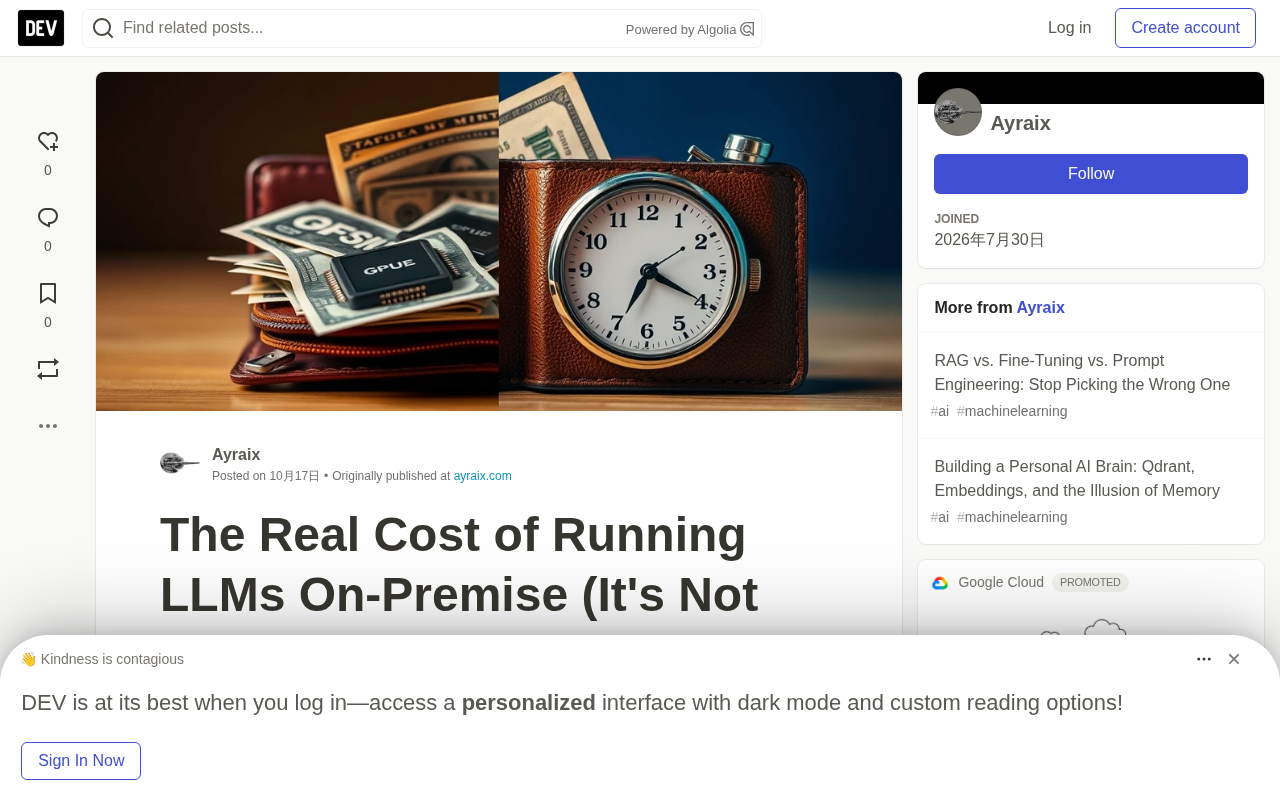
The author laid out the expenses from the first three months. On the hardware side, a mid-range GPU plus a host memory upgrade kit, amortized over 24 months; on the power side, the GPU and full system running 24/7, drawing power in the hundreds of watts. Adding up all three, the monthly operating cost comes to roughly $58 to $73.
Compare that to cloud APIs: at an estimated usage of about 500,000 tokens per day, a frontier model's monthly bill runs about $180 to $240. That's a net saving of $107 to $180 per month, breaking even around month four.
The math works out, but with a strict precondition: high-frequency, repetitive tasks such as ticket classification, information extraction, and structured output, where the data is sensitive and you don't want it leaving your premises, and where you can accept a model that's "very good" rather than "the absolute best." The author explicitly notes that if you're making fewer than 100 calls per day, and you honestly factor in your time, the API is actually cheaper.
TCO (Total Cost of Ownership) is a financial framework commonly used to evaluate IT infrastructure investments. It requires accounting for all direct and indirect expenses of an asset from procurement to retirement, not just the initial purchase price. Typical TCO components include: hardware procurement cost amortized over its depreciation period, electricity and cooling, data center space, software licenses, operations labor, downtime losses, and upgrade/replacement costs. In the context of local LLM inference, TCO is especially important because the sticker price of a GPU is just the tip of the iceberg—hidden labor for driver maintenance, system troubleshooting, and model version management often accounts for a larger share. Comparing only electricity against cloud API unit prices creates the illusion that "local is essentially free"; only when you factor in 24-month amortization and operations time under a TCO lens does the conclusion reflect reality. The author's three-month ledger is a simplified application of exactly this framework.
The Hidden Costs Nobody Puts in the Spreadsheet
What really undermines the "free local inference" narrative is those 40 hours over the first three months—time that had nothing to do with building the AI system itself.
The author lists a painful inventory: a CUDA driver conflict after a host system kernel update, 4 hours; Docker networking changes breaking Ollama hostname resolution, 6 hours; a model silently outputting corrupted JSON, eventually traced to a GPU memory allocation bug, 8 hours; GPU utilization inexplicably stuck at 60% during batch jobs, 3 hours of profiling that never fully explained it; the rest spent on config drift, model re-downloads, and Ollama version pinning.
What those 40 hours bought was a real understanding of how the inference engine allocates GPU memory under concurrent load, how Docker networking interacts with GPU passthrough, and how context window size affects system memory (not just GPU memory). The author's characterization is precise: this isn't a tax, it's tuition—but before you buy a GPU, you should know which one you're paying.
A cloud API call generates a bill the moment it happens; a local inference call generates a time cost, implicitly amortized over months of ownership. Both are real—it's just that only one shows up on an invoice.
Ollama, which comes up repeatedly in the article, is an open-source tool for running large models locally. It wraps model downloads, quantized format loading, and exposing inference as a local HTTP endpoint into simple commands, greatly lowering the barrier to local deployment, and is often seen as the default entry point for "running LLMs locally." Ollama relies on the llama.cpp inference backend, supports GPU passthrough and CPU fallback, and manages prompt templates and parameters through Modelfiles. But its convenience also brings the operational issues mentioned in the article: version upgrades may change API behavior or model cache paths, containerized deployments require correct hostname resolution and port mapping, and running multiple versions side by side requires version pinning for reproducibility. Understanding where Ollama sits in the stack—it's an inference service layer, not the model itself—helps you determine which failures are toolchain issues and which are hardware or driver issues.
The Overlooked Bottleneck: System Memory
Almost every local LLM tutorial focuses on GPU memory, but the author hit the system memory wall before GPU memory maxed out. Large context windows caused the host OS to page frequently, slowing inference to the point where it erased every advantage the GPU offered.
The solution wasn't a better GPU but a system memory upgrade—and that upgrade improved actual throughput more than any model optimization the author tried. The conclusion is straightforward: to run 14B+ models with long context, configure system memory as if "it really matters."
The context window refers to the total number of tokens a model can read in a single inference pass, including the prompt, conversation history, and content to be generated. Expanding the context window significantly increases memory usage: beyond the KV Cache (key-value cache, which grows linearly with sequence length and typically resides in GPU memory), the inference framework also consumes substantial host memory when loading model weights, chunking long inputs, and handling intermediate tensors. When GPU memory can't hold the KV Cache, some implementations offload weights or cache to system memory, causing frequent data transfer between CPU and GPU, manifesting as paging and a sharp drop in throughput. This is exactly the phenomenon the author encountered: GPU memory hadn't errored out yet, but system memory was already being dragged down by paging. So in long-context scenarios, system memory capacity and bandwidth are just as critical as GPU memory, and configuration should be estimated jointly based on model parameter count, concurrency, and maximum context length.
Privacy Is the Real Driving Force
Usage is arithmetic on a spreadsheet; privacy is an argument of a different nature—and the author's real motivation.
What does his pipeline handle? Structured records in document ingestion workflows and the revision history of every generated output; contact details, preference data, and personal statements in form automation; what he worries about, what he's working toward, and what he thinks of colleagues in a daily reflection system; the operating status of each service and the shape of the entire system in infrastructure health monitoring.
Not a single token of this data leaves. Nothing goes to OpenAI, Anthropic, Google, or any cloud provider. The model runs on a GPU three feet away, with no network access, no third-party server logs, and no terms of service handing over rights to professional data to a company. The author calls this an architectural decision, not paranoia—once you systematically audit which workflows handle personal data, you realize how casually you've been sending things to third-party infrastructure.
Where Cloud APIs Still Win
The author doesn't hide that he still uses frontier cloud APIs and Claude—and for good reason: frontier-level reasoning tasks such as architectural decisions, complex multi-step debugging, and writing that genuinely needs to be well-crafted; one-off tasks where the overhead of setting up a local environment exceeds the cost of just calling the API; scenarios where wrong answers have real consequences and 14B capability isn't enough; and tasks involving public data where privacy isn't a variable and quality is what matters most.
The capability ceiling of 14B models is real. Local models excel at classification, extraction, structured output, and pattern-based code completion, but they're unreliable on nuanced judgment and complex reasoning chains. Know where the ceiling is and route accordingly—a hybrid architecture isn't a compromise, it's the right architecture.
A hybrid architecture means routing requests to different inference backends within the same AI system based on task characteristics: sensitive, high-frequency, patterned tasks go to a local small model, while complex reasoning, high-quality writing, or low-frequency tasks go to a frontier cloud API. In practice, this usually requires a routing layer that decides where to send requests based on data sensitivity level, task type, confidence thresholds, or cost budget, and that validates and falls back on local model outputs. The value of this design is that it delivers privacy boundaries, cost control, and capability ceilings all at once: local models handle 80% of routine traffic, while cloud models only process the tail requests that genuinely need strong reasoning. Routing policies should be configurable and observable, logging which backend each request type hits and how failures fall back, so that "hybrid" doesn't turn into two separate systems stitched together.
One Question to Answer Before Buying a GPU
Will I run this model more than 100 times a day over the next 12 months on data I don't want to send to a cloud API?
If yes: buy. Both the economics and the privacy case hold up. If no: the API is cheaper, faster to get started with, and zero maintenance—and that answer is nothing to be ashamed of. The real mistake is buying hardware for occasional use and then pretending those 40 hours of infrastructure work don't count as a cost.
The author's final advice is very practical: pull up your cloud API bills from the past three months, total the tokens, sum the costs, and divide by 30. If the monthly figure is higher than the amortized cost of a mid-range GPU (about $25 to $30 per month over 24 months), it's worth building a spreadsheet and doing the math; if it's lower, keep paying the API bill—your time is worth more than what you'd save. Either way, it's worth running one pipeline on local inference first—not to save money, but to learn what you don't yet know you don't know.
Related articles

REA: Reverse Engineer Any App with AI, No Coding Required
REA is a viral open-source AI reverse-engineering tool that lets Claude, Codex, and other AI agents analyze any app and generate functional clones—no coding required. This article covers how it works, installation, a hands-on test, and legal risks.
2026 AI Coding Tools Comparison: Claude, ChatGPT, Gemini — Which Is the Best?
A 2026 comparison of five mainstream AI coding tools — Claude Code, ChatGPT Codex, Gemini, DeepSeek, and GitHub Copilot — on real projects, pricing, and code quality, to help you decide where that $20/month should go.

ChatGPT Codex Can Clone Any Software? Testing the Risks and the Truth
YouTube shorts claim ChatGPT Codex or Claude Code can clone Adobe, Excel, and Figma for lifelong free use. We break down the feasibility, legal risks, and DM-funnel tactics—and explain what AI coding tools are truly good for.