The Silent Failures Lurking in LangChain Agents: Four Real Cases and How to Investigate Them

Four real cases reveal silent failures in agent frameworks like LangChain that don't error but corrupt results, plus defensive strategies.
The article focuses on a class of problems in the LangChain, LangGraph, and Deep Agents ecosystem that are more dangerous than crashes: silent failures. The author's team reproduced four cases offline using fake models—with_structured_output returning None with an empty parsing_error under a dict schema, Anthropic's pause_turn being treated as the final answer by create_agent, a set of tuples in LangGraph state degrading to a list of lists after a checkpoint round trip, and Deep Agents' compact_conversation returning a success message when summarization fails. These failures all return seemingly legitimate outputs without throwing exceptions, yet quietly corrupt data or decisions. The article provides workarounds for each, such as switching to pydantic schemas, checking stop_reason, using safely serializable types, upgrading versions, and adding result validation, and concludes with four general troubleshooting approaches: log monitoring, automated evals, type assertions, and user feedback.
Silent Failures: When Agents Go Wrong Without Erroring
In the LangChain, LangGraph, and Deep Agents ecosystem, the most frustrating problems aren't the errors that throw exceptions—they're the "silent failures" where everything looks fine but the results are completely wrong. Recently, a Reddit discussion thread highlighted several such issues that the author's team uncovered in recent issues, and they reproduced four representative cases offline using fake models, involving langchain 1.5.0, langgraph 1.2.21, and deepagents 0.7.32 respectively. Each case returned seemingly normal results without throwing any exceptions.
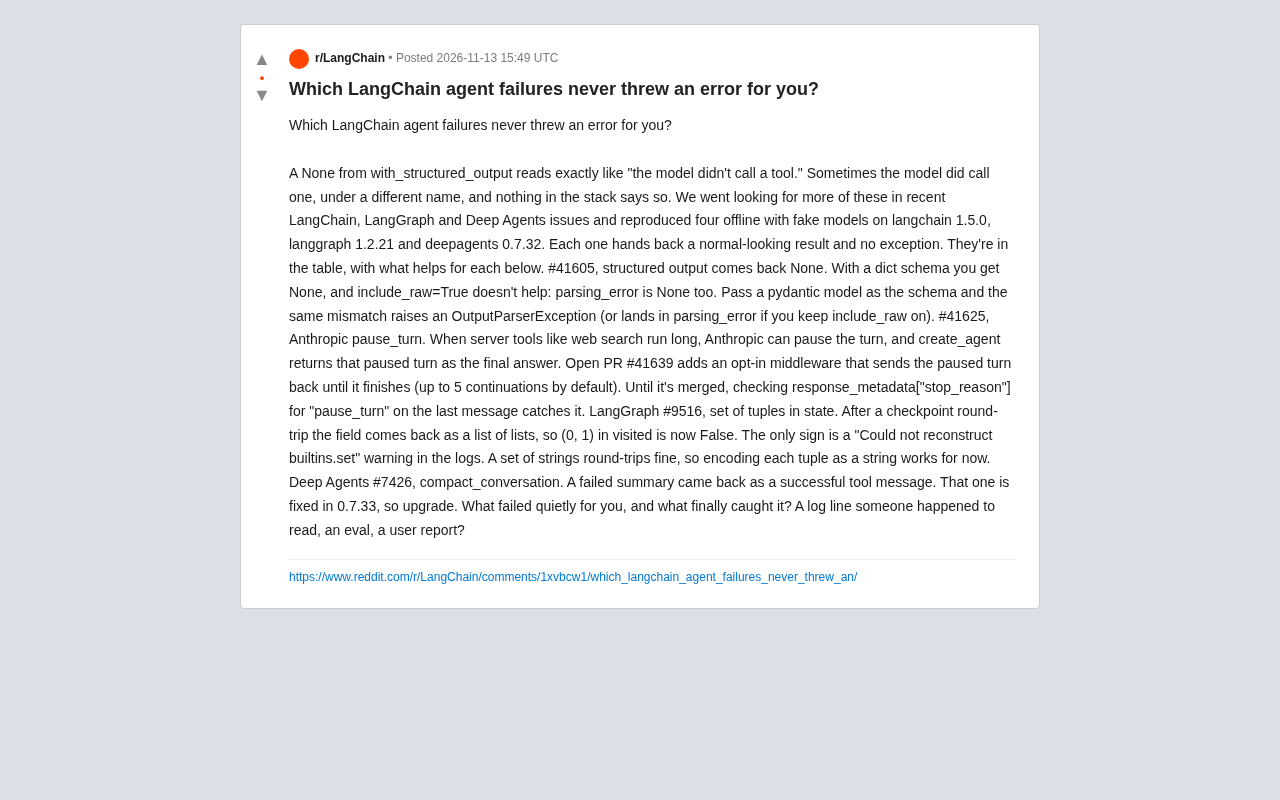
What these problems have in common is that they don't interrupt your program flow, but they quietly corrupt your data or decisions. For applications relying on agent automation, this silence can be more dangerous than a crash.
Why Silent Failures Deserve More Attention
In traditional software development, exceptions are clear signals. But in LLM-based agents, many failures manifest as "legitimate outputs"—a None value, a paused reply, a state field whose type silently changes. Without targeted checks, developers can easily treat these results as normal flow and continue processing, until downstream logic exhibits hard-to-trace deviations.
Case 1: Structured Output Returns None Without a Parsing Error
The first case corresponds to issue #41605. When using with_structured_output with a dict schema, the result may be None. More confusingly, even with include_raw=True, parsing_error is also None. This means nothing in the entire chain tells you "parsing failed."
The author notes that this sometimes happens because the model actually called a tool but used a different name, with no indication in the call stack. The fix is to switch to a pydantic model as the schema: the same mismatch will then throw an OutputParserException, or, when include_raw=True is preserved, the error will be written to parsing_error.
Implications for Developers
If you rely on structured output for downstream decisions, prefer pydantic schemas and explicitly check the parsing_error field. Don't assume that None means "the model didn't call a tool"—it might just have failed silently.
with_structured_output is a core method in LangChain for constraining model output format. It binds a tool or JSON schema during the model call so the model returns structured data according to the specified schema. When you pass a dict schema, LangChain converts it into a tool description for the model, and the model returns structured results via tool calls; when you pass a pydantic model, LangChain not only generates the schema but also performs strict pydantic validation upon receiving the result. The key difference lies in the failure path: pydantic validation failures throw OutputParserException, while under a dict schema, if the tool call name doesn't match or arguments are missing, the framework may simply fail to find the corresponding result and ultimately return None without triggering any exception. The purpose of include_raw=True is to let the caller receive both the raw message and the parsed result; normally, parsing errors are written to the parsing_error field, but in the dict schema tool-call path, this field may remain None because the parsing step is never triggered.
OutputParserException is the standard exception thrown by LangChain parsers when they cannot convert model output into the target structure. It typically carries the raw output for debugging. In the pydantic schema path, when the model returns fields of the wrong type, misses required fields, or the overall output isn't valid JSON, pydantic validation errors are wrapped and thrown as this exception, making the failure visible. This is why the author recommends preferring pydantic schemas: they turn silent None into a catchable exception.
Case 2: Anthropic's pause_turn Treated as the Final Answer
The second case is issue #41625. When Anthropic's server-side tools (such as web search) run for a long time, the API may return a paused turn (pause_turn). And create_agent returns this paused turn directly as the final answer. Users see an incomplete reply with no error indication.
There is currently an open PR #41639 that plans to add an optional middleware to resend paused turns until completion (defaulting to a maximum of 5 continuations). Until it's merged, a temporary check is to look for "pause_turn" in the last message's response_metadata["stop_reason"].
Temporary Workarounds
If your application uses Anthropic's server-side tools, explicitly check stop_reason after the agent returns. If you find pause_turn, you can implement your own retry logic, or at least log it for manual intervention.
pause_turn is a value of stop_reason in the Anthropic Messages API, specifically for server-side tool scenarios (such as web search, code execution). When the model initiates a server-side tool call and the tool takes a long time to execute on the server, exceeding the processing window of a single request, the API doesn't block and wait indefinitely; instead, it returns a response with stop_reason: "pause_turn", containing the partial content generated so far and the state of the unfinished tool call. According to Anthropic's design intent, the client should send this response back as-is so the server can continue executing the unfinished tool call and generate subsequent content—this process may repeat multiple times. If the client treats it as the final answer, the user will see a reply that cuts off abruptly.
stop_reason is the field in Anthropic responses that indicates why generation ended. Common values also include end_turn (normal completion), max_tokens (length limit reached), tool_use (model requests a client-side tool call), and stop_sequence (stop sequence hit). It resides in the response metadata, and after LangChain wraps it, it's usually accessible via the message's response_metadata["stop_reason"]. Distinguishing these values is the first-hand basis for judging whether a reply is complete, especially since both pause_turn and max_tokens mean the content may be incomplete, yet neither appears as an exception.
Case 3: A Set of Tuples in LangGraph State Changes Type After a Round Trip
The third case comes from LangGraph issue #9516. When the state contains a set of tuples, after one checkpoint round trip, the field becomes a list of lists. The original check (0, 1) in visited returns False because the element types have changed.
The only clue is a warning in the logs: "Could not reconstruct builtins.set". The author notes that sets of strings round-trip fine, so a temporary workaround is to encode each tuple as a string.
The Pitfalls of State Serialization
This case reminds us that when using LangGraph's checkpoint feature, pay special attention to serialization and deserialization of complex types in state. For types like sets and tuples, it's advisable to use safely round-trippable types (such as strings or lists) in state definitions, or add type-check assertions.
LangGraph's checkpoint mechanism serializes and persists the state at each step to support resuming from breakpoints, time-travel debugging, and human intervention. By default, LangGraph uses a JSON-based serializer (such as JsonPlusSerializer), which adds special markers for certain Python types during serialization and uses them to reconstruct during deserialization. Sets and tuples are not native JSON types; the serializer converts them to lists with type markers. When markers are lost, nesting is too deep, or the type combination isn't supported, deserialization degrades to plain lists and outputs warnings like "Could not reconstruct builtins.set".
A set of tuples is an especially fragile structure because it's a nested combination of "set containing tuples." The serializer must correctly reconstruct both container types; if either layer's marker is lost, the result becomes a list of lists. Once the type degrades, membership checks like (0, 1) in visited fail because the list elements are lists rather than tuples, and the semantics of hashing and equality comparison change. More insidiously, this degradation only produces warning-level logs and doesn't interrupt execution. The workaround is to use only JSON-native types in state fields: encode tuples as strings or fixed-length lists, and explicitly convert them back to the required types when reading, or add type assertions in state update nodes.
Case 4: Deep Agents' compact_conversation Wraps Failure as Success
The fourth case is Deep Agents issue #7426. When summarization fails, the compact_conversation feature returns a successful tool message. This bug has been fixed in version 0.7.33, so upgrading resolves it.
Although this case has a fix, it reveals a common problem: the result-wrapping layer of tool calls can mask underlying failures. Beyond upgrading, developers can also add result validation in their own tool wrappers to avoid similar situations.
Upgrading and Defensive Programming
Keeping dependencies up to date is essential, but more importantly, add defensive checks on critical paths. For example, for summarization tools, you can validate whether the returned content is empty or matches the expected format.
compact_conversation is a feature in Deep Agents for context compression: when the conversation history gets too long and approaches the model's context window limit, it calls the model to summarize earlier messages into a shorter text, freeing up space to continue reasoning. Such features are on the agent's "housekeeping" path, and their failures often don't directly affect the current turn's answer, making them more likely to be swallowed by the wrapping layer. Tool call results usually flow back to the agent as a tool message with a success or failure status indicator; if the wrapping layer still constructs a success message when the summarization call fails, the agent believes compression is complete and continues running, while in reality the history hasn't been effectively compressed, potentially leading to harder-to-diagnose issues later due to context overflow.
The general lesson from this bug is: result-wrapping layers are a high-incidence area for silent failures. Tool wrappers should explicitly map underlying exceptions or empty results to failure states instead of falling back to a default success message; callers should validate the content of critical tool results, for example, checking whether summary text is non-empty, within the expected length range, and contains necessary structured fields. Upgrading to the fixed version is necessary, but retaining validation logic in your own wrapper is what prevents similar problems from recurring in other tools.
How to Spot These Silent Failures
The original article ends with an open question: what silent failures have you encountered? What eventually revealed them? Was it a log line someone happened to read, an eval, or a user report?
From these four cases, we can summarize some general troubleshooting approaches:
- Log monitoring: Warnings like "Could not reconstruct builtins.set" are valuable clues. Stay sensitive to warning-level information in logs.
- Evaluation systems: Build automated evals for agent outputs, especially validation of structured outputs, state changes, and tool call results.
- Type assertions: Add type checks at key nodes in state transitions, such as confirming that sets are still sets and tuples are still tuples.
- User feedback loops: User reports are often the last line of defense; having a process for quick localization and reproduction is crucial.
Silent failures are an obstacle that agent systems must overcome to reach production. By understanding these real cases, developers can design defensive measures more consciously, making agent failures "loud" rather than "silent."
One-line Summary
Four real cases reveal silent failures that don't throw errors but corrupt results in agent frameworks like LangChain, along with defensive strategies.
Related articles

VP ≠ VNP: A Major Breakthrough in Computational Complexity Theory
A study claiming to prove VP ≠ VNP over every field sparks heated discussion on Hacker News. This article analyzes the algebraic complexity background of VP and VNP, the proof approach, community controversy, and its potential impact on computational complexity theory.

Developer Naming Woes: The Technical Names That Drive Us Crazy
Why is technical naming so maddening? From Nginx and Vite to Qt and Sudo, a YouTube creator rants about the chaos of developer naming and pronunciation, revealing the tug-of-war between creators' intentions and community habits, and the cultural roots behind spelling traps like PyPI and GNOME.

Figma Workplace Scandal: Employee Sues CEO for Forcing Confrontation with Harasser
Figma and its CEO are sued by a current employee alleging sexual harassment and discrimination, and forcing the victim to confront her harasser. This article outlines the background, potential impact, and industry reflection.