Three Hidden LangGraph Production Pitfalls: CVE Vulnerability, 85% Storage Bloat, and Silent Loops

LangGraph production risks: a CVE exploit, 85% storage bloat, and silent post-crash state corruption.
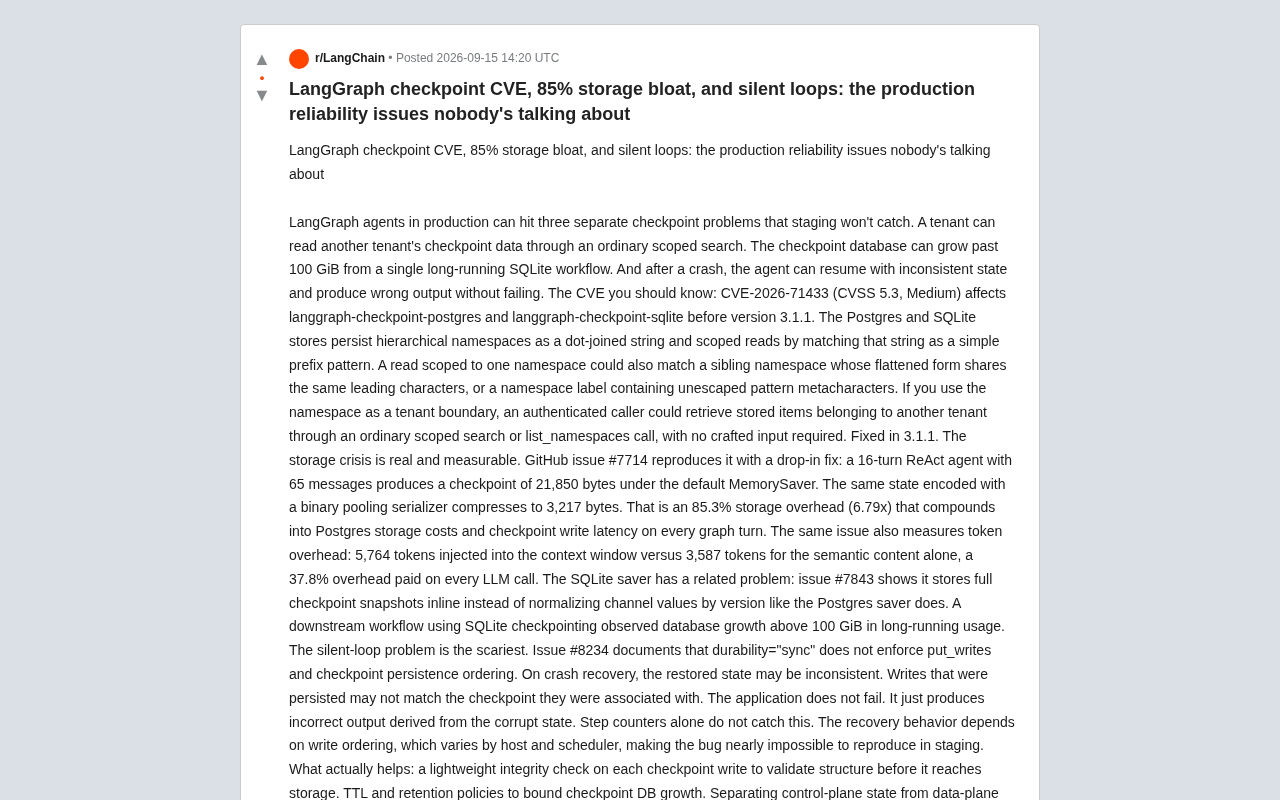
This article exposes three serious production-environment risks in LangGraph agents. CVE-2026-71433 (CVSS 5.3) allows authenticated callers to read cross-tenant data via namespace prefix-matching flaws in versions before 3.1.1. Default MemorySaver serialization causes 85.3% redundant storage overhead and 37.8% extra token costs per LLM call, with SQLite saver pushing databases past 100 GiB. Most dangerously, durability="sync" doesn't enforce write ordering, causing crash recovery to silently output wrong results without any error. Mitigations include upgrading to 3.1.1, using binary pooling serializers, setting TTL policies, and monitoring database growth rate.
LangGraph agents that run perfectly in test environments can run into three hard-to-detect checkpoint issues once they hit production: unauthorized cross-tenant data reads, single long-running workflows bloating databases past 100 GiB, and post-crash recovery that silently produces wrong outputs without throwing a single error. These problems are nearly impossible to reproduce in staging, yet quietly compound under real-world load.
CVE-2026-71433: Unauthorized Reads via Namespace Prefix Matching
This vulnerability is tracked as CVE-2026-71433 with a CVSS score of 5.3 (medium severity). It affects langgraph-checkpoint-postgres and langgraph-checkpoint-sqlite in versions prior to 3.1.1.
The root cause lies in how the storage layer handles hierarchical namespaces. Both Postgres and SQLite backends persist hierarchical namespaces as dot-joined strings, and range reads match against these strings using simple prefix patterns. This creates two risks: a namespace's flattened form can accidentally match a sibling namespace that shares the same leading characters, and unescaped pattern metacharacters in namespace labels can cause runaway matches.
If you're using namespaces as tenant boundaries, an authenticated caller can read storage data belonging to other tenants through a normal range search or list_namespaces call — no crafted input required. For multi-tenant SaaS architectures, this is a classic horizontal privilege escalation. The issue is fixed in version 3.1.1, and upgrading is the only remediation.
In LangGraph's multi-tenant deployment model, developers typically use namespaces to isolate agent state per tenant — for example, assigning tenant_a.workflow and tenant_b.workflow to different customers. The fundamental flaw in prefix matching is that when the storage layer executes a query like WHERE namespace LIKE 'tenant_a%', a sibling namespace such as tenant_a2 will also match and be returned. Metacharacter risks are equally dangerous — if a tenant ID contains _ (which matches any single character in SQL LIKE syntax) or % (which matches any sequence of characters), unescaped queries lose all boundary guarantees. The 3.1.1 fix typically switches namespace lookups to exact array-column matching or enforces metacharacter escaping before query construction, eliminating prefix-semantic ambiguity entirely.
85% Storage Bloat: The Hidden Cost of Checkpoint Serialization
The second issue isn't a security vulnerability — it's a measurable, real-money cost problem. GitHub issue #7714 provides a reproducible case with an accompanying fix.
The numbers are striking: a 16-turn ReAct agent with 65 messages produces a checkpoint size of 21,850 bytes under the default MemorySaver. The same state encoded with a binary pooling serializer compresses down to 3,217 bytes — an 85.3% reduction in storage overhead (roughly 6.79×).
This overhead isn't a one-time cost. It accumulates on every graph turn, directly inflating Postgres storage bills and checkpoint write latency. Even more concerning is the token-level waste: the same issue measured 5,764 tokens injected into the context window, while the semantic content itself required only 3,587 tokens — a 37.8% token overhead on every LLM call. At high call volumes, this adds up fast.
The SQLite saver has a related but more severe problem. Issue #7843 notes that it stores full checkpoint snapshots inline, rather than normalizing channel values by version the way the Postgres saver does. The result: a downstream workflow using SQLite checkpointing observed the database size exceed 100 GiB during long-running operation.
LangGraph's checkpoint mechanism is fundamentally a "full state snapshot" strategy: each time graph execution reaches a node boundary, the framework serializes and persists the complete current state graph so it can resume from any intermediate step after a crash. The default MemorySaver uses JSON serialization, serializing message lists, tool call results, and other structures field by field with no deduplication or incremental compression. As conversation turns accumulate, the messages array in the state grows linearly — and since every checkpoint contains the full history, this is the root cause of storage bloat. The "binary pooling serializer" works by extracting recurring sub-structures (such as identical system prompts or tool definitions) into a shared object pool and replacing inline copies with references, significantly reducing serialized size — with greater benefit the more turns a conversation has. The Postgres saver's "per-version channel normalization" follows the same principle: only store changed channels rather than writing a full snapshot every time.
Silent Loops: State Inconsistency After Crash Recovery
The most dangerous of the three issues is the silent loop, documented in issue #8234.
The core problem: durability="sync" does not enforce ordering between put_writes and checkpoint persistence. When a crash recovery occurs, the restored state may be inconsistent — writes that were already persisted don't necessarily correspond to the checkpoint they're associated with.
What makes this so insidious is the failure mode: the application doesn't raise an error. It simply produces wrong outputs quietly, based on a corrupted state. Step counters alone can't catch this class of problem. Recovery behavior depends on write ordering, which varies across hosts and schedulers, making this bug nearly impossible to reproduce in staging. This is a textbook "production-only disaster" — you only discover the state has been quietly corrupted after a real crash has already occurred.
durability="sync" intuitively implies "flush to disk immediately, confirm to caller before continuing," which leads developers to assume checkpoint persistence order maps one-to-one with write operations. In practice, this setting only guarantees the durability of individual writes, not a global ordering across multiple write operations. Within a single turn, LangGraph may issue multiple put_writes calls (recording node outputs) and one put_checkpoint call (snapshotting full state), and these two operation types may reach the database via different async code paths. When the process crashes between them, recovery logic that uses the checkpoint as ground truth will lose already-written node outputs; logic that uses the latest writes will replay without a corresponding checkpoint — either path produces semantically incorrect state. Because this kind of race condition depends on specific OS scheduling, database connection pool state, and crash timing, it's nearly impossible to reproduce reliably in controlled staging environments.
Practical Production Mitigations
For all three issues, the original thread outlines several actionable engineering practices:
- Lightweight integrity checks before writes: Validate checkpoint structure before each write to ensure data is complete and trustworthy before it reaches the storage layer — an effective defense against silent loops.
- TTL and retention policies: Set expiration and retention rules on the checkpoint database to actively bound growth and prevent unbounded bloat.
- Separate control-plane and data-plane state: Decouple the two state types to prevent bloated checkpoints from slowing down hot-path processing.
- Monitor checkpoint database growth rate as a production metric: Don't just watch query latency — growth rate itself is a key health signal.
These measures are straightforward, but they address the blind spots most commonly overlooked when taking LangGraph agents to production. Upgrading to 3.1.1 resolves the privilege escalation issue; serialization optimization and SQLite normalization reduce storage pressure; and integrity checks are the last line of defense against silent state corruption. For any team running or planning to run LangGraph agents in production, all three of these issues are worth auditing proactively.
Related articles

Complete Guide to Running Your Own Local DeepSeek: Web Access, Knowledge Base & Privacy
Step-by-step guide to deploying a private DeepSeek locally using Ollama, Chatbox, and AnythingLLM — with web access, RAG knowledge base, and full privacy.
AI Agent Development: A 4-Stage Learning Roadmap from Beginner to Enterprise-Level Practice
A complete AI Agent learning roadmap from zero to enterprise-level: covering ReAct, multi-agent collaboration, Prompt tuning, RAG, MCP, and real-world projects.
A New DeepSeek Harness Experiment: Agent Supervising Agent for Self-Evolution
A developer built an "Agent supervising Agent" self-evolution system using DeepSeek Harness, with a ledger mechanism enabling near-unattended overnight software iteration.