Toone: Build Reliable AI Agent Workflows with Natural Language
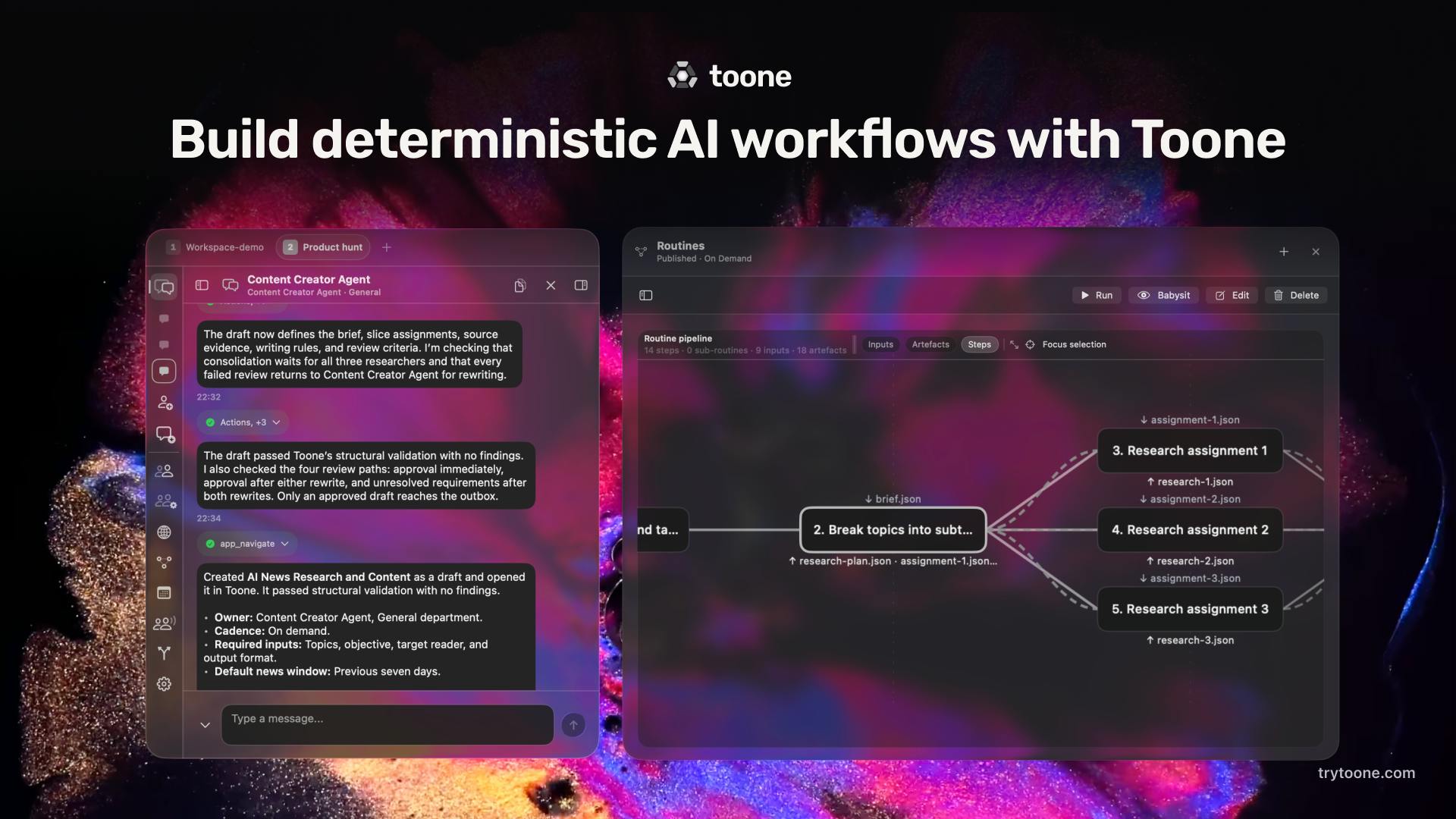
Toone lets you build, debug, and resume AI agent workflows using natural language with production-grade observability.
Toone is an AI agent orchestration tool that recently launched on Product Hunt, targeting the gap between impressive demos and unstable production deployments. It lets users build complex workflows in natural language, with step-level debugging visibility, breakpoint resume, and multimodal data passing. Built on top of OpenAI or Anthropic accounts rather than its own models, Toone focuses on making AI execution predictable and maintainable — though its real-world accuracy on complex branching logic remains to be tested.
As AI agents become increasingly widespread, helping them execute complex tasks in production environments in a stable and predictable way has become a core challenge for developers. Toone, a new tool that recently launched on Product Hunt, aims to address this pain point through a combination of natural language authoring and observable debugging.
What Problem Is Toone Solving?
Toone is designed to help users build, run, and debug long-running or structurally complex AI agent workflows & routines. Its one-line pitch is "Build complex, reliable AI agent workflows & routines" — with the key words being complex and reliable.
A common failure mode in today's AI agent projects is that demos look impressive, but once these agents enter real production scenarios — with longer chains and more steps — outputs become unpredictable, and there's no good way to diagnose what went wrong. Toone targets exactly this gap between "Demo" and "Production," with a focus on turning non-deterministic AI into predictable, deterministic execution pipelines.
Core Features: Natural Language Orchestration and Step-by-Step Debugging
Based on official descriptions, Toone's product design revolves around several key capabilities.
Build Workflows with Natural Language
Users can build and run workflows by simply describing them in natural language — no need to write complex orchestration code from scratch. This lowers the barrier for building agent pipelines, allowing users without a pure engineering background to design automated tasks.
Step-Level Visibility and Debugging
One of Toone's key selling points is the ability to "inspect and debug every single step." It provides the visibility and control required for production-grade workflows, allowing users to examine the execution state at each step and pinpoint where things go wrong. For long-chain tasks, this kind of step-by-step observability is especially critical.
Observability is a concept borrowed from distributed systems engineering. Its core idea is to let developers infer the internal state of a system from the outside, using three types of data: Logs, Metrics, and Traces. Applying this concept to AI agents is particularly urgent. In traditional software, each execution step produces a deterministic result. But every inference call to an LLM is fundamentally a probabilistic sampling operation — intermediate outputs are hard to predict. When an agent pipeline involves multiple model calls, tool calls, and conditional branches, a single step that deviates from expectations can cause errors to cascade, ultimately causing the entire task to fail. The value of step-level observability is that it turns what was previously a "black box" into a "white box" that can be inspected piece by piece — letting developers pinpoint exactly which model call produced faulty reasoning or which tool returned bad data, reducing debugging time from "re-run everything and guess" to "targeted root cause analysis."
Edit and Resume from Where You Stopped
Toone supports editing a workflow and resuming from the point where it was interrupted. When a long-running pipeline stalls at a particular step or needs adjusting, users don't have to re-run the entire flow from scratch — they can make changes and pick up from the breakpoint. For complex, time-consuming tasks, this can significantly reduce both time and API call costs.
Multimodal Passing and Deterministic Output
Toone emphasizes support for multimodal data passing between steps, and aims for "predictable and deterministic AI" — orchestrating workflows with the consistency and observability required for production environments.
Prerequisites and Ecosystem Positioning
It's worth noting that Toone is not a standalone LLM service — it's an orchestration layer built on top of mainstream models. Using it requires an OpenAI or Anthropic account, meaning it organizes a user's existing model capabilities into reliable pipelines rather than replacing the models themselves.
The official page also includes a small tip: the experience is best when used alongside the ChatGPT desktop app. Combined with its Product Hunt categories — "Mac," "Artificial Intelligence," and "OpenAI Day" — Toone currently skews toward desktop users within the OpenAI ecosystem.
Orchestration Layer is a key architectural concept in AI agent systems. In a typical agent setup, the foundation consists of base large language models (e.g., GPT-4o, Claude). The middle tier is the orchestration layer, which manages multi-step execution order, tool calls, state management, and error handling. The top tier is the user-facing application interface. Toone sits squarely in the orchestration layer, alongside products like LangChain/LangGraph, LlamaIndex Workflows, and Temporal (a workflow engine). The orchestration layer exists because the raw LLM API only handles single request-response cycles — it can't natively support multi-step state persistence, conditional routing, or failure retries. The orchestration layer abstracts away this engineering complexity so developers can focus on business logic rather than low-level scheduling. Toone's decision to rely on users' own OpenAI/Anthropic accounts rather than hosting its own model service signals that its business model is centered on the value of orchestration itself — not on marking up model inference costs.
Market Reception by the Numbers
On Product Hunt, Toone was launched by Maker Matheus Paranhos. It received 78 upvotes and 9 comments, ranking 13th on its launch day. For a newly released agent orchestration tool, these numbers suggest it resonates with a real subset of developers — though it hasn't yet reached breakout popularity.
This performance also reflects the broader landscape: AI agent workflow tools are in a crowded, rapidly evolving phase, with many players ranging from LangChain and n8n to various visual orchestration platforms. Toone's differentiation is primarily its bet on the combination of natural language orchestration + production-grade debugging observability + breakpoint resume.
Notable Strengths and Open Questions
Toone's product philosophy targets a genuine industry pain point: agents don't lack capability — they lack reliability and maintainability. Front-loading engineering concerns like debugging, observability, and breakpoint recovery into the product design is the right direction.
That said, based on official materials alone, several questions remain to be validated in practice: How accurate is natural language orchestration when handling complex conditional branching? What does "determinism" actually mean when the underlying system still relies on LLMs? And will Toone eventually support models beyond OpenAI and Anthropic? These are questions that only real-world projects can answer.
For developers actively looking for an agent workflow tool who already use OpenAI or Anthropic, Toone is worth trying out. Interested readers can explore it at trytoone.com.
Related articles
Free Open-Source Tool Rejected: The Community Controversy Sparked by r/DnD's AI Ban
A free open-source DnD campaign tool was rejected by r/DnD's AI ban — yet the same tool was approved a year ago. The case highlights the blurry line between AI tools and AI-generated content.
What LLMs Can You Run with 1.9TB of RAM? Exploring the Ceiling of Local AI Deployment
A Reddit user with 1.9TB of RAM sparked debate about local LLM deployment. We break down what massive RAM enables, where CPU inference falls short, and the real bottlenecks.
Researchers Use Claude to Hack OpenAI Systems: A New Wake-Up Call for AI Security
Security researchers used Anthropic's Claude to breach OpenAI systems, taking over employee accounts and accessing internal repos. What this means for AI security.