Unsloth Syncs with New Releases: DeepSeek-V4.1-Flash and FLUX.3 Now Run Locally

Unsloth v0.1.909-beta runs 552B DeepSeek in as little as 125GB of memory and supports local FLUX.3 fine-tuning.
Unsloth v0.1.909-beta supports local running and fine-tuning of DeepSeek-V4.1-Flash-1017 (552B params, ~16B active, 1M context, ~125 GB RAM at 1-bit with Engram tables on SSD, Terminal-Bench 4.0 up from 31.2 to 42.3) and FLUX.3 Image Klein (5.6B, 24 GB VRAM, up to 10 reference images). It also unifies chat/image/video models, adds FSDP2, context parallelism, VRAM optimizations, ~28% faster LoRA fused kernels, and one-command MCP integration with Claude Code, Codex, and Cursor.
The open-source fine-tuning framework Unsloth has released v0.1.909-beta, bringing two heavyweight models — DeepSeek-V4.1-Flash-1017 and FLUX.3 Image Klein — into local running and fine-tuning workflows in one go. The focus of this update isn't just "it runs," but pushing forward on VRAM thresholds for large models, training efficiency, and agent integration.
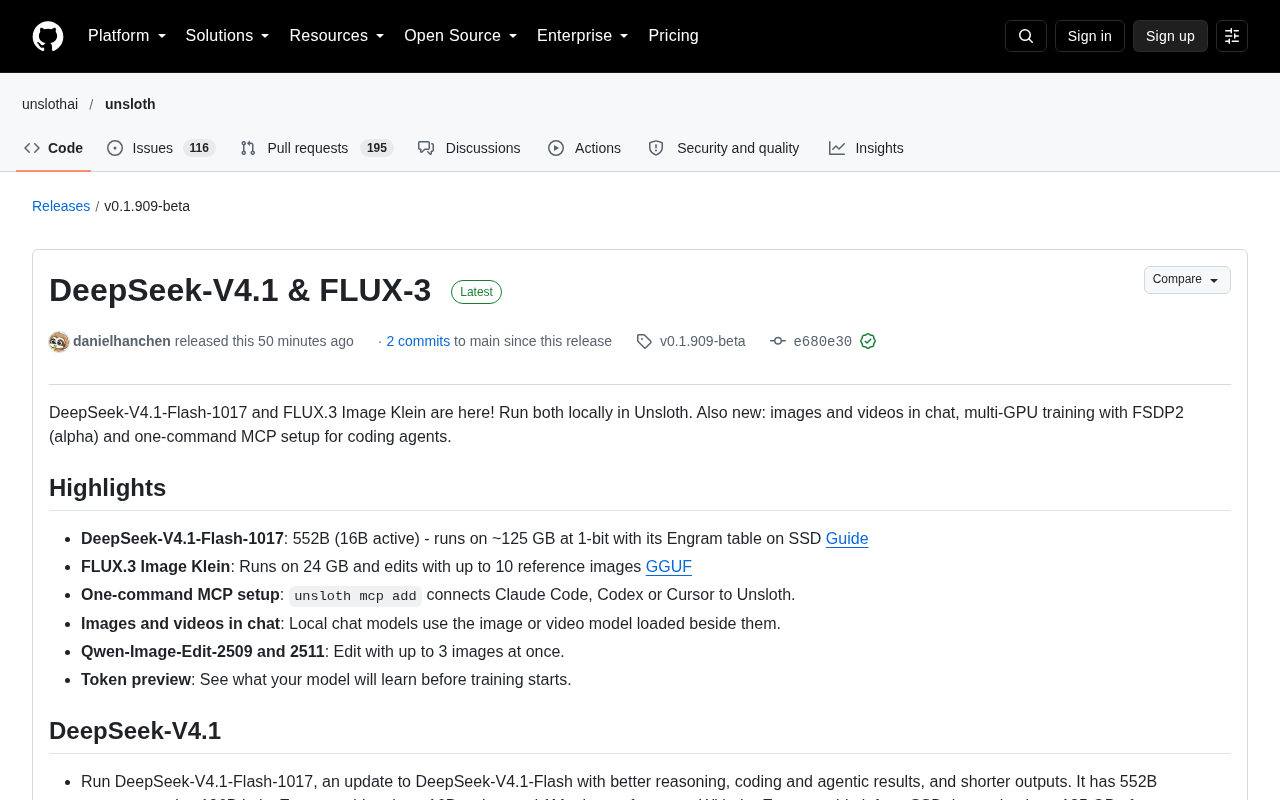
DeepSeek-V4.1-Flash-1017: 552B Parameters Running in 125 GB
DeepSeekAd-V4.1-Flash-1017 is an updated version of the previous DeepSeek-V4.1-Flash, officially positioned as stronger at reasoning, coding, and agent tasks, with shorter outputs. The model has 552B parameters, with an additional 196B parameters stored in Engram tables, approximately 16B active parameters, and a context length of 1M tokens.
The really interesting part is the VRAM strategy. Unsloth keeps the Engram tables on SSD, so under 1-bit quantization the model needs roughly 125 GB of memory to run; switching to 4-bit requires about 300 GB. This offers a realistic path for users without multi-GPU clusters but with fast solid-state storage and large memory capacity.
The capability gains are backed by concrete data: the Terminal-Bench 4.0 score improved from 31.2 on the previous DeepSeek-V4.1-Flash to 42.3. Thinking mode is enabled by default at high intensity, and users can adjust it between low and max, or turn thinking off entirely.
Engram tables are an external parameter structure in DeepSeek models, which can be understood as "memory" parameters stored outside the main model weights and looked up on demand. Keeping Engram tables on SSD is essentially trading storage for VRAM: activation computation depends only on about 16B parameters, and the static lookup portion doesn't need to stay resident in memory — the cost being that access must go through high-speed SSD bandwidth. MoE active parameters refer to the scale of the expert subset that actually participates in computation per token; 552B total parameters does not mean 552B are computed at each step, which is also the root reason why 125 GB of memory suffices after 1-bit quantization.
FLUX.3 Image Klein: 24 GB VRAM and 10 Reference Images
The new image-side addition is Black Forest Labs' FLUX.3 Image Klein, a 5.6B-parameter model that supports text rendering and image editing with up to 10 reference images. It can run on GPUs with 24 GB of VRAM, and the GGUF version can run on computers without a supported GPU; an undistilled Klein Base version is also provided.
The prompt enhancement feature, enabled by default, deserves a separate mention: it expands short prompts into detailed descriptions, which the official documentation says can fix body distortion in most difficult poses. The preview interface shows the expanded description for easy copying or manual editing.
Chat, Images, and Video Connected
This update puts local chat models and image/video models in the same working environment. On computers with a dedicated GPU, image, video, and text-to-speech models can stay resident alongside the chat model, with settings offering "load when it fits" or "always load."
With the Images toggle on, the local chat model can directly call the adjacent image or video model to generate images and playable videos. After replacing the GGUF chat model with an image model, as long as cross-offload conversation context retention is enabled, the chat won't re-read the entire conversation.
Qwen-Image-Edit-2509 and 2511 now accept up to 3 images per edit; video dimensions and aspect ratios can be customized, and model-trained sizes can also be selected. Image and video models with large text encoders default to loading quantized encoders when the GPU supports it, cutting encoder VRAM usage by up to half and speeding up loading. LTX-2.5 no longer requires a Hugging Face login.
Training: FSDP2, Context Parallelism, and VRAM Optimization
Multi-GPU training is another main thread of this release. In Python, FSDP2 can distribute LoRA, QLoRA, and full fine-tuning across multiple GPUs, combined with context_parallel_size to split long sequences, including packed sequences. Before running, you can check the environment with unsloth doctor --gpus.
Several switches are provided for VRAM optimization: optim = "adamw_flash" reduces optimizer memory for full fine-tuning; setting UNSLOTH_OFFLOAD_OPTIMIZER_STATE=1 offloads optimizer state to system memory, at a cost to speed. LoRA training with lora_dropout or lora_bias enabled now uses Unsloth fused kernels, running about 28% faster per step.
Gemma 4's global attention layers now use new kernels on NVIDIA Ampere and newer GPUs, with attention speed improved by 1.4 to 2.1x and attention VRAM reduced by up to 4.9x. Qwen3.8-Flash-Next is up to 1.4x faster on MLX on M5 Macs and up to 1.2x faster on M1 to M4; parallel multi-turn conversations with 4-bit and 8-bit MLX models on M1 to M4 are up to 1.8x faster.
The pre-training Token preview feature shows the portion of the dataset the model actually trains on and flags samples truncated by the context limit. Data Recipe conversations now train as multi-turn conversations, and Qwen fine-tuning preserves thinking text in the dataset.
FSDP2 (Fully Sharded Data Parallel v2) is PyTorch's next-generation fully sharded data parallel implementation. It shards model parameters, gradients, and optimizer states across GPUs and aggregates them on demand during forward and backward passes, enabling training of models that don't fit on a single GPU across multiple GPUs. Context parallelism, meanwhile, shards along the sequence length dimension, assigning different segments of a long sequence to different GPUs for attention computation; combining the two relieves both parameter VRAM and long-context VRAM pressure.
LoRA fused kernels refer to merging the low-rank matrix operations in low-rank adaptation with operations such as dropout and bias into a single CUDA/Triton kernel, reducing reads and writes of intermediate results and kernel launch overhead — which is also why each step is about 28% faster.
One Command to Connect Coding Agents
Unsloth has added MCP server support: a single unsloth mcp add claude-code (or codex, cursor) command connects Claude Code, Codex, or Cursor. Agents can upload datasets, start training, load produced checkpoints, pre-download models, preview what will be downloaded on load, or queue video generation tasks.
MCP (Model Context Protocol) is an open protocol that lets large model applications call external tools and data sources in a unified way. With Unsloth's built-in MCP server, coding agents like Claude Code, Codex, and Cursor can discover and call capabilities such as "upload dataset," "start training," and "load checkpoint" through a standard interface, without writing a separate adapter layer for each client — which is the prerequisite for "one command to connect."
Hardware Compatibility: Vulkan and Hybrid GPUs
Computers without NVIDIA GPUs or ROCm, such as Snapdragon laptops and Linux ARM boards, can now run GGUF on the GPU via Vulkan instead of falling back to CPU. NVIDIA MIG slices are correctly partitioned and selectable, and machines mixing GPUs of different generations get settings and llama.cpp builds that run on every card. Windows on ARM devices can enable Sandbox High in settings.
Vulkan is a cross-platform modern graphics and compute API. On devices lacking the CUDA (NVIDIA) or ROCm (AMD) ecosystem, inference backends such as llama.cpp can call the GPU through Vulkan for matrix operations, avoiding a full fallback to CPU. NVIDIA MIG (Multi-Instance GPU) partitions a physical GPU into multiple independent instances, suitable for multi-user or multi-task isolation, but tools must correctly identify and select slices, otherwise VRAM or device allocation errors occur.
A Few Observations
Compressing a 552B model to 125 GB of memory and letting a 5.6B image model edit 10 reference images on 24 GB of VRAM — looking at these two numbers together, the problem Unsloth wants to solve is clear: getting frontier models off cloud APIs and onto personal workstations. Putting Engram tables on SSD is a trade-off that buys a substantial drop in the memory threshold, with the cost staked on storage bandwidth. The addition of FSDP2 and context parallelism shows it is also extending into multi-GPU training scenarios, no longer just a single-GPU fine-tuning tool.
For developers, one-command MCP connection to coding agents may be the most frequently used change day to day; for those who want to run large models locally, the 1-bit route for DeepSeek-V4.1-Flash-1017 is worth testing hands-on, especially its actual performance under long contexts.
One-line Summary
Unsloth v0.1.909-beta runs 552B DeepSeek in as little as 125GB of memory and supports local FLUX.3 fine-tuning.
Paragraph Summary
The open-source fine-tuning framework Unsloth has released v0.1.909-beta, supporting local running and fine-tuning of both DeepSeek-V4.1-Flash-1017 and FLUX.3 Image Klein. The DeepSeek version has 552B parameters, about 16B active, and 1M context; with Engram tables on SSD, 1-bit quantization runs in about 125 GB of memory, and its Terminal-Bench 4.0 score rises from 31.2 to 42.3. On the image side, FLUX.3 Image Klein is a 5.6B model that runs on 24 GB of VRAM and supports editing with up to 10 reference images. The release also connects chat, image, and video models, adds FSDP2, context parallelism, and multiple VRAM optimizations, makes LoRA fused kernels about 28% faster per step, and supports one-command MCP connection to Claude Code, Codex, and Cursor.
Related articles

Build an AI Super Employee System at Zero Cost: A Full Breakdown of Automated Agent Workflows
A deep breakdown of the AI super employee system demoed on Bilibili: agent orchestration, digital human voiceovers, map and enterprise lead generation, 24/7 customer service, and legal modules. We analyze the business logic and compliance risks behind zero-cost signup to help entrepreneurs judge the real ROI of this AI digital employee system.

The Essential Difference Between Chatbots and AI Agents: Crossing from Conversation to Execution
What's the difference between a chatbot and an AI agent? Based on the MCP series on the Learn Tech channel, this article uses examples like booking flights and summarizing notes to explain: a chatbot only gives answers, while an agent actually completes tasks through a think-act-observe loop. It breaks down the four core components—model, tools, memory, and goal—as well as MCP's role as a bridge, and discusses agents' applicable boundaries and permission risks.

Free GitHub Repo: 342 Hours of AI Courses, from Math to MCP Servers
A free GitHub repo offers 342 hours of AI courses: 523 lessons across 20 phases, from math fundamentals to agent building and MCP servers. Nearly 100,000 learners have started.