Vercel AI SDK Releases sandbox-vercel 1.0.133 Patch Update

Vercel AI SDK releases sandbox-vercel 1.0.133, a routine patch update focused on dependency synchronization with no breaking changes.
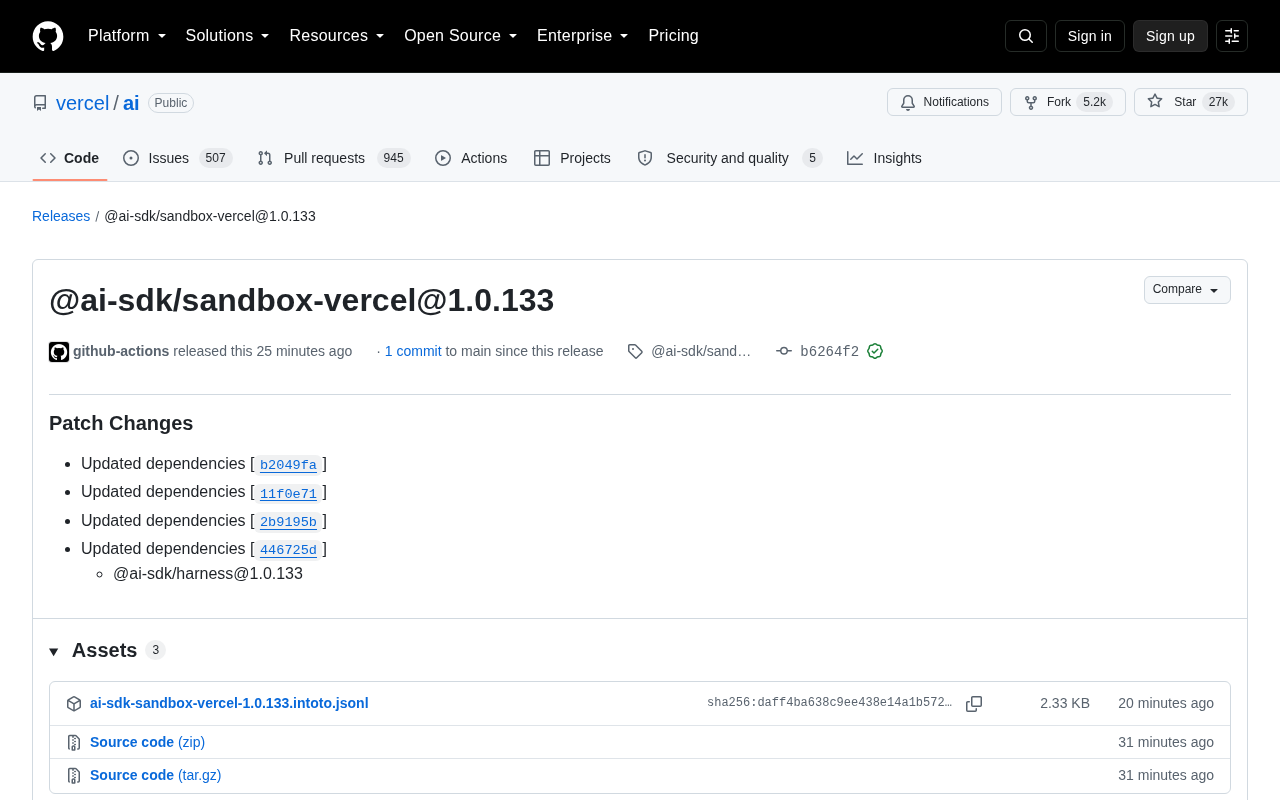
Vercel AI SDK's `@ai-sdk/sandbox-vercel` has released version 1.0.133, a routine patch update focused on syncing internal dependencies (commit refs: b2049fa, 11f0e71, etc.), with `@ai-sdk/harness` bumped to the same version. Published automatically via GitHub Actions with verified signature, the release ensures trustworthy provenance. As a core sandboxing and isolated execution component, `sandbox-vercel` plays a key role in AI Agent and code generation scenarios. With the `ai` repo exceeding 27k GitHub stars and frequent minor iterations, developers are advised to validate upgrades in test environments before deploying to production.
Vercel's widely adopted AI SDK ecosystem has released @ai-sdk/[email protected]. This is a patch-level release focused primarily on dependency updates — while the version bump is minor, it's still worth noting for developers building AI applications on this SDK.
Update Overview
The 1.0.133 release falls under Patch Changes, with its core content being a synchronized update of internal dependencies. According to the release notes, this update involves upgrades to multiple dependencies, with corresponding commit references including b2049fa, 11f0e71, 2b9195b, and 446725d. @ai-sdk/harness has also been bumped to 1.0.133 in sync.
Patch-level updates typically don't introduce breaking changes — they're primarily used for bug fixes, dependency version synchronization, and internal optimizations. For teams already running this SDK in production, these kinds of updates are generally safe to apply.
This version was automatically published on GitHub via github-actions and signed with GitHub's verified signature, ensuring the integrity and trustworthiness of the release.
The Role of sandbox-vercel in the AI SDK
@ai-sdk/sandbox-vercel is a component within the Vercel AI SDK ecosystem, typically associated with code sandboxing and isolated execution environments. In AI application development — especially in scenarios involving AI-generated code execution and Agent tool calls — a secure sandbox execution environment is a critical foundational capability.
As AI Agents and code-generation applications continue to rise in popularity, running untrusted code in a controlled environment has become a key requirement. Sandbox components are designed precisely for this purpose, working in tandem with modules like @ai-sdk/harness to form the execution and testing infrastructure of the AI SDK.
@ai-sdk/harness is the module within Vercel AI SDK responsible for test orchestration and execution management. Its name draws from the software testing concept of a "test harness" — a framework infrastructure used to drive the subject under test and collect results. Within the AI SDK architecture, the harness module typically handles tool call lifecycle management, execution context passing, and result capture. It complements sandbox-vercel: the sandbox provides an isolated runtime environment, while the harness "translates" AI model instructions into executable calls and coordinates the entire process. The fact that both modules share the same version number (1.0.133) indicates they have tightly coupled interface dependencies internally and should be upgraded together as a paired set.
Vercel AI SDK Ecosystem Activity
According to GitHub data, Vercel's ai repository has accumulated over 27k stars and 5.2k forks, making it one of the most popular AI application development toolkits available today. The frequent patch releases — with the version number already at 1.0.133 — reflect a tightly maintained, actively iterated project.
For developers, this high-frequency minor version cadence means bug fixes and dependency updates reach end users quickly. However, it also requires teams to establish solid dependency management and upgrade validation processes to avoid potential compatibility issues from frequent updates. It's recommended to review the full changelog before upgrading and to thoroughly validate in a test environment before applying changes to production.
Semantic Versioning (SemVer) defines version numbers as MAJOR.MINOR.PATCH. The patch version is specifically reserved for backwards-compatible bug fixes and should theoretically never introduce breaking changes. A version number of 1.0.133 means the team has pushed 133 patches since the 1.0 official release, reflecting a high-frequency continuous integration and automated release workflow. For downstream projects, tools like npm audit, Dependabot, or Renovate can automatically track these patch updates, keeping dependencies secure while reducing manual maintenance overhead.
Summary
@ai-sdk/[email protected] is a routine dependency synchronization patch update that doesn't include any new features, but it demonstrates the consistent, stable maintenance investment behind the Vercel AI SDK. For developers relying on this ecosystem, staying on top of version updates helps ensure timely access to security fixes and performance improvements.
Related articles

Apple HomeView Hands-On Review: Is the $300 Smart Home Hub Worth It?
Apple HomeView hands-on: a $300 smart home hub with facial recognition for quick account switching, but no App Store or voice recognition. Is the wall-mounted version worth it? Should you buy the first generation?

Meta Muse Wonder Launch: What It Means for Meta's Return to the Frontier AI Race
Meta releases Muse Wonder and WonderFull, benchmarks reach the frontier, community feedback is polarized. An in-depth look at Meta's return to the frontier AI race, its personal agent strategy, and Zuckerberg's different path.

Apple Home Smart Home Lineup Leaked: LG and Schneider Team Up, UWB Door Lock on Board
Apple Home ecosystem gains new LG and Schneider devices: UWB smart lock with proximity unlock, 2.5K dual-camera doorbell, privacy indoor camera, and AirPods-like seamless pairing.