Vercel Schedules Enters Public Beta: The Era of Agent-Driven Task Scheduling Arrives

Vercel Schedules public beta lets Agents and apps autonomously define and create scheduled tasks.
Vercel announced that its task scheduling service Vercel Schedules has entered public beta, shifting from a cron tool for operations staff to letting Agents and applications "schedule and manage their own work." It makes two key changes to traditional cron: declaring static tasks once in code that take effect with deployment, in line with infrastructure-as-code; and allowing tasks to be created dynamically at runtime, so an Agent can decide on its own when to check back later without the developer enumerating every branch. Scheduling also supports any environment, including temporary preview environments that are usually hard to cover. For Agent developers, moving scheduling down to the platform primitive layer can reduce dependence on custom queues and external workflow engines, but quota, limit, and billing details have not yet been disclosed.
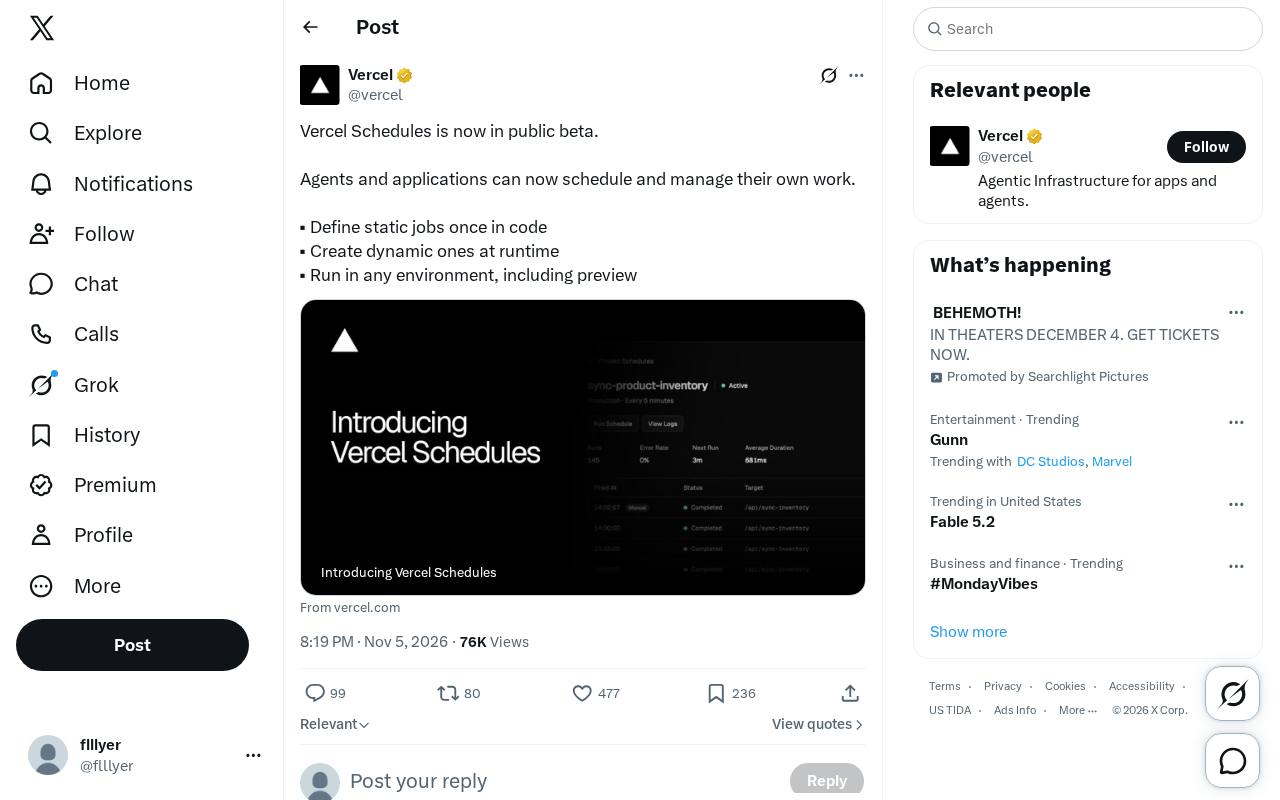
Vercel recently announced that its task scheduling service, Vercel Schedules, has officially entered public beta. Unlike traditional cron tools aimed at operations staff, this service is positioned to let Agents and applications "schedule and manage their own work."
From "Humans Define Rules" to "Applications Schedule Themselves"
The traditional cron job approach is: developers write execution rules in advance, and the system triggers them at the appointed time. Vercel Schedules continues this mechanism but adds two key changes.
The first is how static tasks are defined—declaring tasks once in code, taking effect with the application deployment, in line with the modern "infrastructure as code" habit. The second offers more room for imagination: tasks can be created dynamically at runtime. This means an Agent, after completing some step of reasoning, can decide on its own to "come back and check this result in two hours," rather than the developer having to enumerate every branch in advance.
According to Vercel's official announcement, this capability is open to both Agents and applications, with scheduling authority delegated from operations configuration down to the application logic itself.
Cron and cron job: cron is a long-standing daemon in Unix systems that periodically triggers commands according to time expressions described in crontab (e.g., every minute, every day at dawn). The derived term cron job broadly refers to any "task automatically executed according to preset time rules," whose core characteristic is that the rules are fixed before the task runs and the executor itself does not participate in deciding when it is invoked. The static task portion of Vercel Schedules follows this model, with the time expression and the task body written together in code; the difference is that it incorporates task declarations into the deployment artifact and additionally allows runtime code to create tasks, expanding the source of scheduling rules from a single external configuration to two paths: "configuration + application logic." Understanding this helps distinguish it from traditional operations cron.
Three Capability Details Worth Noting
Define static tasks in code. Task declarations share the same source as code, so version tracking and code review processes can be reused directly, without the need to maintain synchronization between two systems.
Create dynamic tasks at runtime. This is the most differentiated capability in this release. For Agent-type applications, behaviors such as asynchrony, delays, and periodic retries can be orchestrated by the application itself at runtime, rather than hard-coded in the configuration of an external scheduler.
Runs in any environment, including preview environments. Preview environments are usually temporary and generated per branch, which traditional scheduling systems struggle to cover. By including preview environments in its support scope, Vercel means scheduling capabilities can take effect at every stage of the development workflow, so timed logic can be validated during testing rather than problems only being discovered after going live.
Preview environment: On platforms like Vercel, each commit or pull request can generate an independent preview deployment with a temporary domain and separate environment variables, used to validate changes before merging. Preview environments are short-lived, numerous, and change dynamically as branches are added or removed. Traditional scheduling systems usually configure tasks by fixed host or fixed environment, making it difficult to individually register and clean up schedules for each temporary environment. Supporting preview environments means scheduling configurations need to be automatically created and destroyed alongside deployments, which also allows timed logic to be truly validated before launch rather than only running for the first time in production.
What It Means for Agent Developers
A common pain point for Agent applications is "long-running tasks": the model needs to wait for external state changes, poll data sources, or maintain rhythm across multiple rounds of interaction. In the past, such needs often required building custom queues and schedulers, or assembling them with external workflow engines.
Vercel Schedules puts scheduling capability into the platform primitive layer, so Agents can complete task definition, triggering, and execution within the same deployment chain. For applications already deployed on Vercel, this reduces the need to introduce additional infrastructure; for teams designing Agent workflows, "applications managing their own scheduling" also offers a lighter architectural option.
It should be noted that the public information this time mainly comes from Vercel's official announcement, and specific quotas, limits, and billing methods have not yet been detailed in the announcement. Before actual integration, it is recommended to consult the official documentation to confirm the details.
Long-running tasks and polling: A complete behavior of an Agent often spans from minutes to hours, for example waiting for a third-party API to return an asynchronous result, waiting for human approval, or checking at intervals whether a data source has been updated. Such scenarios are not suitable for blocking indefinitely with synchronous requests and usually adopt polling (repeatedly querying status at fixed intervals) or callbacks. The cost of polling lies in the need for reliable timed triggers, deduplication and backoff strategies, and retry records after failures. If this logic is hard-coded within the application process, a process restart or instance reclamation will lose the rhythm; if handed to an external scheduler, another set of configurations requiring synchronized maintenance is added. The reason dynamically creating tasks at runtime matters for Agents is precisely that it leaves the decision of "when to check next" within the application logic while handing "wake me up at the appointed time" to the platform for execution.
Scheduling Capability Is Becoming Standard Agent Infrastructure
Delegating scheduling authority to the application itself follows the trend of Agents moving from "passive response" to "proactive execution." When an Agent can autonomously schedule the timing of follow-up actions, its behavior pattern becomes closer to a continuously running assistant rather than a one-off question-and-answer interface.
Vercel Schedules is currently in public beta, and its functional boundaries may be adjusted based on feedback. For developers focused on AI application infrastructure, this is a development worth adding to the technology selection list for observation.
One-line Summary
Vercel Schedules enters public beta, letting Agents and applications autonomously define and create scheduled tasks.
Paragraph Summary
Vercel announced that its task scheduling service Vercel Schedules has entered public beta, shifting its positioning from a cron tool for operations staff to letting Agents and applications "schedule and manage their own work." It makes two key changes on top of the traditional cron mechanism: first, static tasks are declared once in code and take effect with deployment, in line with infrastructure-as-code habits; second, tasks can be created dynamically at runtime, allowing an Agent, after completing some step of reasoning, to decide on its own when to check back later without the developer enumerating every branch. Scheduling also supports any environment, including temporary preview environments that are usually difficult to cover. For Agent developers, moving scheduling capability down to the platform primitive layer can reduce dependence on custom queues and external workflow engines, but quota, limit, and billing details have not yet been disclosed.
Related articles

Gemini 4 Neon Review: Benchmark Scores Rival Carbon, API Pricing and Quota Breakdown
Google Gemini 4 Neon is now live, benchmark scores closely tracking Carbon, API pricing 3/15 at twice Hydrogen's rate. This article compiles Bilibili creator testing: Neon can replace 90% of Carbon scenarios, AntiGravity quota consumption is only one-third of Carbon, plus subscription channel restrictions and 2API ban risks.

Gemini 4 Helium Coming Soon? Signals of Google Loosening Subscription Restrictions
Google team member hints releases will continue; community speculates Gemini 4 Helium (Flash Lite) may be next. Subscription ban controversy gets a response as product lead says "Soon," suggesting restrictions may be lifted. This article covers Gemini developments, OpenAI Coding Agent and risk management, Doubao real-time audio-video API, and compute business dynamics.

AI-Assisted React Development in Practice: Optimizing a Video App and Handling Errors
A 14-year veteran developer demonstrates AI-assisted React video app optimization: compressing video from 80MB to 5MB (~94%) via ImageKit, plus reliable error handling and retry mechanisms. Includes planning, code understanding, and verification methods for working with AI.