Vercel Skills: Making Agent Skills Plug-and-Play with a Single npx Command

Vercel Labs' skills tool installs skill packages with one npx command, betting on an open Agent skill standard via "files as skills."
Vercel Labs' open-source skills tool injects skill packages into projects via `npx skills`, reusing npm for distribution and drastically lowering the barrier to extending Agent capabilities. Its core design—"files as skills"—lets any Agent client read skill folders for cross-client compatibility and auditability at the cost of some execution power. With 34k+ stars, it bets on the open route before a de facto standard emerges, backed by TypeScript and Vercel's brand. Risks include proprietary format competition and supply chain security.
The boundary of an Agent's capabilities is shifting from "how powerful the model is" to "how rich the skill ecosystem is." Vercel Labs' open-source skills tool brings this back to the workflow developers know best with a single npx skills command.
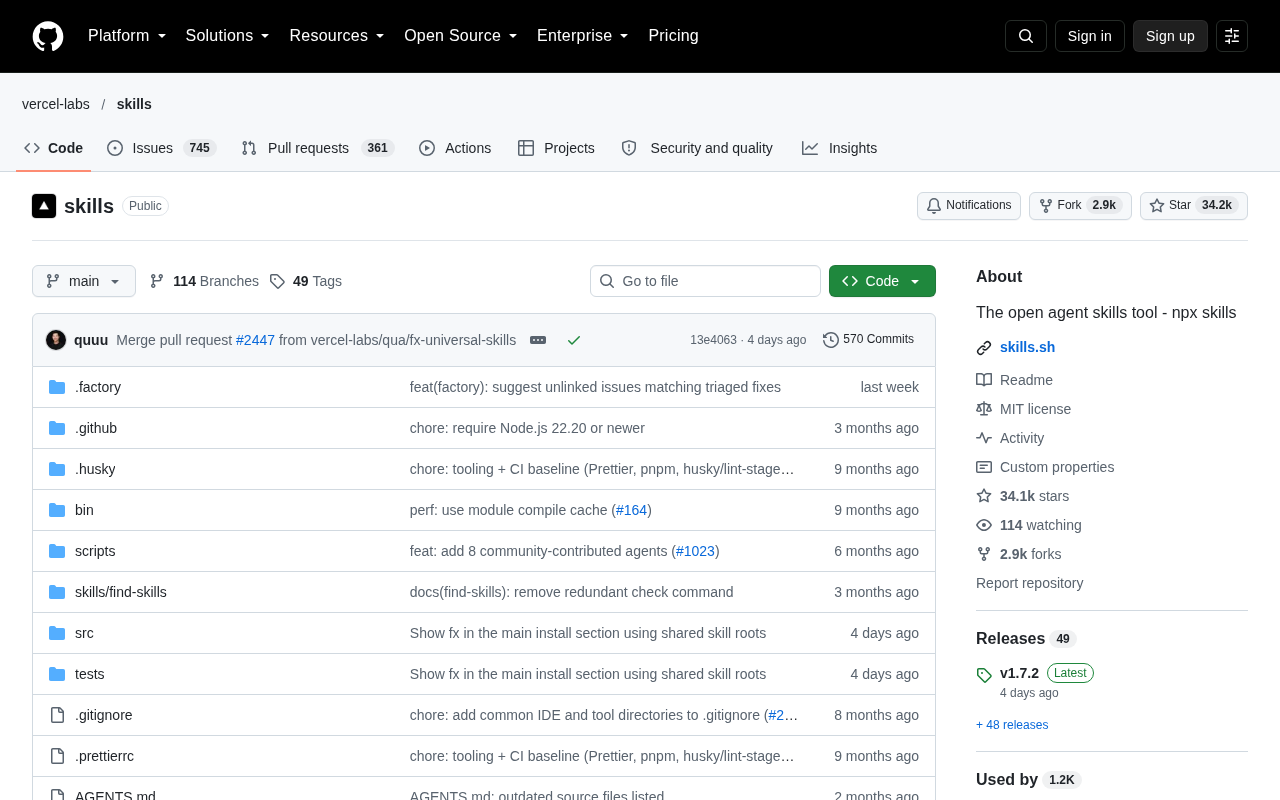
Understanding what skills does in one sentence
skills positions itself as "the open agent skills tool." The problem it solves is very specific: when you want Claude Code, Cursor, Codex, or any other coding Agent to gain a new capability, you don't need to modify model weights or write a complex plugin system—you just install a "skill package" and the Agent knows what to do.
This aligns with the evolution of the AI toolchain over the past few years—the model itself is gradually becoming commoditized, and differentiation comes from the tooling layer around the model. MCP solved the connection protocol between Agents and external tools, while skills attempts to solve the problem of "how skills are distributed and reused." Its ambition isn't in any single feature, but in establishing a skill description specification that any Agent client can read.
MCP (Model Context Protocol) is an open protocol proposed by Anthropic at the end of 2024 to standardize how AI models connect with external tools and data sources. It defines how servers describe available capabilities and how clients invoke them, essentially giving Agents a universal "peripheral interface." MCP solves the question of "what an Agent can call," but the specific knowledge of how to invoke those capabilities—such as best practices for certain tasks or operational procedures in specific domains—still needs a mechanism to be transmitted. skills operates at precisely this level: it doesn't define a communication protocol, but rather defines how skills themselves are described, packaged, and distributed. The two are complementary—MCP is the pipe, and skills are the knowledge packages flowing through it. Understanding this division of labor makes it clear why skills chose "files as skills" rather than runtime plugins—what it aims to build isn't yet another protocol layer, but a standardized container for skill content.
The distribution logic behind npx skills
Choosing npx as the entry point is a smart decision. npx is muscle memory that frontend developers have already internalized—no additional CLI installation, no global configuration, just one command to inject skills into the current project.
This means skill packages can be published through the npm ecosystem—version management, dependency resolution, private registries, and all that infrastructure are reused entirely. For an emerging open standard, leveraging an existing ecosystem is far more pragmatic than building a distribution system from scratch. Judging by the repository's 34k+ stars, developers are highly receptive to this "low-ceremony" approach, and it's still growing at nearly 200 stars per day.
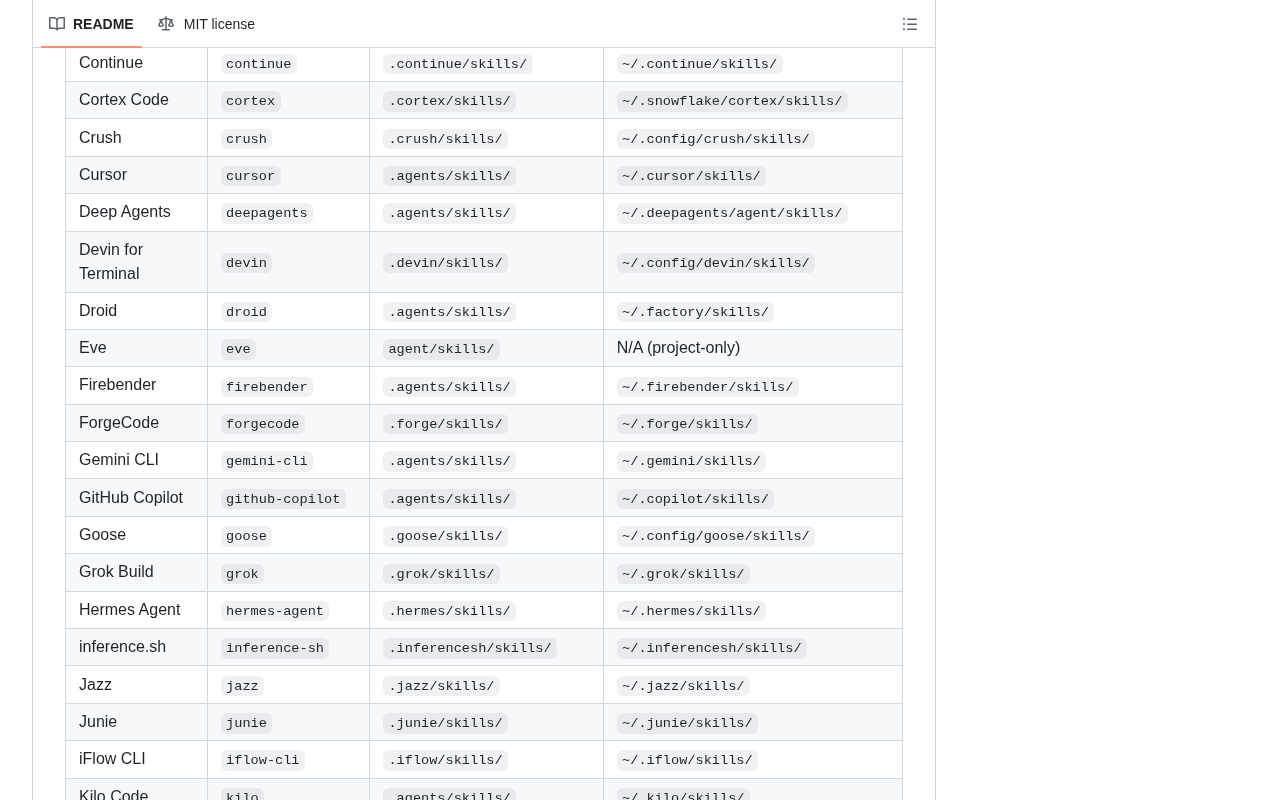
npx is a command-line tool built into npm since version 5.2.0, allowing developers to run executables from npm packages without global installation. Its mechanism: it checks whether the target package already exists in the local node_modules; if not, it temporarily downloads it to a cache directory for execution, which can be cleaned up afterward. This means users don't need to worry about installation location, version conflicts, or PATH configuration—one command accomplishes "fetch and run." For skills, choosing npx as the entry point is equivalent to fully delegating skill distribution to the npm ecosystem: skill authors publish skills like regular npm packages, users invoke skills like regular CLI tools, and infrastructure like version management, dependency resolution, and private registries is reused at zero cost. This is also why skills gained widespread developer adoption so quickly—the barrier to entry is nearly zero.
Skills as files: a lighter extension paradigm
The design philosophy of skills can be summarized in one sentence: a skill is a folder, not a piece of runtime code.
Each skill essentially contains description metadata and usage instructions, and the Agent reads these files and follows them accordingly. The benefit of this approach is cross-client compatibility—as long as an Agent is willing to read these files, it can acquire the skill without needing separate adaptation for each client.
Compared to traditional plugin systems, this "files as skills" approach sacrifices some execution capability in exchange for strong portability and auditability. You can directly open a skill folder to see exactly what it's telling the Agent to do, rather than reading an obscure runtime configuration. For enterprise scenarios requiring compliance review, this characteristic may be more important than feature richness.
The core of "files as skills" lies in defining skills as purely declarative description files, typically metadata and usage instructions in Markdown or JSON format, rather than executable code. Agent clients read these files, and the model itself understands and performs the corresponding operations. This design brings two key characteristics: first, portability—the same set of skill files can be used by Claude Code, Cursor, Codex, or any other client willing to read the format, without separate adaptation for each; second, auditability—skill content exists as human-readable text, and reviewers can directly open the files to see what the Agent is being instructed to do, rather than reverse-engineering runtime behavior. The trade-off is that skills cannot contain complex runtime logic, and execution capability is limited by the model's own reasoning and tool-calling abilities. This is a trade-off of execution capability for transparency and cross-platform compatibility—in enterprise compliance scenarios, this trade-off is often valued more.
Early positioning in the open standards battle
There is currently no de facto standard for Agent skill formats. Anthropic has its own approach, and various IDEs are building their own extension systems. vercel-labs is betting on the "open" card—whoever becomes the widely accepted specification first will control the gateway to the skill ecosystem.
A TypeScript implementation combined with Vercel's brand endorsement gives it an advantage in neutrality and engineering credibility over single-vendor solutions. The network effects from 343k stars are already beginning to show: the more skill packages there are, the more attractive it is to Agent users, which in turn incentivizes more people to contribute skills.
Risks exist as well. If leading Agent vendors insist on proprietary formats, the open standard could be marginalized; if there's no review mechanism for skill quality, "installing a skill" could become a new entry point for supply chain attacks. These aren't problems the tool itself can solve—they depend on the subsequent maneuvering of ecosystem participants.
In the tech ecosystem, a "de facto standard" refers to a dominant specification that isn't established by official standards bodies but forms naturally through market adoption. Agent skill formats are currently in a window where no de facto standard has been established: Anthropic has its own skill approach, various IDEs have their own extension systems, and they're mutually incompatible. vercel-labs choosing to enter via the open route is essentially betting on the principle that "whoever gets widely adopted first becomes the standard." The TypeScript implementation lowers the barrier for developer participation, and the Vercel brand provides the project with neutrality and engineering credibility. Network effects are especially pronounced in this kind of ecosystem: the more skill packages there are, the more Agent users tend to choose clients supporting that format, which in turn incentivizes more skill authors to contribute. But the risks are also significant—if leading Agent vendors insist on proprietary formats and build barriers through their user scale, the open standard could be marginalized. Historically, both successful early-positioning cases for open standards (like npm, Docker image formats) and failures (like various open attempts replaced by vendor proprietary protocols) are not uncommon, and the outcome ultimately depends on the maneuvering of ecosystem participants.
Is it worth trying now
If you're using a coding Agent, it's worth spending ten minutes trying npx skills—even just to see what the skill packages it offers look like, it'll give you a concrete feel for "Agent capability extension." If you're a tool developer, what's more worth paying attention to is whether its skill description format will become the de facto standard—the cost of participating in ecosystem building now is far lower than after the standard solidifies.
One-line Summary
Vercel Labs' open-source skills tool installs skill packages with a single npx command, betting on an open Agent skill standard with "files as skills."
Paragraph Summary
Vercel Labs' open-source skills tool injects skill packages into projects via a single npx skills command, reusing the npm ecosystem for distribution and greatly reducing the barrier to extending Agent capabilities. Its core design is "files as skills": skills exist as folders containing description metadata and usage instructions, usable by any Agent client willing to read the format, sacrificing some execution capability for cross-client compatibility and auditability. The project has gained 34k+ stars, betting on the open route during a window where no de facto standard exists for Agent skill formats, leveraging a TypeScript implementation and Vercel brand endorsement to build neutrality and engineering credibility. Risks include competitive pressure from leading vendors' proprietary formats and supply chain security issues that could arise from a lack of skill review—these depend on the subsequent maneuvering of ecosystem participants.
Related articles

Free Unlimited Claude Code Solution: Agnes AI + CC Switch Setup Guide
No paid subscription needed — pair the free AI platform Agnes AI with the open-source tool CC Switch to provide a backend for Claude Code, enabling unlimited free calls to text, image, and video models. This guide covers the full setup, test results, and usage boundaries.

A Complete Zero-Cost Guide to Getting Started with Claude Code for Beginners in China
A beginner's guide to Claude Code for users in China: two installation methods (command line and IDE plugin), full configuration steps for replacing the official API with the free domestic LongCat model, and a hands-on demo of building a small tool with natural language, plus tips.

When the NSA Gets Involved: The AI Supply Chain Crisis Behind Open-Source CVEs and API Key Hijacking
Multiple open-source projects disclosed severe CVEs in one day, PHP flaws alarmed the FBI, and Railway and OpenCode were breached with API keys stolen. This article breaks down the vulnerability window, AI-accelerated exploitation, and the AI supply chain crisis behind the API key black market, with a developer defense checklist.