What Are AI Agents? How AI Agents Are Changing the Future, from Planning to Execution

AI Agents move AI from talking to doing, but their abilities have boundaries and their mistakes need human oversight.
The article explains the core features of AI Agents: they can receive goals, autonomously plan steps, call external tools, and execute tasks, with some also closing the loop by checking results and adjusting strategy—turning AI from an "information generator" into a "task executor." But an Agent's abilities are constrained by available tools, permission scope, and system design, so tool integration and permission design matter more than the model itself. Typical uses include calendar organization, topic research, and email sorting. The article stresses that Agents are imperfect and important actions still need human approval, framing trust as a triple challenge of technical reliability, user psychology, and accountability.
From Answering Questions to Completing Tasks: The Leap of AI Agents
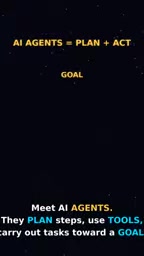
If ChatGPT taught machines to "talk," then AI Agents have taught machines to "do things." According to the YouTube channel Tech Grow, an AI Agent is a type of system that can autonomously plan steps, call tools, and execute tasks toward a goal. It is no longer limited to single-turn Q&A; instead, it acts like a digital assistant: it first receives a goal, then breaks it down into steps, calls external tools when necessary, and ultimately gets the job done.
The significance of this leap in capability is that AI has gone from an "information generator" to a "task executor." You no longer need to direct it step by step—just give it a goal, and it handles the planning and execution.
How Do AI Agents Work?
A Four-Step Loop: Goal, Planning, Tools, Feedback
Tech Grow summarizes the Agent workflow into several core stages: receive a goal → plan steps → call connected tools → execute the task. Going further, some Agents also have the ability to "check results and adjust their strategy"—if the first attempt doesn't meet expectations, they reflect and try a different approach, forming a closed loop.
This "plan-execute-feedback" cycle is exactly what distinguishes an Agent from an ordinary chatbot. A regular model outputs a piece of text and stops there, while an Agent keeps acting until the goal is achieved or it determines it cannot continue.
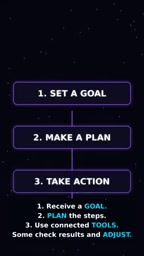
"Tool Use" (Function Calling) is the key technical link for understanding the Agent loop. A large language model on its own can only generate text and cannot directly check a calendar, send an email, or access a database. The tool-calling mechanism lets the model output a structured call request during reasoning (for example, "query tomorrow's 10 a.m. schedule"), which an external runtime executes and returns the result to the model, which then continues reasoning based on it. It is precisely this collaboration—"the model expresses intent, the system performs execution"—that turns an Agent from a pure text generator into an executor capable of acting on the outside world. The design of tool interfaces, the format of returned results, and error handling all directly affect the quality of an Agent's planning.
Capability Boundaries Depend on Three Things
What an Agent can do is not unlimited. The original text clearly points out that it is constrained by available tools, permission scope, and system design. In other words, an Agent's "abilities" are artificially defined: which data it can access, which software it can operate, and which actions it can perform all determine its actual ceiling. This also means that when deploying an Agent, tool integration and permission design are worth more investment than the model itself.
Real-World Scenarios: What Can Agents Already Do for You?
Tech Grow gives several everyday examples:
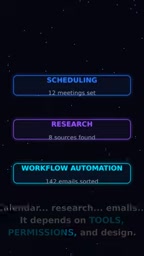
- Organizing calendars: automatically scheduling meetings according to your preferences and avoiding conflicts;
- Researching topics: autonomously retrieving materials, summarizing information, and forming a preliminary report;
- Sorting emails: categorizing by priority, drafting replies, and flagging to-dos.
What these tasks have in common is that they have clear goals, require multiple steps, and involve multiple tools. This is exactly where Agents deliver value, and where traditional Q&A-style AI struggles to complete tasks independently.
Don't Deify It: Agents Make Mistakes Too
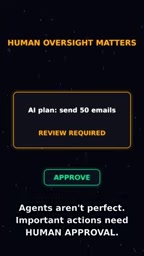
The original text offers a key reminder: Agents are not perfect, and they can make mistakes. Therefore, when important actions are involved, human approval and supervision are still required.
This judgment deserves attention. The stronger an Agent's autonomy, the greater the consequences of its errors may be—for example, deleting emails by mistake, scheduling meetings incorrectly, or producing biased research conclusions. A reasonable approach is to set up "human-in-the-loop" checkpoints: let the Agent handle low-risk tasks on its own, while high-risk operations must be confirmed.
"Human-in-the-Loop" (HITL) is a common mechanism in AI system governance, referring to the introduction of human confirmation or intervention at key points in an automated process. In Agent scenarios, it usually manifests as tiered authorization: read-only and reversible operations can be executed automatically, while irreversible or high-impact actions such as deletion, sending, and payment require human approval. The value of HITL is not just fallback error correction; it can also continuously generate feedback signals during operation to help improve planning strategies. Alongside it is "observability" design—recording every decision and tool call made by the Agent so that, after an error occurs, the cause can be traced and responsibility can be defined.
The Trust Problem: Are You Willing to Hand Your Daily Tasks to AI?
At the end of the video, Tech Grow raises an open question: Would you trust an AI Agent to handle your daily tasks? This is both a technical question and a question of psychology and responsibility.
From the technical side, an Agent's reliability depends on tool stability, planning quality, and error recovery capability; from the psychological side, users need time to build trust; from the responsibility side, when an Agent makes a mistake, accountability still needs to be clarified. These three dimensions together determine whether Agents can truly enter daily life.
Conclusion: Agents Are the Direction, but Not the Destination
AI Agents represent the trend of AI applications moving from "conversation" to "action." They can free people from repetitive, multi-step tasks, but their current maturity still requires human supervision. For ordinary users, understanding an Agent's capability boundaries and risks is more important than blindly chasing hype; for developers, tool integration, permission control, and human review mechanisms are questions that must be answered before deployment.
The future is already here, but the steering wheel is still in human hands.
One-line Summary
AI Agents move AI from talking to doing, but their abilities have boundaries and their mistakes need human oversight.
Paragraph Summary
The article introduces the core characteristics of AI Agents: they can receive goals, autonomously plan steps, call external tools, and execute tasks, and some also have a feedback loop for checking results and adjusting strategy, thereby turning AI from an "information generator" into a "task executor." However, an Agent's capabilities are not unlimited; they are constrained by three factors: available tools, permission scope, and system design. When deploying, tool integration and permission design are more critical than the model itself. Typical applications include organizing calendars, topic research, and email sorting—tasks with clear goals that require multiple steps. The article emphasizes that Agents are not perfect and that important operations still require human approval and supervision, and it raises the trust problem as a triple challenge involving technical reliability, user psychology, and accountability.
Related articles

Free Unlimited Claude Code Solution: Agnes AI + CC Switch Setup Guide
No paid subscription needed — pair the free AI platform Agnes AI with the open-source tool CC Switch to provide a backend for Claude Code, enabling unlimited free calls to text, image, and video models. This guide covers the full setup, test results, and usage boundaries.

A Complete Zero-Cost Guide to Getting Started with Claude Code for Beginners in China
A beginner's guide to Claude Code for users in China: two installation methods (command line and IDE plugin), full configuration steps for replacing the official API with the free domestic LongCat model, and a hands-on demo of building a small tool with natural language, plus tips.

When the NSA Gets Involved: The AI Supply Chain Crisis Behind Open-Source CVEs and API Key Hijacking
Multiple open-source projects disclosed severe CVEs in one day, PHP flaws alarmed the FBI, and Railway and OpenCode were breached with API keys stolen. This article breaks down the vulnerability window, AI-accelerated exploitation, and the AI supply chain crisis behind the API key black market, with a developer defense checklist.