What Is a Harness? Understanding the Core Scaffolding Framework for Agent Deployment
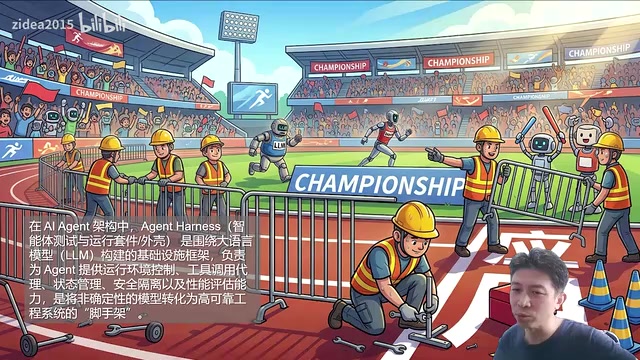
Harness is the infrastructure framework that constrains non-deterministic LLMs into reliable, production-ready Agent systems.
This article provides a systematic introduction to Harness — the key infrastructure for engineering Agent deployments. Using a racetrack guardrail analogy, it explains that Harness builds constraints and safeguards around non-deterministic language models rather than directly boosting model capability. Designing a Harness requires considering three factors: model characteristics, application scenario, and security level. Its four core functions are: execution control and lifecycle management (hosting the ReAct loop), security sandboxing and permission isolation (via Docker/E2B), observability and tracing (recording chain-of-thought and tool calls), and automated evaluation via standard benchmarks. Tool design should follow a "few but precise" principle. Claude Code and Codex are both concrete implementations of this framework.
Understanding the Value of Harness Through a Running Analogy
Imagine an Agent completing a task as a multi-step marathon. The large language model is the runner — blazingly fast, but prone to drifting off course. Models are inherently probabilistic, and their outputs carry intrinsic variance. In long-horizon tasks, this variance compounds at every decision point — much like reward variance accumulating in reinforcement learning — and can ultimately cause the entire Agent to spiral out of control.
This is exactly the problem Harness is designed to solve. Its role is like the guardrails on either side of a racetrack: they don't slow the runner down, but they ensure the runner stays on course all the way to the finish line. In a single sentence: Harness is a scaffolding framework that transforms a "non-deterministic model" into a "highly reliable engineering system." It doesn't directly determine model capability — instead, it builds the infrastructure around the model for execution, control, constraint, and evaluation.
It's worth emphasizing that Harness is more of an abstract methodology or solution framework — it defines what modules should exist and what needs to be accomplished, but the specific implementations vary. Tools like Claude Code and Codex are, at their core, different implementations of the Harness framework.
Three Prerequisite Design Elements for Harness
There's no single standard answer for how a Harness framework should be implemented. The specific form it takes depends on three key elements.
The first is model characteristics. Different models have different capability boundaries, stability profiles, and tool-calling tendencies. Harness must be designed around the specific traits of the model it wraps.
The second is application scenario. This directly determines how tight or loose the guardrails should be. For creative, open-ended use cases that don't involve sensitive operations like private data or payments, you can afford to give the Agent more freedom. For rigorous, stability-critical scenarios, Harness needs to do much more work to ensure the Agent completes tasks reliably.
The third is security level. The higher the security requirements, the more comprehensive the isolation, permission controls, and filtering mechanisms need to be. Understanding these three elements is the foundation for judging whether a Harness design is sound.
The Four Core Functions of Harness
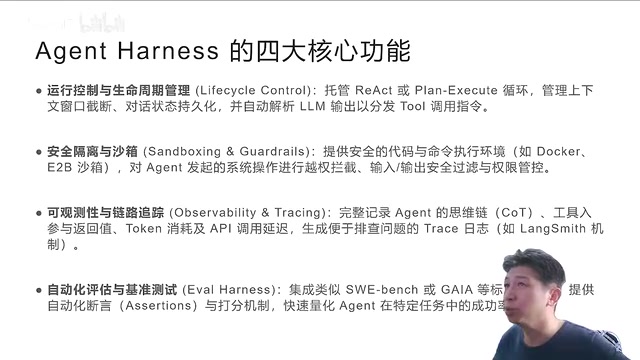
Harness is an infrastructure framework built around large language models. It provides the Agent with a runtime environment, tool-calling control, state management, security isolation, and performance evaluation capabilities. Its capabilities can be broken down into four core functions.
Execution Control and Lifecycle Management
This is the most foundational layer of Harness. Anyone who has built an Agent knows that every step — from creation and execution to pausing and tool invocation — corresponds to a different state. Harness needs to host the ReAct or Plan-style loop, manage context window phases, persist conversation state, and automatically parse model outputs and dispatch tool-calling instructions.
The quality of planning determines how a task begins. Good Agent design must first produce a reasonably complete plan — but more critically, it must effectively feed execution results back to the agent and allow it to update the plan accordingly. This "act → observe → adjust" closed loop is the true measure of an agent's intelligence, and also the hardest part to get right.
ReAct (Reasoning + Acting) is one of the most mainstream Agent execution paradigms today, proposed by Yao et al. in 2022. Its core idea is to interleave the language model's reasoning process (Thought) with tool-calling actions (Action), re-injecting the environment's returned result (Observation) into the context after each action to drive the next round of reasoning. This explicit "think → act → observe" loop allows the model to dynamically revise its plan mid-execution, rather than blindly executing a complete plan generated upfront. Compared to a pure "Plan then Execute" approach, ReAct is better suited for complex tasks that encounter unexpected situations and require on-the-fly strategy adjustments. The lifecycle management module in Harness is essentially an orchestration layer for this loop — including when to trigger tool calls, how to format Observations before feeding them back to the model, and when to determine that a task has completed or should be terminated.
Security Sandboxing and Isolation
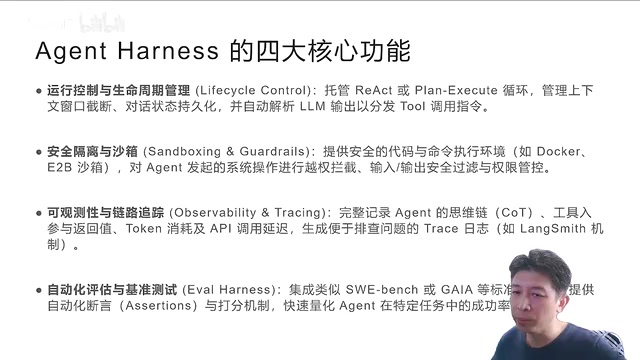
As more Agents move into production, what matters isn't just accuracy — it's safety. You need to ensure that the Agent operates in a completely safe and trustworthy manner in any given scenario. This involves providing secure code execution environments like Docker or E2B, tiering permissions for system operations, and applying security filters to both inputs and outputs.
Permission management is the centerpiece of this layer. Different tools map to different permissions, and different Agents hold different permission levels. By configuring specific conditions through sandboxes or execution engines — limiting the scope an Agent can access through its tools — the goal is to achieve "most reasonable permission allocation" while still enabling task completion. This is what truly guarantees system security.
E2B (Environment to Browser) is a cloud-based code execution sandbox service designed specifically for AI Agents. It allows models to safely run arbitrary code inside isolated micro-VMs; once execution is complete, the environment is destroyed and the host system remains unaffected. The key difference from Docker is that Docker containers typically require pre-configured images and persistent runtimes, whereas E2B targets "short-lived, on-demand" Agent workloads — with lower startup latency and finer-grained billing. Under the principle of least privilege, the sandbox only exposes the system calls necessary for the task, with strict limits on filesystem access scope and network egress. This minimizes the blast radius of any accidental misoperations or malicious prompt injection attacks the model might trigger.
Observability and Distributed Tracing
Because Agents are built on language models, their decision-making is highly stochastic, and complex or long-chain decisions are often difficult to reproduce. Harness therefore needs to fully record the Agent's chain of thought, tool parameters and return values, token consumption, API call latency, and generate traces for debugging.
When investigating issues, it's also important to distinguish between two types of problems: those originating from the language model itself, and those originating from fixable Agent system design flaws. Making that distinction clearly depends on thorough logging. Additionally, many iterative mechanisms consume tokens at a significant rate — if the system falls into an infinite loop due to a configuration error or bad system design, it can cause massive token waste. Monitoring token usage in real time and setting thresholds to break out of anomalies is a must-consider aspect of Agent design.
Trace (distributed tracing) is a concept borrowed from the distributed systems world, inspired by the OpenTelemetry standard. The core idea is to generate a globally unique Trace ID for a complete request-handling flow and propagate it through every sub-call (Span), ultimately forming a visualizable call tree. In an Agent context, a single trace typically covers the full path from user input to final output: including the Prompt/Completion content of each LLM inference, input parameters and return values of each tool call, latency, and token consumption. Tools like LangSmith, Langfuse, and Arize Phoenix have already adapted this mechanism specifically for LLM applications, supporting playback of an Agent's decision process by Trace. For debugging questions like "why did the Agent go wrong at step 7," complete trace records are irreplaceable infrastructure.
Automated Evaluation and Benchmarking
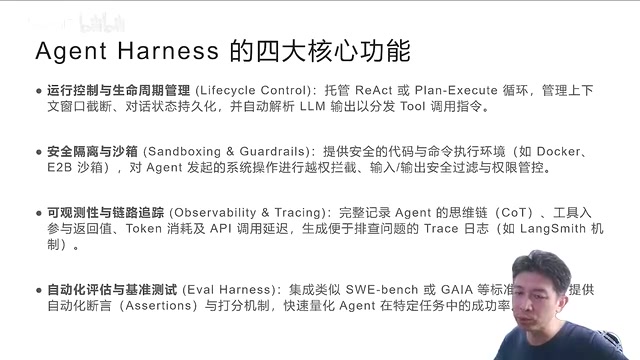
Performance evaluation deserves repeated emphasis, for two reasons: without a comprehensive evaluation system, you can't convince users to buy your product, and you have no directional signal when tuning. Harness needs to integrate standard test suites similar to Bench, provide automated assertion and scoring mechanisms, and quickly quantify the Agent's success rate on specific tasks.
Two dimensions need to be tracked simultaneously: model/system accuracy, and system performance — especially latency as a critical metric. Minimizing manual involvement in the evaluation process and achieving traceable, quantitative feedback through standard test suites is a necessary condition for engineering deployment.
The core challenge in Agent evaluation is that open-ended outputs are difficult to judge automatically using rules. Current mainstream approaches fall into three categories: (1) deterministic assertion-based task completion rate (e.g., can the code pass unit tests, was the file correctly created); (2) using another LLM as a judge (LLM-as-Judge), scoring output quality, relevance, and safety; and (3) end-to-end benchmark suites like SWE-Bench (software engineering tasks) and WebArena (web navigation tasks), which provide standardized task sets and scoring criteria for cross-system comparison. In practice, all three methods are often used in combination: deterministic assertions handle "did it get done," LLM judges handle "was it done well," and standard benchmarks handle "how does it compare to the industry" — together forming a trustworthy evaluation system.
A Typical Harness Execution Flow
Connecting all of these capabilities, we can sketch out a relatively complete picture of how a Harness operates. At the center is the reasoning core (the large language model), following the ReAct pattern: Thought → Action → Observation.
When the model decides to call a tool, the request enters the tool-calling router. Tools split into two paths: one category runs in execution environments like filesystems or browsers via an execution sandbox; the other makes API calls. Results from both are returned to the language model. If execution fails, a retry or error-feedback mechanism kicks in to recover, with heartbeat-style monitoring to track runtime status.
At the memory and context layer, each round compresses the context and retrieves relevant memories. Long-term memory can be updated to a vector database — which is essentially a RAG implementation — working alongside an external filesystem to support the Agent's state management. Finally, the Agent's overall state is updated and surfaced to the user or upstream application.
Practical Principles for Tool Design
Tool management is often naively understood as "give the model more tools to choose from" — but practice suggests the opposite. Too many tools create selection confusion for the model, making it harder to identify the right one. The current mainstream direction is to provide a small number of tools and let the model iteratively leverage them, or let it dynamically design tools (especially by writing scripts) based on the specific task.
Beyond that, tool-calling efficiency is worth paying attention to: whether tools can be called concurrently, and whether tools can later be merged or composed, are both important levers for optimizing system latency. These details collectively form an engineering dimension of Harness that cannot be overlooked.
Summary
Harness is the critical infrastructure that takes an Agent from "able to run" to "running reliably and trustworthily." Built around large models, it uses four core pillars — lifecycle management, security sandboxing, observability, and automated evaluation — to constrain an unpredictable model into a dependable engineering system. The real design challenge isn't listing out the modules; it's finding the optimal balance between constraint and freedom by combining model characteristics, application scenarios, and security requirements.
Related articles
Capsule: Pack Web Apps and Data into a Single SQLite File
Capsule is a Rust/Tauri 2.0 tool that packs HTML web apps and data into a single SQLite file — privacy-first, local storage, portable sharing, with AI support.

DSH-SUBAGENT-UI Plugin: The Ultimate Sub-Agent Manager for DeepSeek Harness
DSH-SUBAGENT-UI is a DeepSeek Harness browser plugin offering sub-agent overview, search, local categorization, and completion snapshots — install with one command.
RTX 5090 Scalped for $9,000 in the US? Flying to Taipei to Buy One Might Actually Be Cheaper
RTX 5090 scalped for $9,000 in the US — a Reddit user did the math and found flying to Taipei to buy one is actually cheaper. A look at the real supply-demand crisis behind the joke.